Myeloproliferative Neoplasms—Patient Version

Myeloproliferative Neoplasms—Patient Version

Overview

Myeloproliferative neoplasms and myelodysplastic syndromes are diseases of the blood cells and bone marrow. Sometimes both conditions are present. Explore the links on this page to learn about their treatment, research, and clinical trials.

Causes & Prevention

NCI does not have PDQ evidence-based information about prevention of myeloproliferative neoplasms.

Screening

NCI does not have PDQ evidence-based information about screening for myeloproliferative neoplasms.

Coping with Cancer

The information in this section is meant to help you cope with the many issues and concerns that occur when you have cancer.

Emotions and Cancer Adjusting to Cancer Support for Caregivers Survivorship Advanced Cancer Managing Cancer Care

Chronic Myeloproliferative Neoplasms Treatment (PDQ®)–Patient Version

Chronic Myeloproliferative Neoplasms Treatment (PDQ®)–Patient Version

General Information About Chronic Myeloproliferative Neoplasms

Key Points

  • Myeloproliferative neoplasms are a group of diseases in which the bone marrow makes too many red blood cells, white blood cells, or platelets.
  • There are 6 types of chronic myeloproliferative neoplasms.
  • Tests that examine the blood and bone marrow are used to diagnose chronic myeloproliferative neoplasms.

Myeloproliferative neoplasms are a group of diseases in which the bone marrow makes too many red blood cells, white blood cells, or platelets.

Normally, the bone marrow makes blood stem cells (immature cells) that become mature blood cells over time.

EnlargeAnatomy of the bone; drawing shows spongy bone, red marrow, and yellow marrow. A cross section of the bone shows compact bone and blood vessels in the bone marrow. Also shown are red blood cells, white blood cells, platelets, and a blood stem cell.
Anatomy of the bone. The bone is made up of compact bone, spongy bone, and bone marrow. Compact bone makes up the outer layer of the bone. Spongy bone is found mostly at the ends of bones and contains red marrow. Bone marrow is found in the center of most bones and has many blood vessels. There are two types of bone marrow: red and yellow. Red marrow contains blood stem cells that can become red blood cells, white blood cells, or platelets. Yellow marrow is made mostly of fat.

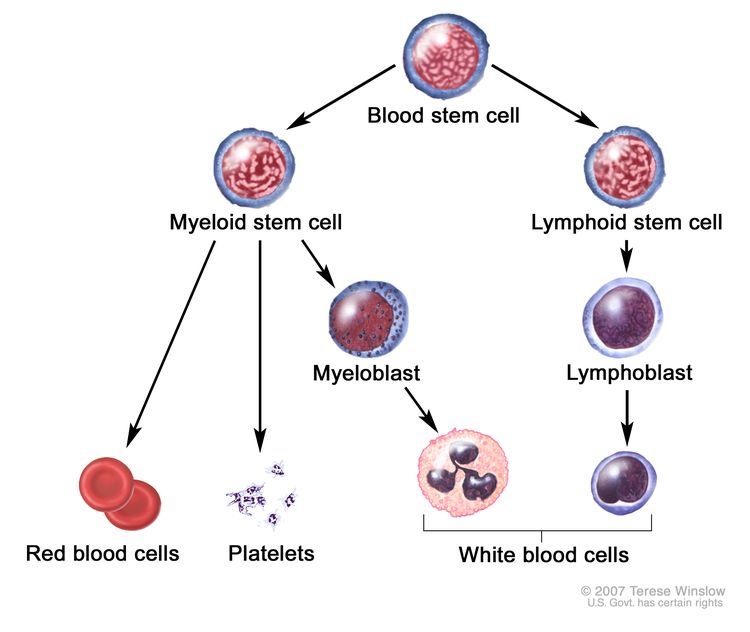
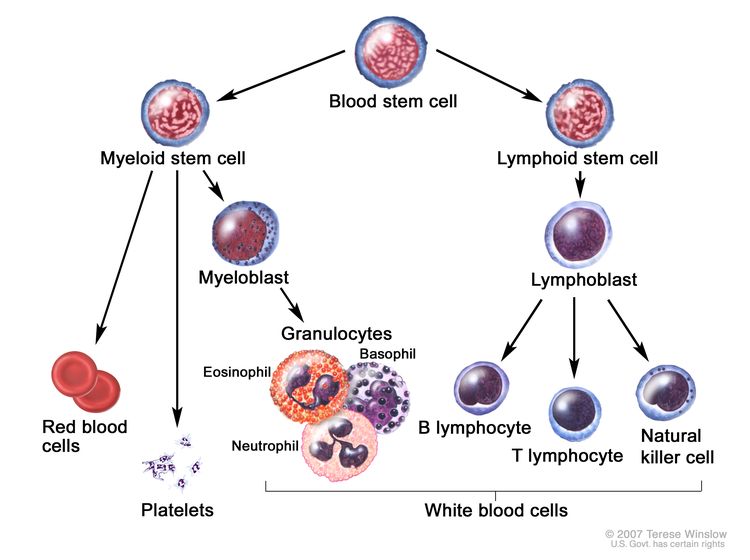
A blood stem cell may become a myeloid stem cell or a lymphoid stem cell. A lymphoid stem cell becomes a white blood cell. A myeloid stem cell becomes one of three types of mature blood cells:

EnlargeBlood cell development; drawing shows the steps a blood stem cell goes through to become a red blood cell, platelet, or white blood cell. Drawing shows a myeloid stem cell becoming a red blood cell, platelet, or myeloblast, which then becomes a white blood cell. Drawing also shows a lymphoid stem cell becoming a lymphoblast and then one of several different types of white blood cells.
Blood cell development. A blood stem cell goes through several steps to become a red blood cell, platelet, or white blood cell.

In myeloproliferative neoplasms, too many blood stem cells become one or more types of blood cells. The neoplasms usually get worse slowly as the number of extra blood cells increases.

There are 6 types of chronic myeloproliferative neoplasms.

The type of myeloproliferative neoplasm is based on whether too many red blood cells, white blood cells, or platelets are being made. Sometimes the body will make too many of more than one type of blood cell, but usually one type of blood cell is affected more than the others are. Chronic myeloproliferative neoplasms include the following 6 types:

These types are described below. Chronic myeloproliferative neoplasms sometimes become acute leukemia, in which too many abnormal white blood cells are made.

Tests that examine the blood and bone marrow are used to diagnose chronic myeloproliferative neoplasms.

The following tests and procedures may be used:

  • Physical exam and health history: An exam of the body to check general signs of health, including checking for signs of disease, such as lumps or anything else that seems unusual. A history of the patient’s health habits and past illnesses and treatments will also be taken.
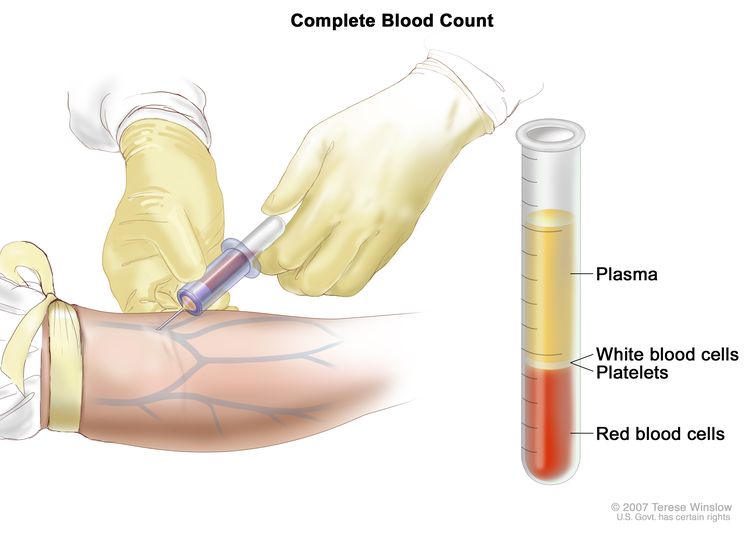
  • Complete blood count (CBC) with differential: A procedure in which a sample of blood is drawn and checked for the following:
    • The number of red blood cells and platelets.
    • The number and type of white blood cells.
    • The amount of hemoglobin (the protein that carries oxygen) in the red blood cells.
    • The portion of the blood sample made up of red blood cells.
    EnlargeComplete blood count (CBC); left panel shows blood being drawn from a vein on the inside of the elbow using a tube attached to a syringe; right panel shows a laboratory test tube with blood cells separated into layers: plasma, white blood cells, platelets, and red blood cells.
    Complete blood count (CBC). Blood is collected by inserting a needle into a vein and allowing the blood to flow into a tube. The blood sample is sent to the laboratory and the red blood cells, white blood cells, and platelets are counted. The CBC is used to test for, diagnose, and monitor many different conditions.
  • Peripheral blood smear: A procedure in which a sample of blood is checked for the following:
    • Whether there are red blood cells shaped like teardrops.
    • The number and kinds of white blood cells.
    • The number of platelets.
    • Whether there are blast cells.
  • Blood chemistry studies: A procedure in which a blood sample is checked to measure the amounts of certain substances released into the blood by organs and tissues in the body. An unusual (higher or lower than normal) amount of a substance can be a sign of disease.
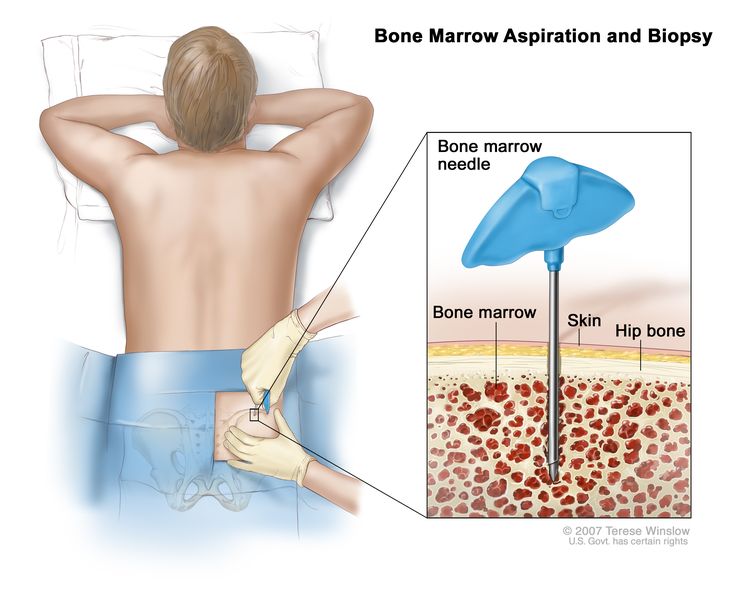
  • Bone marrow aspiration and biopsy: The removal of bone marrow, blood, and a small piece of bone by inserting a hollow needle into the hipbone or breastbone. A pathologist views the bone marrow, blood, and bone under a microscope to look for abnormal cells.
    EnlargeBone marrow aspiration and biopsy; drawing shows a patient lying face down on a table and a bone marrow needle being inserted into the hip bone. An inset shows a close up of the needle being inserted through the skin and hip bone into the bone marrow.
    Bone marrow aspiration and biopsy. After a small area of skin is numbed, a long, hollow needle is inserted through the patient’s skin and hip bone into the bone marrow. A sample of bone marrow and a small piece of bone are removed for examination under a microscope.
  • Cytogenetic analysis: A laboratory test in which the chromosomes of cells in a sample of bone marrow or blood are counted and checked for any changes, such as broken, missing, rearranged, or extra chromosomes. Changes in certain chromosomes may be a sign of cancer. Cytogenetic analysis is used to help diagnose cancer, plan treatment, or find out how well treatment is working.
  • Gene mutation test: A laboratory test done on a bone marrow or blood sample to check for mutations in JAK2, MPL, or CALR genes. A JAK2 gene mutation is often found in patients with polycythemia vera, essential thrombocythemia, or primary myelofibrosis. MPL or CALR gene mutations are found in patients with essential thrombocythemia or primary myelofibrosis.

Chronic Myelogenous Leukemia

Chronic myelogenous leukemia is a disease in which too many white blood cells are made in the bone marrow. See the PDQ summary on Chronic Myelogenous Leukemia Treatment for information on diagnosis, staging, and treatment.

Polycythemia Vera

Key Points

  • Polycythemia vera is a disease in which too many red blood cells are made in the bone marrow.
  • Symptoms of polycythemia vera include headaches and a feeling of fullness below the ribs on the left side.
  • Special blood tests are used to diagnose polycythemia vera.

Polycythemia vera is a disease in which too many red blood cells are made in the bone marrow.

In polycythemia vera, the blood becomes thickened with too many red blood cells. The number of white blood cells and platelets may also increase. These extra blood cells may collect in the spleen and cause it to swell. The increased number of red blood cells, white blood cells, or platelets in the blood can cause bleeding problems and make clots form in blood vessels. This can increase the risk of stroke or heart attack. In patients who are older than 65 years or who have a history of blood clots, the risk of stroke or heart attack is higher. Patients also have an increased risk of acute myeloid leukemia or primary myelofibrosis.

Symptoms of polycythemia vera include headaches and a feeling of fullness below the ribs on the left side.

Polycythemia vera often does not cause early signs or symptoms. It may be found during a routine blood test. Signs and symptoms may occur as the number of blood cells increases. Other conditions may cause the same signs and symptoms. Check with your doctor if you have any of the following:

  • A feeling of pressure or fullness below the ribs on the left side.
  • Headaches.
  • Double vision or seeing dark or blind spots that come and go.
  • Itching all over the body, especially after being in warm or hot water.
  • Reddened face that looks like a blush or sunburn.
  • Weakness.
  • Dizziness.
  • Weight loss for no known reason.

Special blood tests are used to diagnose polycythemia vera.

In addition to a complete blood count, bone marrow aspiration and biopsy, and cytogenetic analysis, a serum erythropoietin test is used to diagnose polycythemia vera. In this test, a sample of blood is checked for the level of erythropoietin (a hormone that stimulates new red blood cells to be made). In polycythemia vera, the erythropoietin level would be lower than normal because the body does not need to make more red blood cells.

Primary Myelofibrosis

Key Points

  • Primary myelofibrosis is a disease in which abnormal blood cells and fibers build up inside the bone marrow.
  • Symptoms of primary myelofibrosis include pain below the ribs on the left side and feeling very tired.
  • Certain factors affect prognosis (chance of recovery) and treatment options for primary myelofibrosis.

Primary myelofibrosis is a disease in which abnormal blood cells and fibers build up inside the bone marrow.

The bone marrow is made of tissues that make blood cells (red blood cells, white blood cells, and platelets) and a web of fibers that support the blood-forming tissues. In primary myelofibrosis (also called chronic idiopathic myelofibrosis), large numbers of blood stem cells become blood cells that do not mature properly (blasts). The web of fibers inside the bone marrow also becomes very thick (like scar tissue) and slows the blood-forming tissue’s ability to make blood cells. This causes the blood-forming tissues to make fewer and fewer blood cells. In order to make up for the low number of blood cells made in the bone marrow, the liver and spleen begin to make the blood cells.

Symptoms of primary myelofibrosis include pain below the ribs on the left side and feeling very tired.

Primary myelofibrosis often does not cause early signs or symptoms. It may be found during a routine blood test. Signs and symptoms may be caused by primary myelofibrosis or by other conditions. Check with your doctor if you have any of the following:

  • Feeling pain or fullness below the ribs on the left side.
  • Feeling full sooner than normal when eating.
  • Feeling very tired.
  • Shortness of breath.
  • Easy bruising or bleeding.
  • Petechiae (flat, red, pinpoint spots under the skin that are caused by bleeding).
  • Fever.
  • Drenching night sweats.
  • Weight loss.

Certain factors affect prognosis (chance of recovery) and treatment options for primary myelofibrosis.

Prognosis depends on the following:

  • The age of the patient.
  • The number of abnormal red blood cells and white blood cells.
  • The number of blasts in the blood.
  • Whether there are certain changes in the chromosomes.
  • Whether the patient has signs such as fever, drenching night sweats, or weight loss.

Essential Thrombocythemia

Key Points

  • Essential thrombocythemia is a disease in which too many platelets are made in the bone marrow.
  • Patients with essential thrombocythemia may have no signs or symptoms.
  • Certain factors affect prognosis (chance of recovery) and treatment options for essential thrombocythemia.

Essential thrombocythemia is a disease in which too many platelets are made in the bone marrow.

Essential thrombocythemia causes an abnormal increase in the number of platelets made in the blood and bone marrow.

Patients with essential thrombocythemia may have no signs or symptoms.

Essential thrombocythemia often does not cause early signs or symptoms. It may be found during a routine blood test. Signs and symptoms may be caused by essential thrombocythemia or by other conditions. Check with your doctor if you have any of the following:

  • Headache.
  • Burning or tingling in the hands or feet.
  • Redness and warmth of the hands or feet.
  • Vision or hearing problems.

Platelets are sticky. When there are too many platelets, they may clump together and make it hard for the blood to flow. Clots may form in blood vessels and there may also be increased bleeding. These can cause serious health problems such as stroke or heart attack.

Certain factors affect prognosis (chance of recovery) and treatment options for essential thrombocythemia.

Prognosis and treatment options depend on the following:

  • The age of the patient.
  • Whether the patient has signs or symptoms or other problems related to essential thrombocythemia.

Chronic Neutrophilic Leukemia

Chronic neutrophilic leukemia is a disease in which too many blood stem cells become a type of white blood cell called neutrophils. Neutrophils are infection-fighting blood cells that surround and destroy dead cells and foreign substances (such as bacteria). The spleen and liver may swell because of the extra neutrophils. Chronic neutrophilic leukemia may stay the same or it may progress quickly to acute leukemia.

Chronic Eosinophilic Leukemia

Key Points

  • Chronic eosinophilic leukemia is a disease in which too many white blood cells (eosinophils) are made in the bone marrow.
  • Signs and symptoms of chronic eosinophilic leukemia include fever and feeling very tired.

Chronic eosinophilic leukemia is a disease in which too many white blood cells (eosinophils) are made in the bone marrow.

Eosinophils are white blood cells that react to allergens (substances that cause an allergic response) and help fight infections caused by certain parasites. In chronic eosinophilic leukemia, there are too many eosinophils in the blood, bone marrow, and other tissues. Chronic eosinophilic leukemia may stay the same for many years or it may progress quickly to acute leukemia.

Signs and symptoms of chronic eosinophilic leukemia include fever and feeling very tired.

Chronic eosinophilic leukemia may not cause early signs or symptoms. It may be found during a routine blood test. Signs and symptoms may be caused by chronic eosinophilic leukemia or by other conditions. Check with your doctor if you have any of the following:

  • Fever.
  • Feeling very tired.
  • Cough.
  • Swelling under the skin around the eyes and lips, in the throat, or on the hands and feet.
  • Muscle pain.
  • Itching.
  • Diarrhea.

Stages of Chronic Myeloproliferative Neoplasms

Key Points

  • There is no standard staging system for chronic myeloproliferative neoplasms.

There is no standard staging system for chronic myeloproliferative neoplasms.

The process used to find out if cancer has spread to other parts of the body is called staging. There is no standard staging system for chronic myeloproliferative neoplasms. It is important to know the type of myeloproliferative neoplasm in order to plan treatment.

Treatment Option Overview

Key Points

  • There are different types of treatment for patients with chronic myeloproliferative neoplasms.
  • Eleven types of standard treatment are used:
    • Watchful waiting
    • Phlebotomy
    • Platelet apheresis
    • Transfusion therapy
    • Chemotherapy
    • Radiation therapy
    • Other drug therapy
    • Surgery
    • Immunotherapy
    • Targeted therapy
    • High-dose chemotherapy with stem cell transplant
  • New types of treatment are being tested in clinical trials.
  • Treatment for chronic myeloproliferative neoplasms may cause side effects.
  • Patients may want to think about taking part in a clinical trial.
  • Patients can enter clinical trials before, during, or after starting their cancer treatment.
  • Follow-up tests may be needed.

There are different types of treatment for patients with chronic myeloproliferative neoplasms.

Different types of treatments are available for patients with chronic myeloproliferative neoplasms. Some treatments are standard (the currently used treatment), and some are being tested in clinical trials. A treatment clinical trial is a research study meant to help improve current treatments or obtain information on new treatments. When clinical trials show that a new treatment is better than the standard treatment, the new treatment may become the standard treatment. Patients may want to think about taking part in a clinical trial. Some clinical trials are open only to patients who have not started treatment.

Eleven types of standard treatment are used:

Watchful waiting

Watchful waiting is closely monitoring a patient’s condition without giving any treatment until signs or symptoms appear or change.

Phlebotomy

Phlebotomy is a procedure in which blood is taken from a vein. A sample of blood may be taken for tests such as a CBC or blood chemistry. Sometimes phlebotomy is used as a treatment and blood is taken from the body to remove extra red blood cells. Phlebotomy is used in this way to treat some chronic myeloproliferative neoplasms.

Platelet apheresis

Platelet apheresis is a treatment that uses a special machine to remove platelets from the blood. Blood is taken from the patient and put through a blood cell separator where the platelets are removed. The rest of the blood is then returned to the patient’s bloodstream.

Transfusion therapy

Transfusion therapy (blood transfusion) is a method of giving red blood cells, white blood cells, or platelets to replace blood cells destroyed by disease or cancer treatment.

Chemotherapy

Chemotherapy is a cancer treatment that uses drugs to stop the growth of cancer cells, either by killing the cells or by stopping them from dividing. When chemotherapy is taken by mouth or injected into a vein or muscle, the drugs enter the bloodstream and can reach cancer cells throughout the body (systemic chemotherapy).

See Drugs Approved for Myeloproliferative Neoplasms for more information.

Radiation therapy

Radiation therapy is a cancer treatment that uses high-energy x-rays or other types of radiation to kill cancer cells or keep them from growing. External radiation therapy uses a machine outside the body to send radiation toward the area of the body, such as the spleen, with cancer.

Other drug therapy

Prednisone and danazol are drugs that may be used to treat anemia in patients with primary myelofibrosis.

Anagrelide therapy is used to reduce the risk of blood clots in patients who have too many platelets in their blood. Low-dose aspirin may also be used to reduce the risk of blood clots.

Thalidomide, lenalidomide, and pomalidomide are drugs that prevent blood vessels from growing into areas of tumor cells.

Erythropoietic growth factors are used to stimulate the bone marrow to make red blood cells.

See Drugs Approved for Myeloproliferative Neoplasms for more information.

Surgery

Splenectomy (surgery to remove the spleen) may be done if the spleen is enlarged.

Immunotherapy

Immunotherapy is a treatment that uses the patient’s immune system to fight cancer. Substances made by the body or made in a laboratory are used to boost, direct, or restore the body’s natural defenses against cancer. This cancer treatment is a type of biologic therapy.

  • Interferon: Interferon affects the division of cancer cells and can slow tumor growth. Interferon alfa and pegylated interferon alpha are commonly used to treat certain chronic myeloproliferative neoplasms.

Targeted therapy

Targeted therapy is a type of treatment that uses drugs or other substances to identify and attack specific cancer cells.

See Drugs Approved for Myeloproliferative Neoplasms for more information.

Other types of targeted therapies are being studied in clinical trials.

High-dose chemotherapy with stem cell transplant

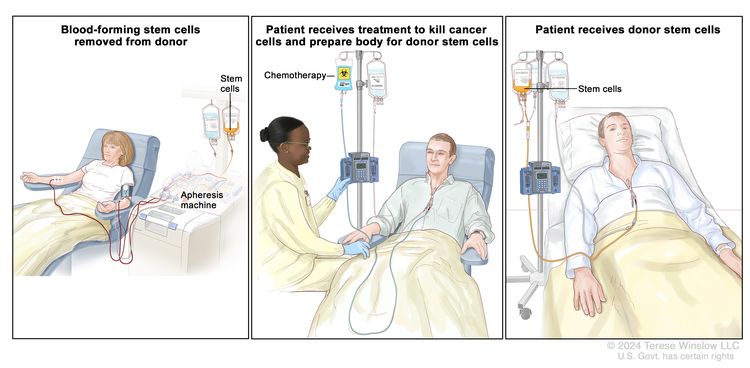
High doses of chemotherapy are given to kill cancer cells. Healthy cells, including blood-forming cells, are also destroyed by the cancer treatment. Stem cell transplant is a treatment to replace the blood-forming cells. Stem cells (immature blood cells) are removed from the blood or bone marrow of the patient or a donor and are frozen and stored. After the patient completes chemotherapy, the stored stem cells are thawed and given back to the patient through an infusion. These reinfused stem cells grow into (and restore) the body’s blood cells.

EnlargeDonor stem cell transplant; (Panel 1): Drawing of stem cells being collected from a donor's bloodstream using an apheresis machine. Blood is removed from a vein in the donor's arm and flows through the machine where the stem cells are removed. The rest of the blood is then returned to the donor through a vein in their other arm. (Panel 2): Drawing of a health care provider giving a patient an infusion of chemotherapy through a catheter in the patient's chest. The chemotherapy is given to kill cancer cells and prepare the patient's body for the donor stem cells. (Panel 3): Drawing of a patient receiving an infusion of the donor stem cells through a catheter in the chest.
Donor stem cell transplant. (Step 1): Four to five days before donor stem cell collection, the donor receives a medicine to increase the number of stem cells circulating through their bloodstream (not shown). The blood-forming stem cells are then collected from the donor through a large vein in their arm. The blood flows through an apheresis machine that removes the stem cells. The rest of the blood is returned to the donor through a vein in their other arm. (Step 2): The patient receives chemotherapy to kill cancer cells and prepare their body for the donor stem cells. The patient may also receive radiation therapy (not shown). (Step 3): The patient receives an infusion of the donor stem cells.

New types of treatment are being tested in clinical trials.

Information about clinical trials is available from the NCI website.

Treatment for chronic myeloproliferative neoplasms may cause side effects.

For information about side effects caused by treatment for cancer, visit our Side Effects page.

Patients may want to think about taking part in a clinical trial.

For some patients, taking part in a clinical trial may be the best treatment choice. Clinical trials are part of the cancer research process. Clinical trials are done to find out if new cancer treatments are safe and effective or better than the standard treatment.

Many of today’s standard treatments for cancer are based on earlier clinical trials. Patients who take part in a clinical trial may receive the standard treatment or be among the first to receive a new treatment.

Patients who take part in clinical trials also help improve the way cancer will be treated in the future. Even when clinical trials do not lead to effective new treatments, they often answer important questions and help move research forward.

Patients can enter clinical trials before, during, or after starting their cancer treatment.

Some clinical trials only include patients who have not yet received treatment. Other trials test treatments for patients whose cancer has not gotten better. There are also clinical trials that test new ways to stop cancer from recurring (coming back) or reduce the side effects of cancer treatment.

Clinical trials are taking place in many parts of the country. Information about clinical trials supported by NCI can be found on NCI’s clinical trials search webpage. Clinical trials supported by other organizations can be found on the ClinicalTrials.gov website.

Follow-up tests may be needed.

As you go through treatment, you will have follow-up tests or check-ups. Some tests that were done to diagnose or stage the cancer may be repeated to see how well the treatment is working. Decisions about whether to continue, change, or stop treatment may be based on the results of these tests.

Some of the tests will continue to be done from time to time after treatment has ended. The results of these tests can show if your condition has changed or if the cancer has recurred (come back).

Treatment of Chronic Myelogenous Leukemia

See the PDQ summary about Chronic Myelogenous Leukemia Treatment for information.

Use our clinical trial search to find NCI-supported cancer clinical trials that are accepting patients. You can search for trials based on the type of cancer, the age of the patient, and where the trials are being done. General information about clinical trials is also available.

Treatment of Polycythemia Vera

For information about the treatments listed below, see the Treatment Option Overview section.

The purpose of treatment for polycythemia vera is to reduce the number of extra blood cells. Treatment of polycythemia vera may include the following:

Use our clinical trial search to find NCI-supported cancer clinical trials that are accepting patients. You can search for trials based on the type of cancer, the age of the patient, and where the trials are being done. General information about clinical trials is also available.

Treatment of Primary Myelofibrosis

For information about the treatments listed below, see the Treatment Option Overview section.

Treatment of primary myelofibrosis in patients without signs or symptoms is usually watchful waiting.

Patients with primary myelofibrosis may have signs or symptoms of anemia. Anemia is usually treated with transfusion of red blood cells to relieve symptoms and improve quality of life. In addition, anemia may be treated with:

Treatment of primary myelofibrosis in patients with other signs or symptoms may include the following:

Use our clinical trial search to find NCI-supported cancer clinical trials that are accepting patients. You can search for trials based on the type of cancer, the age of the patient, and where the trials are being done. General information about clinical trials is also available.

Treatment of Essential Thrombocythemia

For information about the treatments listed below, see the Treatment Option Overview section.

Treatment of essential thrombocythemia in patients younger than 60 years who have no signs or symptoms and an acceptable platelet count is usually watchful waiting. Treatment of other patients may include the following:

Use our clinical trial search to find NCI-supported cancer clinical trials that are accepting patients. You can search for trials based on the type of cancer, the age of the patient, and where the trials are being done. General information about clinical trials is also available.

Treatment of Chronic Neutrophilic Leukemia

For information about the treatments listed below, see the Treatment Option Overview section.

Treatment of chronic neutrophilic leukemia may include the following:

Use our clinical trial search to find NCI-supported cancer clinical trials that are accepting patients. You can search for trials based on the type of cancer, the age of the patient, and where the trials are being done. General information about clinical trials is also available.

Treatment of Chronic Eosinophilic Leukemia

For information about the treatments listed below, see the Treatment Option Overview section.

Treatment of chronic eosinophilic leukemia may include the following:

Use our clinical trial search to find NCI-supported cancer clinical trials that are accepting patients. You can search for trials based on the type of cancer, the age of the patient, and where the trials are being done. General information about clinical trials is also available.

To Learn More About Chronic Myeloproliferative Neoplasms

About This PDQ Summary

About PDQ

Physician Data Query (PDQ) is the National Cancer Institute’s (NCI’s) comprehensive cancer information database. The PDQ database contains summaries of the latest published information on cancer prevention, detection, genetics, treatment, supportive care, and complementary and alternative medicine. Most summaries come in two versions. The health professional versions have detailed information written in technical language. The patient versions are written in easy-to-understand, nontechnical language. Both versions have cancer information that is accurate and up to date and most versions are also available in Spanish.

PDQ is a service of the NCI. The NCI is part of the National Institutes of Health (NIH). NIH is the federal government’s center of biomedical research. The PDQ summaries are based on an independent review of the medical literature. They are not policy statements of the NCI or the NIH.

Purpose of This Summary

This PDQ cancer information summary has current information about the treatment of chronic myeloproliferative neoplasms. It is meant to inform and help patients, families, and caregivers. It does not give formal guidelines or recommendations for making decisions about health care.

Reviewers and Updates

Editorial Boards write the PDQ cancer information summaries and keep them up to date. These Boards are made up of experts in cancer treatment and other specialties related to cancer. The summaries are reviewed regularly and changes are made when there is new information. The date on each summary (“Updated”) is the date of the most recent change.

The information in this patient summary was taken from the health professional version, which is reviewed regularly and updated as needed, by the PDQ Adult Treatment Editorial Board.

Clinical Trial Information

A clinical trial is a study to answer a scientific question, such as whether one treatment is better than another. Trials are based on past studies and what has been learned in the laboratory. Each trial answers certain scientific questions in order to find new and better ways to help cancer patients. During treatment clinical trials, information is collected about the effects of a new treatment and how well it works. If a clinical trial shows that a new treatment is better than one currently being used, the new treatment may become “standard.” Patients may want to think about taking part in a clinical trial. Some clinical trials are open only to patients who have not started treatment.

Clinical trials can be found online at NCI’s website. For more information, call the Cancer Information Service (CIS), NCI’s contact center, at 1-800-4-CANCER (1-800-422-6237).

Permission to Use This Summary

PDQ is a registered trademark. The content of PDQ documents can be used freely as text. It cannot be identified as an NCI PDQ cancer information summary unless the whole summary is shown and it is updated regularly. However, a user would be allowed to write a sentence such as “NCI’s PDQ cancer information summary about breast cancer prevention states the risks in the following way: [include excerpt from the summary].”

The best way to cite this PDQ summary is:

PDQ® Adult Treatment Editorial Board. PDQ Chronic Myeloproliferative Neoplasms Treatment. Bethesda, MD: National Cancer Institute. Updated <MM/DD/YYYY>. Available at: /types/myeloproliferative/patient/chronic-treatment-pdq. Accessed <MM/DD/YYYY>. [PMID: 26389435]

Images in this summary are used with permission of the author(s), artist, and/or publisher for use in the PDQ summaries only. If you want to use an image from a PDQ summary and you are not using the whole summary, you must get permission from the owner. It cannot be given by the National Cancer Institute. Information about using the images in this summary, along with many other images related to cancer can be found in Visuals Online. Visuals Online is a collection of more than 3,000 scientific images.

Disclaimer

The information in these summaries should not be used to make decisions about insurance reimbursement. More information on insurance coverage is available on Cancer.gov on the Managing Cancer Care page.

Contact Us

More information about contacting us or receiving help with the Cancer.gov website can be found on our Contact Us for Help page. Questions can also be submitted to Cancer.gov through the website’s E-mail Us.

Myeloproliferative Neoplasms Treatment (PDQ®)–Health Professional Version

Myeloproliferative Neoplasms Treatment (PDQ®)–Health Professional Version

General Information About Myeloproliferative Neoplasms

The categories of myeloproliferative neoplasms (MPN) include:[1]

All of these disorders involve dysregulation at the multipotent hematopoietic stem cell, with one or more of the following shared features:

  • Overproduction of one or several blood elements with dominance of a transformed clone.
  • Hypercellular marrow/marrow fibrosis.
  • Cytogenetic abnormalities.
  • Thrombotic and/or hemorrhagic diatheses.[2]
  • Extramedullary hematopoiesis (liver/spleen).
  • Transformation to acute leukemia.
  • Overlapping clinical features.

MPN usually occur sporadically; however, familial clusters of MPN have been reported. These familial clusters include autosomal-dominant inheritance and autosomal-recessive inheritance.[3] Patients with PV and ET have marked increases of red blood cell and platelet production. Treatment is directed at reducing the excessive numbers of blood cells. Both PV and ET can develop a spent phase during their courses that resembles PMF with cytopenias and marrow hypoplasia and fibrosis called post-PV/ET myelofibrosis.[4] A recurrent single nucleotide variant in one copy of the JAK2 gene, a cytoplasmic tyrosine kinase on chromosome 9, has been identified in most patients with PV, ET, and PMF.[5] Other single nucleotide variants were associated with genes encoding calreticulin (CALR) and the thrombopoietin receptor (MPL).[6,7]

There is no standard treatment approach for patients with progression from chronic-phase MPN to accelerated phase (blasts 10% to <20% in the peripheral blood or bone marrow) or blast phase (leukemic transformation, blasts ≥20% in the peripheral blood or bone marrow), and these patients have a poor prognosis (3- to 18-month median survival).[8] Allogeneic hematopoietic cell transplant has resulted in long-term survival, but this approach is often not feasible in older patients with comorbid conditions or lack of initial response to leukemic induction therapy.[9]

References
  1. Arber DA, Orazi A, Hasserjian RP, et al.: International Consensus Classification of Myeloid Neoplasms and Acute Leukemias: integrating morphologic, clinical, and genomic data. Blood 140 (11): 1200-1228, 2022. [PUBMED Abstract]
  2. Hultcrantz M, Björkholm M, Dickman PW, et al.: Risk for Arterial and Venous Thrombosis in Patients With Myeloproliferative Neoplasms: A Population-Based Cohort Study. Ann Intern Med 168 (5): 317-325, 2018. [PUBMED Abstract]
  3. Ranjan A, Penninga E, Jelsig AM, et al.: Inheritance of the chronic myeloproliferative neoplasms. A systematic review. Clin Genet 83 (2): 99-107, 2013. [PUBMED Abstract]
  4. Barosi G, Mesa RA, Thiele J, et al.: Proposed criteria for the diagnosis of post-polycythemia vera and post-essential thrombocythemia myelofibrosis: a consensus statement from the International Working Group for Myelofibrosis Research and Treatment. Leukemia 22 (2): 437-8, 2008. [PUBMED Abstract]
  5. James C, Ugo V, Le Couédic JP, et al.: A unique clonal JAK2 mutation leading to constitutive signalling causes polycythaemia vera. Nature 434 (7037): 1144-8, 2005. [PUBMED Abstract]
  6. Lundberg P, Karow A, Nienhold R, et al.: Clonal evolution and clinical correlates of somatic mutations in myeloproliferative neoplasms. Blood 123 (14): 2220-8, 2014. [PUBMED Abstract]
  7. Tefferi A, Vannucchi AM: Genetic Risk Assessment in Myeloproliferative Neoplasms. Mayo Clin Proc 92 (8): 1283-1290, 2017. [PUBMED Abstract]
  8. Mudireddy M, Gangat N, Hanson CA, et al.: Validation of the WHO-defined 20% circulating blasts threshold for diagnosis of leukemic transformation in primary myelofibrosis. Blood Cancer J 8 (6): 57, 2018. [PUBMED Abstract]
  9. Alchalby H, Zabelina T, Stübig T, et al.: Allogeneic stem cell transplantation for myelofibrosis with leukemic transformation: a study from the Myeloproliferative Neoplasm Subcommittee of the CMWP of the European Group for Blood and Marrow Transplantation. Biol Blood Marrow Transplant 20 (2): 279-81, 2014. [PUBMED Abstract]

Treatment of Chronic Myeloid Leukemia

For information, see Chronic Myeloid Leukemia Treatment.

Treatment of Polycythemia Vera

Disease Overview for Polycythemia Vera (PV)

To establish a diagnosis of PV, the International Consensus Classification requires that the patient meet either all three major criteria or the first two major criteria with the minor criterion.[1]

Major Criteria

  1. Hemoglobin greater than 16.5 g/dL in men or 16.0 g/dL in women, hematocrit greater than 49% in men or 48% in women, or elevated red cell mass greater than 25% above mean normal predicted value.
  2. Presence of a JAK2 V617F variant or a JAK2 exon 12 variant.
  3. Bone marrow biopsy showing age-adjusted hypercellularity with trilineage proliferation (panmyelosis), including prominent erythroid, granulocytic, and increase in pleomorphic, mature megakaryocytes without atypia.

Minor Criterion

  1. Serum erythropoietin level below reference range.

There is no staging system for this disease.

Patients have an increased risk of cardiovascular and thrombotic events [2] and leukemic transformation (blast-phase disease) or post-PV myelofibrosis.[35] Age older than 67 years, leukocytosis (≥15 × 109/L), a history of thrombosis, and the presence of pathogenic variants (SRSF2) are associated with a poor prognosis.[6]

Treatment Option Overview for PV

The primary therapy for PV includes the use of phlebotomy or cytoreductive therapy to maintain the hematocrit below 45%. This approach was confirmed in a randomized prospective trial, which demonstrated lower rates of cardiovascular death and major thrombosis using this hematocrit target.[7]

Complications of phlebotomy include:

  • Thrombocytosis and symptoms related to chronic iron deficiency, including pica, angular stomatitis, and glossitis.
  • Dysphagia resulting from esophageal webs (very rare).
  • Potential muscle weakness.

In addition, progressive splenomegaly and pruritus not controllable by antihistamines may persist despite control of the hematocrit by phlebotomy. For more information, see Pruritus.

If symptoms persist or phlebotomy is not tolerated, cytoreductive therapy can be added to control the disease.

Guidelines based on anecdotal reports have been developed for the management of pregnant patients with PV.[8]

Treatment Options for PV

Treatment options for PV include:

  1. Phlebotomy.[7]
  2. Hydroxyurea.[9]
  3. Pegylated interferon alfa-2a.[1012]
  4. Ropeginterferon alfa-2B.[13,14]
  5. Ruxolitinib.[15]
  6. Low-dose aspirin (≤100 mg) daily, unless contraindicated by major bleeding or gastric intolerance.[16]

Frontline cytoreductive therapy

Early retrospective studies in patients with PV suggested a superior median survival with myelosuppressive therapy as opposed to either no treatment or treatment with phlebotomy alone. This observation was countered by concerns regarding the leukemogenicity of cytoreductive therapy. The Polycythemia Vera Study Group (PSVG) found that both chlorambucil and radioisotope phosphorous 32 can have leukemogenic potential and are detrimental to survival, but hydroxyurea does not have these effects.[9] Similarly, the leukemic potential of pipobroman and busulfan has been established.[17,18] The leukemogenic hazards of hydroxyurea are still being debated. In several large studies, no consistent association between exposure to hydroxyurea and leukemic transformation (blast-phase MPN) has been identified.

Evidence (frontline cytoreductive therapy):

  1. In an analysis of 51 patients from the PSVG-08 study, the use of hydroxyurea, along with phlebotomy as needed, significantly reduced the risk of thrombosis compared with 134 patients treated with phlebotomy alone from the PSVG-01 study.[19]
    • During the first 7.25 years of observation, there were fewer thrombotic events in patients who received hydroxyurea (9.8%) compared with those who received phlebotomy alone (32.8%) (P = .18). There was no difference in the incidence of leukemic transformation between the two groups at that time point.
    • With further follow-up (median, 8.6 years; maximum, 15.3 years), leukemic transformation occurred in three patients who received hydroxyurea (5.9%) and two patients who received phlebotomy alone (1.5%) (P = .25). There was no significant difference in the incidence of post-PV myelofibrosis or overall survival between the two groups.[19][Level of evidence C3]
  2. The randomized phase III MPN-RC 112 study (NCT01259856) included 87 patients with high-risk PV. Patients were randomly assigned to receive either hydroxyurea or pegylated interferon alfa.[20]
    • The complete response rates at 12 months were similar between patients who received hydroxyurea or pegylated interferon alfa (30% vs. 28%, respectively).[20][Level of evidence A3]
    • Thrombotic events and disease progression were infrequent in both arms, whereas grade 3 or 4 adverse events were more frequent for patients who received pegylated interferon alfa (46% vs. 28%).
  3. The PROUD-PV study (NCT01949805) randomly assigned 257 patients with an indication for cytoreduction to receive either ropeginterferon alfa-2B or hydroxyurea. Patients could have previously received hydroxyurea for up to 3 years, but with suboptimal response or intolerance. After 1 year, patients could choose to continue study treatment in the CONTINUATION-PV trial (NCT02218047): patients either continued to receive ropeginterferon alfa-2B or received best-available treatment (hydroxyurea or another standard first-line treatment).[13]
    • In PROUD-PV, the 12-month complete hematological response rates were similar between the treatment groups (43% for ropeginterferon alfa-2B vs. 46% for hydroxyurea; P = .63).
    • In PROUD-PV, adverse events resulting in dose reduction occurred in 40% of the patients in the ropeginterferon alfa-2B group and 58% of patients in the hydroxyurea group. Serious treatment-related adverse events occurred in 3 of 127 patients (2%) in the ropeginterferon alfa-2B group and 5 of 127 patients (4%) in the hydroxyurea group.
    • In CONTINUATION-PV, the 5-year complete hematological response rate (with the last observation carried forward) was 72.6% (69 of 95 patients) in the ropeginterferon alfa-2B group and 52.6% (40 of 76 patients) in the best-available treatment group (rate ratio,1.43; 95% confidence interval [CI], 1.12–1.81; P = .004). The 5-year molecular response rate was 69.1% in the ropeginterferon alfa-2B group and 21.6% in the best-available treatment group (rate ratio, 3.04; 95% CI, 1.96–4.71; P < .0001). Also at 5 years, the median JAK2 V617F allele burden was better for the ropeginterferon alpha-2B group compared with the hydroxyurea group (8% vs. 44%, respectively; P < .0001).[14][Level of evidence A3]

Posthydroxyurea cytoreductive therapy

Evidence (posthydroxyurea cytoreductive therapy):

  1. In the phase II MPN-RC 111 study (NCT01259817), 50 patients with PV received pegylated interferon alfa-2a. Patients had previously received hydroxyurea and had either an inadequate response or unacceptable side effects.[12]
    • The complete response rate was 22%, and the partial response rate was 38%. A total of 14% of patients discontinued treatment because of side effects.[12][Level of evidence C3]
  2. In the open-label RESPONSE study (NCT01243944), patients with phlebotomy-dependent PV and palpable splenomegaly were randomly assigned to receive either ruxolitinib or standard therapy (interferon, pipobroman, anagrelide, immunomodulators, or no treatment/phlebotomy alone). Patients had previously received hydroxyurea but had either an inadequate response or unacceptable side effects.[21]
    • Ruxolitinib was superior to standard therapy with regards to phlebotomy-free control of hematocrit (60% vs. 20%; P < .001), reduction of spleen volume (38% vs. 1%; P < .001), and reduction in symptom score by 50% (49% vs. 5%; P < .001).[21][Level of evidence B3]
  3. The follow-up open-label RESPONSE-2 study (NCT02038036) included 173 patients with phlebotomy-dependent PV without palpable splenomegaly who had either an inadequate response to or unacceptable side effects from hydroxyurea. Patients were randomly assigned to receive either ruxolitinib or best-available therapy (interferon, pipobroman, anagrelide, immunomodulators, or no treatment/phlebotomy alone).[15]
    • Hematocrit control was achieved in 62% of patients who received ruxolitinib and 19% of patients who received best-available therapy (hazard ratio [HR], 7.28; 95% CI, 3.43‒15.45; P < .001).[15][Level of evidence B3]
  4. MAJIC-PV was a phase II study that randomly assigned 180 patients to receive either ruxolitinib or best-available therapy. Patients had experienced an inadequate response or unacceptable side effects from prior hydroxyurea therapy. Patients remained on study for up to 5 years without crossover.[22]
    • At 1 year, the complete response rate was 43% for patients who received ruxolitinib and 26% for patients who received best-available therapy (odds ratio, 2.12; 90% CI, 1.25–3.60; P = .02).[22][Level of evidence B1]
    • Thromboembolic event–free survival was significantly higher in the ruxolitinib group compared with the best-available therapy group (HR, 0.58; 95% CI, 0.35–0.94; P = .03).

No randomized trial has compared ruxolitinib with interferons in patients with PV who have previously received hydroxyurea.

Antiplatelet therapy

After controlling hematocrit with phlebotomy or cytoreductive therapy, the second principle in treating PV is the use of antiplatelet agents to reduce the risk of thrombosis.

Evidence (antiplatelet therapy):

  1. The double-blind, randomized, phase III European Collaboration on Low-Dose Aspirin in Polycythemia Vera (ECLAP) studied the use of aspirin in patients with PV.[16]
    • Aspirin use was associated with a lower combined risk of nonfatal myocardial infarction, nonfatal stroke, pulmonary embolism, major venous thrombosis, or death from cardiovascular causes (relative risk, 0.40; 95 % CI, 0.18–0.91).[16][Level of evidence B1]
    • The incidence of major bleeding was not significantly increased in the aspirin group.

Current Clinical Trials

Use our advanced clinical trial search to find NCI-supported cancer clinical trials that are now enrolling patients. The search can be narrowed by location of the trial, type of treatment, name of the drug, and other criteria. General information about clinical trials is also available.

References
  1. Arber DA, Orazi A, Hasserjian RP, et al.: International Consensus Classification of Myeloid Neoplasms and Acute Leukemias: integrating morphologic, clinical, and genomic data. Blood 140 (11): 1200-1228, 2022. [PUBMED Abstract]
  2. Hultcrantz M, Björkholm M, Dickman PW, et al.: Risk for Arterial and Venous Thrombosis in Patients With Myeloproliferative Neoplasms: A Population-Based Cohort Study. Ann Intern Med 168 (5): 317-325, 2018. [PUBMED Abstract]
  3. Marchioli R, Finazzi G, Landolfi R, et al.: Vascular and neoplastic risk in a large cohort of patients with polycythemia vera. J Clin Oncol 23 (10): 2224-32, 2005. [PUBMED Abstract]
  4. Elliott MA, Tefferi A: Thrombosis and haemorrhage in polycythaemia vera and essential thrombocythaemia. Br J Haematol 128 (3): 275-90, 2005. [PUBMED Abstract]
  5. Chait Y, Condat B, Cazals-Hatem D, et al.: Relevance of the criteria commonly used to diagnose myeloproliferative disorder in patients with splanchnic vein thrombosis. Br J Haematol 129 (4): 553-60, 2005. [PUBMED Abstract]
  6. Tefferi A, Guglielmelli P, Lasho TL, et al.: Mutation-enhanced international prognostic systems for essential thrombocythaemia and polycythaemia vera. Br J Haematol 189 (2): 291-302, 2020. [PUBMED Abstract]
  7. Marchioli R, Finazzi G, Specchia G, et al.: Cardiovascular events and intensity of treatment in polycythemia vera. N Engl J Med 368 (1): 22-33, 2013. [PUBMED Abstract]
  8. McMullin MF, Bareford D, Campbell P, et al.: Guidelines for the diagnosis, investigation and management of polycythaemia/erythrocytosis. Br J Haematol 130 (2): 174-95, 2005. [PUBMED Abstract]
  9. Kaplan ME, Mack K, Goldberg JD, et al.: Long-term management of polycythemia vera with hydroxyurea: a progress report. Semin Hematol 23 (3): 167-71, 1986. [PUBMED Abstract]
  10. Quintás-Cardama A, Kantarjian H, Manshouri T, et al.: Pegylated interferon alfa-2a yields high rates of hematologic and molecular response in patients with advanced essential thrombocythemia and polycythemia vera. J Clin Oncol 27 (32): 5418-24, 2009. [PUBMED Abstract]
  11. Quintás-Cardama A, Abdel-Wahab O, Manshouri T, et al.: Molecular analysis of patients with polycythemia vera or essential thrombocythemia receiving pegylated interferon α-2a. Blood 122 (6): 893-901, 2013. [PUBMED Abstract]
  12. Yacoub A, Mascarenhas J, Kosiorek H, et al.: Pegylated interferon alfa-2a for polycythemia vera or essential thrombocythemia resistant or intolerant to hydroxyurea. Blood 134 (18): 1498-1509, 2019. [PUBMED Abstract]
  13. Gisslinger H, Klade C, Georgiev P, et al.: Ropeginterferon alfa-2b versus standard therapy for polycythaemia vera (PROUD-PV and CONTINUATION-PV): a randomised, non-inferiority, phase 3 trial and its extension study. Lancet Haematol 7 (3): e196-e208, 2020. [PUBMED Abstract]
  14. Kiladjian JJ, Klade C, Georgiev P, et al.: Long-term outcomes of polycythemia vera patients treated with ropeginterferon Alfa-2b. Leukemia 36 (5): 1408-1411, 2022. [PUBMED Abstract]
  15. Passamonti F, Griesshammer M, Palandri F, et al.: Ruxolitinib for the treatment of inadequately controlled polycythaemia vera without splenomegaly (RESPONSE-2): a randomised, open-label, phase 3b study. Lancet Oncol 18 (1): 88-99, 2017. [PUBMED Abstract]
  16. Landolfi R, Marchioli R, Kutti J, et al.: Efficacy and safety of low-dose aspirin in polycythemia vera. N Engl J Med 350 (2): 114-24, 2004. [PUBMED Abstract]
  17. Finazzi G, Caruso V, Marchioli R, et al.: Acute leukemia in polycythemia vera: an analysis of 1638 patients enrolled in a prospective observational study. Blood 105 (7): 2664-70, 2005. [PUBMED Abstract]
  18. Wang R, Shallis RM, Stempel JM, et al.: Second malignancies among older patients with classical myeloproliferative neoplasms treated with hydroxyurea. Blood Adv 7 (5): 734-743, 2023. [PUBMED Abstract]
  19. Tremblay D, Kosiorek HE, Dueck AC, et al.: Evaluation of Therapeutic Strategies to Reduce the Number of Thrombotic Events in Patients With Polycythemia Vera and Essential Thrombocythemia. Front Oncol 10: 636675, 2020. [PUBMED Abstract]
  20. Mascarenhas J, Kosiorek HE, Prchal JT, et al.: A randomized phase 3 trial of interferon-α vs hydroxyurea in polycythemia vera and essential thrombocythemia. Blood 139 (19): 2931-2941, 2022. [PUBMED Abstract]
  21. Vannucchi AM, Kiladjian JJ, Griesshammer M, et al.: Ruxolitinib versus standard therapy for the treatment of polycythemia vera. N Engl J Med 372 (5): 426-35, 2015. [PUBMED Abstract]
  22. Harrison CN, Nangalia J, Boucher R, et al.: Ruxolitinib Versus Best Available Therapy for Polycythemia Vera Intolerant or Resistant to Hydroxycarbamide in a Randomized Trial. J Clin Oncol 41 (19): 3534-3544, 2023. [PUBMED Abstract]

Treatment of Essential Thrombocythemia

Disease Overview for Essential Thrombocythemia (ET)

To establish a diagnosis of ET, the revised World Health Organization (WHO) classification requires that the patient meet the following criteria:[1]

  1. Sustained platelet count of at least 450 × 109/L.
  2. Bone marrow biopsy showing predominant proliferation of enlarged mature megakaryocytes; no significant increase of granulocytic or erythroid precursors. This finding distinguishes ET from another entity with thrombocytosis, namely prefibrotic primary myelofibrosis (PMF), which is identified by increased granulocytic or erythroid precursors, atypical megakaryocytes, and increased bone marrow cellularity.

    Patients with prefibrotic PMF have a worse survival than patients with ET because of an increased progression to myelofibrosis or acute myeloid leukemia.[24] Patients with prefibrotic PMF may also have a higher tendency to bleed, which can be exacerbated by low-dose aspirin.[5]

  3. Not meeting criteria for polycythemia vera (PV), PMF, chronic myeloid leukemia, myelodysplastic syndrome, or other myeloid neoplasm.
  4. Demonstration of a JAK2 V617F variant or an MPL exon 10 variant.[6] In the absence of a clonal marker, there must be no evidence for reactive thrombocytosis. In particular, with a decreased serum ferritin, there must be no increase in hemoglobin level to PV range with iron replacement therapy. If a JAK2 variant or an MPL variant is present and other myeloproliferative or myelodysplastic features are excluded, a bone marrow aspirate/biopsy may not be mandatory for diagnosis.[7] About 60% of patients with ET carry a JAK2 variant, and about 5% to 10% of the patients have activating variants in the MPL thrombopoietin receptor gene. About 70% of patients without JAK2 or MPL variants carry a somatic variant in the CALR gene, which is associated with a more indolent clinical course than that seen in patients with JAK2 or MPL variants.[812]

Patients older than 60 years or those with a previous thrombotic episode or with leukocytosis have as much as a 25% chance of developing cerebral, cardiac, or peripheral arterial thromboses and, less often, a chance of developing a pulmonary embolism or deep venous thrombosis.[2,1315] Similar to the other myeloproliferative syndromes, conversion to acute leukemia is found in a small percentage of patients (<10%) with long-term follow-up. Patients younger than 40 years have a more indolent course, with fewer thrombotic events or transformation to acute leukemia.[16] A multivariable analysis in several cohorts that included almost 1,500 patients showed worse outcomes for men, with a hazard ratio (HR) of 1.5 (95% confidence interval [CI], 1.1‒2.5).[17]

There is no staging system for this disease.

Categorizing a patient as having untreated ET means that a patient is newly diagnosed and has had no previous treatment except supportive care.

Treatment Option Overview for ET

Initiation of therapy for patients with asymptomatic ET is controversial.[18] In a case-controlled observational study of 65 low-risk patients (age <60 years, platelet count <1,500 × 109/L, and no history of thrombosis or hemorrhage) with a median follow-up of 4.1 years, the thrombotic risk of 1.91 cases per 100 patient-years and hemorrhagic risk of 1.12 cases per 100 patient-years was not increased compared with normal controls.[19]

Treatment Options for ET

Treatment options for ET include:

  1. No treatment, unless complications develop, if patients are asymptomatic, younger than 60 years, and have a platelet count of less than 1,500 × 109/L.
  2. Hydroxyurea.[13]
  3. Interferon alfa [2023] or pegylated interferon alfa-2a.[24,25]
  4. Anagrelide.[26,27]

Hydroxyurea

Evidence (hydroxyurea):

  1. A prospective randomized trial included 382 patients aged 40 to 59 years with ET and without high-risk factors (no history of thrombosis or bleeding, no hypertension, no diabetes, platelet count ≤1,500 × 109/L). Patients were randomly assigned to receive aspirin alone or hydroxyurea plus aspirin.[28]
    • After a median follow-up of 73 months, there was no difference in thrombosis, hemorrhage, or survival (HR, 0.98; 95% CI, 0.42‒2.25; P = 1.0).[28][Level of evidence B1] Patients younger than 60 years who lacked high-risk factors did not benefit from the addition of hydroxyurea to aspirin.
  2. A randomized trial of patients with ET and a high risk of thrombosis compared treatment with hydroxyurea titrated to attain a platelet count below 600 × 109/L with a control group that received no therapy. Hydroxyurea was found to be effective in preventing thrombotic episodes (4% vs. 24%).[13][Level of evidence B3]
    • A retrospective analysis of this trial found that antiplatelet drugs had no significant influence on the outcome. Resistance to hydroxyurea was defined as (1) a platelet count of greater than 600 × 109/L after 3 months of at least 2 g per day of hydroxyurea or (2) a platelet count greater than 400 × 109/L and a white blood cell count of less than 2.5 × 10⁹/L or a hemoglobin less than 10 g/dL at any dose of hydroxyurea.[29]
  3. A prospective randomized trial in the United Kingdom of 809 patients compared hydroxyurea plus aspirin with anagrelide plus aspirin.[30]
    • Although the platelet-lowering effect was equivalent, the anagrelide group had significantly more thrombotic and hemorrhagic events (HR, 1.57; P = .03) and more myelofibrosis (HR, 2.92; P = .01).
    • No differences were seen for subsequent myelodysplasia or acute leukemia in this trial.[27][Level of evidence B1]
  4. Another prospective randomized trial also compared hydroxyurea with anagrelide in 259 previously untreated and high-risk patients.[31] In this central European trial, the diagnosis of ET was made by the WHO recommendations, not by the Polycythemia Vera Study Group criteria as in the U.K. study. This means that patients with leukocytosis and a diagnosis of early prefibrotic myelofibrosis (both groups with much higher rates of thrombosis) were excluded from the central European trial.
    • In this analysis, there were no differences in outcome for thrombotic or hemorrhagic events.[31][Level of evidence B1]

These randomized prospective trials establish the efficacy and safety for the use of hydroxyurea for patients with high-risk ET (age >60 years + platelet count >1,000 × 109/L or >1,500 × 109/L). For patients diagnosed by WHO standards (excluding patients with leukocytosis and prefibrotic myelofibrosis by bone marrow biopsy), anagrelide represents a reasonable alternative therapy. The addition of aspirin to cytoreductive therapies like hydroxyurea or anagrelide remains controversial, but a retrospective anecdotal report suggested reduction in thrombosis for patients older than 60 years.[32] In a phase II study (NCT01259856), 65 patients with ET who required therapy with hydroxyurea and had either an inadequate response or unacceptable side effects received pegylated interferon alfa-2a. The complete response rate was 43% and the partial response rate was 26%, with only a 14% discontinuation rate from side effects. Patients with a CALR variant had a significantly higher complete response rate than patients without a CALR variant (57% vs. 28%).[33][Level of evidence C3] Unlike results for PV or myelofibrosis, ruxolitinib was not helpful for patients resistant to hydroxyurea.[34]

Many clinicians use hydroxyurea or platelet apheresis prior to elective surgery to reduce the platelet count and to prevent postoperative thromboembolism. No prospective or randomized trials document the value of this approach.

Among low-risk patients (defined as age ≤60 years with no prior thrombotic episodes), a retrospective review of 300 patients showed benefit for antiplatelet agents in reducing venous thrombosis in JAK2-positive cases and in reducing arterial thrombosis in patients with cardiovascular risk factors.[35] Balancing the risks and benefits of aspirin for low-risk patients can be difficult.[36] In an extrapolation of the data from trials of PV, low-dose aspirin to prevent vascular events has been suggested, but there are no data from clinical trials to address this issue.[37,38]

Current Clinical Trials

Use our advanced clinical trial search to find NCI-supported cancer clinical trials that are now enrolling patients. The search can be narrowed by location of the trial, type of treatment, name of the drug, and other criteria. General information about clinical trials is also available.

References
  1. Tefferi A, Thiele J, Vardiman JW: The 2008 World Health Organization classification system for myeloproliferative neoplasms: order out of chaos. Cancer 115 (17): 3842-7, 2009. [PUBMED Abstract]
  2. Passamonti F, Thiele J, Girodon F, et al.: A prognostic model to predict survival in 867 World Health Organization-defined essential thrombocythemia at diagnosis: a study by the International Working Group on Myelofibrosis Research and Treatment. Blood 120 (6): 1197-201, 2012. [PUBMED Abstract]
  3. Barbui T, Thiele J, Carobbio A, et al.: Disease characteristics and clinical outcome in young adults with essential thrombocythemia versus early/prefibrotic primary myelofibrosis. Blood 120 (3): 569-71, 2012. [PUBMED Abstract]
  4. Barbui T, Thiele J, Passamonti F, et al.: Survival and disease progression in essential thrombocythemia are significantly influenced by accurate morphologic diagnosis: an international study. J Clin Oncol 29 (23): 3179-84, 2011. [PUBMED Abstract]
  5. Finazzi G, Carobbio A, Thiele J, et al.: Incidence and risk factors for bleeding in 1104 patients with essential thrombocythemia or prefibrotic myelofibrosis diagnosed according to the 2008 WHO criteria. Leukemia 26 (4): 716-9, 2012. [PUBMED Abstract]
  6. Campbell PJ, Green AR: The myeloproliferative disorders. N Engl J Med 355 (23): 2452-66, 2006. [PUBMED Abstract]
  7. Harrison CN, Bareford D, Butt N, et al.: Guideline for investigation and management of adults and children presenting with a thrombocytosis. Br J Haematol 149 (3): 352-75, 2010. [PUBMED Abstract]
  8. Klampfl T, Gisslinger H, Harutyunyan AS, et al.: Somatic mutations of calreticulin in myeloproliferative neoplasms. N Engl J Med 369 (25): 2379-90, 2013. [PUBMED Abstract]
  9. Nangalia J, Massie CE, Baxter EJ, et al.: Somatic CALR mutations in myeloproliferative neoplasms with nonmutated JAK2. N Engl J Med 369 (25): 2391-405, 2013. [PUBMED Abstract]
  10. Cazzola M, Kralovics R: From Janus kinase 2 to calreticulin: the clinically relevant genomic landscape of myeloproliferative neoplasms. Blood 123 (24): 3714-9, 2014. [PUBMED Abstract]
  11. Rumi E, Pietra D, Ferretti V, et al.: JAK2 or CALR mutation status defines subtypes of essential thrombocythemia with substantially different clinical course and outcomes. Blood 123 (10): 1544-51, 2014. [PUBMED Abstract]
  12. Rotunno G, Mannarelli C, Guglielmelli P, et al.: Impact of calreticulin mutations on clinical and hematological phenotype and outcome in essential thrombocythemia. Blood 123 (10): 1552-5, 2014. [PUBMED Abstract]
  13. Cortelazzo S, Finazzi G, Ruggeri M, et al.: Hydroxyurea for patients with essential thrombocythemia and a high risk of thrombosis. N Engl J Med 332 (17): 1132-6, 1995. [PUBMED Abstract]
  14. Harrison C, Kiladjian JJ, Al-Ali HK, et al.: JAK inhibition with ruxolitinib versus best available therapy for myelofibrosis. N Engl J Med 366 (9): 787-98, 2012. [PUBMED Abstract]
  15. Hultcrantz M, Björkholm M, Dickman PW, et al.: Risk for Arterial and Venous Thrombosis in Patients With Myeloproliferative Neoplasms: A Population-Based Cohort Study. Ann Intern Med 168 (5): 317-325, 2018. [PUBMED Abstract]
  16. Boddu P, Masarova L, Verstovsek S, et al.: Patient characteristics and outcomes in adolescents and young adults with classical Philadelphia chromosome-negative myeloproliferative neoplasms. Ann Hematol 97 (1): 109-121, 2018. [PUBMED Abstract]
  17. Tefferi A, Betti S, Barraco D, et al.: Gender and survival in essential thrombocythemia: A two-center study of 1,494 patients. Am J Hematol 92 (11): 1193-1197, 2017. [PUBMED Abstract]
  18. Masarova L, Verstovsek S: Therapeutic Approach to Young Patients With Low-Risk Essential Thrombocythemia: Primum Non Nocere. J Clin Oncol : JCO2018793497, 2018. [PUBMED Abstract]
  19. Ruggeri M, Finazzi G, Tosetto A, et al.: No treatment for low-risk thrombocythaemia: results from a prospective study. Br J Haematol 103 (3): 772-7, 1998. [PUBMED Abstract]
  20. Sacchi S: The role of alpha-interferon in essential thrombocythaemia, polycythaemia vera and myelofibrosis with myeloid metaplasia (MMM): a concise update. Leuk Lymphoma 19 (1-2): 13-20, 1995. [PUBMED Abstract]
  21. Gilbert HS: Long term treatment of myeloproliferative disease with interferon-alpha-2b: feasibility and efficacy. Cancer 83 (6): 1205-13, 1998. [PUBMED Abstract]
  22. Huang BT, Zeng QC, Zhao WH, et al.: Interferon α-2b gains high sustained response therapy for advanced essential thrombocythemia and polycythemia vera with JAK2V617F positive mutation. Leuk Res 38 (10): 1177-83, 2014. [PUBMED Abstract]
  23. Masarova L, Patel KP, Newberry KJ, et al.: Pegylated interferon alfa-2a in patients with essential thrombocythaemia or polycythaemia vera: a post-hoc, median 83 month follow-up of an open-label, phase 2 trial. Lancet Haematol 4 (4): e165-e175, 2017. [PUBMED Abstract]
  24. Quintás-Cardama A, Kantarjian H, Manshouri T, et al.: Pegylated interferon alfa-2a yields high rates of hematologic and molecular response in patients with advanced essential thrombocythemia and polycythemia vera. J Clin Oncol 27 (32): 5418-24, 2009. [PUBMED Abstract]
  25. Quintás-Cardama A, Abdel-Wahab O, Manshouri T, et al.: Molecular analysis of patients with polycythemia vera or essential thrombocythemia receiving pegylated interferon α-2a. Blood 122 (6): 893-901, 2013. [PUBMED Abstract]
  26. Anagrelide, a therapy for thrombocythemic states: experience in 577 patients. Anagrelide Study Group. Am J Med 92 (1): 69-76, 1992. [PUBMED Abstract]
  27. Green A, Campbell P, Buck G: The Medical Research Council PT1 trial in essential thrombocythemia. [Abstract] Blood 104 (11): A-6, 2004.
  28. Godfrey AL, Campbell PJ, MacLean C, et al.: Hydroxycarbamide Plus Aspirin Versus Aspirin Alone in Patients With Essential Thrombocythemia Age 40 to 59 Years Without High-Risk Features. J Clin Oncol 36 (34): 3361-3369, 2018. [PUBMED Abstract]
  29. Barosi G, Besses C, Birgegard G, et al.: A unified definition of clinical resistance/intolerance to hydroxyurea in essential thrombocythemia: results of a consensus process by an international working group. Leukemia 21 (2): 277-80, 2007. [PUBMED Abstract]
  30. Harrison CN, Campbell PJ, Buck G, et al.: Hydroxyurea compared with anagrelide in high-risk essential thrombocythemia. N Engl J Med 353 (1): 33-45, 2005. [PUBMED Abstract]
  31. Gisslinger H, Gotic M, Holowiecki J, et al.: Anagrelide compared with hydroxyurea in WHO-classified essential thrombocythemia: the ANAHYDRET Study, a randomized controlled trial. Blood 121 (10): 1720-8, 2013. [PUBMED Abstract]
  32. Alvarez-Larrán A, Pereira A, Arellano-Rodrigo E, et al.: Cytoreduction plus low-dose aspirin versus cytoreduction alone as primary prophylaxis of thrombosis in patients with high-risk essential thrombocythaemia: an observational study. Br J Haematol 161 (6): 865-71, 2013. [PUBMED Abstract]
  33. Yacoub A, Mascarenhas J, Kosiorek H, et al.: Pegylated interferon alfa-2a for polycythemia vera or essential thrombocythemia resistant or intolerant to hydroxyurea. Blood 134 (18): 1498-1509, 2019. [PUBMED Abstract]
  34. Harrison CN, Mead AJ, Panchal A, et al.: Ruxolitinib vs best available therapy for ET intolerant or resistant to hydroxycarbamide. Blood 130 (17): 1889-1897, 2017. [PUBMED Abstract]
  35. Alvarez-Larrán A, Cervantes F, Pereira A, et al.: Observation versus antiplatelet therapy as primary prophylaxis for thrombosis in low-risk essential thrombocythemia. Blood 116 (8): 1205-10; quiz 1387, 2010. [PUBMED Abstract]
  36. Harrison C, Barbui T: Aspirin in low-risk essential thrombocythemia, not so simple after all? Leuk Res 35 (3): 286-9, 2011. [PUBMED Abstract]
  37. Finazzi G: How to manage essential thrombocythemia. Leukemia 26 (5): 875-82, 2012. [PUBMED Abstract]
  38. Squizzato A, Romualdi E, Passamonti F, et al.: Antiplatelet drugs for polycythaemia vera and essential thrombocythaemia. Cochrane Database Syst Rev 4: CD006503, 2013. [PUBMED Abstract]

Treatment of Primary Myelofibrosis

Disease Overview for Primary Myelofibrosis (PMF)

PMF (also known as agnogenic myeloid metaplasia, chronic idiopathic myelofibrosis, myelosclerosis with myeloid metaplasia, and idiopathic myelofibrosis) is characterized by splenomegaly, immature peripheral blood granulocytes and erythrocytes, and teardrop-shaped red blood cells.[1] In its early phase, the disease is characterized by elevated numbers of CD34-positive cells in the marrow, while the later phases involve marrow fibrosis with decreasing CD34 cells in the marrow and a corresponding increase in splenic and liver engorgement with CD34 cells.

As distinguished from chronic myeloid leukemia (CML), PMF usually presents as follows:[2]

  • A white blood cell count less than 30 × 109/L.
  • Prominent teardrops on peripheral smear.
  • Normocellular or hypocellular marrow with moderate to marked fibrosis.
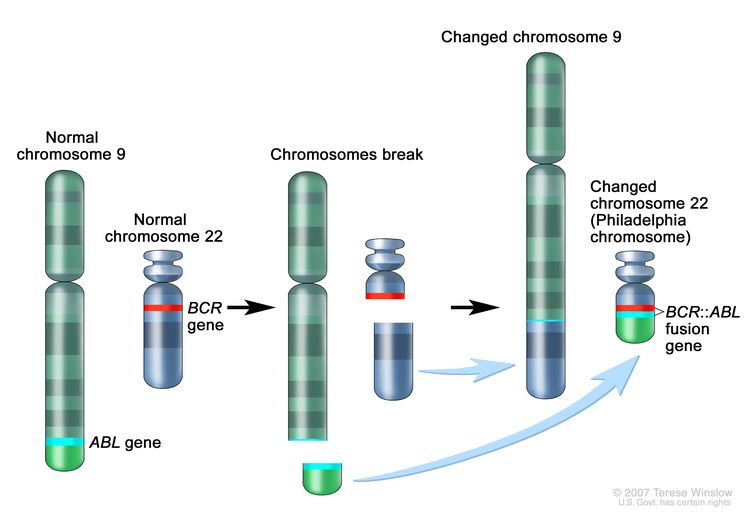
  • An absence of the Philadelphia chromosome or the BCR::ABL translocation.
  • Identification of a JAK2, MPL, or CALR variant (70% of patients).[35]

In addition to the clonal proliferation of a multipotent hematopoietic progenitor cell, an event common to all chronic myeloproliferative neoplasms, myeloid metaplasia is characterized by colonization of extramedullary sites such as the spleen or liver.[6,7]

Most patients are older than 60 years at diagnosis, and 33% of patients are asymptomatic at presentation. Splenomegaly, sometimes massive, is a characteristic finding. Patients younger than 40 years have a more indolent course, with fewer thrombotic events or transformation to acute leukemia.[8]

Symptoms of PMF include:

  • Splenic pain.
  • Early satiety.
  • Anemia.
  • Bone pain.
  • Fatigue.
  • Fever.
  • Night sweats.
  • Weight loss.

For more information about the symptoms listed above, see Fatigue, Hot Flashes and Night Sweats, and Nutrition in Cancer Care.

To establish a diagnosis of PMF, the World Health Organization classification requires that the patient meet all three major criteria and two minor criteria.[9]

Major Criteria

  1. Megakaryocyte proliferation and atypia, usually accompanied by either reticulin and/or collagen fibrosis; or, in the absence of significant reticulin fibrosis, the megakaryocyte changes must be accompanied by increased bone marrow cellularity characterized by granulocytic proliferation and often decreased erythropoiesis (so-called prefibrotic cellular-phase disease).
  2. Not meeting criteria for polycythemia vera (PV), CML, myelodysplastic syndrome, or other myeloid neoplasm.
  3. Demonstration of JAK2 V617F or other clonal marker; or, in the absence of a clonal marker, no evidence of bone marrow fibrosis caused by an underlying inflammatory disease or another neoplastic disease. About 60% of patients with PMF carry a JAK2 variant, and about 5% to 10% of the patients have activating variants in the thrombopoietin receptor gene, MPL. More than half of the patients without JAK2 or MPL carry a somatic pathogenic variant in the CALR gene, which is associated with a more indolent clinical course than that seen in patients with JAK2 or MPL variants.[35,1012]

Minor Criteria

  1. Leukoerythroblastosis.
  2. Increased serum lactate dehydrogenase level.
  3. Anemia.
  4. Palpable splenomegaly.

The major causes of death include:[13]

  • Progressive marrow failure.
  • Transformation to acute nonlymphoblastic leukemia.[14]
  • Infection.
  • Thrombohemorrhagic events.[15]
  • Heart failure.
  • Portal hypertension.

Fatal and nonfatal thrombosis was associated with age older than 60 years and JAK2 V617F positivity in a multivariable analysis of 707 patients followed from 1973 to 2008.[16] Bone marrow examination including cytogenetic testing may exclude other causes of myelophthisis, such as CML, myelodysplastic syndrome, metastatic cancer, lymphomas, and plasma cell disorders.[7] In acute myelofibrosis, patients present with pancytopenia but no splenomegaly or peripheral blood myelophthisis. Peripheral blood or marrow monocytosis is suggestive for myelodysplasia in this setting.

There is no staging system for this disease.

Prognostic factors include:[1721]

  • Age 65 years or older.
  • Anemia (hemoglobin <10 g/dL).
  • Constitutional symptoms: fever, night sweats, or weight loss.
  • Leukocytosis (white blood cell count >25 × 109/L).
  • Circulating blasts of at least 1%.

Patients without any of the adverse features, excluding age, have a median survival of more than 10 to 15 years, but the presence of any two of the adverse features lowers the median survival to less than 4 years.[22,23] International prognostic scoring systems incorporate the aforementioned prognostic factors.[22,24] Thrombocytopenia (platelet count <50 × 109/L) is a very poor prognostic factor for PMF and for myelofibrosis following thrombocythemia or PV.[25]

Karyotype abnormalities can also affect prognosis. In a retrospective series, the 13q and 20q deletions and trisomy 9 correlated with improved survival and no leukemia transformation in comparison with the worse prognosis with trisomy 8, complex karyotype, -7/7q-, i(17q), inv(3), -5/5q-, 12p-, or 11q23 rearrangement.[16,26]

Treatment Option Overview for PMF

Asymptomatic low-risk patients (based on the aforementioned prognostic systems) should be monitored with a watchful waiting approach. The development of symptomatic anemia, marked leukocytosis, drenching night sweats, weight loss, fever, or symptomatic splenomegaly warrants therapeutic intervention.

The profound anemia that develops in this disease usually requires red blood cell transfusion. Red blood cell survival is markedly decreased in some patients; this can sometimes be treated with glucocorticoids. Disease-associated anemia may occasionally respond to:[7,2729]

  • Erythropoietic growth factors. Erythropoietin and darbepoetin are less likely to help when patients are transfusion dependent or manifest a serum erythropoietin level greater than 125 U/L.[30,31]
  • Prednisone (40–80 mg/day).
  • Danazol (600 mg/day).
  • Thalidomide (50 mg/day) with or without prednisone.[32] Patients on thalidomide require prophylaxis for avoiding thrombosis and careful monitoring for hematologic toxicity.
  • Lenalidomide (10 mg/day) with or without prednisone.[3335] In the presence of del(5q), lenalidomide with or without prednisone, can reverse anemia and splenomegaly in most patients.[3335] However, patients receiving lenalidomide require prophylaxis for avoiding thrombosis and careful monitoring for hematologic toxicity.
  • Pomalidomide.[36] Patients on pomalidomide require prophylaxis for avoiding thrombosis and careful monitoring for hematologic toxicity.

Treatment Options for PMF

Treatment options for PMF include:

  1. Ruxolitinib.[3740]
  2. Clinical trials involving other JAK2 inhibitors.
  3. Hydroxyurea.[6,7]
  4. Allogeneic peripheral stem cell or bone marrow transplant.[4145]
  5. Thalidomide.[27,32,4649]
  6. Lenalidomide.[29,3335,49]
  7. Pomalidomide.[36]
  8. Splenectomy.[50,51]
  9. Splenic radiation therapy or radiation to sites of symptomatic extramedullary hematopoiesis (e.g., large lymph nodes, cord compression).[7]
  10. Cladribine.[52]
  11. Interferon alfa.[53,54]

Cytoreductive therapy

Ruxolitinib, an inhibitor of JAK1 and JAK2, can reduce the splenomegaly and debilitating symptoms of weight loss, fatigue, and night sweats for patients with JAK2-positive or JAK2-negative PMF, post–essential thrombocythemia myelofibrosis, or post-PV myelofibrosis.[55]

Evidence (cytoreductive therapy):

  1. In two prospective randomized trials, 528 higher-risk patients were randomly assigned to ruxolitinib or to either placebo (COMFORT-I [NCT00952289]) or best-available therapy (COMFORT-II [NCT00934544]).[37,38]
    • At 48 weeks, patients who received ruxolitinib had a decrease of 30% to 40% in mean spleen volume compared with an increase of 7% to 8% in the control patients.[37,38][Level of evidence B3]
    • Ruxolitinib also improved overall quality-of-life measures, with low toxic effects in both studies, but with no benefit in overall survival in the initial reports.
    • Additional follow-up in both studies (5 years in COMFORT-I and in COMFORT-II) showed a survival benefit (statistically significant only for COMFORT-I) among patients who received ruxolitinib compared with control patients (COMFORT-I hazard ratio [HR], 0.69; 95% confidence interval [CI], 0.50–0.96; P = .025; and COMFORT-II HR, 0.67; 95% CI, 0.44–1.02; P = .06).[56,57][Level of evidence A1]
    • Clinical benefits were observed across a wide variety of clinical subgroups.[58,59]

Discontinuation of ruxolitinib results in a rapid worsening of splenomegaly and the recurrence of systemic symptoms.[3739] Ruxolitinib does not reverse bone marrow fibrosis or induce histological or cytogenetic remissions. Aggressive B-cell lymphomas have occurred among patients treated with ruxolitinib when a preexisting clonal B-cell population was identified at diagnosis in conjunction with myelofibrosis.[60]

Treatment of splenomegaly

Painful splenomegaly can be treated temporarily with ruxolitinib, hydroxyurea, thalidomide, lenalidomide, cladribine, or radiation therapy, but sometimes requires splenectomy.[29,50,61] The decision to perform splenectomy represents a weighing of the benefits (i.e., reduction of symptoms, decreased portal hypertension, and less need for red blood cell transfusions lasting for 1 to 2 years) versus the debits (i.e., postoperative mortality of 10% and morbidity of 30% caused by infection, bleeding, or thrombosis; no benefit for thrombocytopenia; and accelerated progression to the blast-crisis phase that was seen by some investigators but not others).[7,50]

After splenectomy, many physicians use anticoagulation therapy for 4 to 6 weeks to reduce portal vein thrombosis. Hydroxyurea can be used to reduce high platelet levels (>1 million).[62] However, in a retrospective review of 150 patients who underwent surgery, 8% of the patients had a thromboembolism and 7% had a major hemorrhage with prior cytoreduction and postoperative subcutaneous heparin used in one-half of the patients.[63]

Hydroxyurea is useful in patients with splenomegaly but may have a leukemogenic effect.[7] In patients with thrombocytosis and hepatomegaly after splenectomy, cladribine may be an alternative to hydroxyurea.[52] The use of interferon alfa may result in hematological responses, including reduction in spleen size in 30% to 50% of patients, though many patients do not tolerate this medication.[53,54] Favorable responses to thalidomide and lenalidomide have been reported in about 20% to 60% of patients.[2729,4749][Level of evidence C3]

A more aggressive approach involves allogeneic peripheral stem cell or bone marrow transplant when a suitable donor is available.[4146] Allogeneic stem cell transplant is the only potentially curative treatment available, but the associated morbidity and mortality limit its use to younger, high-risk patients.[44,64] Detection of a JAK2 variant after transplant is associated with a worse prognosis.[65]

Current Clinical Trials

Use our advanced clinical trial search to find NCI-supported cancer clinical trials that are now enrolling patients. The search can be narrowed by location of the trial, type of treatment, name of the drug, and other criteria. General information about clinical trials is also available.

References
  1. Hennessy BT, Thomas DA, Giles FJ, et al.: New approaches in the treatment of myelofibrosis. Cancer 103 (1): 32-43, 2005. [PUBMED Abstract]
  2. Campbell PJ, Green AR: The myeloproliferative disorders. N Engl J Med 355 (23): 2452-66, 2006. [PUBMED Abstract]
  3. Cazzola M, Kralovics R: From Janus kinase 2 to calreticulin: the clinically relevant genomic landscape of myeloproliferative neoplasms. Blood 123 (24): 3714-9, 2014. [PUBMED Abstract]
  4. Rumi E, Pietra D, Ferretti V, et al.: JAK2 or CALR mutation status defines subtypes of essential thrombocythemia with substantially different clinical course and outcomes. Blood 123 (10): 1544-51, 2014. [PUBMED Abstract]
  5. Rotunno G, Mannarelli C, Guglielmelli P, et al.: Impact of calreticulin mutations on clinical and hematological phenotype and outcome in essential thrombocythemia. Blood 123 (10): 1552-5, 2014. [PUBMED Abstract]
  6. Barosi G: Myelofibrosis with myeloid metaplasia: diagnostic definition and prognostic classification for clinical studies and treatment guidelines. J Clin Oncol 17 (9): 2954-70, 1999. [PUBMED Abstract]
  7. Tefferi A: Myelofibrosis with myeloid metaplasia. N Engl J Med 342 (17): 1255-65, 2000. [PUBMED Abstract]
  8. Boddu P, Masarova L, Verstovsek S, et al.: Patient characteristics and outcomes in adolescents and young adults with classical Philadelphia chromosome-negative myeloproliferative neoplasms. Ann Hematol 97 (1): 109-121, 2018. [PUBMED Abstract]
  9. Tefferi A, Thiele J, Vardiman JW: The 2008 World Health Organization classification system for myeloproliferative neoplasms: order out of chaos. Cancer 115 (17): 3842-7, 2009. [PUBMED Abstract]
  10. Klampfl T, Gisslinger H, Harutyunyan AS, et al.: Somatic mutations of calreticulin in myeloproliferative neoplasms. N Engl J Med 369 (25): 2379-90, 2013. [PUBMED Abstract]
  11. Nangalia J, Massie CE, Baxter EJ, et al.: Somatic CALR mutations in myeloproliferative neoplasms with nonmutated JAK2. N Engl J Med 369 (25): 2391-405, 2013. [PUBMED Abstract]
  12. Guglielmelli P, Lasho TL, Rotunno G, et al.: The number of prognostically detrimental mutations and prognosis in primary myelofibrosis: an international study of 797 patients. Leukemia 28 (9): 1804-10, 2014. [PUBMED Abstract]
  13. Chim CS, Kwong YL, Lie AK, et al.: Long-term outcome of 231 patients with essential thrombocythemia: prognostic factors for thrombosis, bleeding, myelofibrosis, and leukemia. Arch Intern Med 165 (22): 2651-8, 2005 Dec 12-26. [PUBMED Abstract]
  14. Odenike O: How I treat the blast phase of Philadelphia chromosome-negative myeloproliferative neoplasms. Blood 132 (22): 2339-2350, 2018. [PUBMED Abstract]
  15. Hultcrantz M, Björkholm M, Dickman PW, et al.: Risk for Arterial and Venous Thrombosis in Patients With Myeloproliferative Neoplasms: A Population-Based Cohort Study. Ann Intern Med 168 (5): 317-325, 2018. [PUBMED Abstract]
  16. Hussein K, Pardanani AD, Van Dyke DL, et al.: International Prognostic Scoring System-independent cytogenetic risk categorization in primary myelofibrosis. Blood 115 (3): 496-9, 2010. [PUBMED Abstract]
  17. Cervantes F, Barosi G, Demory JL, et al.: Myelofibrosis with myeloid metaplasia in young individuals: disease characteristics, prognostic factors and identification of risk groups. Br J Haematol 102 (3): 684-90, 1998. [PUBMED Abstract]
  18. Strasser-Weippl K, Steurer M, Kees M, et al.: Age and hemoglobin level emerge as most important clinical prognostic parameters in patients with osteomyelofibrosis: introduction of a simplified prognostic score. Leuk Lymphoma 47 (3): 441-50, 2006. [PUBMED Abstract]
  19. Tefferi A: Survivorship and prognosis in myelofibrosis with myeloid metaplasia. Leuk Lymphoma 47 (3): 379-80, 2006. [PUBMED Abstract]
  20. Tam CS, Kantarjian H, Cortes J, et al.: Dynamic model for predicting death within 12 months in patients with primary or post-polycythemia vera/essential thrombocythemia myelofibrosis. J Clin Oncol 27 (33): 5587-93, 2009. [PUBMED Abstract]
  21. Morel P, Duhamel A, Hivert B, et al.: Identification during the follow-up of time-dependent prognostic factors for the competing risks of death and blast phase in primary myelofibrosis: a study of 172 patients. Blood 115 (22): 4350-5, 2010. [PUBMED Abstract]
  22. Cervantes F, Dupriez B, Pereira A, et al.: New prognostic scoring system for primary myelofibrosis based on a study of the International Working Group for Myelofibrosis Research and Treatment. Blood 113 (13): 2895-901, 2009. [PUBMED Abstract]
  23. Tefferi A, Lasho TL, Jimma T, et al.: One thousand patients with primary myelofibrosis: the mayo clinic experience. Mayo Clin Proc 87 (1): 25-33, 2012. [PUBMED Abstract]
  24. Gangat N, Caramazza D, Vaidya R, et al.: DIPSS plus: a refined Dynamic International Prognostic Scoring System for primary myelofibrosis that incorporates prognostic information from karyotype, platelet count, and transfusion status. J Clin Oncol 29 (4): 392-7, 2011. [PUBMED Abstract]
  25. Masarova L, Alhuraiji A, Bose P, et al.: Significance of thrombocytopenia in patients with primary and postessential thrombocythemia/polycythemia vera myelofibrosis. Eur J Haematol 100 (3): 257-263, 2018. [PUBMED Abstract]
  26. Caramazza D, Begna KH, Gangat N, et al.: Refined cytogenetic-risk categorization for overall and leukemia-free survival in primary myelofibrosis: a single center study of 433 patients. Leukemia 25 (1): 82-8, 2011. [PUBMED Abstract]
  27. Giovanni B, Michelle E, Letizia C, et al.: Thalidomide in myelofibrosis with myeloid metaplasia: a pooled-analysis of individual patient data from five studies. Leuk Lymphoma 43 (12): 2301-7, 2002. [PUBMED Abstract]
  28. Marchetti M, Barosi G, Balestri F, et al.: Low-dose thalidomide ameliorates cytopenias and splenomegaly in myelofibrosis with myeloid metaplasia: a phase II trial. J Clin Oncol 22 (3): 424-31, 2004. [PUBMED Abstract]
  29. Tefferi A, Cortes J, Verstovsek S, et al.: Lenalidomide therapy in myelofibrosis with myeloid metaplasia. Blood 108 (4): 1158-64, 2006. [PUBMED Abstract]
  30. Cervantes F, Alvarez-Larrán A, Hernández-Boluda JC, et al.: Erythropoietin treatment of the anaemia of myelofibrosis with myeloid metaplasia: results in 20 patients and review of the literature. Br J Haematol 127 (4): 399-403, 2004. [PUBMED Abstract]
  31. Huang J, Tefferi A: Erythropoiesis stimulating agents have limited therapeutic activity in transfusion-dependent patients with primary myelofibrosis regardless of serum erythropoietin level. Eur J Haematol 83 (2): 154-5, 2009. [PUBMED Abstract]
  32. Thomas DA, Giles FJ, Albitar M, et al.: Thalidomide therapy for myelofibrosis with myeloid metaplasia. Cancer 106 (9): 1974-84, 2006. [PUBMED Abstract]
  33. Tefferi A, Lasho TL, Mesa RA, et al.: Lenalidomide therapy in del(5)(q31)-associated myelofibrosis: cytogenetic and JAK2V617F molecular remissions. Leukemia 21 (8): 1827-8, 2007. [PUBMED Abstract]
  34. Mesa RA, Yao X, Cripe LD, et al.: Lenalidomide and prednisone for myelofibrosis: Eastern Cooperative Oncology Group (ECOG) phase 2 trial E4903. Blood 116 (22): 4436-8, 2010. [PUBMED Abstract]
  35. Quintás-Cardama A, Kantarjian HM, Manshouri T, et al.: Lenalidomide plus prednisone results in durable clinical, histopathologic, and molecular responses in patients with myelofibrosis. J Clin Oncol 27 (28): 4760-6, 2009. [PUBMED Abstract]
  36. Begna KH, Mesa RA, Pardanani A, et al.: A phase-2 trial of low-dose pomalidomide in myelofibrosis. Leukemia 25 (2): 301-4, 2011. [PUBMED Abstract]
  37. Harrison C, Kiladjian JJ, Al-Ali HK, et al.: JAK inhibition with ruxolitinib versus best available therapy for myelofibrosis. N Engl J Med 366 (9): 787-98, 2012. [PUBMED Abstract]
  38. Verstovsek S, Mesa RA, Gotlib J, et al.: A double-blind, placebo-controlled trial of ruxolitinib for myelofibrosis. N Engl J Med 366 (9): 799-807, 2012. [PUBMED Abstract]
  39. Tefferi A, Litzow MR, Pardanani A: Long-term outcome of treatment with ruxolitinib in myelofibrosis. N Engl J Med 365 (15): 1455-7, 2011. [PUBMED Abstract]
  40. Verstovsek S: Janus-activated kinase 2 inhibitors: a new era of targeted therapies providing significant clinical benefit for Philadelphia chromosome-negative myeloproliferative neoplasms. J Clin Oncol 29 (7): 781-3, 2011. [PUBMED Abstract]
  41. Deeg HJ, Gooley TA, Flowers ME, et al.: Allogeneic hematopoietic stem cell transplantation for myelofibrosis. Blood 102 (12): 3912-8, 2003. [PUBMED Abstract]
  42. Daly A, Song K, Nevill T, et al.: Stem cell transplantation for myelofibrosis: a report from two Canadian centers. Bone Marrow Transplant 32 (1): 35-40, 2003. [PUBMED Abstract]
  43. Kröger N, Holler E, Kobbe G, et al.: Allogeneic stem cell transplantation after reduced-intensity conditioning in patients with myelofibrosis: a prospective, multicenter study of the Chronic Leukemia Working Party of the European Group for Blood and Marrow Transplantation. Blood 114 (26): 5264-70, 2009. [PUBMED Abstract]
  44. Gupta V, Hari P, Hoffman R: Allogeneic hematopoietic cell transplantation for myelofibrosis in the era of JAK inhibitors. Blood 120 (7): 1367-79, 2012. [PUBMED Abstract]
  45. Abelsson J, Merup M, Birgegård G, et al.: The outcome of allo-HSCT for 92 patients with myelofibrosis in the Nordic countries. Bone Marrow Transplant 47 (3): 380-6, 2012. [PUBMED Abstract]
  46. Guardiola P, Anderson JE, Bandini G, et al.: Allogeneic stem cell transplantation for agnogenic myeloid metaplasia: a European Group for Blood and Marrow Transplantation, Société Française de Greffe de Moelle, Gruppo Italiano per il Trapianto del Midollo Osseo, and Fred Hutchinson Cancer Research Center Collaborative Study. Blood 93 (9): 2831-8, 1999. [PUBMED Abstract]
  47. Strupp C, Germing U, Scherer A, et al.: Thalidomide for the treatment of idiopathic myelofibrosis. Eur J Haematol 72 (1): 52-7, 2004. [PUBMED Abstract]
  48. Mesa RA, Elliott MA, Schroeder G, et al.: Durable responses to thalidomide-based drug therapy for myelofibrosis with myeloid metaplasia. Mayo Clin Proc 79 (7): 883-9, 2004. [PUBMED Abstract]
  49. Jabbour E, Thomas D, Kantarjian H, et al.: Comparison of thalidomide and lenalidomide as therapy for myelofibrosis. Blood 118 (4): 899-902, 2011. [PUBMED Abstract]
  50. Barosi G, Ambrosetti A, Centra A, et al.: Splenectomy and risk of blast transformation in myelofibrosis with myeloid metaplasia. Italian Cooperative Study Group on Myeloid with Myeloid Metaplasia. Blood 91 (10): 3630-6, 1998. [PUBMED Abstract]
  51. Tefferi A, Silverstein MN, Li CY: 2-Chlorodeoxyadenosine treatment after splenectomy in patients who have myelofibrosis with myeloid metaplasia. Br J Haematol 99 (2): 352-7, 1997. [PUBMED Abstract]
  52. Tefferi A, Mesa RA, Nagorney DM, et al.: Splenectomy in myelofibrosis with myeloid metaplasia: a single-institution experience with 223 patients. Blood 95 (7): 2226-33, 2000. [PUBMED Abstract]
  53. Sacchi S: The role of alpha-interferon in essential thrombocythaemia, polycythaemia vera and myelofibrosis with myeloid metaplasia (MMM): a concise update. Leuk Lymphoma 19 (1-2): 13-20, 1995. [PUBMED Abstract]
  54. Gilbert HS: Long term treatment of myeloproliferative disease with interferon-alpha-2b: feasibility and efficacy. Cancer 83 (6): 1205-13, 1998. [PUBMED Abstract]
  55. Verstovsek S, Kantarjian H, Mesa RA, et al.: Safety and efficacy of INCB018424, a JAK1 and JAK2 inhibitor, in myelofibrosis. N Engl J Med 363 (12): 1117-27, 2010. [PUBMED Abstract]
  56. Verstovsek S, Mesa RA, Gotlib J, et al.: Long-term treatment with ruxolitinib for patients with myelofibrosis: 5-year update from the randomized, double-blind, placebo-controlled, phase 3 COMFORT-I trial. J Hematol Oncol 10 (1): 55, 2017. [PUBMED Abstract]
  57. Harrison CN, Vannucchi AM, Kiladjian JJ, et al.: Long-term findings from COMFORT-II, a phase 3 study of ruxolitinib vs best available therapy for myelofibrosis. Leukemia 30 (8): 1701-7, 2016. [PUBMED Abstract]
  58. Mascarenhas J, Hoffman R: A comprehensive review and analysis of the effect of ruxolitinib therapy on the survival of patients with myelofibrosis. Blood 121 (24): 4832-7, 2013. [PUBMED Abstract]
  59. Verstovsek S, Mesa RA, Gotlib J, et al.: The clinical benefit of ruxolitinib across patient subgroups: analysis of a placebo-controlled, Phase III study in patients with myelofibrosis. Br J Haematol 161 (4): 508-16, 2013. [PUBMED Abstract]
  60. Porpaczy E, Tripolt S, Hoelbl-Kovacic A, et al.: Aggressive B-cell lymphomas in patients with myelofibrosis receiving JAK1/2 inhibitor therapy. Blood 132 (7): 694-706, 2018. [PUBMED Abstract]
  61. Lavrenkov K, Krepel-Volsky S, Levi I, et al.: Low dose palliative radiotherapy for splenomegaly in hematologic disorders. Leuk Lymphoma 53 (3): 430-4, 2012. [PUBMED Abstract]
  62. Mesa RA, Nagorney DS, Schwager S, et al.: Palliative goals, patient selection, and perioperative platelet management: outcomes and lessons from 3 decades of splenectomy for myelofibrosis with myeloid metaplasia at the Mayo Clinic. Cancer 107 (2): 361-70, 2006. [PUBMED Abstract]
  63. Ruggeri M, Rodeghiero F, Tosetto A, et al.: Postsurgery outcomes in patients with polycythemia vera and essential thrombocythemia: a retrospective survey. Blood 111 (2): 666-71, 2008. [PUBMED Abstract]
  64. Alchalby H, Yunus DR, Zabelina T, et al.: Risk models predicting survival after reduced-intensity transplantation for myelofibrosis. Br J Haematol 157 (1): 75-85, 2012. [PUBMED Abstract]
  65. Alchalby H, Badbaran A, Zabelina T, et al.: Impact of JAK2V617F mutation status, allele burden, and clearance after allogeneic stem cell transplantation for myelofibrosis. Blood 116 (18): 3572-81, 2010. [PUBMED Abstract]

Treatment of Chronic Neutrophilic Leukemia

Disease Overview for Chronic Neutrophilic Leukemia (CNL)

CNL is a rare chronic myeloproliferative neoplasm of unknown etiology, characterized by sustained peripheral blood neutrophilia (>25 × 109/L) and hepatosplenomegaly.[1,2] The bone marrow is hypercellular in patients with CNL. No significant dysplasia is in any of the cell lineages, and bone marrow fibrosis is uncommon.[1,2] Cytogenetic studies are normal in nearly 90% of the patients. In the remaining patients, clonal karyotypic abnormalities may include +8, +9, del (20q) and del(11q).[1,35] There is no Philadelphia chromosome or BCR::ABL fusion gene. CNL is a slowly progressive disorder, and the survival of patients ranges from 6 months to more than 20 years.

Treatment Option Overview for CNL

In the past, the treatment of CNL focused on disease control rather than cure. Once the disease progressed to a more aggressive leukemia, there was typically little chance of obtaining a long-lasting remission because of the older age of most patients, as well as the acquisition of multiple poor prognostic cytogenetic abnormalities. Allogeneic bone marrow transplant represents a potentially curative treatment modality for CNL.[68] Results vary with the use of traditional chemotherapies including hydroxyurea and interferon.[9]

Current Clinical Trials

Use our advanced clinical trial search to find NCI-supported cancer clinical trials that are now enrolling patients. The search can be narrowed by location of the trial, type of treatment, name of the drug, and other criteria. General information about clinical trials is also available.

References
  1. Imbert M, Bain B, Pierre R, et al.: Chronic neutrophilic leukemia. In: Jaffe ES, Harris NL, Stein H, et al., eds.: Pathology and Genetics of Tumours of Haematopoietic and Lymphoid Tissues. IARC Press, 2001. World Health Organization Classification of Tumours, 3, pp 27-8.
  2. Zittoun R, Réa D, Ngoc LH, et al.: Chronic neutrophilic leukemia. A study of four cases. Ann Hematol 68 (2): 55-60, 1994. [PUBMED Abstract]
  3. Froberg MK, Brunning RD, Dorion P, et al.: Demonstration of clonality in neutrophils using FISH in a case of chronic neutrophilic leukemia. Leukemia 12 (4): 623-6, 1998. [PUBMED Abstract]
  4. Yanagisawa K, Ohminami H, Sato M, et al.: Neoplastic involvement of granulocytic lineage, not granulocytic-monocytic, monocytic, or erythrocytic lineage, in a patient with chronic neutrophilic leukemia. Am J Hematol 57 (3): 221-4, 1998. [PUBMED Abstract]
  5. Matano S, Nakamura S, Kobayashi K, et al.: Deletion of the long arm of chromosome 20 in a patient with chronic neutrophilic leukemia: cytogenetic findings in chronic neutrophilic leukemia. Am J Hematol 54 (1): 72-5, 1997. [PUBMED Abstract]
  6. Piliotis E, Kutas G, Lipton JH: Allogeneic bone marrow transplantation in the management of chronic neutrophilic leukemia. Leuk Lymphoma 43 (10): 2051-4, 2002. [PUBMED Abstract]
  7. Hasle H, Olesen G, Kerndrup G, et al.: Chronic neutrophil leukaemia in adolescence and young adulthood. Br J Haematol 94 (4): 628-30, 1996. [PUBMED Abstract]
  8. Böhm J, Schaefer HE: Chronic neutrophilic leukaemia: 14 new cases of an uncommon myeloproliferative disease. J Clin Pathol 55 (11): 862-4, 2002. [PUBMED Abstract]
  9. Elliott MA, Dewald GW, Tefferi A, et al.: Chronic neutrophilic leukemia (CNL): a clinical, pathologic and cytogenetic study. Leukemia 15 (1): 35-40, 2001. [PUBMED Abstract]

Treatment of Chronic Eosinophilic Leukemia

Disease Overview for Chronic Eosinophilic Leukemia (CEL)

CEL is a chronic myeloproliferative neoplasm of unknown etiology in which a clonal proliferation of eosinophilic precursors results in persistently increased numbers of eosinophils in the blood, bone marrow, and peripheral tissues. In CEL, the eosinophil count is greater than or equal to 1.5 × 10⁹/L.[1] To make a diagnosis of CEL, there should be evidence for clonality of the eosinophils or an increase in blasts in the blood or bone marrow. However, in many cases, it is impossible to prove clonality of the eosinophils, in which case, if there is no increase in blast cells, the diagnosis of idiopathic hypereosinophilic syndrome (HES) is preferred. Because of the difficulty in distinguishing CEL from HES, the true incidence of these diseases is unknown, although they are rare. In about 10% of patients, eosinophilia is detected incidentally. In others, the constitutional symptoms found include:[1,2]

  • Fever.
  • Fatigue.
  • Cough.
  • Angioedema.
  • Muscle pains.
  • Pruritus.
  • Diarrhea.

No single or specific cytogenetic or molecular genetic abnormality has been identified in CEL.

For more information about the symptoms listed above, see Hot Flashes and Night Sweats, Fatigue, Cardiopulmonary Syndromes, Pruritus, and Gastrointestinal Complications.

Treatment Option Overview for CEL

CEL is rare, and the optimal treatment remains uncertain. The clinical course can range from cases with decades of stable disease to cases with rapid progression to acute leukemia. Case reports suggest that treatment options include bone marrow transplant and interferon alfa.[3,4]

Treatment of HES has included corticosteroids, chemotherapeutic agents (e.g., hydroxyurea, cyclophosphamide, or vincristine), and interferon alfa.[5,6]

Case reports suggest that patients with HES who have not responded to conventional options may have symptomatic responses to imatinib mesylate.[68][Level of evidence C3] Imatinib mesylate acts as an inhibitor of a novel FIP1L1::PDGFRA fusion tyrosine kinase, which results as a consequence of an interstitial chromosomal deletion.[6,9][Level of evidence C3] HES with the FIP1L1::PDGFRA fusion tyrosine kinase translocation has been shown to respond to low-dose imatinib mesylate.[9]

Current Clinical Trials

Use our advanced clinical trial search to find NCI-supported cancer clinical trials that are now enrolling patients. The search can be narrowed by location of the trial, type of treatment, name of the drug, and other criteria. General information about clinical trials is also available.

References
  1. Bain B, Pierre P, Imbert M, et al.: Chronic eosinophillic leukaemia and the hypereosinophillic syndrome. In: Jaffe ES, Harris NL, Stein H, et al., eds.: Pathology and Genetics of Tumours of Haematopoietic and Lymphoid Tissues. IARC Press, 2001. World Health Organization Classification of Tumours, 3, pp 29-31.
  2. Weller PF, Bubley GJ: The idiopathic hypereosinophilic syndrome. Blood 83 (10): 2759-79, 1994. [PUBMED Abstract]
  3. Basara N, Markova J, Schmetzer B, et al.: Chronic eosinophilic leukemia: successful treatment with an unrelated bone marrow transplantation. Leuk Lymphoma 32 (1-2): 189-93, 1998. [PUBMED Abstract]
  4. Yamada O, Kitahara K, Imamura K, et al.: Clinical and cytogenetic remission induced by interferon-alpha in a patient with chronic eosinophilic leukemia associated with a unique t(3;9;5) translocation. Am J Hematol 58 (2): 137-41, 1998. [PUBMED Abstract]
  5. Butterfield JH, Gleich GJ: Interferon-alpha treatment of six patients with the idiopathic hypereosinophilic syndrome. Ann Intern Med 121 (9): 648-53, 1994. [PUBMED Abstract]
  6. Gotlib J, Cools J, Malone JM, et al.: The FIP1L1-PDGFRalpha fusion tyrosine kinase in hypereosinophilic syndrome and chronic eosinophilic leukemia: implications for diagnosis, classification, and management. Blood 103 (8): 2879-91, 2004. [PUBMED Abstract]
  7. Gleich GJ, Leiferman KM, Pardanani A, et al.: Treatment of hypereosinophilic syndrome with imatinib mesilate. Lancet 359 (9317): 1577-8, 2002. [PUBMED Abstract]
  8. Ault P, Cortes J, Koller C, et al.: Response of idiopathic hypereosinophilic syndrome to treatment with imatinib mesylate. Leuk Res 26 (9): 881-4, 2002. [PUBMED Abstract]
  9. Cools J, DeAngelo DJ, Gotlib J, et al.: A tyrosine kinase created by fusion of the PDGFRA and FIP1L1 genes as a therapeutic target of imatinib in idiopathic hypereosinophilic syndrome. N Engl J Med 348 (13): 1201-14, 2003. [PUBMED Abstract]

Latest Updates to This Summary (09/27/2024)

The PDQ cancer information summaries are reviewed regularly and updated as new information becomes available. This section describes the latest changes made to this summary as of the date above.

This summary was renamed from Chronic Myeloproliferative Neoplasms Treatment.

General Information About Myeloproliferative Neoplasms (MPN)

Added Arber et al. as reference 1.

Added Barosi et al. as reference 4.

Revised text to state that there is no standard treatment approach for patients with progression from chronic-phase MPN to accelerated or blast phase, and these patients have a poor prognosis (cited Mudireddy et al. as reference 8).

Treatment of Polycythemia Vera

This section was extensively revised.

This summary is written and maintained by the PDQ Adult Treatment Editorial Board, which is editorially independent of NCI. The summary reflects an independent review of the literature and does not represent a policy statement of NCI or NIH. More information about summary policies and the role of the PDQ Editorial Boards in maintaining the PDQ summaries can be found on the About This PDQ Summary and PDQ® Cancer Information for Health Professionals pages.

About This PDQ Summary

Purpose of This Summary

This PDQ cancer information summary for health professionals provides comprehensive, peer-reviewed, evidence-based information about the treatment of myeloproliferative neoplasms. It is intended as a resource to inform and assist clinicians in the care of their patients. It does not provide formal guidelines or recommendations for making health care decisions.

Reviewers and Updates

This summary is reviewed regularly and updated as necessary by the PDQ Adult Treatment Editorial Board, which is editorially independent of the National Cancer Institute (NCI). The summary reflects an independent review of the literature and does not represent a policy statement of NCI or the National Institutes of Health (NIH).

Board members review recently published articles each month to determine whether an article should:

  • be discussed at a meeting,
  • be cited with text, or
  • replace or update an existing article that is already cited.

Changes to the summaries are made through a consensus process in which Board members evaluate the strength of the evidence in the published articles and determine how the article should be included in the summary.

The lead reviewers for Myeloproliferative Neoplasms Treatment are:

  • Aaron Gerds, MD (Cleveland Clinic Taussig Cancer Institute)
  • Eric J. Seifter, MD (Johns Hopkins University)

Any comments or questions about the summary content should be submitted to Cancer.gov through the NCI website’s Email Us. Do not contact the individual Board Members with questions or comments about the summaries. Board members will not respond to individual inquiries.

Levels of Evidence

Some of the reference citations in this summary are accompanied by a level-of-evidence designation. These designations are intended to help readers assess the strength of the evidence supporting the use of specific interventions or approaches. The PDQ Adult Treatment Editorial Board uses a formal evidence ranking system in developing its level-of-evidence designations.

Permission to Use This Summary

PDQ is a registered trademark. Although the content of PDQ documents can be used freely as text, it cannot be identified as an NCI PDQ cancer information summary unless it is presented in its entirety and is regularly updated. However, an author would be permitted to write a sentence such as “NCI’s PDQ cancer information summary about breast cancer prevention states the risks succinctly: [include excerpt from the summary].”

The preferred citation for this PDQ summary is:

PDQ® Adult Treatment Editorial Board. PDQ Myeloproliferative Neoplasms Treatment. Bethesda, MD: National Cancer Institute. Updated <MM/DD/YYYY>. Available at: /types/myeloproliferative/hp/myeloproliferative-neoplasms-treatment. Accessed <MM/DD/YYYY>. [PMID: 26389291]

Images in this summary are used with permission of the author(s), artist, and/or publisher for use within the PDQ summaries only. Permission to use images outside the context of PDQ information must be obtained from the owner(s) and cannot be granted by the National Cancer Institute. Information about using the illustrations in this summary, along with many other cancer-related images, is available in Visuals Online, a collection of over 2,000 scientific images.

Disclaimer

Based on the strength of the available evidence, treatment options may be described as either “standard” or “under clinical evaluation.” These classifications should not be used as a basis for insurance reimbursement determinations. More information on insurance coverage is available on Cancer.gov on the Managing Cancer Care page.

Contact Us

More information about contacting us or receiving help with the Cancer.gov website can be found on our Contact Us for Help page. Questions can also be submitted to Cancer.gov through the website’s Email Us.

Chronic Myeloid Leukemia Treatment (PDQ®)–Health Professional Version

Chronic Myeloid Leukemia Treatment (PDQ®)–Health Professional Version

General Information About Chronic Myeloid Leukemia (CML)

Incidence and Mortality

Estimated new cases and deaths from CML in the United States in 2025:[1]

  • New cases: 9,560.
  • Deaths: 1,290.

CML is one of a group of diseases called the myeloproliferative disorders. It is also called chronic myelogenous leukemia. Other related entities include:

  • Polycythemia vera.
  • Myelofibrosis.
  • Essential thrombocythemia.

For more information, see Myeloproliferative Neoplasms Treatment.

Molecular Genetics

CML is identified by too many myeloblasts in the blood and bone marrow, and the disease worsens as the number of myeloblasts increase.

EnlargeBlood cell development; drawing shows the steps a blood stem cell goes through to become a red blood cell, platelet, or white blood cell. A myeloid stem cell becomes a red blood cell, a platelet, or a myeloblast, which then becomes a granulocyte (the types of granulocytes are eosinophils, basophils, and neutrophils). A lymphoid stem cell becomes a lymphoblast and then becomes a B-lymphocyte, T-lymphocyte, or natural killer cell.
Figure 1. Hematopoietic tree, expanded lymphoid line.

CML is a clonal disorder that is easily diagnosed because the leukemic cells of more than 95% of patients have a distinctive cytogenetic abnormality, the Philadelphia chromosome (Ph).[2]

EnlargePhiladelphia chromosome; three-panel drawing shows a piece of chromosome 9 and a piece of chromosome 22 breaking off and trading places, creating a changed chromosome 22 called the Philadelphia chromosome. In the left panel, the drawing shows a normal chromosome 9 with the ABL1 gene and a normal chromosome 22 with the BCR gene. In the center panel, the drawing shows part of the ABL1 gene breaking off from chromosome 9 and a piece of chromosome 22 breaking off, below the BCR gene. In the right panel, the drawing shows chromosome 9 with the piece from chromosome 22 attached. It also shows a shortened version of chromosome 22 with the piece from chromosome 9 containing part of the ABL1 gene attached. The ABL1 gene joins to the BCR gene on chromosome 22 to form the BCR::ABL1 fusion gene. The changed chromosome 22 with the BCR::ABL1 fusion gene on it is called the Philadelphia chromosome.
Figure 2. The Philadelphia chromosome is a translocation between the ABL1 oncogene (on the long arm of chromosome 9) and the BCR gene (on the long arm of chromosome 22), resulting in the BCR::ABL1 fusion gene. BCR::ABL1 encodes an oncogenic protein with tyrosine kinase activity.

The Ph chromosome results from a reciprocal translocation between the long arms of chromosomes 9 and 22, and it is demonstrable in all hematopoietic precursors.[3] This translocation results in the transfer of the ABL1 oncogene on chromosome 9 to an area of chromosome 22 termed the breakpoint cluster region (within the BCR gene).[3] This, in turn, results in a BCR::ABL1 fusion gene and in the production of an abnormal tyrosine kinase protein that causes the disordered myelopoiesis found in CML. Using peripheral blood, molecular techniques can detect the presence of the 9;22 translocation.

Clinical Presentation

Although CML may present without symptoms, splenomegaly is the most common finding during physical examination at the time of diagnosis.[4] The spleen may be enormous, filling most of the abdomen, causing pain or a feeling of fullness and presenting a significant clinical problem, or the spleen may be only minimally enlarged. In about 10% of patients, the spleen is neither palpable nor enlarged on computed tomography (CT) scan.

Patients may also present with the following symptoms:

  • Fatigue.
  • Unexplained weight loss.
  • Drenching night sweats.
  • Fever.

Transition between the chronic, accelerated, and blastic phases may occur gradually over 1 year or more, or it may occur abruptly (blast crisis). Patients with accelerated-phase CML show signs of progression without meeting the criteria for blast crisis (acute leukemia). The following signs and symptoms indicate a change to accelerated-phase CML:

  • Progressive splenomegaly.
  • Increased leukocytosis and/or thrombocytosis.
  • Progressive anemia.

The following signs and symptoms indicate a change to a blast crisis, in addition to the accelerated-phase CML symptoms:

  • Thrombocytopenia.
  • Increasing and painful splenomegaly or hepatomegaly.
  • Fever.
  • Bone pain.
  • Development of destructive bone lesions.

In the accelerated phase, differentiated cells persist, although they often show increasing morphological abnormalities. The patient experiences increased anemia, thrombocytopenia, and marrow fibrosis.[4]

Risk Factors

Risk factors for CML include:

  • Older age.
  • Exposure to high-dose ionizing radiation.

Diagnostic Evaluation

In addition to a health history and physical examination, the initial workup may include:

  • Complete blood count with differential.
  • Blood chemistry studies.
  • Bone marrow aspiration and biopsy. In routine presentations of CML, the utility of bone marrow aspiration and biopsy for all newly diagnosed patients is questionable outside the context of a clinical trial. Bone marrow testing is appropriate for patients with clinical signs of accelerated phase or blast crisis (fever, enlarged spleen, or >20% blasts in the peripheral blood).[5]
  • Cytogenetic analysis.
  • Fluorescence in situ hybridization (FISH). FISH of the BCR::ABL1 translocation can be performed using the bone marrow aspirate or peripheral blood of patients with CML.[4]
  • Reverse transcription–polymerase chain reaction (RT-PCR). A small subset of patients has the BCR::ABL1 rearrangement detectable only by RT-PCR, which is the most sensitive technique currently available. Patients with RT-PCR evidence of the BCR::ABL1 fusion gene appear clinically and prognostically identical to patients with a classic Ph chromosome. However, patients who are BCR::ABL1-negative by RT-PCR have a clinical course more consistent with chronic myelomonocytic leukemia, which is a distinct clinical entity related to myelodysplastic syndrome.[68]
  • CT scan.

Prognosis and Survival

The median age of patients with Ph chromosome–positive CML is 67 years.[9] With the advent of the oral tyrosine kinase inhibitors (TKIs) , the median survival is projected to approach normal life expectancy for most patients.[10]

Ph chromosome–negative CML is a poorly defined entity that is less clearly distinguished from other myeloproliferative syndromes. Patients with Ph chromosome–negative CML generally have a poorer response to treatment and shorter survival than Ph chromosome–positive patients.[11] Ph chromosome–negative patients who have BCR::ABL1 gene rearrangements detectable by Southern blot analysis, however, have prognoses equivalent to Ph chromosome–positive patients.[6,12]

References
  1. American Cancer Society: Cancer Facts and Figures 2025. American Cancer Society, 2025. Available online. Last accessed January 16, 2025.
  2. Jabbour E, Kantarjian H: Chronic myeloid leukemia: 2020 update on diagnosis, therapy and monitoring. Am J Hematol 95 (6): 691-709, 2020. [PUBMED Abstract]
  3. Deininger MW, Goldman JM, Melo JV: The molecular biology of chronic myeloid leukemia. Blood 96 (10): 3343-56, 2000. [PUBMED Abstract]
  4. Jabbour E, Kantarjian H: Chronic myeloid leukemia: 2012 update on diagnosis, monitoring, and management. Am J Hematol 87 (11): 1037-45, 2012. [PUBMED Abstract]
  5. Hidalgo-Lόpez JE, Kanagal-Shamanna R, Quesada AE, et al.: Bone marrow core biopsy in 508 consecutive patients with chronic myeloid leukemia: Assessment of potential value. Cancer 124 (19): 3849-3855, 2018. [PUBMED Abstract]
  6. Martiat P, Michaux JL, Rodhain J: Philadelphia-negative (Ph-) chronic myeloid leukemia (CML): comparison with Ph+ CML and chronic myelomonocytic leukemia. The Groupe Français de Cytogénétique Hématologique. Blood 78 (1): 205-11, 1991. [PUBMED Abstract]
  7. Oscier DG: Atypical chronic myeloid leukaemia, a distinct clinical entity related to the myelodysplastic syndrome? Br J Haematol 92 (3): 582-6, 1996. [PUBMED Abstract]
  8. Kurzrock R, Bueso-Ramos CE, Kantarjian H, et al.: BCR rearrangement-negative chronic myelogenous leukemia revisited. J Clin Oncol 19 (11): 2915-26, 2001. [PUBMED Abstract]
  9. Lee SJ, Anasetti C, Horowitz MM, et al.: Initial therapy for chronic myelogenous leukemia: playing the odds. J Clin Oncol 16 (9): 2897-903, 1998. [PUBMED Abstract]
  10. Bower H, Björkholm M, Dickman PW, et al.: Life Expectancy of Patients With Chronic Myeloid Leukemia Approaches the Life Expectancy of the General Population. J Clin Oncol 34 (24): 2851-7, 2016. [PUBMED Abstract]
  11. Onida F, Ball G, Kantarjian HM, et al.: Characteristics and outcome of patients with Philadelphia chromosome negative, bcr/abl negative chronic myelogenous leukemia. Cancer 95 (8): 1673-84, 2002. [PUBMED Abstract]
  12. Cortes JE, Talpaz M, Beran M, et al.: Philadelphia chromosome-negative chronic myelogenous leukemia with rearrangement of the breakpoint cluster region. Long-term follow-up results. Cancer 75 (2): 464-70, 1995. [PUBMED Abstract]

Histopathology and Phases of CML

Histopathological examination of the bone marrow aspirate of patients with chronic myeloid leukemia (CML) demonstrates a shift in the myeloid series to immature forms that increase in number as patients progress to the blastic phase of the disease. The marrow is hypercellular, and differential counts of both marrow and blood show a spectrum of mature and immature granulocytes like that found in normal marrow. Increased numbers of eosinophils or basophils are often present, and monocytosis is sometimes seen. Increased megakaryocytes are often found in the marrow, and sometimes fragments of megakaryocytic nuclei are present in the blood, especially when the platelet count is very high. The percentage of lymphocytes is reduced in both the marrow and blood compared with normal samples. The myeloid:erythroid ratio in the marrow is usually greatly elevated. The leukocyte alkaline phosphatase enzyme is either absent or markedly reduced in the neutrophils of patients with CML.[1]

Most patients do not require bone marrow examination. However, bone marrow testing is appropriate for patients with fever, malaise, rapidly enlarging splenomegaly, and more than 10% circulating blasts. In patients with CML, bone marrow sampling is performed to assess cellularity, fibrosis, and cytogenetics. Reverse transcription–polymerase chain reaction (RT-PCR) or fluorescence in situ hybridization (FISH) analyses using blood or marrow aspirates demonstrate the 9;22 translocation.[1]

Chronic-Phase CML

Chronic-phase CML is characterized by bone marrow and cytogenetic findings as listed below with less than 10% blasts and promyelocytes in the peripheral blood and bone marrow.[2] The following factors are predictive of a shorter chronic phase after treatment with tyrosine kinase inhibitors:

  • Older age.[3]
  • Cytogenetic abnormalities in addition to the Philadelphia chromosome.[3,4]
  • A higher proportion of marrow or peripheral blood blasts.[3]
  • Anemia.[3]

Predictive models using multivariate analysis have been derived.[57]

The rate of progression from chronic phase to blast crisis is 5% to 10% in the first 2 years and 20% in subsequent years.[5]

For more information, see the Treatment of Chronic-Phase CML section.

Accelerated-Phase CML

Accelerated-phase CML is characterized by 10% to 19% blasts in either the peripheral blood or bone marrow.[2]

For more information, see the Treatment of Accelerated-Phase CML section.

Blastic-Phase CML

Blastic-phase CML is characterized by 20% or more blasts in the peripheral blood or bone marrow.

When 20% or more blasts are present along with fever, malaise, and progressive splenomegaly, the patient has entered blast crisis.[2]

For more information, see the Treatment of Blastic-Phase CML section.

References
  1. Jabbour E, Kantarjian H: Chronic myeloid leukemia: 2012 update on diagnosis, monitoring, and management. Am J Hematol 87 (11): 1037-45, 2012. [PUBMED Abstract]
  2. Cortes JE, Talpaz M, O’Brien S, et al.: Staging of chronic myeloid leukemia in the imatinib era: an evaluation of the World Health Organization proposal. Cancer 106 (6): 1306-15, 2006. [PUBMED Abstract]
  3. Lauseker M, Bachl K, Turkina A, et al.: Prognosis of patients with chronic myeloid leukemia presenting in advanced phase is defined mainly by blast count, but also by age, chromosomal aberrations and hemoglobin. Am J Hematol 94 (11): 1236-1243, 2019. [PUBMED Abstract]
  4. Fabarius A, Leitner A, Hochhaus A, et al.: Impact of additional cytogenetic aberrations at diagnosis on prognosis of CML: long-term observation of 1151 patients from the randomized CML Study IV. Blood 118 (26): 6760-8, 2011. [PUBMED Abstract]
  5. Sokal JE, Baccarani M, Russo D, et al.: Staging and prognosis in chronic myelogenous leukemia. Semin Hematol 25 (1): 49-61, 1988. [PUBMED Abstract]
  6. Hasford J, Pfirrmann M, Hehlmann R, et al.: A new prognostic score for survival of patients with chronic myeloid leukemia treated with interferon alfa. Writing Committee for the Collaborative CML Prognostic Factors Project Group. J Natl Cancer Inst 90 (11): 850-8, 1998. [PUBMED Abstract]
  7. Kvasnicka HM, Thiele J, Schmitt-Graeff A, et al.: Bone marrow features improve prognostic efficiency in multivariate risk classification of chronic-phase Ph(1+) chronic myelogenous leukemia: a multicenter trial. J Clin Oncol 19 (12): 2994-3009, 2001. [PUBMED Abstract]

Treatment Option Overview for CML

Treatment of patients with chronic myeloid leukemia (CML) is usually initiated at diagnosis, which is based on the presence of an elevated white blood cell count, splenomegaly, thrombocytosis, and identification of the BCR::ABL1 translocation.[1]

Table 1. Treatment Options for CML Phases
Phase Treatment Options
BMT = bone marrow transplant; CML = chronic myeloid leukemia; SCT = stem cell transplant; TKIs = tyrosine kinase inhibitors.
Chronic-phase CML Targeted therapy with an allosteric inhibitor of BCR::ABL1 at the ABL1 myristoyl pocket
Targeted therapy with other BCR::ABL1 TKIs
Allogeneic BMT or SCT
Accelerated-phase CML Targeted therapy with TKIs
Allogeneic SCT
Blastic-phase CML Targeted therapy with TKIs
Allogeneic BMT or SCT
Relapsed CML Targeted therapy with TKIs

Targeted Therapy With Tyrosine Kinase Inhibitors (TKIs)

The optimal front-line treatment for patients with chronic-phase CML involves specific inhibitors of the BCR::ABL1 tyrosine kinase. Although imatinib mesylate has been extensively studied in patients with CML, TKIs with greater potency and selectivity for BCR::ABL1 than imatinib have also been evaluated.[14] Bariatric surgery may impede proper absorption of oral TKIs, resulting in suboptimal responses.[5]

Allogeneic Bone Marrow Transplant (BMT) or Stem Cell Transplant (SCT)

Allogeneic BMT or SCT has also been used with curative intent.[6] Long-term data beyond 10 years of therapy are available, and most long-term survivors show no evidence of the BCR::ABL1 translocation by any available test (e.g., cytogenetics, reverse transcription–polymerase chain reaction, or fluorescence in situ hybridization). Some patients, however, are not eligible for this approach because of age, comorbid conditions, or lack of a suitable donor. In addition, substantial morbidity and mortality result from allogeneic BMT or SCT; a 5% to 10% treatment-related mortality can be expected, depending on whether a donor is related and the presence of mismatched antigens.[6]

Evidence (allogeneic SCT vs. drug treatment):

  1. In a prospective trial of 427 transplant-eligible, previously untreated patients, 166 patients were allocated to allogeneic SCT, and 261 patients were allocated to drug treatment (mostly imatinib).[6][Level of evidence C1]
    • No difference in 10-year overall survival was reported between the treatment groups.

    Similar outcomes were seen in patients who underwent allogeneic SCT because of TKI intolerance or nonadherence.[7]

Interferon Alfa

Long-term data are also available for patients treated with interferon alfa.[810] Approximately 10% to 20% of these patients have a complete cytogenetic response with no evidence of BCR::ABL1 translocation by any available test, and most of these patients are disease free beyond 10 years. Maintenance therapy with interferon is required, however, and some patients experience side effects that preclude continued treatment.

Hydroxyurea

Hydroxyurea is superior to busulfan in the chronic phase of CML, with significantly longer median survival and significantly fewer severe adverse effects.[11] A dose of 40 mg/kg per day is often used initially, and frequently results in a rapid reduction of the white blood cell (WBC) count. When the WBC count drops below 20 × 109/L, the hydroxyurea dose is often reduced and titrated to maintain a WBC count between 5 × 10⁹/L and 20 × 109/L.

Hydroxyurea is used primarily to stabilize patients with hyperleukocytosis or as palliative therapy for patients who have not responded to other therapies.

References
  1. Cortes J, Pavlovsky C, Saußele S: Chronic myeloid leukaemia. Lancet 398 (10314): 1914-1926, 2021. [PUBMED Abstract]
  2. Jabbour E, Kantarjian H: Chronic myeloid leukemia: 2020 update on diagnosis, therapy and monitoring. Am J Hematol 95 (6): 691-709, 2020. [PUBMED Abstract]
  3. Brümmendorf TH, Cortes JE, Milojkovic D, et al.: Bosutinib versus imatinib for newly diagnosed chronic phase chronic myeloid leukemia: final results from the BFORE trial. Leukemia 36 (7): 1825-1833, 2022. [PUBMED Abstract]
  4. Hochhaus A, Wang J, Kim DW, et al.: Asciminib in Newly Diagnosed Chronic Myeloid Leukemia. N Engl J Med 391 (10): 885-898, 2024. [PUBMED Abstract]
  5. Haddad FG, Kantarjian HM, Bidikian A, et al.: Association between bariatric surgery and outcomes in chronic myeloid leukemia. Cancer 129 (12): 1866-1872, 2023. [PUBMED Abstract]
  6. Gratwohl A, Pfirrmann M, Zander A, et al.: Long-term outcome of patients with newly diagnosed chronic myeloid leukemia: a randomized comparison of stem cell transplantation with drug treatment. Leukemia 30 (3): 562-9, 2016. [PUBMED Abstract]
  7. Wu J, Chen Y, Hageman L, et al.: Late mortality after bone marrow transplant for chronic myelogenous leukemia in the context of prior tyrosine kinase inhibitor exposure: A Blood or Marrow Transplant Survivor Study (BMTSS) report. Cancer 125 (22): 4033-4042, 2019. [PUBMED Abstract]
  8. Ozer H, George SL, Schiffer CA, et al.: Prolonged subcutaneous administration of recombinant alpha 2b interferon in patients with previously untreated Philadelphia chromosome-positive chronic-phase chronic myelogenous leukemia: effect on remission duration and survival: Cancer and Leukemia Group B study 8583. Blood 82 (10): 2975-84, 1993. [PUBMED Abstract]
  9. Kantarjian HM, Smith TL, O’Brien S, et al.: Prolonged survival in chronic myelogenous leukemia after cytogenetic response to interferon-alpha therapy. The Leukemia Service. Ann Intern Med 122 (4): 254-61, 1995. [PUBMED Abstract]
  10. Long-term follow-up of the Italian trial of interferon-alpha versus conventional chemotherapy in chronic myeloid leukemia. The Italian Cooperative Study Group on Chronic Myeloid Leukemia. Blood 92 (5): 1541-8, 1998. [PUBMED Abstract]
  11. Hehlmann R, Heimpel H, Hasford J, et al.: Randomized comparison of busulfan and hydroxyurea in chronic myelogenous leukemia: prolongation of survival by hydroxyurea. The German CML Study Group. Blood 82 (2): 398-407, 1993. [PUBMED Abstract]

Treatment of Chronic-Phase CML

Treatment Options for Chronic-Phase CML

Treatment options for chronic-phase chronic myeloid leukemia (CML) include:

The preferred initial treatment for patients with newly diagnosed chronic-phase CML could be any of the specific inhibitors of the BCR::ABL1 tyrosine kinase (including asciminib, nilotinib, dasatinib, bosutinib, or imatinib).[1] With any of these agents, the 10-year event-free survival and overall survival (OS) rates exceed 90%.[24]

CML response rate abbreviations used in this section include:

  • DMR: Deep molecular response (previously called CMR [complete molecular response]). This means greater than 4-log reduction (BCR::ABL1 ≤ 0.01%) and is also called MR 4 (molecular response 4). MR 4.5 is designated for BCR::ABL1 ≤ 0.0032%, and MR 5 is designated for BCR::ABL1 ≤ 0.001%.
  • EMR: Early molecular response. This means a greater than 1-log reduction (BCR::ABL1 ≤ 10%) at 3 months.
  • MMR: Major molecular response. This means a greater than 3-log reduction (BCR::ABL1 ≤ 0.1%).

A BCR::ABL1 transcript level of 10% or less in patients after 3 months of treatment with a specific TKI (deemed EMR) is associated with the best prognosis in terms of failure-free survival, progression-free survival (PFS), and OS.[510] However, in a retrospective analysis, even patients with a BCR::ABL1 transcript level greater than 10% after 3 months of therapy did well when the halving time was less than 76 days.[11]

Mandating a change of therapy based on this 10% transcript level at 3 to 6 months is problematic because 75% of patients do well even with a suboptimal response.[12] After 1 year, the preferred response target is an MMR, which is defined as a BCR::ABL1 level of less than or equal to 0.1%. The optimal target is a DMR, which is defined as under 4 logs (BCR::ABL1 ≤ 0.01%) or undetectable, which is usually a BCR::ABL1 level of less than or equal to 0.001% (MR 5).[13]

Targeted therapy with an allosteric inhibitor of BCR::ABL1 at the ABL1 myristoyl pocket

Evidence (targeted therapy with an allosteric inhibitor of BCR::ABL1 at the ABL1 myristoyl pocket):

  1. A prospective study (NCT04971226) included 405 patients with newly diagnosed CML. Patients were randomly assigned to receive asciminib (n = 201) (an allosteric inhibitor of BCR::ABL1 at the ABL1 myristoyl pocket, a site unique from those used by other TKIs) or either imatinib mesylate (n = 102) or nilotinib, dasatinib, or bosutinib (n = 102).[14]
    • With a median follow-up of 16.3 months, the 48-week MMR rate was 67.7% for patients who received asciminib and 49% for patients who received imatinib, nilotinib, dasatinib, or bosutinib (P < .002).[14][Level of evidence B3]
    • Patients who received asciminib had fewer grade 3 or greater adverse events (38%) compared with imatinib (44%) and the other TKIs (55%). The rate of discontinuation due to adverse events was lower for patients who received asciminib (5%) compared with patients who received imatinib (11%) or the other TKIs (10%).
    • Asciminib showed improved efficacy in this early reporting of the trial, and it also showed better tolerability based on adverse events and discontinuations. On this basis, the U.S. Food and Drug Administration approved the use of asciminib as first-line therapy. Use of asciminib will pose significant financial toxicity ($260,000 per year in 2024) versus imatinib ($500 per year in 2024). The price of the other TKIs may decrease because dasatinib is available as a generic, and nilotinib, bosutinib, and ponatinib are expected to be released as generics in 2027.
    • A prespecified subgroup analysis compared asciminib with the second-generation TKIs (not including imatinib). At week 48, 66.0% of patients who received asciminib had an MMR, and 57.8% of patients who received second-generation TKIs had an MMR. The 8.2% difference was not statistically significant (95% confidence interval [CI], -5.1 to 21.5). In the first year, it appears that the efficacy of asciminib is equivalent to those of second-generation TKIs. Longer follow-up is required to fully assess efficacy and toxicity outcomes.[14]

Targeted therapy with other BCR::ABL1 TKIs

Evidence (targeted therapy with other BCR::ABL1 TKIs):

  1. A randomized prospective study of 846 patients compared nilotinib with imatinib.[15][Level of evidence B3]
    • The rate of MMR at 24 months was 71% and 67% for patients who received two-dose schedules of nilotinib and 44% for patients who received imatinib (P < .0001 for both comparisons).
    • Progression to accelerated-phase CML or blast crisis occurred in 17 patients who received imatinib (14%), but this progression only occurred in two patients who received nilotinib 300 mg twice daily (<1%, P = .0003) and in five patients who received nilotinib 400 mg twice daily (1.8%, P = .0089).
  2. A randomized prospective study of 519 patients compared dasatinib with imatinib, with the following results:[16][Level of evidence B3]
    • The rate of MMR at 12 months was 46% for patients who received dasatinib and 28% for patients who received imatinib (P < .0001).
    • The rate of MMR at 24 months was 64% for patients who received dasatinib and 46% for patients who received imatinib (P < .0001).
    • At 5 years, there was no difference in PFS or OS.
    • Progression to accelerated-phase CML or blast crisis occurred in 13 patients (5%) who received imatinib and in six patients (2.3%) who received dasatinib (not statistically significant).
    • In retrospective comparative analyses, a dasatinib dose of 50 mg a day showed equal efficacy to 100 mg, but resulted in fewer pleural effusions (5% vs. 21%).[17][Level of evidence C3]
  3. A randomized prospective study of 536 patients compared bosutinib with imatinib.[18][Level of evidence B3]
    • The MMR rate at 5 years was 73.9% for patients in the bosutinib arm versus 64.6% for patients in the imatinib arm (hazard ratio [HR], 1.57; 95% CI, 1.08–2.28; P = .0075). At 5 years, a DMR (4.5 logs) was attained by 47.4% of patients in the bosutinib arm and 36.6% of patients in the imatinib arm (HR, 1.57; 95% CI, 1.11–2.22).[18]
    • Progression to accelerated-phase CML or blast crisis occurred in four patients (1.6%) who received bosutinib and in six patients (2.5%) who received imatinib.

In randomized prospective trials, nilotinib, dasatinib, and bosutinib showed higher rates of earlier MMR compared with imatinib. It is unclear whether this will translate to improved long-term outcomes.[8,9,18][Level of evidence B3] A dose-ranging phase II study of dasatinib in patients older than 70 years showed optimal response and reduction of toxicity starting at 20 mg once daily (with dose escalation if needed), versus the standard dose of 100 mg daily.[19][Level of evidence C3]

Can TKIs be discontinued?

For patients who obtain a DMR, it is unclear if TKI therapy can be discontinued. Several nonrandomized reports are summarized as follows:[2024][Level of evidence C3]

  • Patients who have taken a TKI for more than 3 to 5 years and attained a DMR (molecular remission, 4.5; BCR::ABL1 ≤ 0.0032%) are the best candidates to consider stopping therapy.
  • 50% of patients will experience a relapse of their disease if they discontinue TKI therapy. However, a retrospective analysis with a median follow-up of 3 years found that patients who were in DMR (4 to 4.5 logs) for 5 or more years had a relapse rate of approximately 10%.[25][Level of evidence C3] Another retrospective report with a median of 3 years of follow-up found three measurable factors predictive of MMR maintenance: increased duration of TKI treatment, increased duration of DMR on TKI treatment, and the absence of any peripheral blood blast cells at diagnosis.[20]
  • Almost all patients who relapse based on BCR::ABL1 quantitative reverse transcription–polymerase chain reaction (RT-PCR) testing can be successfully reinduced with the previous TKI.

However, after the reinduction of a previous TKI, the duration of remissions or the depth of responses are not known. Data to recommend universal discontinuation of TKIs are insufficient, even in patients with a DMR or CMR. Follow-up (i.e., at least every 3 months initially, although the precise interval is not well-defined) is required after stopping therapy because relapses have been noted even after 2 to 3 years. A withdrawal syndrome of muscle and joint pain has been reported after discontinuing TKI therapy.[26] Quality-of-life assessments suggest improved social function, diarrhea, and fatigue after stopping TKI therapy.[27][Level of evidence C1]

Allogeneic BMT or SCT

Allogeneic BMT or SCT is the only consistently successful curative treatment for patients with CML.[2830] Patients younger than 60 years with an identical twin or with HLA–matched siblings can consider BMT early in the chronic phase. Although the procedure is associated with considerable acute morbidity and mortality, 50% to 70% of patients who undergo transplant in the chronic phase appear to be cured. The results are better in younger patients, especially for those younger than 20 years. The outcomes of patients who undergo transplant in the accelerated and blastic phases of the disease are progressively worse.[31,32] Most transplant series suggest improved survival when the procedure is performed within 1 year of diagnosis.[3335][Level of evidence C1] The data supporting early transplant, however, have never been confirmed in controlled trials.

Evidence (allogeneic SCT):

  1. In a randomized clinical trial, patients underwent allogeneic SCT after receiving preparative therapy with either cyclophosphamide and total-body irradiation (TBI) or busulfan and cyclophosphamide without TBI. The following results were reported:[36][Level of evidence A1]
    • Disease-free survival and OS were comparable between arms.
    • Busulfan and cyclophosphamide without TBI was associated with less graft-versus-host disease (GVHD) and fewer fevers, hospitalizations, and hospital days.
  2. A retrospective review of 2,444 patients who underwent myeloablative allogeneic SCT reported the following:[37]
    • The 15-year OS rates were 88% (95% CI, 86%–90%) for sibling-matched transplant recipients and 87% (95% CI, 83%–90%) for unrelated-donor transplant recipients.
    • The cumulative incidences of relapse were 8% (95% CI, 7%–10%) for sibling-matched transplant recipients and 2% (95% CI, 1%– 4%) for unrelated-donor transplant recipients.
  3. In a prospective trial of 354 patients younger than 60 years, 123 of 135 patients with a matched, related donor underwent early allogeneic SCT while the others received interferon-based therapy and imatinib at relapse. Some patients also underwent a matched unrelated-donor SCT in remission.[38][Level of evidence B4]
    • With a 9-year median follow-up, survival still favored the drug treatment arm (P = .049), but most of the benefit was early from transplant-related mortality, with the survival curves converging by 8 years.

Although most relapses occur within 5 years of transplant, relapses have occurred as late as 15 years after a BMT.[39] In a molecular analysis of 243 patients who underwent allogeneic BMT over a 20-year interval, only 15% had no detectable BCR::ABL1 transcript by PCR analysis.[40] The risk of relapse appears to be less in patients who underwent transplant early in disease and in patients who developed chronic GVHD.[32,41] In a retrospective review, patients with relapsed disease after allogeneic transplant who received TKI therapy had a 3-year OS rate of 60%.[42][Level of evidence C1]

With the introduction of asciminib, imatinib, dasatinib, bosutinib, and nilotinib therapy, the timing and sequence of allogeneic BMT or SCT has been questioned.[43] Allogeneic SCT is the preferred choice for certain patients presenting with blastic-phase disease, those with a T315I variant and resistance to ponatinib (an oral TKI), and for patients with complete intolerance to the pharmacological options.[44] Similar outcomes were seen in patients who underwent allogeneic SCT because of TKI intolerance or nonadherence.[45]

Current Clinical Trials

Use our advanced clinical trial search to find NCI-supported cancer clinical trials that are now enrolling patients. The search can be narrowed by location of the trial, type of treatment, name of the drug, and other criteria. General information about clinical trials is also available.

References
  1. Wei G, Rafiyath S, Liu D: First-line treatment for chronic myeloid leukemia: dasatinib, nilotinib, or imatinib. J Hematol Oncol 3: 47, 2010. [PUBMED Abstract]
  2. Hochhaus A, Larson RA, Guilhot F, et al.: Long-Term Outcomes of Imatinib Treatment for Chronic Myeloid Leukemia. N Engl J Med 376 (10): 917-927, 2017. [PUBMED Abstract]
  3. Masarova L, Cortes JE, Patel KP, et al.: Long-term results of a phase 2 trial of nilotinib 400 mg twice daily in newly diagnosed patients with chronic-phase chronic myeloid leukemia. Cancer 126 (7): 1448-1459, 2020. [PUBMED Abstract]
  4. Maiti A, Cortes JE, Patel KP, et al.: Long-term results of frontline dasatinib in chronic myeloid leukemia. Cancer 126 (7): 1502-1511, 2020. [PUBMED Abstract]
  5. Marin D, Ibrahim AR, Lucas C, et al.: Assessment of BCR-ABL1 transcript levels at 3 months is the only requirement for predicting outcome for patients with chronic myeloid leukemia treated with tyrosine kinase inhibitors. J Clin Oncol 30 (3): 232-8, 2012. [PUBMED Abstract]
  6. Branford S, Kim DW, Soverini S, et al.: Initial molecular response at 3 months may predict both response and event-free survival at 24 months in imatinib-resistant or -intolerant patients with Philadelphia chromosome-positive chronic myeloid leukemia in chronic phase treated with nilotinib. J Clin Oncol 30 (35): 4323-9, 2012. [PUBMED Abstract]
  7. Marin D, Hedgley C, Clark RE, et al.: Predictive value of early molecular response in patients with chronic myeloid leukemia treated with first-line dasatinib. Blood 120 (2): 291-4, 2012. [PUBMED Abstract]
  8. Jabbour E, Kantarjian HM, Saglio G, et al.: Early response with dasatinib or imatinib in chronic myeloid leukemia: 3-year follow-up from a randomized phase 3 trial (DASISION). Blood 123 (4): 494-500, 2014. [PUBMED Abstract]
  9. Hughes TP, Saglio G, Kantarjian HM, et al.: Early molecular response predicts outcomes in patients with chronic myeloid leukemia in chronic phase treated with frontline nilotinib or imatinib. Blood 123 (9): 1353-60, 2014. [PUBMED Abstract]
  10. Neelakantan P, Gerrard G, Lucas C, et al.: Combining BCR-ABL1 transcript levels at 3 and 6 months in chronic myeloid leukemia: implications for early intervention strategies. Blood 121 (14): 2739-42, 2013. [PUBMED Abstract]
  11. Branford S, Yeung DT, Parker WT, et al.: Prognosis for patients with CML and >10% BCR-ABL1 after 3 months of imatinib depends on the rate of BCR-ABL1 decline. Blood 124 (4): 511-8, 2014. [PUBMED Abstract]
  12. Baccarani M, Deininger MW, Rosti G, et al.: European LeukemiaNet recommendations for the management of chronic myeloid leukemia: 2013. Blood 122 (6): 872-84, 2013. [PUBMED Abstract]
  13. Shanmuganathan N, Hughes TP: Molecular monitoring in CML: how deep? How often? How should it influence therapy? Blood 132 (20): 2125-2133, 2018. [PUBMED Abstract]
  14. Hochhaus A, Wang J, Kim DW, et al.: Asciminib in Newly Diagnosed Chronic Myeloid Leukemia. N Engl J Med 391 (10): 885-898, 2024. [PUBMED Abstract]
  15. Kantarjian HM, Hochhaus A, Saglio G, et al.: Nilotinib versus imatinib for the treatment of patients with newly diagnosed chronic phase, Philadelphia chromosome-positive, chronic myeloid leukaemia: 24-month minimum follow-up of the phase 3 randomised ENESTnd trial. Lancet Oncol 12 (9): 841-51, 2011. [PUBMED Abstract]
  16. Cortes JE, Saglio G, Kantarjian HM, et al.: Final 5-Year Study Results of DASISION: The Dasatinib Versus Imatinib Study in Treatment-Naïve Chronic Myeloid Leukemia Patients Trial. J Clin Oncol 34 (20): 2333-40, 2016. [PUBMED Abstract]
  17. Jabbour E, Sasaki K, Haddad FG, et al.: Low-dose dasatinib 50 mg/day versus standard-dose dasatinib 100 mg/day as frontline therapy in chronic myeloid leukemia in chronic phase: A propensity score analysis. Am J Hematol 97 (11): 1413-1418, 2022. [PUBMED Abstract]
  18. Brümmendorf TH, Cortes JE, Milojkovic D, et al.: Bosutinib versus imatinib for newly diagnosed chronic phase chronic myeloid leukemia: final results from the BFORE trial. Leukemia 36 (7): 1825-1833, 2022. [PUBMED Abstract]
  19. Murai K, Ureshino H, Kumagai T, et al.: Low-dose dasatinib in older patients with chronic myeloid leukaemia in chronic phase (DAVLEC): a single-arm, multicentre, phase 2 trial. Lancet Haematol 8 (12): e902-e911, 2021. [PUBMED Abstract]
  20. Mahon FX, Pfirrmann M, Dulucq S, et al.: European Stop Tyrosine Kinase Inhibitor Trial (EURO-SKI) in Chronic Myeloid Leukemia: Final Analysis and Novel Prognostic Factors for Treatment-Free Remission. J Clin Oncol 42 (16): 1875-1880, 2024. [PUBMED Abstract]
  21. Mahon FX, Boquimpani C, Kim DW, et al.: Treatment-Free Remission After Second-Line Nilotinib Treatment in Patients With Chronic Myeloid Leukemia in Chronic Phase: Results From a Single-Group, Phase 2, Open-Label Study. Ann Intern Med 168 (7): 461-470, 2018. [PUBMED Abstract]
  22. Legros L, Nicolini FE, Etienne G, et al.: Second tyrosine kinase inhibitor discontinuation attempt in patients with chronic myeloid leukemia. Cancer 123 (22): 4403-4410, 2017. [PUBMED Abstract]
  23. Chamoun K, Kantarjian H, Atallah R, et al.: Tyrosine kinase inhibitor discontinuation in patients with chronic myeloid leukemia: a single-institution experience. J Hematol Oncol 12 (1): 1, 2019. [PUBMED Abstract]
  24. Atallah E, Schiffer CA, Radich JP, et al.: Assessment of Outcomes After Stopping Tyrosine Kinase Inhibitors Among Patients With Chronic Myeloid Leukemia: A Nonrandomized Clinical Trial. JAMA Oncol 7 (1): 42-50, 2021. [PUBMED Abstract]
  25. Haddad FG, Sasaki K, Issa GC, et al.: Treatment-free remission in patients with chronic myeloid leukemia following the discontinuation of tyrosine kinase inhibitors. Am J Hematol 97 (7): 856-864, 2022. [PUBMED Abstract]
  26. Richter J, Söderlund S, Lübking A, et al.: Musculoskeletal pain in patients with chronic myeloid leukemia after discontinuation of imatinib: a tyrosine kinase inhibitor withdrawal syndrome? J Clin Oncol 32 (25): 2821-3, 2014. [PUBMED Abstract]
  27. Schoenbeck KL, Atallah E, Lin L, et al.: Patient-Reported Functional Outcomes in Patients With Chronic Myeloid Leukemia After Stopping Tyrosine Kinase Inhibitors. J Natl Cancer Inst 114 (1): 160-164, 2022. [PUBMED Abstract]
  28. Gratwohl A, Hermans J: Allogeneic bone marrow transplantation for chronic myeloid leukemia. Working Party Chronic Leukemia of the European Group for Blood and Marrow Transplantation (EBMT). Bone Marrow Transplant 17 (Suppl 3): S7-9, 1996. [PUBMED Abstract]
  29. Crawley C, Szydlo R, Lalancette M, et al.: Outcomes of reduced-intensity transplantation for chronic myeloid leukemia: an analysis of prognostic factors from the Chronic Leukemia Working Party of the EBMT. Blood 106 (9): 2969-76, 2005. [PUBMED Abstract]
  30. Bacher U, Klyuchnikov E, Zabelina T, et al.: The changing scene of allogeneic stem cell transplantation for chronic myeloid leukemia–a report from the German Registry covering the period from 1998 to 2004. Ann Hematol 88 (12): 1237-47, 2009. [PUBMED Abstract]
  31. Wagner JE, Zahurak M, Piantadosi S, et al.: Bone marrow transplantation of chronic myelogenous leukemia in chronic phase: evaluation of risks and benefits. J Clin Oncol 10 (5): 779-89, 1992. [PUBMED Abstract]
  32. Enright H, Davies SM, DeFor T, et al.: Relapse after non-T-cell-depleted allogeneic bone marrow transplantation for chronic myelogenous leukemia: early transplantation, use of an unrelated donor, and chronic graft-versus-host disease are protective. Blood 88 (2): 714-20, 1996. [PUBMED Abstract]
  33. Goldman JM, Szydlo R, Horowitz MM, et al.: Choice of pretransplant treatment and timing of transplants for chronic myelogenous leukemia in chronic phase. Blood 82 (7): 2235-8, 1993. [PUBMED Abstract]
  34. Clift RA, Appelbaum FR, Thomas ED: Treatment of chronic myeloid leukemia by marrow transplantation. Blood 82 (7): 1954-6, 1993. [PUBMED Abstract]
  35. Hansen JA, Gooley TA, Martin PJ, et al.: Bone marrow transplants from unrelated donors for patients with chronic myeloid leukemia. N Engl J Med 338 (14): 962-8, 1998. [PUBMED Abstract]
  36. Clift RA, Buckner CD, Thomas ED, et al.: Marrow transplantation for chronic myeloid leukemia: a randomized study comparing cyclophosphamide and total body irradiation with busulfan and cyclophosphamide. Blood 84 (6): 2036-43, 1994. [PUBMED Abstract]
  37. Goldman JM, Majhail NS, Klein JP, et al.: Relapse and late mortality in 5-year survivors of myeloablative allogeneic hematopoietic cell transplantation for chronic myeloid leukemia in first chronic phase. J Clin Oncol 28 (11): 1888-95, 2010. [PUBMED Abstract]
  38. Hehlmann R, Berger U, Pfirrmann M, et al.: Drug treatment is superior to allografting as first-line therapy in chronic myeloid leukemia. Blood 109 (11): 4686-92, 2007. [PUBMED Abstract]
  39. Maziarz R: Transplantation for CML: lifelong PCR monitoring? Blood 107 (10): 3820, 2006.
  40. Kaeda J, O’Shea D, Szydlo RM, et al.: Serial measurement of BCR-ABL transcripts in the peripheral blood after allogeneic stem cell transplantation for chronic myeloid leukemia: an attempt to define patients who may not require further therapy. Blood 107 (10): 4171-6, 2006. [PUBMED Abstract]
  41. Pichert G, Roy DC, Gonin R, et al.: Distinct patterns of minimal residual disease associated with graft-versus-host disease after allogeneic bone marrow transplantation for chronic myelogenous leukemia. J Clin Oncol 13 (7): 1704-13, 1995. [PUBMED Abstract]
  42. Shimazu Y, Murata M, Kondo T, et al.: The new generation tyrosine kinase inhibitor improves the survival of chronic myeloid leukemia patients after allogeneic stem cell transplantation. Hematol Oncol 40 (3): 442-456, 2022. [PUBMED Abstract]
  43. Saussele S, Lauseker M, Gratwohl A, et al.: Allogeneic hematopoietic stem cell transplantation (allo SCT) for chronic myeloid leukemia in the imatinib era: evaluation of its impact within a subgroup of the randomized German CML Study IV. Blood 115 (10): 1880-5, 2010. [PUBMED Abstract]
  44. O’Brien S, Berman E, Moore JO, et al.: NCCN Task Force report: tyrosine kinase inhibitor therapy selection in the management of patients with chronic myelogenous leukemia. J Natl Compr Canc Netw 9 (Suppl 2): S1-25, 2011. [PUBMED Abstract]
  45. Wu J, Chen Y, Hageman L, et al.: Late mortality after bone marrow transplant for chronic myelogenous leukemia in the context of prior tyrosine kinase inhibitor exposure: A Blood or Marrow Transplant Survivor Study (BMTSS) report. Cancer 125 (22): 4033-4042, 2019. [PUBMED Abstract]

Treatment of Accelerated-Phase CML

Treatment Options for Accelerated-Phase CML

Treatment options for accelerated-phase chronic myeloid leukemia (CML) include:

Targeted therapy with TKIs

Bosutinib

The U.S. Food and Drug Administration approved bosutinib as a first-line treatment for patients with accelerated-phase CML. These patients were included in the initial phase I/II trial that showed improved efficacy versus imatinib, based on response rates and major molecular response at 5 years of follow-up.[1][Level of evidence C3]

Allogeneic SCT

Induction of remission using a TKI and consideration of an allogeneic SCT for patients with poor responses, when feasible, is a standard approach for patients with accelerated-phase CML.[2]

Evidence (imatinib vs. allogeneic SCT):

  1. A cohort study of 132 patients with accelerated-phase CML compared imatinib with allogeneic SCT as first-line therapy, with a median follow-up of 32 months.[2][Level of evidence C1]
    • The overall survival rate was improved using allogeneic SCT for the Sokal high-risk patients (100% vs. 17.7%; P = .008).
    • For Sokal low- and intermediate-risk patients, there were no survival differences between the two first-line approaches.

Current Clinical Trials

Use our advanced clinical trial search to find NCI-supported cancer clinical trials that are now enrolling patients. The search can be narrowed by location of the trial, type of treatment, name of the drug, and other criteria. General information about clinical trials is also available.

References
  1. Gambacorti-Passerini C, Cortes JE, Lipton JH, et al.: Safety and efficacy of second-line bosutinib for chronic phase chronic myeloid leukemia over a five-year period: final results of a phase I/II study. Haematologica 103 (8): 1298-1307, 2018. [PUBMED Abstract]
  2. Jiang Q, Xu LP, Liu DH, et al.: Imatinib mesylate versus allogeneic hematopoietic stem cell transplantation for patients with chronic myelogenous leukemia in the accelerated phase. Blood 117 (11): 3032-40, 2011. [PUBMED Abstract]

Treatment of Blastic-Phase CML

Treatment Options for Blastic-Phase CML

Treatment options for blastic-phase chronic myeloid leukemia (CML) include:

Targeted therapy with TKIs

Bosutinib, imatinib mesylate, dasatinib, and nilotinib have demonstrated activity in patients with myeloid blast crisis and lymphoid blast crisis or Philadelphia (Ph) chromosome–positive acute lymphoblastic leukemia (ALL).[13]

Evidence (targeted therapy with TKIs):

  1. Two trials of imatinib mesylate and one trial of dasatinib involved a total of 518 patients with blastic-phase CML.[2,4,5][Level of evidence C1]
    • The studies confirmed a hematologic response rate of 42% to 55% and a major cytogenetic response rate of 16% to 25%, but the estimated 2-year survival rate was below 28%.
  2. Patients with lymphoid blastic-phase CML (as opposed to the more common myeloid blastic phase) have been given the same therapy as patients with Ph chromosome–positive ALL. In a phase II trial, 23 patients with lymphoid blastic-phase CML received hyper-CVAD (hyperfractionated cyclophosphamide, vincristine, doxorubicin, and dexamethasone) and dasatinib. The major molecular response rate was 70%, and most patients were referred for allogeneic SCT.[6][Level of evidence C3]
  3. A review of 477 patients with blastic-phase CML treated between 1997 and 2016 at a single center showed that 72% had received previous TKI therapy in chronic phase before transformation.[7][Level of evidence C3]
    • The median overall survival was 12 months.
    • The median failure-free survival was 5 months.
    • Patients who could complete an allogeneic SCT fared best, but this may have resulted from selection bias.

Allogeneic BMT or SCT

Allogeneic BMT or SCT should be considered when feasible, depending on response and durability of response.[812]

Current Clinical Trials

Use our advanced clinical trial search to find NCI-supported cancer clinical trials that are now enrolling patients. The search can be narrowed by location of the trial, type of treatment, name of the drug, and other criteria. General information about clinical trials is also available.

References
  1. Druker BJ, Sawyers CL, Kantarjian H, et al.: Activity of a specific inhibitor of the BCR-ABL tyrosine kinase in the blast crisis of chronic myeloid leukemia and acute lymphoblastic leukemia with the Philadelphia chromosome. N Engl J Med 344 (14): 1038-42, 2001. [PUBMED Abstract]
  2. Saglio G, Hochhaus A, Goh YT, et al.: Dasatinib in imatinib-resistant or imatinib-intolerant chronic myeloid leukemia in blast phase after 2 years of follow-up in a phase 3 study: efficacy and tolerability of 140 milligrams once daily and 70 milligrams twice daily. Cancer 116 (16): 3852-61, 2010. [PUBMED Abstract]
  3. Gambacorti-Passerini C, Cortes JE, Lipton JH, et al.: Safety and efficacy of second-line bosutinib for chronic phase chronic myeloid leukemia over a five-year period: final results of a phase I/II study. Haematologica 103 (8): 1298-1307, 2018. [PUBMED Abstract]
  4. Kantarjian HM, Cortes J, O’Brien S, et al.: Imatinib mesylate (STI571) therapy for Philadelphia chromosome-positive chronic myelogenous leukemia in blast phase. Blood 99 (10): 3547-53, 2002. [PUBMED Abstract]
  5. Sawyers CL, Hochhaus A, Feldman E, et al.: Imatinib induces hematologic and cytogenetic responses in patients with chronic myelogenous leukemia in myeloid blast crisis: results of a phase II study. Blood 99 (10): 3530-9, 2002. [PUBMED Abstract]
  6. Morita K, Kantarjian HM, Sasaki K, et al.: Outcome of patients with chronic myeloid leukemia in lymphoid blastic phase and Philadelphia chromosome-positive acute lymphoblastic leukemia treated with hyper-CVAD and dasatinib. Cancer 127 (15): 2641-2647, 2021. [PUBMED Abstract]
  7. Jain P, Kantarjian HM, Ghorab A, et al.: Prognostic factors and survival outcomes in patients with chronic myeloid leukemia in blast phase in the tyrosine kinase inhibitor era: Cohort study of 477 patients. Cancer 123 (22): 4391-4402, 2017. [PUBMED Abstract]
  8. Wagner JE, Zahurak M, Piantadosi S, et al.: Bone marrow transplantation of chronic myelogenous leukemia in chronic phase: evaluation of risks and benefits. J Clin Oncol 10 (5): 779-89, 1992. [PUBMED Abstract]
  9. Enright H, Davies SM, DeFor T, et al.: Relapse after non-T-cell-depleted allogeneic bone marrow transplantation for chronic myelogenous leukemia: early transplantation, use of an unrelated donor, and chronic graft-versus-host disease are protective. Blood 88 (2): 714-20, 1996. [PUBMED Abstract]
  10. Goldman JM, Szydlo R, Horowitz MM, et al.: Choice of pretransplant treatment and timing of transplants for chronic myelogenous leukemia in chronic phase. Blood 82 (7): 2235-8, 1993. [PUBMED Abstract]
  11. Clift RA, Appelbaum FR, Thomas ED: Treatment of chronic myeloid leukemia by marrow transplantation. Blood 82 (7): 1954-6, 1993. [PUBMED Abstract]
  12. Hansen JA, Gooley TA, Martin PJ, et al.: Bone marrow transplants from unrelated donors for patients with chronic myeloid leukemia. N Engl J Med 338 (14): 962-8, 1998. [PUBMED Abstract]

Treatment of Relapsed CML

Treatment Options for Relapsed CML

Treatment options for relapsed chronic myeloid leukemia (CML) include:

Relapsed CML is characterized by any evidence of progression of disease from a stable remission. This may include:

  • Increasing myeloid or blast cells in the peripheral blood or bone marrow.
  • Cytogenetic positivity when previously cytogenetic negative.
  • Fluorescence in situ hybridization (FISH) positivity for BCR::ABL1 translocation when previously FISH negative.

Detection of the BCR::ABL1 translocation by reverse transcription–polymerase chain reaction (RT-PCR) during prolonged remissions does not constitute relapse on its own. However, exponential drops in quantitative RT-PCR measurements for 3 to 12 months correlates with the degree of cytogenetic response, just as exponential rises may be associated with quantitative RT-PCR measurements that are closely connected with clinical relapse.[1] Overt treatment failure is defined as a loss of hematologic remission or progression to accelerated-phase or blast crisis phase CML. A consistently rising quantitative RT-PCR BCR::ABL1 level suggests relapsed disease.

Targeted therapy with TKIs

In case of treatment failure or suboptimal response, patients should undergo BCR::ABL1 kinase domain mutation analysis to help guide therapy with the newer TKIs or with allogeneic transplant.[2,3]

Variants in the tyrosine kinase domain can confer resistance to imatinib mesylate. Alternative TKIs such as dasatinib, nilotinib, or bosutinib, higher doses of imatinib mesylate, and allogeneic stem cell transplant (SCT) have been studied in this setting.[416] In particular, the T315I variant marks resistance to imatinib, dasatinib, nilotinib, and bosutinib.

Ponatinib

Ponatinib is an oral TKI that has activity in patients with T315I variants or in patients for whom another TKI failed.[1719] Multiple phase II studies concluded that the optimal response (≤1% BCR::ABL1) and least toxicity occurred at a 45 mg starting dose, with a decrease to 15 mg upon achieving the response.[20,21][Level of evidence C3] Ponatinib is associated with increased cardiovascular adverse events. Patients with significant cardiovascular disease, hypertension, or diabetes mellitus have been excluded from clinical trials.[20,21]

Evidence (ponatinib):

  1. Ponatinib has been studied in multiple phase II studies involving 799 patients.[17,21][Level of evidence C3]
    • Of the 799 patients with the T315I variant or resistance to two or more prior TKIs, 46% to 68% had an optimal response (≤1% BCR::ABL1) to ponatinib.
  2. In a retrospective review of 184 patients with recurrent chronic CML and the T315I variant, the following was reported:[18][Level of evidence C3]
    • Patients treated with ponatinib had a higher 4-year overall survival (OS) rate than did patients treated with allogeneic SCT (73% vs. 56%; hazard ratio [HR], 0.37; 95% confidence interval [CI], 0.16−0.84; P = .017).
    • For patients with accelerated-phase CML, survival was equivalent; however, for patients with blast crisis-phase CML, OS was worse for those who received ponatinib (HR, 2.29; 95% CI, 1.08−4.82; P = .030).
  3. In a retrospective review, patients with a T315I variant and CML that did not respond to ponatinib had a poor prognosis, with a median survival of 16 months. The outcomes for these patients were best after allogeneic SCT, but this could have resulted from selection bias.[22][Level of evidence C3]
  4. A phase II trial of 282 patients was conducted to determine the lowest efficacious dose of ponatinib, because higher doses are correlated with arterial occlusive events.[20]
    • The optimal dose was found to be an initial 45 mg dose given once daily, then lowered to 15 mg upon achievement of a response (≤1% BCR::ABL1).[20]
Asciminib

Asciminib is an allosteric inhibitor of BCR::ABL1 at the ABL1 myristoyl pocket, a site unique from those used by TKIs.

Evidence (asciminib):

  1. An open-label randomized clinical trial compared asciminib with bosutinib. With a median follow-up of 14.9 months, 233 patients with refractory or resistant disease were randomly assigned in a 2:1 ratio to receive either asciminib or bosutinib.[23]
    • The major molecular response (MMR) rate at week 24 was 25.5% for patients who received asciminib versus 13.2% for patients who received bosutinib. The difference in response (adjusted for major cytogenetic response at baseline) was 12.2% (95% CI, 2.19%–22.30%; P = .029).[23][Level of evidence B3]
    • Grade 3 or 4 adverse events were experienced by 50.6% of patients who received asciminib and 60.5% of patients who received bosutinib.
  2. A phase I trial of asciminib included heavily pretreated patients who experienced resistance or unacceptable side effects after standard TKIs. Patients with a T315I variant and those in whom ponatinib failed were included.[24][Level of evidence C3]
    • Of 141 patients, 48% achieved an MMR by 12 months.
  3. A phase II trial included 31 patients who received asciminib.[25][Level of evidence C3]
    • An MMR rate of 41% was reported by 12 months.
    • Three of nine patients with disease that failed to respond to previous ponatinib responded to asciminib.

Current Clinical Trials

Use our advanced clinical trial search to find NCI-supported cancer clinical trials that are now enrolling patients. The search can be narrowed by location of the trial, type of treatment, name of the drug, and other criteria. General information about clinical trials is also available.

References
  1. Martinelli G, Iacobucci I, Rosti G, et al.: Prediction of response to imatinib by prospective quantitation of BCR-ABL transcript in late chronic phase chronic myeloid leukemia patients. Ann Oncol 17 (3): 495-502, 2006. [PUBMED Abstract]
  2. Soverini S, Hochhaus A, Nicolini FE, et al.: BCR-ABL kinase domain mutation analysis in chronic myeloid leukemia patients treated with tyrosine kinase inhibitors: recommendations from an expert panel on behalf of European LeukemiaNet. Blood 118 (5): 1208-15, 2011. [PUBMED Abstract]
  3. Parker WT, Lawrence RM, Ho M, et al.: Sensitive detection of BCR-ABL1 mutations in patients with chronic myeloid leukemia after imatinib resistance is predictive of outcome during subsequent therapy. J Clin Oncol 29 (32): 4250-9, 2011. [PUBMED Abstract]
  4. Jabbour E, Cortes J, Kantarjian HM, et al.: Allogeneic stem cell transplantation for patients with chronic myeloid leukemia and acute lymphocytic leukemia after Bcr-Abl kinase mutation-related imatinib failure. Blood 108 (4): 1421-3, 2006. [PUBMED Abstract]
  5. le Coutre PD, Giles FJ, Hochhaus A, et al.: Nilotinib in patients with Ph+ chronic myeloid leukemia in accelerated phase following imatinib resistance or intolerance: 24-month follow-up results. Leukemia 26 (6): 1189-94, 2012. [PUBMED Abstract]
  6. Hochhaus A, Baccarani M, Deininger M, et al.: Dasatinib induces durable cytogenetic responses in patients with chronic myelogenous leukemia in chronic phase with resistance or intolerance to imatinib. Leukemia 22 (6): 1200-6, 2008. [PUBMED Abstract]
  7. Guilhot F, Apperley J, Kim DW, et al.: Dasatinib induces significant hematologic and cytogenetic responses in patients with imatinib-resistant or -intolerant chronic myeloid leukemia in accelerated phase. Blood 109 (10): 4143-50, 2007. [PUBMED Abstract]
  8. Kantarjian HM, Giles FJ, Bhalla KN, et al.: Nilotinib is effective in patients with chronic myeloid leukemia in chronic phase after imatinib resistance or intolerance: 24-month follow-up results. Blood 117 (4): 1141-5, 2011. [PUBMED Abstract]
  9. Kantarjian H, Cortes J, Kim DW, et al.: Phase 3 study of dasatinib 140 mg once daily versus 70 mg twice daily in patients with chronic myeloid leukemia in accelerated phase resistant or intolerant to imatinib: 15-month median follow-up. Blood 113 (25): 6322-9, 2009. [PUBMED Abstract]
  10. Jabbour E, Jones D, Kantarjian HM, et al.: Long-term outcome of patients with chronic myeloid leukemia treated with second-generation tyrosine kinase inhibitors after imatinib failure is predicted by the in vitro sensitivity of BCR-ABL kinase domain mutations. Blood 114 (10): 2037-43, 2009. [PUBMED Abstract]
  11. Apperley JF, Cortes JE, Kim DW, et al.: Dasatinib in the treatment of chronic myeloid leukemia in accelerated phase after imatinib failure: the START a trial. J Clin Oncol 27 (21): 3472-9, 2009. [PUBMED Abstract]
  12. Hughes T, Saglio G, Branford S, et al.: Impact of baseline BCR-ABL mutations on response to nilotinib in patients with chronic myeloid leukemia in chronic phase. J Clin Oncol 27 (25): 4204-10, 2009. [PUBMED Abstract]
  13. Kantarjian H, Pasquini R, Lévy V, et al.: Dasatinib or high-dose imatinib for chronic-phase chronic myeloid leukemia resistant to imatinib at a dose of 400 to 600 milligrams daily: two-year follow-up of a randomized phase 2 study (START-R). Cancer 115 (18): 4136-47, 2009. [PUBMED Abstract]
  14. Saglio G, Hochhaus A, Goh YT, et al.: Dasatinib in imatinib-resistant or imatinib-intolerant chronic myeloid leukemia in blast phase after 2 years of follow-up in a phase 3 study: efficacy and tolerability of 140 milligrams once daily and 70 milligrams twice daily. Cancer 116 (16): 3852-61, 2010. [PUBMED Abstract]
  15. Cortes JE, Kantarjian HM, Brümmendorf TH, et al.: Safety and efficacy of bosutinib (SKI-606) in chronic phase Philadelphia chromosome-positive chronic myeloid leukemia patients with resistance or intolerance to imatinib. Blood 118 (17): 4567-76, 2011. [PUBMED Abstract]
  16. Khoury HJ, Cortes JE, Kantarjian HM, et al.: Bosutinib is active in chronic phase chronic myeloid leukemia after imatinib and dasatinib and/or nilotinib therapy failure. Blood 119 (15): 3403-12, 2012. [PUBMED Abstract]
  17. Cortes JE, Kim DW, Pinilla-Ibarz J, et al.: A phase 2 trial of ponatinib in Philadelphia chromosome-positive leukemias. N Engl J Med 369 (19): 1783-96, 2013. [PUBMED Abstract]
  18. Nicolini FE, Basak GW, Kim DW, et al.: Overall survival with ponatinib versus allogeneic stem cell transplantation in Philadelphia chromosome-positive leukemias with the T315I mutation. Cancer 123 (15): 2875-2880, 2017. [PUBMED Abstract]
  19. Shacham-Abulafia A, Raanani P, Lavie D, et al.: Real-life Experience With Ponatinib in Chronic Myeloid Leukemia: A Multicenter Observational Study. Clin Lymphoma Myeloma Leuk 18 (7): e295-e301, 2018. [PUBMED Abstract]
  20. Cortes J, Apperley J, Lomaia E, et al.: Ponatinib dose-ranging study in chronic-phase chronic myeloid leukemia: a randomized, open-label phase 2 clinical trial. Blood 138 (21): 2042-2050, 2021. [PUBMED Abstract]
  21. Kantarjian HM, Jabbour E, Deininger M, et al.: Ponatinib after failure of second-generation tyrosine kinase inhibitor in resistant chronic-phase chronic myeloid leukemia. Am J Hematol 97 (11): 1419-1426, 2022. [PUBMED Abstract]
  22. Boddu P, Shah AR, Borthakur G, et al.: Life after ponatinib failure: outcomes of chronic and accelerated phase CML patients who discontinued ponatinib in the salvage setting. Leuk Lymphoma 59 (6): 1312-1322, 2018. [PUBMED Abstract]
  23. Réa D, Mauro MJ, Boquimpani C, et al.: A phase 3, open-label, randomized study of asciminib, a STAMP inhibitor, vs bosutinib in CML after 2 or more prior TKIs. Blood 138 (21): 2031-2041, 2021. [PUBMED Abstract]
  24. Hughes TP, Mauro MJ, Cortes JE, et al.: Asciminib in Chronic Myeloid Leukemia after ABL Kinase Inhibitor Failure. N Engl J Med 381 (24): 2315-2326, 2019. [PUBMED Abstract]
  25. Garcia-Gutiérrez V, Luna A, Alonso-Dominguez JM, et al.: Safety and efficacy of asciminib treatment in chronic myeloid leukemia patients in real-life clinical practice. Blood Cancer J 11 (2): 16, 2021. [PUBMED Abstract]

Key References for CML

These references have been identified by members of the PDQ Adult Treatment Editorial Board as significant in the field of chronic myeloid leukemia (CML) treatment. This list is provided to inform users of important studies that have helped shape the current understanding of and treatment options for CML. Listed after each reference are the sections within this summary where the reference is cited.

  • Hughes TP, Saglio G, Kantarjian HM, et al.: Early molecular response predicts outcomes in patients with chronic myeloid leukemia in chronic phase treated with frontline nilotinib or imatinib. Blood 123 (9): 1353-60, 2014. [PUBMED Abstract]

    Cited in:

  • Jabbour E, Kantarjian HM, Saglio G, et al.: Early response with dasatinib or imatinib in chronic myeloid leukemia: 3-year follow-up from a randomized phase 3 trial (DASISION). Blood 123 (4): 494-500, 2014. [PUBMED Abstract]

    Cited in:

  • Kantarjian HM, Hochhaus A, Saglio G, et al.: Nilotinib versus imatinib for the treatment of patients with newly diagnosed chronic phase, Philadelphia chromosome-positive, chronic myeloid leukaemia: 24-month minimum follow-up of the phase 3 randomised ENESTnd trial. Lancet Oncol 12 (9): 841-51, 2011. [PUBMED Abstract]

    Cited in:

Latest Updates to This Summary (03/13/2025)

The PDQ cancer information summaries are reviewed regularly and updated as new information becomes available. This section describes the latest changes made to this summary as of the date above.

General Information About Chronic Myeloid Leukemia (CML)

Updated statistics with estimated new cases and deaths for 2025 (cited American Cancer Society as reference 1). 

Treatment of Chronic-Phase CML

Revised text about a prospective study that included 405 patients with newly diagnosed CML. Patients were randomly assigned to receive asciminib or either imatinib mesylate or nilotinib, dasatinib, or bosutinib. A prespecified subgroup analysis compared asciminib with the second-generation tyrosine kinase inhibitors (TKIs) (not including imatinib). At week 48, 66.0% who received asciminib had a major molecular response (MMR), and 57.8% of patients who received second-generation TKIs had an MMR. The 8.2% difference was not statistically significant. In the first year, it appears that the efficacy of asciminib is equivalent to those of second-generation TKIs. Longer follow-up is required to fully assess efficacy and toxicity outcomes.

This summary is written and maintained by the PDQ Adult Treatment Editorial Board, which is editorially independent of NCI. The summary reflects an independent review of the literature and does not represent a policy statement of NCI or NIH. More information about summary policies and the role of the PDQ Editorial Boards in maintaining the PDQ summaries can be found on the About This PDQ Summary and PDQ® Cancer Information for Health Professionals pages.

About This PDQ Summary

Purpose of This Summary

This PDQ cancer information summary for health professionals provides comprehensive, peer-reviewed, evidence-based information about the treatment of chronic myeloid leukemia. It is intended as a resource to inform and assist clinicians in the care of their patients. It does not provide formal guidelines or recommendations for making health care decisions.

Reviewers and Updates

This summary is reviewed regularly and updated as necessary by the PDQ Adult Treatment Editorial Board, which is editorially independent of the National Cancer Institute (NCI). The summary reflects an independent review of the literature and does not represent a policy statement of NCI or the National Institutes of Health (NIH).

Board members review recently published articles each month to determine whether an article should:

  • be discussed at a meeting,
  • be cited with text, or
  • replace or update an existing article that is already cited.

Changes to the summaries are made through a consensus process in which Board members evaluate the strength of the evidence in the published articles and determine how the article should be included in the summary.

The lead reviewers for Chronic Myeloid Leukemia Treatment are:

  • Aaron Gerds, MD (Cleveland Clinic Taussig Cancer Institute)
  • Eric J. Seifter, MD (Johns Hopkins University)

Any comments or questions about the summary content should be submitted to Cancer.gov through the NCI website’s Email Us. Do not contact the individual Board Members with questions or comments about the summaries. Board members will not respond to individual inquiries.

Levels of Evidence

Some of the reference citations in this summary are accompanied by a level-of-evidence designation. These designations are intended to help readers assess the strength of the evidence supporting the use of specific interventions or approaches. The PDQ Adult Treatment Editorial Board uses a formal evidence ranking system in developing its level-of-evidence designations.

Permission to Use This Summary

PDQ is a registered trademark. Although the content of PDQ documents can be used freely as text, it cannot be identified as an NCI PDQ cancer information summary unless it is presented in its entirety and is regularly updated. However, an author would be permitted to write a sentence such as “NCI’s PDQ cancer information summary about breast cancer prevention states the risks succinctly: [include excerpt from the summary].”

The preferred citation for this PDQ summary is:

PDQ® Adult Treatment Editorial Board. PDQ Chronic Myeloid Leukemia Treatment. Bethesda, MD: National Cancer Institute. Updated <MM/DD/YYYY>. Available at: /types/leukemia/hp/cml-treatment-pdq. Accessed <MM/DD/YYYY>. [PMID: 26389354]

Images in this summary are used with permission of the author(s), artist, and/or publisher for use within the PDQ summaries only. Permission to use images outside the context of PDQ information must be obtained from the owner(s) and cannot be granted by the National Cancer Institute. Information about using the illustrations in this summary, along with many other cancer-related images, is available in Visuals Online, a collection of over 2,000 scientific images.

Disclaimer

Based on the strength of the available evidence, treatment options may be described as either “standard” or “under clinical evaluation.” These classifications should not be used as a basis for insurance reimbursement determinations. More information on insurance coverage is available on Cancer.gov on the Managing Cancer Care page.

Contact Us

More information about contacting us or receiving help with the Cancer.gov website can be found on our Contact Us for Help page. Questions can also be submitted to Cancer.gov through the website’s Email Us.

Childhood Chronic Myeloid Leukemia Treatment (PDQ®)–Health Professional Version

Childhood Chronic Myeloid Leukemia Treatment (PDQ®)–Health Professional Version

Incidence and Clinical Presentation

Chronic myeloid leukemia (CML) results from the BCR::ABL1 translocation. CML is primarily an adult disease but represents the most common of the chronic myeloproliferative disorders in children. CML accounts for approximately 13% to 20% of all childhood myeloid leukemias and 2% of all childhood leukemias.[14] Although it has been reported in very young children, most patients are aged 6 years and older. CML most commonly occurs in older adolescents.

CML is a clonal panmyelopathy that involves all hematopoietic cell lineages. CML is characterized by a marked leukocytosis and is often associated with thrombocytosis, sometimes with abnormal platelet function. Bone marrow aspiration or biopsy reveals hypercellularity with relatively normal granulocytic maturation and no significant increase in leukemic blasts. Although reduced leukocyte alkaline phosphatase activity is seen in patients with CML, this is not a specific finding.

CML historically was divided into the following three clinical phases:

  • Chronic phase. Chronic phase, which lasts for approximately 3 years if untreated, usually presents with symptoms secondary to hyperleukocytosis such as weakness, fever, night sweats, bone pain, respiratory distress, priapism, left upper quadrant pain (splenomegaly), and, rarely, hearing loss and visual disturbances.
  • Accelerated phase. This phase is now omitted in the 5th edition of the World Health Organization (WHO) Classification of Hematolymphoid Tumors.[5,6] It was previously defined by progressive splenomegaly, thrombocytopenia, and increased percentage of peripheral and bone marrow blasts, along with accumulation of karyotypic abnormalities in addition to the Philadelphia (Ph) chromosome. However, in the era of using tyrosine kinase inhibitors (TKIs), this phase is less prognostically relevant.
  • Blast crisis phase. Blast crisis is notable for the bone marrow showing greater than 20% blasts or chloromatous lesions or the presence of increased lymphoblasts (even if <10%) in peripheral blood or bone marrow. The clinical picture of CML is indistinguishable from acute leukemia. Approximately two-thirds of blast crisis is myeloid, and the remainder is lymphoid, usually of B lineage. Patients in blast crisis will die within a few months.[7]

The 5th edition of the WHO classification now divides clinical presentation into either chronic phase or blast phase and eliminates the accelerated phase. This change was partially due to the impact of TKIs on the disease course, which has reduced the proportion of patients who develop progression. Also, the 5th edition of the WHO classification identifies certain chronic phase characteristics as high risk for disease progression and TKI resistance.[6] These characteristics, present at diagnosis or during TKI therapy, include the following:

  • High-risk features of chronic-phase CML at diagnosis include the following:
    • High European Treatment and Outcome Study (EUTOS) long-term survival (ELTS) score.
    • Ten percent to 19% myeloid blasts in the peripheral blood or bone marrow. Presence of lymphoblasts in the peripheral blood or bone marrow (even if <10%) is indicative of blast crisis–phase disease.
    • Basophils of 20% or higher in the peripheral blood.
    • Additional chromosomal aberrations in Ph chromosome–positive (Ph+) cells (3q26.2 rearrangements, monosomy 7, isochromosome 17q, and/or complex karyotypes). Other aberrations include trisomy 8, 11q23 rearrangements, trisomy 19, trisomy 21, additional Ph+ in Ph+ cells, although the evidence of association with disease progression is less clear.
    • Clusters of small megakaryocytes associated with significant bone marrow fibrosis (MF2-3).
  • High-risk features of chronic-phase CML during treatment with TKIs include the following:
    • Failure to achieve a complete hematologic response to the first TKI.
    • Development of hematologic, cytogenetic, or molecular indications of resistance to two sequential TKIs.
    • Development of new additional chromosomal abnormalities and/or occurrence of compound variants (≥2 variants in the same BCR::ABL1 molecule) in the BCR::ABL1 fusion gene during TKI therapy.
References
  1. Ries LA, Smith MA, Gurney JG, et al., eds.: Cancer incidence and survival among children and adolescents: United States SEER Program 1975-1995. National Cancer Institute, SEER Program, 1999. NIH Pub.No. 99-4649. Also available online. Last accessed December 22, 2023.
  2. Surveillance Research Program, National Cancer Institute: SEER*Explorer: An interactive website for SEER cancer statistics. Bethesda, MD: National Cancer Institute. Available online. Last accessed December 30, 2024.
  3. National Cancer Institute: NCCR*Explorer: An interactive website for NCCR cancer statistics. Bethesda, MD: National Cancer Institute. Available online. Last accessed February 25, 2025.
  4. Mattano L Jr, Nachman J, Ross J, et al.: Leukemias. In: Bleyer A, O’Leary M, Barr R, et al., eds.: Cancer Epidemiology in Older Adolescents and Young Adults 15 to 29 Years of Age, Including SEER Incidence and Survival: 1975-2000. National Cancer Institute, 2006. NIH Pub. No. 06-5767., pp 39-52.
  5. Khoury JD, Solary E, Abla O, et al.: The 5th edition of the World Health Organization Classification of Haematolymphoid Tumours: Myeloid and Histiocytic/Dendritic Neoplasms. Leukemia 36 (7): 1703-1719, 2022. [PUBMED Abstract]
  6. Loghavi S, Kanagal-Shamanna R, Khoury JD, et al.: Fifth Edition of the World Health Classification of Tumors of the Hematopoietic and Lymphoid Tissue: Myeloid Neoplasms. Mod Pathol 37 (2): 100397, 2024. [PUBMED Abstract]
  7. O’Dwyer ME, Mauro MJ, Kurilik G, et al.: The impact of clonal evolution on response to imatinib mesylate (STI571) in accelerated phase CML. Blood 100 (5): 1628-33, 2002. [PUBMED Abstract]

Cytogenetics of CML

Genomics of CML

The cytogenetic abnormality required for diagnosis of CML is the Philadelphia chromosome (Ph), which represents a translocation of chromosomes 9 and 22 (t(9;22)), resulting in a BCR::ABL1 fusion protein.[1]

Additional chromosomal abnormalities have been found in studies of adults with CML in the TKI era. These studies have illustrated a number of adverse prognostic variants, including those identified as high risk in the chronic phase.[2,3]

References
  1. Quintás-Cardama A, Cortes J: Molecular biology of bcr-abl1-positive chronic myeloid leukemia. Blood 113 (8): 1619-30, 2009. [PUBMED Abstract]
  2. Loghavi S, Kanagal-Shamanna R, Khoury JD, et al.: Fifth Edition of the World Health Classification of Tumors of the Hematopoietic and Lymphoid Tissue: Myeloid Neoplasms. Mod Pathol 37 (2): 100397, 2024. [PUBMED Abstract]
  3. Wang W, Cortes JE, Tang G, et al.: Risk stratification of chromosomal abnormalities in chronic myelogenous leukemia in the era of tyrosine kinase inhibitor therapy. Blood 127 (22): 2742-50, 2016. [PUBMED Abstract]

Special Considerations for the Treatment of Children With Cancer

Cancer in children and adolescents is rare, although the overall incidence has slowly increased since 1975.[1] Children and adolescents with cancer should be referred to medical centers that have a multidisciplinary team of cancer specialists with experience treating the cancers that occur during childhood and adolescence.[2] This multidisciplinary team approach incorporates the skills of the following pediatric specialists and others to ensure that children receive treatment, supportive care, and rehabilitation to achieve optimal survival and quality of life:

  • Primary care physicians.
  • Pediatric surgeons.
  • Pathologists.
  • Pediatric radiation oncologists.
  • Pediatric medical oncologists and hematologists.
  • Rehabilitation specialists.
  • Pediatric oncology nurses.
  • Social workers.
  • Child-life professionals.
  • Psychologists.
  • Nutritionists.

For specific information about supportive care for children and adolescents with cancer, see the summaries on Supportive and Palliative Care.

The American Academy of Pediatrics has outlined guidelines for pediatric cancer centers and their role in the treatment of children and adolescents with cancer.[3] At these centers, clinical trials are available for most types of cancer that occur in children and adolescents, and the opportunity to participate is offered to most patients and their families. Clinical trials for children and adolescents diagnosed with cancer are generally designed to compare potentially better therapy with current standard therapy. Other types of clinical trials test novel therapies when there is no standard therapy for a cancer diagnosis. Most of the progress in identifying curative therapies for childhood cancers has been achieved through clinical trials. Information about ongoing clinical trials is available from the NCI website.

References
  1. Smith MA, Seibel NL, Altekruse SF, et al.: Outcomes for children and adolescents with cancer: challenges for the twenty-first century. J Clin Oncol 28 (15): 2625-34, 2010. [PUBMED Abstract]
  2. Wolfson J, Sun CL, Wyatt L, et al.: Adolescents and Young Adults with Acute Lymphoblastic Leukemia and Acute Myeloid Leukemia: Impact of Care at Specialized Cancer Centers on Survival Outcome. Cancer Epidemiol Biomarkers Prev 26 (3): 312-320, 2017. [PUBMED Abstract]
  3. American Academy of Pediatrics: Standards for pediatric cancer centers. Pediatrics 134 (2): 410-4, 2014. Also available online. Last accessed February 25, 2025.

Historical (Pre–Tyrosine Kinase Inhibitor) Therapy for Childhood CML

Before the tyrosine kinase inhibitor (TKI) era, allogeneic hematopoietic stem cell transplant (HSCT) was the primary treatment for children with chronic myeloid leukemia (CML). Published reports from this period described survival rates of 70% to 80% when an HLA–matched-family donor (MFD) was used in the treatment of children in early chronic phase. Lower survival rates were reported when HLA–matched-unrelated donors were used.[13]

Relapse rates were low (less than 20%) when transplant was performed in the chronic phase.[1,2] The primary cause of death was treatment-related mortality, which was increased with HLA–matched-unrelated donors compared with HLA-MFDs in most reports.[1,2] High-resolution DNA matching for HLA alleles appeared to reduce rates of treatment-related mortality, leading to improved outcome for HSCT using unrelated donors.[4]

Compared with transplant in the chronic phase, transplant in the accelerated phase or blast crisis and in the second chronic phase resulted in significantly reduced survival.[13] The use of T-lymphocyte depletion to avoid graft-versus-host disease resulted in a higher relapse rate and decreased overall survival,[5] supporting the contribution of a graft-versus-leukemia effect to favorable outcome after allogeneic HSCT.

The introduction of the TKI imatinib as a therapeutic drug targeted at inhibiting the BCR::ABL1 fusion kinase revolutionized the treatment of patients with CML, for both children and adults.[6] Most data on the use of TKIs for CML are from adult clinical trials. For more information, see Chronic Myeloid Leukemia Treatment. The more limited experience in children is described below.

References
  1. Millot F, Esperou H, Bordigoni P, et al.: Allogeneic bone marrow transplantation for chronic myeloid leukemia in childhood: a report from the Société Française de Greffe de Moelle et de Thérapie Cellulaire (SFGM-TC). Bone Marrow Transplant 32 (10): 993-9, 2003. [PUBMED Abstract]
  2. Cwynarski K, Roberts IA, Iacobelli S, et al.: Stem cell transplantation for chronic myeloid leukemia in children. Blood 102 (4): 1224-31, 2003. [PUBMED Abstract]
  3. Weisdorf DJ, Anasetti C, Antin JH, et al.: Allogeneic bone marrow transplantation for chronic myelogenous leukemia: comparative analysis of unrelated versus matched sibling donor transplantation. Blood 99 (6): 1971-7, 2002. [PUBMED Abstract]
  4. Lee SJ, Klein J, Haagenson M, et al.: High-resolution donor-recipient HLA matching contributes to the success of unrelated donor marrow transplantation. Blood 110 (13): 4576-83, 2007. [PUBMED Abstract]
  5. Horowitz MM, Gale RP, Sondel PM, et al.: Graft-versus-leukemia reactions after bone marrow transplantation. Blood 75 (3): 555-62, 1990. [PUBMED Abstract]
  6. Druker BJ: Translation of the Philadelphia chromosome into therapy for CML. Blood 112 (13): 4808-17, 2008. [PUBMED Abstract]

Treatment of Childhood CML

Treatment options for children with chronic myeloid leukemia (CML) may include the following:

  1. Tyrosine kinase inhibitor (TKI) therapy.

TKI Therapy

An increasing number of targeted agents are now approved for use in adults with CML. The use of these agents in pediatric patients is slow because there are not many studies that include children. Table 1 and the following narratives describe findings from specific trials where pediatric data are available.

Table 1. Targeted Therapies and Outcomes Reported in Pediatric Clinical Trials
Target and Agents Prospective Pediatric Outcomes Reference
  CHR CCyR MMR PFS  
ATP = adenosine triphosphate; CHR = complete hematologic response; CCyR = complete cytogenetic response; MMR = major molecular response; PFS = progression-free survival.
aAt 36 months.
bAt 12 months.
cAt 48 months.
dFor available active clinical trials using this agent, see the Treatment Options Under Clinical Evaluation section.
BCR::ABL1 kinase domain ATP-binding pocket:          
  Imatinib 260 mg/m2 98%a 61% 31%b 98% Giona et al.[1]
  Imatinib 340 mg/m2   91.5% 66.6%b   Giona et al.[1]
  Dasatinib 60–72 mg/m2   92%b 52%b 93%c Gore et al.[2]
  Nilotinib 230 mg/m2     64%b   Hijiya et al.[3]
  Bosutinib 400 mg/m2 Phase I study only       Brivio et al.[4]
  Ponatinibd Anecdotal data only        
BCR::ABL1 kinase domain myristoyl-binding pocket:          
  Asciminibd No prospective pediatric data        

Imatinib

Imatinib has shown a high level of activity in children with CML that is comparable with the activity observed in adults.[1,58] As a result of this high level of activity, it is common to initiate imatinib treatment in children with CML rather than proceeding immediately to allogeneic stem cell transplant.[9] The pharmacokinetics of imatinib in children appear consistent with previous results in adults.[10]

Doses of imatinib used in phase II trials for children with CML have ranged from 260 mg/m2 to 340 mg/m2, which provide comparable drug exposures as the adult flat-doses of 400 mg to 600 mg.[1,7,8]

Evidence (imatinib in children):

  1. In a prospective trial, 44 pediatric patients with newly diagnosed CML were treated with imatinib (260 mg/day).[1]
    • The progression-free survival (PFS) rate was 98% at 36 months.
    • A complete hematologic response was achieved in 98% of the patients.
    • The rate of complete cytogenetic response was 61%, and the rate of major molecular response was 31% at 12 months. These are similar to the rates seen in adult patients with chronic-phase CML who were treated with imatinib.
  2. In an Italian study, 47 pediatric patients with chronic-phase CML were treated with 340 mg/m2 per day of imatinib.[1]
    • Complete cytogenetic response was achieved in 91.5% of patients at a median time of 6 months.
    • The rate of major molecular response (MMR) at 12 months was 66.6%.
    • Thus, it appears that starting with the higher dose of 340 mg/m2 has superior efficacy and is typically tolerable, with dose adjustment as needed for toxicity.[1,8]

Early molecular responses, such as the polymerase chain reaction (PCR)–based minimal residual disease (MRD) measurement at 3 months of therapy showing 10% BCR::ABL1 fusion transcripts, have been reported to be associated with improved PFS, similar to early molecular response data in adults.[11] The European LeukemiaNet (ELN) has defined optimal molecular milestones of BCR::ABL1 transcript levels to be 10% or less at 3 months, 1% or less at 6 months, and 0.1% or less at 12 months or more of therapy.[12]

The monitoring parameters described for adults with CML are reasonable to use in children. Monitoring occurs every 3 months until MMR is achieved and confirmed every 3 to 6 months thereafter. For more information, see Chronic Myeloid Leukemia Treatment.

Imatinib is generally well tolerated in children. Adverse effects are generally mild to moderate and reversible with treatment discontinuation or dose reduction.[7,8] Growth delay occurs in most prepubertal children who receive imatinib.[13] Children who receive imatinib and experience growth impairment may show some catch-up growth during their pubertal growth spurts, but they are at risk of having lower-than-expected adult height, as most patients do not achieve midparental height.[13,14]

Dasatinib

Dasatinib is a TKI that is approved by the U.S. Food and Drug Administration (FDA) for the treatment of children with CML.

Evidence (dasatinib in children):

  1. A phase I trial of dasatinib in children showed that drug disposition, tolerability, and efficacy of this agent was similar to that observed in adults.[15,16]
  2. A phase II trial of dasatinib, which included 84 children with newly diagnosed CML in chronic phase, used a dose of 60 mg/m2 (tablets) or 72 mg/m2 (oral solution) given to patients once daily.[2]
    • Complete cytogenetic response and MMR (≥3-log reduction or ≤0.1% on the International Scale [IS]) were achieved in 92% and 52% of patients, respectively, after 12 months of therapy.
    • The 4-year PFS rate was 93%.
    • Dasatinib was well tolerated, with very few grade 3 or grade 4 adverse events. No pleural or pericardial effusions or pulmonary complications were observed.

Nilotinib

Nilotinib is a TKI that is approved by the FDA for the treatment of children with CML.

Evidence (nilotinib in children):

The FDA approved nilotinib in March 2018 for the treatment of children with CML based on two sponsored trials.[3,17]

  1. An initial study (NCT01077544 [CAMN107A2120]) of 11 patients evaluated pharmacokinetic, safety, and preliminary efficacy data.
  2. A second study (NCT01844765 [CAMN107A2203; AAML1321]) of 58 patients evaluated efficacy and safety.[3]

    Data from both studies were combined for a pooled-data analysis of 69 patients, which included 25 patients with newly diagnosed CML and 44 patients with resistant or intolerant CML. Both studies used a dose of 230 mg/m2 given twice daily (rounded to the nearest 50 mg; maximum single dose, 400 mg).[3,17]

    • In the phase II trial, 64% of patients with newly diagnosed CML achieved an MMR at 1 year.
    • The tolerability of nilotinib in children was similar to that observed in adults. Primary side effects affecting more than 30% of children included headache, fever, and hyperbilirubinemia.
    • Prolongation of QTc interval (defined in this trial as an increase of >30 msec over baseline) is a recognized side effect of nilotinib, and it was observed in 25% of children in these trials. The investigators recommended obtaining an electrocardiogram at baseline, 1 week, periodically afterward, and after dose adjustments.

Other TKIs

Most data on the use of TKIs for CML is from adult clinical trials. A safe pediatric dose has not yet been established for ponatinib.

Bosutinib is a TKI that targets the BCR::ABL1 gene fusion. The FDA approved bosutinib for the treatment of all phases of CML in adults who show intolerance to or whose disease shows resistance to previous therapy with another TKI.

The pediatric recommended phase II dose of bosutinib was determined in a phase I study that included 30 screened children, 28 of whom received treatment. For children previously resistant or intolerant to other TKIs, the dose was 400 mg/m2 with food once daily (maximum dose, 600 mg). For children with newly diagnosed CML, the dose was 300 mg/m2 with food once daily (maximum dose, 500 mg).[4]

  • The most prevalent adverse event (all grades) was diarrhea, which occurred in 93% of the patients, 11% of whom had grade 3 or higher severity. In some cases, the diarrhea persisted for over 1 year of treatment.
  • Additional adverse events of all grades (although most were grades 1–2) that occurred in over 50% of the children included nausea, vomiting, and abdominal pain.
  • Fifteen children discontinued use of the agent (7 were intolerant and 8 had an inadequate response).
  • Responses to bosutinib were considered similar to other TKIs.

Ponatinib is a BCR::ABL1 fusion transcript inhibitor that is effective against the T315I variant.[18] Ponatinib induced objective responses in approximately 70% of heavily pretreated adults with chronic-phase CML. Responses were observed regardless of the baseline BCR::ABL1 kinase domain variant.[19] The use of ponatinib has been complicated by the high rate of vascular occlusion observed in patients receiving the agent. Arterial and venous thrombosis and occlusions (including myocardial infarction and stroke) occurred in more than 20% of treated patients.[20] Ponatinib is being prospectively studied in the pediatric population.

Asciminib is an allosteric inhibitor of the myristoyl-binding pocket, whereas the previously described TKI agents target the adenosine triphosphate (ATP)–binding pocket. Asciminib was initially used to treat adults with CML that had developed resistance to the ATP-binding pocket agents.[21] Asciminib was effective in this setting, and the FDA approved it to treat CML with the T315I variant.[22] Subsequently, asciminib was approved to treat adults with newly diagnosed CML because MMR, as well as time to MMR, was significantly better with asciminib than with imatinib, and it trended similarly compared with second-generation TKIs. Safety profiles were also better with asciminib.[23] To date, there are no prospectively reported pediatric data for asciminib.

Discontinuation of TKI Therapy

Discontinuation of TKI treatment is an accepted strategy for adults with CML who meet strict criteria related to their duration of treatment and response to treatment. Guidelines for discontinuation of TKIs have been developed by both the ELN and the U.S.-based National Comprehensive Cancer Network (NCCN).[12,24] Key elements for both guidelines include the following:

  • TKI therapy for a minimum duration of 4 to 5 years for ELN and 3 years for NCCN.
  • A minimum duration of deep molecular response (DMR or MR4) (BCR::ABL1 protein transcript level ≤0.01% IS) of 2 years for both ELN and NCCN.

These guidelines specify close monitoring of BCR::ABL1 transcript levels after TKI discontinuation. Loss of MMR (or MR3) (BCR::ABL1 transcript level ≤0.1% IS) is generally used as the trigger for reinitiation of TKI therapy.

Loss of MMR is most likely to occur within the first 6 months of TKI discontinuation. Loss of MMR occurs much less frequently more than 1 year after TKI discontinuation. A meta-analysis included 3,105 adult patients who initiated a first attempt at TKI discontinuation. The study found that the probability of molecular recurrence was 35% after 0 to 6 months, 8% after 6 to 12 months, 3% after 12 to 18 months, and 3% after 18 to 24 months.[25] These results indicated that approximately 50% of adult patients maintained their molecular responses 2 years after TKI discontinuation. Relapses can occur when TKIs have been discontinued for more than 2 years, but these recurrences appear to be infrequent (<2%). Unfavorable outcomes were uncommon when relapses occurred. In addition, 90% of patients reacquired deep molecular remission after TKI reinitiation.

There are limited data regarding TKI discontinuation in children with CML. This limited experience is explained, in part, by the low incidence of CML in children. In addition, few children with CML who are treated with TKIs meet the criteria for TKI discontinuation. For example, among patients enrolled on the International Chronic Myeloid Leukemia Pediatric Study (I-CML-Ped [NCT01281735]), only 9% of children with CML who were treated with TKIs met the criteria for TKI discontinuation.[26] Other reports have also supported this trend.[27,28] Although the small number of children studied is a limitation, it appears that the outcome for TKI discontinuation in children with CML is similar to that of adults. Two of the larger pediatric studies that discuss this topic are summarized below:

  • The Japan Pediatric Leukemia and Lymphoma Study Group (JPLSG) reported on 22 children with CML who met their criteria for TKI discontinuation, which was similar to the NCCN’s TKI discontinuation criteria.[28] The median age at CML diagnosis was 9 years, and the median age at TKI discontinuation was 16 years. The median duration of TKI therapy exceeded 8 years, and the median duration of MR4 before TKI discontinuation exceeded 4 years. Eleven of 22 children experienced loss of MMR at a median of 90 days after TKI discontinuation. All of these children subsequently regained MR4 after TKI resumption. The treatment-free remission rate at 12 months was 50%, and no relapses were observed beyond 4 months of TKI discontinuation.

    TKI withdrawal syndrome is observed in approximately 20% to 30% of adults when TKI therapy is discontinued.[29] The syndrome includes musculoskeletal pain that typically develops within 2 months of TKI discontinuation and continues for several months. The JPLSG study did not observe musculoskeletal pain in children after TKI discontinuation.

  • The International Registry of Childhood Chronic Myeloid Leukemia reported on 18 patients with CML who were younger than 18 years at diagnosis. These patients discontinued imatinib after meeting the criteria for TKI discontinuation (i.e., in chronic phase with a sustained DMR to imatinib [MR4; BCR::ABL1 transcript level ≤0.01% IS]) for at least 2 years.[26]

    Among the 18 children who stopped taking imatinib, 9 (50%) eventually resumed treatment.[26] Seven of these nine patients experienced loss of MMR (BCR::ABL1 transcript level ≤0.1% IS). Six of the seven patients regained MR4 within a median of approximately 5 months after TKI reinitiation. The remaining patient achieved MMR after TKI reinitiation. Two additional patients who had a one-log increase in BCR::ABL1 transcript levels, but did not meet the criteria for loss of MMR, were restarted on imatinib by their physicians. For the other nine patients who remained in treatment-free remission, the median follow-up period after imatinib discontinuation was 50 months. TKI withdrawal syndrome was not reported in any patients discontinuing imatinib.

Treatment Options Under Clinical Evaluation

Information about National Cancer Institute (NCI)–supported clinical trials can be found on the NCI website. For information about clinical trials sponsored by other organizations, see the ClinicalTrials.gov website.

References
  1. Giona F, Putti MC, Micalizzi C, et al.: Long-term results of high-dose imatinib in children and adolescents with chronic myeloid leukaemia in chronic phase: the Italian experience. Br J Haematol 170 (3): 398-407, 2015. [PUBMED Abstract]
  2. Gore L, Kearns PR, de Martino ML, et al.: Dasatinib in Pediatric Patients With Chronic Myeloid Leukemia in Chronic Phase: Results From a Phase II Trial. J Clin Oncol 36 (13): 1330-1338, 2018. [PUBMED Abstract]
  3. Hijiya N, Maschan A, Rizzari C, et al.: Phase 2 study of nilotinib in pediatric patients with Philadelphia chromosome-positive chronic myeloid leukemia. Blood 134 (23): 2036-2045, 2019. [PUBMED Abstract]
  4. Brivio E, Pennesi E, Willemse ME, et al.: Bosutinib in Resistant and Intolerant Pediatric Patients With Chronic Phase Chronic Myeloid Leukemia: Results From the Phase I Part of Study ITCC054/COG AAML1921. J Clin Oncol 42 (7): 821-831, 2024. [PUBMED Abstract]
  5. Champagne MA, Capdeville R, Krailo M, et al.: Imatinib mesylate (STI571) for treatment of children with Philadelphia chromosome-positive leukemia: results from a Children’s Oncology Group phase 1 study. Blood 104 (9): 2655-60, 2004. [PUBMED Abstract]
  6. Millot F, Guilhot J, Nelken B, et al.: Imatinib mesylate is effective in children with chronic myelogenous leukemia in late chronic and advanced phase and in relapse after stem cell transplantation. Leukemia 20 (2): 187-92, 2006. [PUBMED Abstract]
  7. Millot F, Baruchel A, Guilhot J, et al.: Imatinib is effective in children with previously untreated chronic myelogenous leukemia in early chronic phase: results of the French national phase IV trial. J Clin Oncol 29 (20): 2827-32, 2011. [PUBMED Abstract]
  8. Champagne MA, Fu CH, Chang M, et al.: Higher dose imatinib for children with de novo chronic phase chronic myelogenous leukemia: a report from the Children’s Oncology Group. Pediatr Blood Cancer 57 (1): 56-62, 2011. [PUBMED Abstract]
  9. Andolina JR, Neudorf SM, Corey SJ: How I treat childhood CML. Blood 119 (8): 1821-30, 2012. [PUBMED Abstract]
  10. Menon-Andersen D, Mondick JT, Jayaraman B, et al.: Population pharmacokinetics of imatinib mesylate and its metabolite in children and young adults. Cancer Chemother Pharmacol 63 (2): 229-38, 2009. [PUBMED Abstract]
  11. Millot F, Guilhot J, Baruchel A, et al.: Impact of early molecular response in children with chronic myeloid leukemia treated in the French Glivec phase 4 study. Blood 124 (15): 2408-10, 2014. [PUBMED Abstract]
  12. Hochhaus A, Baccarani M, Silver RT, et al.: European LeukemiaNet 2020 recommendations for treating chronic myeloid leukemia. Leukemia 34 (4): 966-984, 2020. [PUBMED Abstract]
  13. Shima H, Tokuyama M, Tanizawa A, et al.: Distinct impact of imatinib on growth at prepubertal and pubertal ages of children with chronic myeloid leukemia. J Pediatr 159 (4): 676-81, 2011. [PUBMED Abstract]
  14. Millot F, Guilhot J, Baruchel A, et al.: Growth deceleration in children treated with imatinib for chronic myeloid leukaemia. Eur J Cancer 50 (18): 3206-11, 2014. [PUBMED Abstract]
  15. Aplenc R, Blaney SM, Strauss LC, et al.: Pediatric phase I trial and pharmacokinetic study of dasatinib: a report from the children’s oncology group phase I consortium. J Clin Oncol 29 (7): 839-44, 2011. [PUBMED Abstract]
  16. Zwaan CM, Rizzari C, Mechinaud F, et al.: Dasatinib in children and adolescents with relapsed or refractory leukemia: results of the CA180-018 phase I dose-escalation study of the Innovative Therapies for Children with Cancer Consortium. J Clin Oncol 31 (19): 2460-8, 2013. [PUBMED Abstract]
  17. Novartis Pharmaceuticals Corporation: TASIGNA (nilotinib): Prescribing Information. East Hanover, NJ: Novartis, 2018. Available online. Last accessed April 7, 2022.
  18. O’Hare T, Shakespeare WC, Zhu X, et al.: AP24534, a pan-BCR-ABL inhibitor for chronic myeloid leukemia, potently inhibits the T315I mutant and overcomes mutation-based resistance. Cancer Cell 16 (5): 401-12, 2009. [PUBMED Abstract]
  19. Cortes JE, Kim DW, Pinilla-Ibarz J, et al.: A phase 2 trial of ponatinib in Philadelphia chromosome-positive leukemias. N Engl J Med 369 (19): 1783-96, 2013. [PUBMED Abstract]
  20. Prasad V, Mailankody S: The accelerated approval of oncologic drugs: lessons from ponatinib. JAMA 311 (4): 353-4, 2014 Jan 22-29. [PUBMED Abstract]
  21. Hughes TP, Mauro MJ, Cortes JE, et al.: Asciminib in Chronic Myeloid Leukemia after ABL Kinase Inhibitor Failure. N Engl J Med 381 (24): 2315-2326, 2019. [PUBMED Abstract]
  22. Réa D, Mauro MJ, Boquimpani C, et al.: A phase 3, open-label, randomized study of asciminib, a STAMP inhibitor, vs bosutinib in CML after 2 or more prior TKIs. Blood 138 (21): 2031-2041, 2021. [PUBMED Abstract]
  23. Hochhaus A, Wang J, Kim DW, et al.: Asciminib in Newly Diagnosed Chronic Myeloid Leukemia. N Engl J Med 391 (10): 885-898, 2024. [PUBMED Abstract]
  24. National Comprehensive Cancer Network: NCCN Guidelines for Patients: Chronic Myeloid Leukemia, 2021. Plymouth Meeting, PA: National Comprehensive Cancer Network, 2021. Available online with free subscription. Last accessed August 29, 2022.
  25. Dulucq S, Astrugue C, Etienne G, et al.: Risk of molecular recurrence after tyrosine kinase inhibitor discontinuation in chronic myeloid leukaemia patients: a systematic review of literature with a meta-analysis of studies over the last ten years. Br J Haematol 189 (3): 452-468, 2020. [PUBMED Abstract]
  26. Millot F, Suttorp M, Ragot S, et al.: Discontinuation of Imatinib in Children with Chronic Myeloid Leukemia: A Study from the International Registry of Childhood CML. Cancers (Basel) 13 (16): , 2021. [PUBMED Abstract]
  27. de Bruijn CMA, Millot F, Suttorp M, et al.: Discontinuation of imatinib in children with chronic myeloid leukaemia in sustained deep molecular remission: results of the STOP IMAPED study. Br J Haematol 185 (4): 718-724, 2019. [PUBMED Abstract]
  28. Shima H, Kada A, Tanizawa A, et al.: Discontinuation of tyrosine kinase inhibitors in pediatric chronic myeloid leukemia. Pediatr Blood Cancer 69 (8): e29699, 2022. [PUBMED Abstract]
  29. Berger MG, Pereira B, Rousselot P, et al.: Longer treatment duration and history of osteoarticular symptoms predispose to tyrosine kinase inhibitor withdrawal syndrome. Br J Haematol 187 (3): 337-346, 2019. [PUBMED Abstract]

Treatment of Recurrent or Refractory Childhood CML

Treatment options for children with recurrent or refractory chronic myeloid leukemia (CML) may include the following:

Alternative TKI Therapy

In children who develop a hematologic or cytogenetic relapse during treatment with imatinib or who have an inadequate initial response to their initial TKI agents, determination of BCR::ABL1 kinase domain variant status should be considered to help guide subsequent therapy. Depending on the patient’s variant status, alternative TKIs such as dasatinib, nilotinib, or bosutinib can be considered on the basis of the adult and pediatric experience with these agents.[16]

Evidence (dasatinib in children with resistant or intolerant CML):

  1. In a study of 14 children with resistant or intolerant CML, the following results were observed:[6]
    • 76% of patients were in complete cytogenetic remission, and 41% of patients had a major molecular response (MMR) after 12 months of dasatinib therapy.
    • The progression-free survival (PFS) rate was 78% at 48 months.

Evidence (nilotinib in children with resistant or intolerant CML):

  1. In a study of 44 children with CML who were resistant or intolerant to imatinib or dasatinib, the following results were observed:[7]
    • 40.7% of patients achieved an MMR after 12 months of nilotinib therapy.
    • After a median of 11.3 months, no patients had experienced disease progression.

Dasatinib and nilotinib are active against many BCR::ABL1 variants that confer resistance to imatinib, although the agents are ineffective in patients with the T315I variant. In the presence of the T315I variant, which is resistant to all U.S. Food and Drug Administration (FDA)–approved TKIs, an allogeneic HSCT should be considered. Ponatinib, the BCR::ABL1 inhibitor effective against the T315I variant in adults, has not been prospectively studied in the pediatric population.

Allogeneic HSCT

The question of whether a pediatric patient with CML should receive an allogeneic HSCT when multiple TKIs are available remains unanswered. However, reports suggest that PFS does not improve when using HSCT, compared with the sustained use of imatinib.[8] The potential advantages and disadvantages need to be discussed with the patient and family. While HSCT is currently the only known definitive curative therapy for CML, patients discontinuing treatment with TKIs after sustained molecular remissions, who remained in molecular remission, have been reported.[9]

Treatment Options Under Clinical Evaluation

Information about National Cancer Institute (NCI)–supported clinical trials can be found on the NCI website. For information about clinical trials sponsored by other organizations, see the ClinicalTrials.gov website.

The following are examples of national and/or institutional clinical trials that are currently being conducted:

  • NCT04925479 (Study to Determine the Dose and Safety of Asciminib in Pediatric Patients With Chronic Myeloid Leukemia): This study aims to determine the dose and safety profile of asciminib in pediatric patients who were previously treated with one or more TKIs.
  • NCT03934372 (An Open-Label, Single-Arm, Phase I/II Study Evaluating the Safety and Efficacy of Ponatinib for the Treatment of Recurrent or Refractory Leukemias, Lymphomas, or Solid Tumors in Pediatric Participants): This study will evaluate the safety, tolerability, pharmacokinetics, and efficacy of ponatinib in children aged 1 year to younger than 18 years.
References
  1. Hochhaus A, Baccarani M, Deininger M, et al.: Dasatinib induces durable cytogenetic responses in patients with chronic myelogenous leukemia in chronic phase with resistance or intolerance to imatinib. Leukemia 22 (6): 1200-6, 2008. [PUBMED Abstract]
  2. le Coutre P, Ottmann OG, Giles F, et al.: Nilotinib (formerly AMN107), a highly selective BCR-ABL tyrosine kinase inhibitor, is active in patients with imatinib-resistant or -intolerant accelerated-phase chronic myelogenous leukemia. Blood 111 (4): 1834-9, 2008. [PUBMED Abstract]
  3. Kantarjian H, O’Brien S, Talpaz M, et al.: Outcome of patients with Philadelphia chromosome-positive chronic myelogenous leukemia post-imatinib mesylate failure. Cancer 109 (8): 1556-60, 2007. [PUBMED Abstract]
  4. Kantarjian H, Shah NP, Hochhaus A, et al.: Dasatinib versus imatinib in newly diagnosed chronic-phase chronic myeloid leukemia. N Engl J Med 362 (24): 2260-70, 2010. [PUBMED Abstract]
  5. Saglio G, Kim DW, Issaragrisil S, et al.: Nilotinib versus imatinib for newly diagnosed chronic myeloid leukemia. N Engl J Med 362 (24): 2251-9, 2010. [PUBMED Abstract]
  6. Gore L, Kearns PR, de Martino ML, et al.: Dasatinib in Pediatric Patients With Chronic Myeloid Leukemia in Chronic Phase: Results From a Phase II Trial. J Clin Oncol 36 (13): 1330-1338, 2018. [PUBMED Abstract]
  7. Novartis Pharmaceuticals Corporation: TASIGNA (nilotinib): Prescribing Information. East Hanover, NJ: Novartis, 2018. Available online. Last accessed April 7, 2022.
  8. Giona F, Putti MC, Micalizzi C, et al.: Long-term results of high-dose imatinib in children and adolescents with chronic myeloid leukaemia in chronic phase: the Italian experience. Br J Haematol 170 (3): 398-407, 2015. [PUBMED Abstract]
  9. Ross DM, Branford S, Seymour JF, et al.: Safety and efficacy of imatinib cessation for CML patients with stable undetectable minimal residual disease: results from the TWISTER study. Blood 122 (4): 515-22, 2013. [PUBMED Abstract]

Latest Updates to This Summary (12/10/2024)

The PDQ cancer information summaries are reviewed regularly and updated as new information becomes available. This section describes the latest changes made to this summary as of the date above.

Treatment of Childhood Chronic Myeloid Leukemia (CML)

Added text to state that asciminib is an allosteric inhibitor of the myristoyl-binding pocket, whereas the previously described tyrosine kinase inhibitor (TKI) agents target the adenosine triphosphate (ATP)–binding pocket. Asciminib was initially used to treat adults with CML that had developed resistance to the ATP-binding pocket agents (cited Hughes et al. as reference 21). Asciminib was effective in this setting, and the U.S. Food and Drug Administration approved it to treat CML with the T315I variant (cited Réa et al. as reference 22). Subsequently, asciminib was approved to treat adults with newly diagnosed CML because major molecular response (MMR), as well as time to MMR, was significantly better with asciminib than with imatinib, and it trended similarly compared with second-generation TKIs. Safety profiles were also better with asciminib (cited Hochhaus et al. as reference 23). To date, there are no prospectively reported pediatric data for asciminib.

This summary is written and maintained by the PDQ Pediatric Treatment Editorial Board, which is editorially independent of NCI. The summary reflects an independent review of the literature and does not represent a policy statement of NCI or NIH. More information about summary policies and the role of the PDQ Editorial Boards in maintaining the PDQ summaries can be found on the About This PDQ Summary and PDQ® Cancer Information for Health Professionals pages.

About This PDQ Summary

Purpose of This Summary

This PDQ cancer information summary for health professionals provides comprehensive, peer-reviewed, evidence-based information about the treatment of childhood chronic myeloid leukemia. It is intended as a resource to inform and assist clinicians in the care of their patients. It does not provide formal guidelines or recommendations for making health care decisions.

Reviewers and Updates

This summary is reviewed regularly and updated as necessary by the PDQ Pediatric Treatment Editorial Board, which is editorially independent of the National Cancer Institute (NCI). The summary reflects an independent review of the literature and does not represent a policy statement of NCI or the National Institutes of Health (NIH).

Board members review recently published articles each month to determine whether an article should:

  • be discussed at a meeting,
  • be cited with text, or
  • replace or update an existing article that is already cited.

Changes to the summaries are made through a consensus process in which Board members evaluate the strength of the evidence in the published articles and determine how the article should be included in the summary.

The lead reviewers for Childhood Chronic Myeloid Leukemia Treatment are:

  • Alan Scott Gamis, MD, MPH (Children’s Mercy Hospital)
  • Karen J. Marcus, MD, FACR (Dana-Farber of Boston Children’s Cancer Center and Blood Disorders Harvard Medical School)
  • Jessica Pollard, MD (Dana-Farber/Boston Children’s Cancer and Blood Disorders Center)
  • Michael A. Pulsipher, MD (Huntsman Cancer Institute at University of Utah)
  • Rachel E. Rau, MD (University of Washington School of Medicine, Seatle Children’s)
  • Lewis B. Silverman, MD (Dana-Farber Cancer Institute/Boston Children’s Hospital)
  • Malcolm A. Smith, MD, PhD (National Cancer Institute)
  • Sarah K. Tasian, MD (Children’s Hospital of Philadelphia)

Any comments or questions about the summary content should be submitted to Cancer.gov through the NCI website’s Email Us. Do not contact the individual Board Members with questions or comments about the summaries. Board members will not respond to individual inquiries.

Levels of Evidence

Some of the reference citations in this summary are accompanied by a level-of-evidence designation. These designations are intended to help readers assess the strength of the evidence supporting the use of specific interventions or approaches. The PDQ Pediatric Treatment Editorial Board uses a formal evidence ranking system in developing its level-of-evidence designations.

Permission to Use This Summary

PDQ is a registered trademark. Although the content of PDQ documents can be used freely as text, it cannot be identified as an NCI PDQ cancer information summary unless it is presented in its entirety and is regularly updated. However, an author would be permitted to write a sentence such as “NCI’s PDQ cancer information summary about breast cancer prevention states the risks succinctly: [include excerpt from the summary].”

The preferred citation for this PDQ summary is:

PDQ® Pediatric Treatment Editorial Board. PDQ Childhood Chronic Myeloid Leukemia Treatment. Bethesda, MD: National Cancer Institute. Updated <MM/DD/YYYY>. Available at: /types/leukemia/hp/child-aml-treatment-pdq/childhood-cml-treatment-pdq. Accessed <MM/DD/YYYY>. [PMID: 38630977]

Images in this summary are used with permission of the author(s), artist, and/or publisher for use within the PDQ summaries only. Permission to use images outside the context of PDQ information must be obtained from the owner(s) and cannot be granted by the National Cancer Institute. Information about using the illustrations in this summary, along with many other cancer-related images, is available in Visuals Online, a collection of over 2,000 scientific images.

Disclaimer

Based on the strength of the available evidence, treatment options may be described as either “standard” or “under clinical evaluation.” These classifications should not be used as a basis for insurance reimbursement determinations. More information on insurance coverage is available on Cancer.gov on the Managing Cancer Care page.

Contact Us

More information about contacting us or receiving help with the Cancer.gov website can be found on our Contact Us for Help page. Questions can also be submitted to Cancer.gov through the website’s Email Us.

Childhood Myelodysplastic Neoplasms Treatment (PDQ®)–Health Professional Version

Childhood Myelodysplastic Neoplasms Treatment (PDQ®)–Health Professional Version

General Information About Childhood Myelodysplastic Neoplasms (MDS)

The myelodysplastic neoplasms (MDS) and myeloproliferative neoplasms (MPN) represent between 5% and 10% of all myeloid malignancies in children. They are a heterogeneous group of disorders. MDS usually presents with cytopenias and is characterized by ineffective hematopoiesis and increased cell death. MPN presents with increased peripheral white blood cell, red blood cell, or platelet counts, and it is associated with increased progenitor cell proliferation and survival. Because both types of syndromes represent disorders of very primitive, multipotential hematopoietic stem cells, curative therapeutic approaches nearly always require allogeneic hematopoietic stem cell transplant.

For information about therapy-related MDS, see the Therapy-Related AML and Therapy-Related Myelodysplastic Neoplasms section in Childhood Acute Myeloid Leukemia Treatment.

For information about MDS associated with GATA1 variants in children with Down syndrome who are aged 4 years or younger, see Childhood Myeloid Proliferations Associated with Down Syndrome Treatment.

For information about MPN, see Childhood Chronic Myeloid Leukemia Treatment and Juvenile Myelomonocytic Leukemia Treatment.

Clinical Presentation

Patients with myelodysplastic neoplasms (MDS) often present with signs of cytopenias, including pallor, infection, or bruising.

The bone marrow is usually characterized by hypercellularity and dysplastic changes of 10% or more in one or more precursor lineages. Clonal evolution can eventually lead to the development of acute myeloid leukemia (AML). The percentage of abnormal blasts is less than 20%, and they lack common AML recurrent cytogenetic abnormalities (e.g., t(8;21), inv(16), t(15;17), or KMT2A translocations).

The less common hypocellular MDS can be distinguished from aplastic anemia in part by its marked dysplasia, clonal nature, and higher percentage of CD34-positive precursors.[1,2]

References
  1. Kasahara S, Hara T, Itoh H, et al.: Hypoplastic myelodysplastic syndromes can be distinguished from acquired aplastic anaemia by bone marrow stem cell expression of the tumour necrosis factor receptor. Br J Haematol 118 (1): 181-8, 2002. [PUBMED Abstract]
  2. Orazi A: Histopathology in the diagnosis and classification of acute myeloid leukemia, myelodysplastic syndromes, and myelodysplastic/myeloproliferative diseases. Pathobiology 74 (2): 97-114, 2007. [PUBMED Abstract]

Risk Factors

Patients with the following germline variants or inherited disorders have a significantly increased risk of developing myelodysplastic neoplasms (MDS):

  • Fanconi anemia: Caused by germline pathogenic variants in DNA repair genes.
  • Telomere biology disorders (e.g., dyskeratosis congenita): Resulting from variants in genes that regulate telomere length. Genes altered in dyskeratosis congenita include ACD, CTC1, DKC1, NHP2, NOP10, PARN, RTEL1, TERC, TERT, TINF2, and WRAP53.
  • Shwachman-Diamond syndrome, Diamond-Blackfan anemia, and other bone marrow failure syndromes: Resulting from variants in genes encoding ribosome-associated proteins.[1,2] GATA1 variants have been linked to Diamond-Blackfan anemia and MDS predisposition.[3]
  • Severe congenital neutropenia: Caused by variants in the gene encoding elastase. The 15-year cumulative risk of MDS in patients with severe congenital neutropenia, also known as Kostmann syndrome, has been estimated to be 15%, with an annual risk of MDS/acute myeloid leukemia (AML) of 2% to 3%. It is unclear how variants affecting this protein and how the chronic exposure of granulocyte colony-stimulating factor (G-CSF) contribute to the development of MDS.[4]
  • Trisomy 21 syndrome: GATA1 variants are nearly always present in the transient leukemia associated with Trisomy 21 and MDS in children younger than 3 years with Down syndrome.[5]
  • Congenital amegakaryocytic thrombocytopenia (CAMT): Inherited variants in the RUNX1 or CEPBA genes are associated with CAMT.[6,7] Variants in the MPL gene are the underlying genetic cause of CAMT. The risk of developing MDS/AML in patients with CAMT is less than 10%.[8]
  • GATA2 variants: Germline pathogenic variants in GATA2 have been reported in patients with MDS/AML in conjunction with monocytopenia, B cell and natural killer cell deficiency, pulmonary alveolar proteinosis, and susceptibility to opportunistic infections.[9,10] For more information, see GATA2 Deficiency Syndrome.
  • RUNX1 or CEPBA variants: Inherited variants in the RUNX1 or CEPBA genes are associated with familial MDS/AML.[6,7] For more information, see RUNX1-Familial Platelet Disorder and CEBPA-Associated Familial Acute Myeloid Leukemia.
  • SAMD9 and SAMD9L variants: Inherited variants in SAMD9 and SAMD9L are associated with familial MDS.[1116]

A retrospective analysis was performed on genomic DNA from peripheral blood mononuclear cell samples from patients undergoing hematopoietic stem cell transplant for MDS and aplastic anemia. The analysis used a capture assay to target variants known to predispose individuals to bone marrow failure and MDS. Among the 46 children aged 18 years and younger with MDS, 10 patients (22%) harbored constitutional variants in hematologic predisposition genes (5 GATA2, 1 each of MPL, RTEL1, SBDS, TINF2, and TP53). Only two of these patients were clinically suspected of having genetic variants before their transplants. Children in this study had a higher incidence of genetic variants (22%) than adults aged 18 to 40 years (8%).[17]

References
  1. Alter BP, Giri N, Savage SA, et al.: Malignancies and survival patterns in the National Cancer Institute inherited bone marrow failure syndromes cohort study. Br J Haematol 150 (2): 179-88, 2010. [PUBMED Abstract]
  2. Rosenberg PS, Huang Y, Alter BP: Individualized risks of first adverse events in patients with Fanconi anemia. Blood 104 (2): 350-5, 2004. [PUBMED Abstract]
  3. Ludwig LS, Gazda HT, Eng JC, et al.: Altered translation of GATA1 in Diamond-Blackfan anemia. Nat Med 20 (7): 748-53, 2014. [PUBMED Abstract]
  4. Rosenberg PS, Zeidler C, Bolyard AA, et al.: Stable long-term risk of leukaemia in patients with severe congenital neutropenia maintained on G-CSF therapy. Br J Haematol 150 (2): 196-9, 2010. [PUBMED Abstract]
  5. Wechsler J, Greene M, McDevitt MA, et al.: Acquired mutations in GATA1 in the megakaryoblastic leukemia of Down syndrome. Nat Genet 32 (1): 148-52, 2002. [PUBMED Abstract]
  6. Liew E, Owen C: Familial myelodysplastic syndromes: a review of the literature. Haematologica 96 (10): 1536-42, 2011. [PUBMED Abstract]
  7. Owen C, Barnett M, Fitzgibbon J: Familial myelodysplasia and acute myeloid leukaemia–a review. Br J Haematol 140 (2): 123-32, 2008. [PUBMED Abstract]
  8. Ghauri RI, Naveed M, Mannan J: Congenital amegakaryocytic thrombocytopenic purpura (CAMT). J Coll Physicians Surg Pak 24 (4): 285-7, 2014. [PUBMED Abstract]
  9. Auer PL, Teumer A, Schick U, et al.: Rare and low-frequency coding variants in CXCR2 and other genes are associated with hematological traits. Nat Genet 46 (6): 629-34, 2014. [PUBMED Abstract]
  10. Vinh DC, Patel SY, Uzel G, et al.: Autosomal dominant and sporadic monocytopenia with susceptibility to mycobacteria, fungi, papillomaviruses, and myelodysplasia. Blood 115 (8): 1519-29, 2010. [PUBMED Abstract]
  11. Schwartz JR, Ma J, Lamprecht T, et al.: The genomic landscape of pediatric myelodysplastic syndromes. Nat Commun 8 (1): 1557, 2017. [PUBMED Abstract]
  12. Schwartz JR, Wang S, Ma J, et al.: Germline SAMD9 mutation in siblings with monosomy 7 and myelodysplastic syndrome. Leukemia 31 (8): 1827-1830, 2017. [PUBMED Abstract]
  13. Davidsson J, Puschmann A, Tedgård U, et al.: SAMD9 and SAMD9L in inherited predisposition to ataxia, pancytopenia, and myeloid malignancies. Leukemia 32 (5): 1106-1115, 2018. [PUBMED Abstract]
  14. Narumi S, Amano N, Ishii T, et al.: SAMD9 mutations cause a novel multisystem disorder, MIRAGE syndrome, and are associated with loss of chromosome 7. Nat Genet 48 (7): 792-7, 2016. [PUBMED Abstract]
  15. Chen DH, Below JE, Shimamura A, et al.: Ataxia-Pancytopenia Syndrome Is Caused by Missense Mutations in SAMD9L. Am J Hum Genet 98 (6): 1146-1158, 2016. [PUBMED Abstract]
  16. Wong JC, Bryant V, Lamprecht T, et al.: Germline SAMD9 and SAMD9L mutations are associated with extensive genetic evolution and diverse hematologic outcomes. JCI Insight 3 (14): , 2018. [PUBMED Abstract]
  17. Keel SB, Scott A, Sanchez-Bonilla M, et al.: Genetic features of myelodysplastic syndrome and aplastic anemia in pediatric and young adult patients. Haematologica 101 (11): 1343-1350, 2016. [PUBMED Abstract]

Molecular Abnormalities

Molecular features of myelodysplastic neoplasms (MDS)

Compared with MDS in adults, pediatric MDS is associated with a distinctive constellation of genetic alterations. In adults, MDS often evolves from clonal hematopoiesis and is characterized by variants in TET2, DNMT3A, DDX41 and TP53. In contrast, variants in these genes are rare in pediatric MDS, while variants in GATA2, SAMD9, SAMD9L, ETV6, SETBP1, ASXL1, and RAS/MAPK pathway genes are observed in subsets of children with MDS.[1,2]

A report of the genomic landscape of pediatric MDS described the results of whole-exome sequencing for 32 pediatric patients with primary MDS and targeted sequencing for another 14 cases.[1] These 46 cases were equally divided between childhood MDS with low blasts (cMDS-LB) (previously called refractory cytopenia of childhood) and childhood MDS with increased blasts (cMDS-IB) (previously called MDS with excess blasts [MDS-EB)]). The results from the report include the following:

  • Variants in RAS/MAPK pathway genes were observed in 43% of primary MDS cases, with variants most commonly involving the PTPN11 and NRAS genes. However, variants were also observed in other RAS/MAPK pathway genes (e.g., BRAF [non–BRAF V600E], CBL, and KRAS). RAS/MAPK variants were more common in patients with cMDS-IB (65%) than in patients with cMDS-LB (17%).
  • Germline pathogenic variants in SAMD9 (n = 4) or SAMD9L (n = 4) were observed in 17% of patients with primary MDS, with seven of eight variants occurring in patients with cMDS-LB. These cases all showed loss of material on chromosome 7. Approximately 40% of patients with deletions of part or all of chromosome 7 had germline SAMD9 or SAMD9L variants.
  • GATA2 pathogenic variants were observed in three cases (7%), and all cases were confirmed or presumed to be germline.
  • Deletions involving chromosome 7 were the most common copy number alteration and were observed in 41% of cases. Loss of part or all of chromosome 7 was most commonly observed in SAMD9 and SAMD9L cases (100%) and in cMDS-IB patients with a RAS/MAPK variant (71%).
  • In more than 1 of the 46 cases, other genes were altered (SETBP1, ETV6, and TP53).

A second report described the application of a targeted sequencing panel of 105 genes to 50 pediatric patients with MDS (cMDS-LB = 31 and cMDS-IB = 19) and was enriched for cases with monosomy 7 (48%).[1,2] SAMD9 and SAMD9L were not included in the gene panel. The second report described the following results:

  • Germline GATA2 pathogenic variants were observed in 30% of patients, and germline RUNX1 pathogenic variants were observed in 6% of patients.
  • Somatic variants were observed in 34% of patients and were more common in patients with cMDS-IB than in patients with cMDS-LB (68% vs. 13%).
  • The most commonly altered gene was SETBP1 (18%). Less commonly altered genes included ASXL1, RUNX1, and RAS/MAPK pathway genes (PTPN11, NRAS, KRAS, NF1). Twelve percent of cases had variants in RAS/MAPK pathway genes.

Patients with germline GATA2 pathogenic variants, in addition to MDS, show a wide range of hematopoietic and immune defects as well as nonhematopoietic manifestations.[3] The former defects include monocytopenia with susceptibility to atypical mycobacterial infection and DCML deficiency (loss of dendritic cells, monocytes, and B and natural killer lymphoid cells). The resulting immunodeficiency leads to increased susceptibility to warts, severe viral infections, mycobacterial infections, fungal infections, and human papillomavirus–related cancers. The nonhematopoietic manifestations include deafness and lymphedema.

Germline GATA2 pathogenic variants were studied in 426 pediatric patients with primary MDS and 82 cases with secondary MDS who were enrolled in consecutive studies of the European Working Group of MDS in Childhood (EWOG-MDS).[4] The study had the following results:

  • Germline GATA2 pathogenic variants were identified in 7% of pediatric patients with primary MDS. While the median age of patients presenting with GATA2 variants was 12.3 years in the EWOG-MDS pediatric population, most cases of germline GATA2-related myeloid neoplasms occur during adulthood.[5]
  • GATA2 variants were more common in patients with cMDS-IB (15%) than in patients with cMDS-LB (4%).
  • Among patients with GATA2 variants, 46% presented with cMDS-IB, and 70% showed monosomy 7.
  • Familial MDS/acute myeloid leukemia (AML) was identified in 12 of 53 patients with GATA2 variants for whom detailed family histories were available.
  • Nonhematologic phenotypes of GATA2 deficiency were present in 51% of patients with MDS who had GATA2 variants and included deafness (9%), lymphedema/hydrocele (23%), and immunodeficiency (39%).

SAMD9 and SAMD9L germline pathogenic variants are both associated with pediatric MDS cases in which there is an additional loss of all or part of chromosome 7.[6,7]

In 2016, SAMD9 was identified as the cause of the MIRAGE syndrome (myelodysplasia, infection, restriction of growth, adrenal hypoplasia, genital phenotypes, and enteropathy), which is associated with early-onset MDS with monosomy 7.[8] Subsequently, variants in SAMD9L were identified in patients with ataxia pancytopenia syndrome (ATXPC; OMIM 159550). SAMD9 and SAMD9L variants were also identified as the cause of the myelodysplasia and leukemia syndrome with monosomy 7 (MLSM7; OMIM 252270),[9] a syndrome first identified in phenotypically normal siblings who developed MDS or AML associated with monosomy 7 during childhood.[10]

  • Causative variants in both SAMD9 and SAMD9L are gain-of-function variants and enhance the growth-suppressing activity of SAMD9 and SAMD9L.[8,10]
  • Both SAMD9 and SAMD9L are located at chromosome 7q21.2. Cases of MDS in patients with SAMD9 or SAMD9L variants often show monosomy 7, with the remaining chromosome 7 having wild-type SAMD9 and SAMD9L. This results in the loss of the enhanced growth-suppressing activity of the altered gene.
  • Phenotypically normal patients with SAMD9 or SAMD9L variants and monosomy 7 may progress to develop MDS or AML or, alternatively, may show loss of their monosomy 7 with a return of normal hematopoiesis.[10] The former outcome is associated with the acquisition of variants in genes associated with MDS/AML (e.g., ETV6 or SETBP1). The latter outcome is associated with genetic alterations (e.g., revertant variants or copy-neutral loss of heterozygosity with retention of the wild-type allele) that result in normalization of SAMD9 or SAMD9L activity. These observations suggest that monitoring patients with SAMD9– or SAMD9L-related monosomy 7, using clinical sequencing for acquired somatic variants in genes associated with progression to AML, may identify those at high risk of leukemic transformation. Such patients may benefit most from hematopoietic stem cell transplant.[10]

The presence of an isolated monosomy 7 is the most common cytogenetic abnormality, although it does not appear to portend a poor prognosis, compared with its presence in overt AML. However, the presence of monosomy 7 in combination with other cytogenetic abnormalities is associated with a poor prognosis.[11,12] The relatively common abnormalities of -Y, 20q-, and 5q- in adults with MDS are rare in childhood MDS. The presence of cytogenetic abnormalities that are found in AML (t(8;21)(q22;q22.1), inv(16)(p13.1;q22) or t(16;16)(p13.1;q22), and APL with PML::RARA gene fusions) defines disease that should be treated as AML and not MDS, regardless of blast percentage. The World Health Organization (WHO) notes that whether this should also apply to other recurring genetic abnormalities remains controversial.[13]

References
  1. Schwartz JR, Ma J, Lamprecht T, et al.: The genomic landscape of pediatric myelodysplastic syndromes. Nat Commun 8 (1): 1557, 2017. [PUBMED Abstract]
  2. Pastor V, Hirabayashi S, Karow A, et al.: Mutational landscape in children with myelodysplastic syndromes is distinct from adults: specific somatic drivers and novel germline variants. Leukemia 31 (3): 759-762, 2017. [PUBMED Abstract]
  3. Collin M, Dickinson R, Bigley V: Haematopoietic and immune defects associated with GATA2 mutation. Br J Haematol 169 (2): 173-87, 2015. [PUBMED Abstract]
  4. Wlodarski MW, Hirabayashi S, Pastor V, et al.: Prevalence, clinical characteristics, and prognosis of GATA2-related myelodysplastic syndromes in children and adolescents. Blood 127 (11): 1387-97; quiz 1518, 2016. [PUBMED Abstract]
  5. Wlodarski MW, Collin M, Horwitz MS: GATA2 deficiency and related myeloid neoplasms. Semin Hematol 54 (2): 81-86, 2017. [PUBMED Abstract]
  6. Davidsson J, Puschmann A, Tedgård U, et al.: SAMD9 and SAMD9L in inherited predisposition to ataxia, pancytopenia, and myeloid malignancies. Leukemia 32 (5): 1106-1115, 2018. [PUBMED Abstract]
  7. Schwartz JR, Wang S, Ma J, et al.: Germline SAMD9 mutation in siblings with monosomy 7 and myelodysplastic syndrome. Leukemia 31 (8): 1827-1830, 2017. [PUBMED Abstract]
  8. Narumi S, Amano N, Ishii T, et al.: SAMD9 mutations cause a novel multisystem disorder, MIRAGE syndrome, and are associated with loss of chromosome 7. Nat Genet 48 (7): 792-7, 2016. [PUBMED Abstract]
  9. Chen DH, Below JE, Shimamura A, et al.: Ataxia-Pancytopenia Syndrome Is Caused by Missense Mutations in SAMD9L. Am J Hum Genet 98 (6): 1146-1158, 2016. [PUBMED Abstract]
  10. Wong JC, Bryant V, Lamprecht T, et al.: Germline SAMD9 and SAMD9L mutations are associated with extensive genetic evolution and diverse hematologic outcomes. JCI Insight 3 (14): , 2018. [PUBMED Abstract]
  11. Göhring G, Michalova K, Beverloo HB, et al.: Complex karyotype newly defined: the strongest prognostic factor in advanced childhood myelodysplastic syndrome. Blood 116 (19): 3766-9, 2010. [PUBMED Abstract]
  12. Haase D, Germing U, Schanz J, et al.: New insights into the prognostic impact of the karyotype in MDS and correlation with subtypes: evidence from a core dataset of 2124 patients. Blood 110 (13): 4385-95, 2007. [PUBMED Abstract]
  13. Arber DA, Vardiman JW, Brunning RD: Acute myeloid leukaemia with recurrent genetic abnormalities. In: Swerdlow SH, Campo E, Harris NL, et al., eds.: WHO Classification of Tumours of Haematopoietic and Lymphoid Tissues. 4th ed. International Agency for Research on Cancer, 2008, pp 110-23.

World Health Organization (WHO) Classification of Bone Marrow and Peripheral Blood Findings for MDS

Pediatric myelodysplastic neoplasms (MDS) can be grouped into several general categories, each with distinctive clinical and biological characteristics, as follows:[1]

  • MDS arising from an inherited bone marrow failure syndrome, such as Fanconi anemia, severe congenital neutropenia, and Shwachman-Diamond syndrome, or a germline predisposition syndrome that confers higher risk of myeloid malignancy.
  • MDS arising from severe aplastic anemia.
  • Secondary MDS arising from cytotoxic exposures, such as high-dose alkylating chemotherapy.

Primary MDS includes cases of MDS beyond those listed above, acknowledging that some of the cases characterized as primary MDS are also associated with predisposition syndromes.

Distinguishing MDS from similar-appearing, reactive causes of dysplasia and/or cytopenias can be difficult. In general, the finding of ≥10% dysplasia in a cell lineage is a diagnostic criterion for MDS. However, the 2016 WHO guidelines caution that reactive etiologies, rather than clonal ones, may have ≥10% dysplasia and should be excluded, especially when dysplasia is subtle and/or restricted to a single lineage.[2]

The French-American-British (FAB) classification of MDS was not completely applicable to children.[3,4] Traditionally, MDS classification systems have been divided into several distinct categories based on the presence of the following:[47]

  • Myelodysplasia.
  • Types of cytopenia.
  • Specific chromosomal abnormalities.
  • Percentage of myeloblasts.

A modified classification schema for MDS and myeloproliferative disorders (MPDs) that included subsections on pediatric MDS and MPD was initially proposed in 2003 [8] and then published by the WHO in 2008.[9] A 2016 revision to the WHO classification removed focus on the specific lineage (anemia, thrombocytopenia, or neutropenia) and distinguished cases with dysplasia in single versus multiple lineages.

The 5th edition of the WHO Classification of Hematolymphoid Tumors includes a separate category for childhood MDS because MDS in children (aged <18 years) are biologically distinct from those in adults.[10,11] The WHO classification and defining features of MDS are summarized in Table 1.[12]

Table 1. World Health Organization Classification and Defining Features of Myelodysplastic Neoplasms (MDS)a
Classification Blasts Cytogenetics Variants
MDS with defining genetic abnormalities:      
MDS with low blasts and isolated 5q deletion (MDS-5q) <5% BM and <2% PB 5q deletion alone, or with 1 other abnormality other than monosomy 7 or 7q deletion  
MDS with low blasts and SF3B1 variantb (MDS-SF3B1) Absence of 5q deletion, monosomy 7, or complex karyotype SF3B1
MDS with biallelic TP53 inactivation (MDS-biTP53) <20% BM and PB Usually complex Two or more TP53 variants, or 1 TP53 variant with evidence of TP53 copy number loss or cnLOH
MDS, morphologically defined:      
MDS with low blasts (MDS-LB) <5% BM and <2% PB    
MDS, hypoplasticc (MDS-h)    
MDS with increased blasts (MDS-IB):      
             MDS-IB1 5%–9% BM or 2%–4% PB    
               MDS-IB2 10%–19% BM or 5%–19% PB or Auer rods    
           MDS with fibrosis (MDS-f) 5%–19% BM; 2%–19% PB    
Childhood MDS (cMDS):      
cMDS with low blasts (cMDS-LB):      
  cMDS-LB, hypoplastic <5% BM and <2% PB    
  cMDS-LB, not otherwise specified    
cMDS with increased blasts (cMDS-IB) 5%–19% BM and 2%–19% PB    
BM = bone marrow; cnLOH = copy neutral loss of heterozygosity; PB = peripheral blood.
aCredit: Adapted from Khoury, J.D., Solary, E., Abla, O. et al. The 5th edition of the World Health Organization Classification of Haematolymphoid Tumours: Myeloid and Histiocytic/Dendritic Neoplasms. Leukemia 36, 1703–1719 (2022). https://doi.org/10.1038/s41375-022-01613-1.[12] This is an open access article distributed under the terms of the Creative Commons CC BY license, which permits unrestricted use, distribution, and reproduction in any medium, provided the original work is properly cited.
bDetection of ≥15% ring sideroblasts may substitute for SF3B1 variant. Acceptable related terminology: MDS with low blasts and ring sideroblasts.
cBy definition, ≤25% bone marrow cellularity, age adjusted.
  • Childhood MDS with low blasts (cMDS-LB) includes cases with less than 5% blasts in the bone marrow and less than 2% blasts in the peripheral blood. This group replaces the prior category of refractory cytopenia of childhood. Patients with cMDS-LB can be further categorized as hypocellular (80% of childhood cases; defined as <25% cellularity, adjusted for age) or not otherwise specified (20% of childhood cases).[12,13]
  • As in the 2016 WHO guidelines, reactive etiologies, rather than clonal ones, may have more than 10% dysplasia and should be excluded. Childhood MDS with increased blasts (cMDS-IB) includes the patients with 5% to 19% blasts in the bone marrow or 2% to 19% blasts in the peripheral blood. When children present with dysplasia and blast count <20% but genetic testing reveals recurrent cytogenetic abnormalities that are usually associated with acute myeloid leukemia (AML), a diagnosis of AML is made, and patients are treated accordingly.

A third classification system, the International Consensus Classification (ICC) of Myeloid Neoplasms and Acute Leukemias, has been published and is primarily used as a tool for clinical trial development instead of clinical use. It further incorporates the growing number of discovered germline predisposition syndromes in children with myeloid neoplasms. For more information, see the sections on Risk Factors and Molecular Abnormalities.[14,15]

The International Prognostic Scoring System (IPSS) is used to determine the risk of progression to AML and the outcome in adult patients with MDS. When this system was applied to children with MDS or juvenile myelomonocytic leukemia (JMML), only a blast count of less than 5% and a platelet count of more than 100 × 109/L were associated with a better survival in MDS, and a platelet count of more than 40 × 109/L predicted a better outcome in JMML.[16] These results suggest that MDS and JMML in children may be significantly different disorders than adult-type MDS.

The median survival for children with high-risk MDS remains substantially better than for adults, and the presence of monosomy 7 in children has not had the same adverse prognostic impact as in adults with MDS.[17] However, the presence of monosomy 7 in combination with other cytogenetic abnormalities is associated with a poor prognosis.[18,19] In one retrospective analysis, only the revised IPSS (R-IPSS) very poor–risk subgroup, defined as having complex cytogenetics (i.e., >3 abnormalities), was found to have a significant adverse prognostic impact on overall survival and relapse risk after transplant.[20] The relatively common abnormalities of -Y, 20q-, and 5q- in adults with MDS are rare in childhood MDS. Patients with recurrent cytogenetic abnormalities that are found in AML should be treated for AML and not MDS, regardless of blast percentage.

The R-IPSS prognostic groups and associated cytogenetic abnormalities include the following:[20]

  • Very good prognostic group: -Y; del(11q).
  • Good prognostic group: Normal; del(5q); del(20q); del(12p); double including del(5q).
  • Intermediate prognostic group: del(7q); +8; i(17q); +19; any other single or double independent clones.
  • Poor prognostic group: -7; inv(3)/t(3q)/del(3q); double including -7/del(7q); complex: 3 abnormalities.
  • Very poor prognostic group: Complex: >3 abnormalities.

The IPSS can help to distinguish low-risk from high-risk MDS. However, its utility in children with MDS is more limited than in adults because many characteristics differ between children and adults.[16,21]

Genomic characterization of pediatric primary MDS has identified specific subsets defined by alterations in selected genes. For example, germline pathogenic variants in either GATA2,[22] SAMD9, or SAMD9L [10,23,24] are especially common in children with deletions of all or part of chromosome 7. Spontaneous remission of MDS in young children with SAMD9 or SAMD9L variants led to the discovery that somatic genetic rescue can lead to phenotypic correction.[25] Genomic characterization has also shown that primary MDS in children differs from adult MDS at the molecular level.[10,11] For more information about MDS, see the Molecular Abnormalities section.

References
  1. Wlodarski MW, Sahoo SS, Niemeyer CM: Monosomy 7 in Pediatric Myelodysplastic Syndromes. Hematol Oncol Clin North Am 32 (4): 729-743, 2018. [PUBMED Abstract]
  2. Arber DA, Orazi A, Hasserjian R, et al.: The 2016 revision to the World Health Organization classification of myeloid neoplasms and acute leukemia. Blood 127 (20): 2391-405, 2016. [PUBMED Abstract]
  3. Bennett JM, Catovsky D, Daniel MT, et al.: Proposals for the classification of the myelodysplastic syndromes. Br J Haematol 51 (2): 189-99, 1982. [PUBMED Abstract]
  4. Mandel K, Dror Y, Poon A, et al.: A practical, comprehensive classification for pediatric myelodysplastic syndromes: the CCC system. J Pediatr Hematol Oncol 24 (7): 596-605, 2002. [PUBMED Abstract]
  5. Bennett JM: World Health Organization classification of the acute leukemias and myelodysplastic syndrome. Int J Hematol 72 (2): 131-3, 2000. [PUBMED Abstract]
  6. Head DR: Proposed changes in the definitions of acute myeloid leukemia and myelodysplastic syndrome: are they helpful? Curr Opin Oncol 14 (1): 19-23, 2002. [PUBMED Abstract]
  7. Nösslinger T, Reisner R, Koller E, et al.: Myelodysplastic syndromes, from French-American-British to World Health Organization: comparison of classifications on 431 unselected patients from a single institution. Blood 98 (10): 2935-41, 2001. [PUBMED Abstract]
  8. Hasle H, Niemeyer CM, Chessells JM, et al.: A pediatric approach to the WHO classification of myelodysplastic and myeloproliferative diseases. Leukemia 17 (2): 277-82, 2003. [PUBMED Abstract]
  9. Brunning RD, Porwit A, Orazi A, et al.: Myelodysplastic syndromes/neoplasms overview. In: Swerdlow SH, Campo E, Harris NL, et al., eds.: WHO Classification of Tumours of Haematopoietic and Lymphoid Tissues. 4th ed. International Agency for Research on Cancer, 2008, pp 88-93.
  10. Schwartz JR, Ma J, Lamprecht T, et al.: The genomic landscape of pediatric myelodysplastic syndromes. Nat Commun 8 (1): 1557, 2017. [PUBMED Abstract]
  11. Pastor V, Hirabayashi S, Karow A, et al.: Mutational landscape in children with myelodysplastic syndromes is distinct from adults: specific somatic drivers and novel germline variants. Leukemia 31 (3): 759-762, 2017. [PUBMED Abstract]
  12. Khoury JD, Solary E, Abla O, et al.: The 5th edition of the World Health Organization Classification of Haematolymphoid Tumours: Myeloid and Histiocytic/Dendritic Neoplasms. Leukemia 36 (7): 1703-1719, 2022. [PUBMED Abstract]
  13. Chisholm KM, Bohling SD: Childhood Myelodysplastic Syndrome. Clin Lab Med 43 (4): 639-655, 2023. [PUBMED Abstract]
  14. Arber DA, Orazi A, Hasserjian RP, et al.: International Consensus Classification of Myeloid Neoplasms and Acute Leukemias: integrating morphologic, clinical, and genomic data. Blood 140 (11): 1200-1228, 2022. [PUBMED Abstract]
  15. Rudelius M, Weinberg OK, Niemeyer CM, et al.: The International Consensus Classification (ICC) of hematologic neoplasms with germline predisposition, pediatric myelodysplastic syndrome, and juvenile myelomonocytic leukemia. Virchows Arch 482 (1): 113-130, 2023. [PUBMED Abstract]
  16. Hasle H, Baumann I, Bergsträsser E, et al.: The International Prognostic Scoring System (IPSS) for childhood myelodysplastic syndrome (MDS) and juvenile myelomonocytic leukemia (JMML). Leukemia 18 (12): 2008-14, 2004. [PUBMED Abstract]
  17. Hasle H, Niemeyer CM: Advances in the prognostication and management of advanced MDS in children. Br J Haematol 154 (2): 185-95, 2011. [PUBMED Abstract]
  18. Göhring G, Michalova K, Beverloo HB, et al.: Complex karyotype newly defined: the strongest prognostic factor in advanced childhood myelodysplastic syndrome. Blood 116 (19): 3766-9, 2010. [PUBMED Abstract]
  19. Haase D, Germing U, Schanz J, et al.: New insights into the prognostic impact of the karyotype in MDS and correlation with subtypes: evidence from a core dataset of 2124 patients. Blood 110 (13): 4385-95, 2007. [PUBMED Abstract]
  20. Yamamoto S, Kato M, Watanabe K, et al.: Prognostic value of the revised International Prognostic Scoring System five-group cytogenetic abnormality classification for the outcome prediction of hematopoietic stem cell transplantation in pediatric myelodysplastic syndrome. Bone Marrow Transplant 56 (12): 3016-3023, 2021. [PUBMED Abstract]
  21. Cutler CS, Lee SJ, Greenberg P, et al.: A decision analysis of allogeneic bone marrow transplantation for the myelodysplastic syndromes: delayed transplantation for low-risk myelodysplasia is associated with improved outcome. Blood 104 (2): 579-85, 2004. [PUBMED Abstract]
  22. Wlodarski MW, Hirabayashi S, Pastor V, et al.: Prevalence, clinical characteristics, and prognosis of GATA2-related myelodysplastic syndromes in children and adolescents. Blood 127 (11): 1387-97; quiz 1518, 2016. [PUBMED Abstract]
  23. Narumi S, Amano N, Ishii T, et al.: SAMD9 mutations cause a novel multisystem disorder, MIRAGE syndrome, and are associated with loss of chromosome 7. Nat Genet 48 (7): 792-7, 2016. [PUBMED Abstract]
  24. Davidsson J, Puschmann A, Tedgård U, et al.: SAMD9 and SAMD9L in inherited predisposition to ataxia, pancytopenia, and myeloid malignancies. Leukemia 32 (5): 1106-1115, 2018. [PUBMED Abstract]
  25. Sahoo SS, Pastor VB, Goodings C, et al.: Clinical evolution, genetic landscape and trajectories of clonal hematopoiesis in SAMD9/SAMD9L syndromes. Nat Med 27 (10): 1806-1817, 2021. [PUBMED Abstract]

Special Considerations for the Treatment of Children With Cancer

Cancer in children and adolescents is rare, although the overall incidence has slowly increased since 1975.[1] Children and adolescents with cancer should be referred to medical centers that have a multidisciplinary team of cancer specialists with experience treating the cancers that occur during childhood and adolescence.[2] This multidisciplinary team approach incorporates the skills of the following pediatric specialists and others to ensure that children receive treatment, supportive care, and rehabilitation to achieve optimal survival and quality of life:

  • Primary care physicians.
  • Pediatric surgeons.
  • Pathologists.
  • Pediatric radiation oncologists.
  • Pediatric medical oncologists and hematologists.
  • Rehabilitation specialists.
  • Pediatric oncology nurses.
  • Social workers.
  • Child-life professionals.
  • Psychologists.
  • Nutritionists.

For specific information about supportive care for children and adolescents with cancer, see the summaries on Supportive and Palliative Care.

The American Academy of Pediatrics has outlined guidelines for pediatric cancer centers and their role in the treatment of children and adolescents with cancer.[3] At these centers, clinical trials are available for most types of cancer that occur in children and adolescents, and the opportunity to participate is offered to most patients and their families. Clinical trials for children and adolescents diagnosed with cancer are generally designed to compare potentially better therapy with current standard therapy. Other types of clinical trials test novel therapies when there is no standard therapy for a cancer diagnosis. Most of the progress in identifying curative therapies for childhood cancers has been achieved through clinical trials. Information about ongoing clinical trials is available from the NCI website.

References
  1. Smith MA, Seibel NL, Altekruse SF, et al.: Outcomes for children and adolescents with cancer: challenges for the twenty-first century. J Clin Oncol 28 (15): 2625-34, 2010. [PUBMED Abstract]
  2. Wolfson J, Sun CL, Wyatt L, et al.: Adolescents and Young Adults with Acute Lymphoblastic Leukemia and Acute Myeloid Leukemia: Impact of Care at Specialized Cancer Centers on Survival Outcome. Cancer Epidemiol Biomarkers Prev 26 (3): 312-320, 2017. [PUBMED Abstract]
  3. American Academy of Pediatrics: Standards for pediatric cancer centers. Pediatrics 134 (2): 410-4, 2014. Also available online. Last accessed February 25, 2025.

Treatment of Childhood MDS

Treatment options for children with myelodysplastic neoplasms (MDS) include the following:

HSCT

MDS and associated disorders usually involve a primitive hematopoietic stem cell. Thus, allogeneic HSCT is considered the optimal approach to treatment for pediatric patients with MDS. Although matched sibling donor transplant is preferred, similar survival has been noted with well-matched, unrelated cord blood and haploidentical approaches.[15]

Because survival after HSCT is improved in children with early forms of MDS (refractory anemia), transplant before progression to late MDS or acute myeloid leukemia (AML) should be considered. HSCT should especially be considered when transfusions or other treatments are required, as is usually the case in patients with severe symptomatic cytopenias.[4,6] The 8-year disease-free survival (DFS) rates for children with various stages of MDS has been reported to be 65% for those treated with HLA matched donor transplants and 40% for those treated with mismatched unrelated donor transplants.[6][Level of evidence C2] A 3-year DFS rate of 50% was reported with the use of unrelated cord blood donor transplants for children with MDS when the transplants were done after the year 2001.[7][Level of evidence C2]

When making treatment decisions, certain data should be considered, including the question of whether chemotherapy should be used in high-risk MDS. For example, survival rates as high as 80% have been reported for patients with early-stage MDS who proceeded to transplant within a few months of diagnosis. Additionally, early transplant and no pretransplant chemotherapy have been associated with improved survival in children with MDS.[8][Level of evidence C1]; [9] A retrospective analysis suggested that azacitidine and venetoclax may have a role in the cytoreduction of disease before HSCT in children with MDS. To date, reports of patients with advanced MDS who received venetoclax-based therapy are anecdotal.[10] While results differ in published series, this regimen might prove to be an effective bridge to HSCT. Azacitidine and venetoclax are being prospectively studied as treatment options for children with MDS.

DFS rates have been estimated to be 50% to 70% for pediatric patients with advanced MDS using myeloablative transplant preparative regimens.[4,6,1113] While nonmyeloablative preparative transplant regimens are being tested in patients with MDS and AML, such regimens are still investigational for children with these disorders. However, these regimens may be reasonable in the setting of a clinical trial or when a patient’s organ function is compromised in such a way that a myeloablative regimen would be intolerable.[1417]; [18][Level of evidence C1]

Evidence (HSCT):

  1. The Children’s Cancer Group 2891 trial accrued patients between 1989 and 1995, including children with MDS.[11] There were 77 patients enrolled, including patients with refractory anemia (n = 2), refractory anemia with excess blasts (RAEB) (n = 33), refractory anemia with excess blasts in transformation (RAEB-T) (n = 26), or AML with antecedent MDS (n = 16). Patients were randomly assigned to receive either standard or intensively timed induction. Subsequently, patients were allocated to allogeneic HSCT if there was a suitable family donor or randomly assigned to either autologous HSCT or chemotherapy.
    • Patients with refractory anemia or RAEB had a lower remission rate (45%). Patients with RAEB-T (69%) or AML with a history of MDS (81%) had similar remission rates compared with those with de novo AML (77%).
    • The 6-year survival rates were lower for those with refractory anemia or RAEB (28%) and RAEB-T (30%).
    • Patients with AML and antecedent MDS had a similar outcome to those with de novo AML (survival rates, 50% vs. 45%, respectively).
    • Allogeneic HSCT appeared to improve survival (P = .08).
  2. Based on the results of the EWOG-MDS 98 study, HSCT was verified as an important therapeutic approach necessary to achieve prolonged survival. For many patients, HSCT is the sole therapy received.[19] Children with RAEB (n = 53), RAEB-T (n = 29), and myelodysplasia-related AML (n = 15) were treated with an HSCT from various sources (related and unrelated) using the preparative regimen of busulfan, cyclophosphamide, and melphalan. Among this group, 73 were treated without the use of intensive therapy before the HSCT preparative regimen.
    • Children with a diagnosis of RAEB and RAEB-T had equivalent event-free survival (EFS) rates of 63% (95% confidence interval [CI], 49%–77%) and 64% (95% CI, 46%–82%), respectively.
    • For those with a morphological marrow blast percentage before HSCT of less than 5%, 5% to 20%, or 20% or higher, the EFS rates were 62% (95% CI, 41%–83%), 65% (95% CI, 50%–80%) and 45% (95% CI, 23%–67%), respectively.
    • In the entire cohort (n = 97), patients who received low-dose therapy or no therapy before the preparative regimen (n = 73) had similar EFS rates compared with those who received prior intensive chemotherapy (58% [95% CI, 46%–70%] vs. 62% [95% CI, 42%–82%]).
    • The outcomes of patients who received unrelated donor cells were like the outcomes of patients who received matched-family donor cells.
  3. A single-institution retrospective analysis reported on 37 consecutive children with various types of MDS who underwent HSCT using various donor types. Some patients were treated with pre-HSCT chemotherapy (n = 7).[8]
    • In multivariate analysis, improved DFS was associated with avoiding pre-HSCT chemotherapy (relative risk [RR], 0.30; P = .03) and a shorter interval (<140 days) between diagnosis and HSCT (RR, 0.27; P = .02).
    • In the 16 children who did not receive pre-HSCT chemotherapy and underwent transplant fewer than 140 days from diagnosis, the 3-year overall survival (OS) and DFS rates were both 80% (95% CI, 51%–93%).

When analyzing these results, it is important to consider that the subtype RAEB-T is likely to represent patients with overt AML, while refractory anemia and RAEB represents MDS. The World Health Organization classification has omitted the category of RAEB-T, concluding that it is essentially AML.

Because MDS in children is often associated with inherited predisposition syndromes, reports of transplant in small numbers of patients with these disorders have been documented. For example, in patients with Fanconi anemia and AML or advanced MDS, the 5-year OS rate has been reported to be 33% to 55%.[20,21][Level of evidence C1]

While some patients with inherited predisposition syndromes require significant modification of their transplant approaches because of excess toxicity (e.g., Fanconi anemia), other syndromes have no detectable excessive toxicity associated with the transplant process. Inherited GATA2 deficiency is a good example of the latter. One study compared HSCT outcomes of 65 children with GATA2 germline pathogenic variants and MDS with the outcomes of 404 children with MDS and wild-type germline GATA2. Rates of DFS, relapse, and nonrelapse mortality were similar in the two populations.[22]

Second transplants have also been used in pediatric patients with MDS/myeloproliferative disorders who experience relapse or graft failure. The 3-year OS rates were 33% for those who underwent a second transplant after relapse and 57% for those who underwent a second transplant after initial graft failure.[23][Level of evidence C1]

For patients with clinically significant cytopenias, supportive care that includes transfusions and prophylactic antibiotics are considered the standard of care. The use of hematopoietic growth factors can improve the hematopoietic status, but there are concerns that such treatment could accelerate conversion to AML.[24]

Other Therapies

In general, the primary aim for children with newly diagnosed MDS is to rule out AML-associated somatic variants, which would indicate the need to treat according to AML guidelines. Thereafter, the objective should be to provide supportive care while looking for an appropriate donor for HSCT. During this time, close monitoring for the emergence of AML is imperative.[25] Therapies used in adult MDS have not been shown to be beneficial in childhood MDS, likely owing to differences in underlying variant etiologies.

Other therapies for MDS that have been studied and may be applicable include the following:

  • Agents such as lenalidomide, an analogue of thalidomide, have been tested based on findings that demonstrated increased activity in the bone marrow of patients with MDS. Lenalidomide has shown the most efficacy in patients with 5q- syndrome, especially those with thrombocytosis. The U.S. Food and Drug Administration approved lenalidomide for use in adults with this finding.[26]
References
  1. Uberti JP, Agovi MA, Tarima S, et al.: Comparative analysis of BU and CY versus CY and TBI in full intensity unrelated marrow donor transplantation for AML, CML and myelodysplasia. Bone Marrow Transplant 46 (1): 34-43, 2011. [PUBMED Abstract]
  2. Nemecek ER, Guthrie KA, Sorror ML, et al.: Conditioning with treosulfan and fludarabine followed by allogeneic hematopoietic cell transplantation for high-risk hematologic malignancies. Biol Blood Marrow Transplant 17 (3): 341-50, 2011. [PUBMED Abstract]
  3. Shaw PJ, Kan F, Woo Ahn K, et al.: Outcomes of pediatric bone marrow transplantation for leukemia and myelodysplasia using matched sibling, mismatched related, or matched unrelated donors. Blood 116 (19): 4007-15, 2010. [PUBMED Abstract]
  4. Parikh SH, Mendizabal A, Martin PL, et al.: Unrelated donor umbilical cord blood transplantation in pediatric myelodysplastic syndrome: a single-center experience. Biol Blood Marrow Transplant 15 (8): 948-55, 2009. [PUBMED Abstract]
  5. Locatelli F, Merli P, Pagliara D, et al.: Outcome of children with acute leukemia given HLA-haploidentical HSCT after αβ T-cell and B-cell depletion. Blood 130 (5): 677-685, 2017. [PUBMED Abstract]
  6. Woodard P, Carpenter PA, Davies SM, et al.: Unrelated donor bone marrow transplantation for myelodysplastic syndrome in children. Biol Blood Marrow Transplant 17 (5): 723-8, 2011. [PUBMED Abstract]
  7. Madureira AB, Eapen M, Locatelli F, et al.: Analysis of risk factors influencing outcome in children with myelodysplastic syndrome after unrelated cord blood transplantation. Leukemia 25 (3): 449-54, 2011. [PUBMED Abstract]
  8. Smith AR, Christiansen EC, Wagner JE, et al.: Early hematopoietic stem cell transplant is associated with favorable outcomes in children with MDS. Pediatr Blood Cancer 60 (4): 705-10, 2013. [PUBMED Abstract]
  9. Wachter F, Hebert K, Pikman Y, et al.: Impact of cytoreduction and remission status on hematopoietic cell transplantation outcomes in pediatric myelodysplastic syndrome and related disorders. Pediatr Blood Cancer : e30530, 2023. [PUBMED Abstract]
  10. Masetti R, Baccelli F, Leardini D, et al.: Venetoclax: a new player in the treatment of children with high-risk myeloid malignancies? Blood Adv 8 (13): 3583-3595, 2024. [PUBMED Abstract]
  11. Woods WG, Barnard DR, Alonzo TA, et al.: Prospective study of 90 children requiring treatment for juvenile myelomonocytic leukemia or myelodysplastic syndrome: a report from the Children’s Cancer Group. J Clin Oncol 20 (2): 434-40, 2002. [PUBMED Abstract]
  12. Andolina JR, Kletzel M, Tse WT, et al.: Allogeneic hematopoetic stem cell transplantation in pediatric myelodysplastic syndromes: improved outcomes for de novo disease. Pediatr Transplant 15 (3): 334-43, 2011. [PUBMED Abstract]
  13. Al-Seraihy A, Ayas M, Al-Nounou R, et al.: Outcome of allogeneic stem cell transplantation with a conditioning regimen of busulfan, cyclophosphamide and low-dose etoposide for children with myelodysplastic syndrome. Hematol Oncol Stem Cell Ther 4 (3): 121-5, 2011. [PUBMED Abstract]
  14. Champlin R: Hematopoietic stem cell transplantation for treatment of myleodysplastic syndromes. Biol Blood Marrow Transplant 17 (1 Suppl): S6-8, 2011. [PUBMED Abstract]
  15. Nelson RP, Yu M, Schwartz JE, et al.: Long-term disease-free survival after nonmyeloablative cyclophosphamide/fludarabine conditioning and related/unrelated allotransplantation for acute myeloid leukemia/myelodysplasia. Bone Marrow Transplant 45 (8): 1300-8, 2010. [PUBMED Abstract]
  16. Warlick ED: Optimizing stem cell transplantation in myelodysplastic syndromes: unresolved questions. Curr Opin Oncol 22 (2): 150-4, 2010. [PUBMED Abstract]
  17. Pulsipher MA, Boucher KM, Wall D, et al.: Reduced-intensity allogeneic transplantation in pediatric patients ineligible for myeloablative therapy: results of the Pediatric Blood and Marrow Transplant Consortium Study ONC0313. Blood 114 (7): 1429-36, 2009. [PUBMED Abstract]
  18. Gao L, Gao L, Gong Y, et al.: Reduced-intensity conditioning therapy with fludarabine, idarubicin, busulfan and cytarabine for allogeneic hematopoietic stem cell transplantation in acute myeloid leukemia and myelodysplastic syndrome. Leuk Res 37 (11): 1482-7, 2013. [PUBMED Abstract]
  19. Strahm B, Nöllke P, Zecca M, et al.: Hematopoietic stem cell transplantation for advanced myelodysplastic syndrome in children: results of the EWOG-MDS 98 study. Leukemia 25 (3): 455-62, 2011. [PUBMED Abstract]
  20. Mitchell R, Wagner JE, Hirsch B, et al.: Haematopoietic cell transplantation for acute leukaemia and advanced myelodysplastic syndrome in Fanconi anaemia. Br J Haematol 164 (3): 384-95, 2014. [PUBMED Abstract]
  21. Ayas M, Saber W, Davies SM, et al.: Allogeneic hematopoietic cell transplantation for fanconi anemia in patients with pretransplantation cytogenetic abnormalities, myelodysplastic syndrome, or acute leukemia. J Clin Oncol 31 (13): 1669-76, 2013. [PUBMED Abstract]
  22. Bortnick R, Wlodarski M, de Haas V, et al.: Hematopoietic stem cell transplantation in children and adolescents with GATA2-related myelodysplastic syndrome. Bone Marrow Transplant 56 (11): 2732-2741, 2021. [PUBMED Abstract]
  23. Kato M, Yoshida N, Inagaki J, et al.: Salvage allogeneic stem cell transplantation in patients with pediatric myelodysplastic syndrome and myeloproliferative neoplasms. Pediatr Blood Cancer 61 (10): 1860-6, 2014. [PUBMED Abstract]
  24. Zwierzina H, Suciu S, Loeffler-Ragg J, et al.: Low-dose cytosine arabinoside (LD-AraC) vs LD-AraC plus granulocyte/macrophage colony stimulating factor vs LD-AraC plus Interleukin-3 for myelodysplastic syndrome patients with a high risk of developing acute leukemia: final results of a randomized phase III study (06903) of the EORTC Leukemia Cooperative Group. Leukemia 19 (11): 1929-33, 2005. [PUBMED Abstract]
  25. Locatelli F, Strahm B: How I treat myelodysplastic syndromes of childhood. Blood 131 (13): 1406-1414, 2018. [PUBMED Abstract]
  26. Yazji S, Giles FJ, Tsimberidou AM, et al.: Antithymocyte globulin (ATG)-based therapy in patients with myelodysplastic syndromes. Leukemia 17 (11): 2101-6, 2003. [PUBMED Abstract]

Treatment Options Under Clinical Evaluation

Information about National Cancer Institute (NCI)–supported clinical trials can be found on the NCI website. For information about clinical trials sponsored by other organizations, see the ClinicalTrials.gov website.

Latest Updates to This Summary (12/05/2024)

The PDQ cancer information summaries are reviewed regularly and updated as new information becomes available. This section describes the latest changes made to this summary as of the date above.

Treatment of Childhood Myelodysplastic Neoplasms (MDS)

Added Wachter et al. as reference 9. Added text to state that a retrospective analysis suggested that azacitidine and venetoclax may have a role in the cytoreduction of disease before hematopoietic stem cell transplant (HSCT) in children with MDS. To date, reports of patients with advanced MDS who received venetoclax-based therapy are anecdotal (cited Masetti et al. as reference 10). While results differ in published series, this regimen might prove to be an effective bridge to HSCT. Azacitidine and venetoclax are being prospectively studied as treatment options for children with MDS.

This summary is written and maintained by the PDQ Pediatric Treatment Editorial Board, which is editorially independent of NCI. The summary reflects an independent review of the literature and does not represent a policy statement of NCI or NIH. More information about summary policies and the role of the PDQ Editorial Boards in maintaining the PDQ summaries can be found on the About This PDQ Summary and PDQ® Cancer Information for Health Professionals pages.

About This PDQ Summary

Purpose of This Summary

This PDQ cancer information summary for health professionals provides comprehensive, peer-reviewed, evidence-based information about the treatment of childhood myelodysplastic neoplasms. It is intended as a resource to inform and assist clinicians in the care of their patients. It does not provide formal guidelines or recommendations for making health care decisions.

Reviewers and Updates

This summary is reviewed regularly and updated as necessary by the PDQ Pediatric Treatment Editorial Board, which is editorially independent of the National Cancer Institute (NCI). The summary reflects an independent review of the literature and does not represent a policy statement of NCI or the National Institutes of Health (NIH).

Board members review recently published articles each month to determine whether an article should:

  • be discussed at a meeting,
  • be cited with text, or
  • replace or update an existing article that is already cited.

Changes to the summaries are made through a consensus process in which Board members evaluate the strength of the evidence in the published articles and determine how the article should be included in the summary.

The lead reviewers for Childhood Myelodysplastic Neoplasms Treatment are:

  • Alan Scott Gamis, MD, MPH (Children’s Mercy Hospital)
  • Karen J. Marcus, MD, FACR (Dana-Farber of Boston Children’s Cancer Center and Blood Disorders Harvard Medical School)
  • Jessica Pollard, MD (Dana-Farber/Boston Children’s Cancer and Blood Disorders Center)
  • Michael A. Pulsipher, MD (Huntsman Cancer Institute at University of Utah)
  • Rachel E. Rau, MD (University of Washington School of Medicine, Seatle Children’s)
  • Lewis B. Silverman, MD (Dana-Farber Cancer Institute/Boston Children’s Hospital)
  • Malcolm A. Smith, MD, PhD (National Cancer Institute)
  • Sarah K. Tasian, MD (Children’s Hospital of Philadelphia)

Any comments or questions about the summary content should be submitted to Cancer.gov through the NCI website’s Email Us. Do not contact the individual Board Members with questions or comments about the summaries. Board members will not respond to individual inquiries.

Levels of Evidence

Some of the reference citations in this summary are accompanied by a level-of-evidence designation. These designations are intended to help readers assess the strength of the evidence supporting the use of specific interventions or approaches. The PDQ Pediatric Treatment Editorial Board uses a formal evidence ranking system in developing its level-of-evidence designations.

Permission to Use This Summary

PDQ is a registered trademark. Although the content of PDQ documents can be used freely as text, it cannot be identified as an NCI PDQ cancer information summary unless it is presented in its entirety and is regularly updated. However, an author would be permitted to write a sentence such as “NCI’s PDQ cancer information summary about breast cancer prevention states the risks succinctly: [include excerpt from the summary].”

The preferred citation for this PDQ summary is:

PDQ® Pediatric Treatment Editorial Board. PDQ Childhood Myelodysplastic Neoplasms Treatment. Bethesda, MD: National Cancer Institute. Updated <MM/DD/YYYY>. Available at: /types/leukemia/hp/child-aml-treatment-pdq/myeloid-dysplastic-neoplasms-treatment-pdq. Accessed <MM/DD/YYYY>. [PMID: 38630971]

Images in this summary are used with permission of the author(s), artist, and/or publisher for use within the PDQ summaries only. Permission to use images outside the context of PDQ information must be obtained from the owner(s) and cannot be granted by the National Cancer Institute. Information about using the illustrations in this summary, along with many other cancer-related images, is available in Visuals Online, a collection of over 2,000 scientific images.

Disclaimer

Based on the strength of the available evidence, treatment options may be described as either “standard” or “under clinical evaluation.” These classifications should not be used as a basis for insurance reimbursement determinations. More information on insurance coverage is available on Cancer.gov on the Managing Cancer Care page.

Contact Us

More information about contacting us or receiving help with the Cancer.gov website can be found on our Contact Us for Help page. Questions can also be submitted to Cancer.gov through the website’s Email Us.

Childhood Myeloid Proliferations Associated With Down Syndrome Treatment (PDQ®)–Health Professional Version

Childhood Myeloid Proliferations Associated With Down Syndrome Treatment (PDQ®)–Health Professional Version

General Information About Childhood Myeloid Proliferations Associated With Down Syndrome

Myeloid leukemias that arise in children with Down syndrome, particularly in patients younger than 4 years, are a distinct subset of acute myeloid leukemia (AML) characterized by the co-existence of trisomy 21 and GATA1 variants within the leukemic blasts that are often, but not always, megakaryoblastic.

This distinct leukemia is further subdivided into two types:[1]

  • Transient abnormal myelopoiesis (TAM): A transient newborn and young-infant version, which spontaneously remits over time.
  • Myeloid leukemia of Down syndrome (MLDS): An unremitting but chemosensitive version that appears later, between the ages of 90 days and 3 years.

It is important to recognize the possibility of these versions in both children with Down syndrome phenotypes and in those who have mosaic trisomy 21, which can be solely present in the leukemic blasts. If possible, newborns with apparent AML should not begin therapy until genetic testing results have been returned.[2]

In older children with megakaryocytic AML, it is important to rule out the presence of co-existing trisomy 21 and GATA1 variants. These children may be successfully treated with the lower-intensity chemotherapy regimens that are used for children with myeloid leukemia associated with Down syndrome.[3]

References
  1. Lange B: The management of neoplastic disorders of haematopoiesis in children with Down’s syndrome. Br J Haematol 110 (3): 512-24, 2000. [PUBMED Abstract]
  2. Gamis AS, Smith FO: Transient myeloproliferative disorder in children with Down syndrome: clarity to this enigmatic disorder. Br J Haematol 159 (3): 277-87, 2012. [PUBMED Abstract]
  3. de Rooij JD, Branstetter C, Ma J, et al.: Pediatric non-Down syndrome acute megakaryoblastic leukemia is characterized by distinct genomic subsets with varying outcomes. Nat Genet 49 (3): 451-456, 2017. [PUBMED Abstract]

Special Considerations for the Treatment of Children With Cancer

Cancer in children and adolescents is rare, although the overall incidence has slowly increased since 1975.[1] Children and adolescents with cancer should be referred to medical centers that have a multidisciplinary team of cancer specialists with experience treating the cancers that occur during childhood and adolescence.[2] This multidisciplinary team approach incorporates the skills of the following pediatric specialists and others to ensure that children receive treatment, supportive care, and rehabilitation to achieve optimal survival and quality of life:

  • Primary care physicians.
  • Pediatric surgeons.
  • Pathologists.
  • Pediatric radiation oncologists.
  • Pediatric medical oncologists and hematologists.
  • Rehabilitation specialists.
  • Pediatric oncology nurses.
  • Social workers.
  • Child-life professionals.
  • Psychologists.
  • Nutritionists.

For specific information about supportive care for children and adolescents with cancer, see the summaries on Supportive and Palliative Care.

The American Academy of Pediatrics has outlined guidelines for pediatric cancer centers and their role in the treatment of children and adolescents with cancer.[3] At these centers, clinical trials are available for most types of cancer that occur in children and adolescents, and the opportunity to participate is offered to most patients and their families. Clinical trials for children and adolescents diagnosed with cancer are generally designed to compare potentially better therapy with current standard therapy. Other types of clinical trials test novel therapies when there is no standard therapy for a cancer diagnosis. Most of the progress in identifying curative therapies for childhood cancers has been achieved through clinical trials. Information about ongoing clinical trials is available from the NCI website.

References
  1. Smith MA, Seibel NL, Altekruse SF, et al.: Outcomes for children and adolescents with cancer: challenges for the twenty-first century. J Clin Oncol 28 (15): 2625-34, 2010. [PUBMED Abstract]
  2. Wolfson J, Sun CL, Wyatt L, et al.: Adolescents and Young Adults with Acute Lymphoblastic Leukemia and Acute Myeloid Leukemia: Impact of Care at Specialized Cancer Centers on Survival Outcome. Cancer Epidemiol Biomarkers Prev 26 (3): 312-320, 2017. [PUBMED Abstract]
  3. American Academy of Pediatrics: Standards for pediatric cancer centers. Pediatrics 134 (2): 410-4, 2014. Also available online. Last accessed February 25, 2025.

Transient Abnormal Myelopoiesis (TAM) Associated With Down Syndrome

Incidence

Approximately 10% of neonates with Down syndrome develop TAM (also termed transient myeloproliferative disorder [TMD]).[1] This disorder mimics congenital AML but typically improves spontaneously within the first 3 months of life (median, 49 days). However, TAM has been reported to remit as late as 20 months.[2] The late remissions likely reflect a persistent hepatomegaly from TAM-associated hepatic fibrosis rather than active disease.[3]

Clinical Presentation and Risk Groups

Although TAM is usually a self-resolving condition, it can be associated with significant morbidity and may be fatal in 10% to 17% of affected infants.[26] When TAM is detected, it is either in a proliferative, worsening phase or it has already converted to a resolving, improving phase. Observation over time is needed to determine which phase is present. Infants with progressive organomegaly, visceral effusions, preterm delivery (less than 37 weeks of gestation), bleeding diatheses, failure of spontaneous remission, laboratory evidence of progressive liver dysfunction (elevated direct bilirubin), renal failure, and very high white blood cell (WBC) count are at particularly high risk of early mortality.[3,4,6] In one report, death occurred in 21% of these patients with high-risk TAM, although only 10% were attributable to TAM. The remaining deaths were caused by coexisting conditions known to be more prominent in neonates with Down syndrome.[3]

The following three risk groups have been identified on the basis of the diagnostic clinical findings of hepatomegaly with or without life-threatening symptoms:[3]

  • Low risk. Includes those without hepatomegaly or life-threatening symptoms (38% of patients and an overall survival [OS] rate of 92% ± 8%).
  • Intermediate risk. Includes those with hepatomegaly alone (40% of patients and an OS rate of 77% ± 12%).
  • High risk. Includes those with hepatomegaly and life-threatening symptoms (21% of patients and an OS rate of 51% ± 19%).

Molecular Features

Genomics of TAM

TAM blasts most commonly have megakaryoblastic differentiation characteristics and distinctive variants involving the GATA1 gene in the presence of trisomy 21.[7,8] TAM may occur in phenotypically normal infants with genetic mosaicism in the bone marrow for trisomy 21. While TAM is generally not characterized by cytogenetic abnormalities other than trisomy 21, the presence of additional cytogenetic findings may predict an increased risk of developing subsequent AML.[4]

GATA1 variants are present in most, if not all, children with Down syndrome who have either TAM or acute megakaryoblastic leukemia (AMKL).[7,911] GATA1 is a transcription factor that is required for normal development of erythroid cells, megakaryocytes, eosinophils, and mast cells. X-linked GATA1 variants result in the absence of the full-length GATA1 protein, leaving only the normally minor variant, a truncated GATA1s transcription factor that has decreased activity.[7,8] This confers increased sensitivity to cytarabine by down-regulating cytidine deaminase expression, possibly explaining the superior outcome of children with Down syndrome and M7 AML when treated with cytarabine-containing regimens.[12]

A 2024 analysis screened 143 TAM samples for additional somatic variants in the abnormal cells. With the exception of rare STAG2 variants, the study found no additional abnormalities beyond the typical GATA1 abnormality.[13]

Approximately 20% of infants with TAM and Down syndrome eventually develop AML. Most of these cases are diagnosed within the first 3 years of life.[4,8]

Treatment of TAM

While observation is appropriate for most infants with TAM, therapeutic intervention is warranted in patients with apparent severe hydrops or organ failure. Because TAM eventually spontaneously remits, treatment is short in duration and primarily aimed at the reduction of leukemic burden and resolution of immediate symptoms. Several treatment approaches have been used, including the following:

  • Exchange transfusion.
  • Leukapheresis.
  • Low-dose cytarabine. Of these approaches, only cytarabine has been shown to consistently reduce TAM complications and related mortality.[3,6]; [14][Level of evidence B4] Cytarabine dosing has ranged from 0.4 to 1.5 mg/kg per dose given intravenously (IV) or subcutaneously (SC) once to twice daily for 4 to 12 days.[6] This dosing schedule has produced similar efficacies and less toxicity than higher doses given in continuous 5-day infusions, which led to prolonged severe neutropenia.[3] A prospective trial examined the use of low-dose cytarabine (1.5 mg/kg per day IV or SC for 7 days) to treat symptomatic patients. This trial reported a significant reduction in early death using this regimen, compared with similar patients in the historical control group (12% ± 5% vs. 33% ± 7%, respectively; P = .02).[14][Level of evidence B4]

Risk Factors for the Development of AML After Resolution of TAM

Subsequent development of myeloid leukemia of Down syndrome (MLDS) is seen in 10% to 30% of children with TAM. It has been reported at a mean age of 16 months (range, 1–30 months).[2,3,15] While TAM is generally not characterized by cytogenetic abnormalities other than trisomy 21, the presence of additional cytogenetic findings may connote an increased risk of developing subsequent MLDS.[4] An additional risk factor reported in two studies is the late resolution of TAM, measured by either time to complete resolution of signs of TAM (defined as resolution beyond the median, 47 days from diagnosis) or by persistence of minimal residual disease (MRD) in the peripheral blood at week 12 of follow-up.[3]; [14][Level of evidence B4]

The use of cytarabine for TAM symptoms or persistent MRD in TAM has failed to show a reduction in later MLDS, as reported in large observational cohort studies.[3,6] In a prospective single-arm trial designed to assess whether cytarabine treatment for TAM could prevent the development of later MLDS, no benefit was found when compared with historical controls (19% ± 4% vs. 22% ± 4%, respectively; P = .88).[14][Level of evidence B4]

References
  1. Gamis AS, Smith FO: Transient myeloproliferative disorder in children with Down syndrome: clarity to this enigmatic disorder. Br J Haematol 159 (3): 277-87, 2012. [PUBMED Abstract]
  2. Homans AC, Verissimo AM, Vlacha V: Transient abnormal myelopoiesis of infancy associated with trisomy 21. Am J Pediatr Hematol Oncol 15 (4): 392-9, 1993. [PUBMED Abstract]
  3. Gamis AS, Alonzo TA, Gerbing RB, et al.: Natural history of transient myeloproliferative disorder clinically diagnosed in Down syndrome neonates: a report from the Children’s Oncology Group Study A2971. Blood 118 (26): 6752-9; quiz 6996, 2011. [PUBMED Abstract]
  4. Massey GV, Zipursky A, Chang MN, et al.: A prospective study of the natural history of transient leukemia (TL) in neonates with Down syndrome (DS): Children’s Oncology Group (COG) study POG-9481. Blood 107 (12): 4606-13, 2006. [PUBMED Abstract]
  5. Muramatsu H, Kato K, Watanabe N, et al.: Risk factors for early death in neonates with Down syndrome and transient leukaemia. Br J Haematol 142 (4): 610-5, 2008. [PUBMED Abstract]
  6. Klusmann JH, Creutzig U, Zimmermann M, et al.: Treatment and prognostic impact of transient leukemia in neonates with Down syndrome. Blood 111 (6): 2991-8, 2008. [PUBMED Abstract]
  7. Hitzler JK, Cheung J, Li Y, et al.: GATA1 mutations in transient leukemia and acute megakaryoblastic leukemia of Down syndrome. Blood 101 (11): 4301-4, 2003. [PUBMED Abstract]
  8. Mundschau G, Gurbuxani S, Gamis AS, et al.: Mutagenesis of GATA1 is an initiating event in Down syndrome leukemogenesis. Blood 101 (11): 4298-300, 2003. [PUBMED Abstract]
  9. Groet J, McElwaine S, Spinelli M, et al.: Acquired mutations in GATA1 in neonates with Down’s syndrome with transient myeloid disorder. Lancet 361 (9369): 1617-20, 2003. [PUBMED Abstract]
  10. Rainis L, Bercovich D, Strehl S, et al.: Mutations in exon 2 of GATA1 are early events in megakaryocytic malignancies associated with trisomy 21. Blood 102 (3): 981-6, 2003. [PUBMED Abstract]
  11. Wechsler J, Greene M, McDevitt MA, et al.: Acquired mutations in GATA1 in the megakaryoblastic leukemia of Down syndrome. Nat Genet 32 (1): 148-52, 2002. [PUBMED Abstract]
  12. Ge Y, Stout ML, Tatman DA, et al.: GATA1, cytidine deaminase, and the high cure rate of Down syndrome children with acute megakaryocytic leukemia. J Natl Cancer Inst 97 (3): 226-31, 2005. [PUBMED Abstract]
  13. Sato T, Yoshida K, Toki T, et al.: Landscape of driver mutations and their clinical effects on Down syndrome-related myeloid neoplasms. Blood 143 (25): 2627-2643, 2024. [PUBMED Abstract]
  14. Flasinski M, Scheibke K, Zimmermann M, et al.: Low-dose cytarabine to prevent myeloid leukemia in children with Down syndrome: TMD Prevention 2007 study. Blood Adv 2 (13): 1532-1540, 2018. [PUBMED Abstract]
  15. Ravindranath Y, Abella E, Krischer JP, et al.: Acute myeloid leukemia (AML) in Down’s syndrome is highly responsive to chemotherapy: experience on Pediatric Oncology Group AML Study 8498. Blood 80 (9): 2210-4, 1992. [PUBMED Abstract]

Myeloid Leukemia of Down Syndrome (MLDS)

General Information

Children with Down syndrome have a 10-fold to 45-fold increased risk of leukemia when compared with children without Down syndrome.[1] However, the ratio of acute lymphoblastic leukemia to acute myeloid leukemia (AML) is typical for childhood acute leukemia. The exception is during the first 3 years of life, when AML, particularly the megakaryoblastic subtype, predominates and exhibits a distinctive biology characterized by GATA1 variants and increased sensitivity to cytarabine.[27] Importantly, these risks appear to be similar whether a child has phenotypic characteristics of Down syndrome or whether a child has only genetic bone marrow mosaicism.[8]

Prognosis of Children With MLDS

Outcome is generally favorable for children with Down syndrome who develop AML. This is called myeloid leukemia of Down syndrome (MLDS) in the World Health Organization (WHO) classification.[911] For more information, see the sections on General Information About Childhood Myeloid Malignancies and World Health Organization (WHO) Classification System for Childhood AML in Childhood Acute Myeloid Leukemia Treatment.

Prognostic factors for children with MLDS include the following:

  • Age. The prognosis is particularly good (event-free survival [EFS] rates exceeding 85%) in children aged 4 years or younger at diagnosis. This age group accounts for the vast majority of patients with MLDS.[1013] Children with MLDS who are older than 4 years have a significantly worse prognosis. These patients should undergo the therapy that is used in children with AML without Down syndrome, unless a GATA1 variant is found.[14]
  • White blood cell (WBC) count. A large international Berlin-Frankfurt-Münster (BFM) retrospective study of 451 children with MLDS (aged >6 months and <5 years) observed a 7-year EFS rate of 78% and a 7-year overall survival (OS) rate of 79%. In multivariate analyses, WBC count (≥20 × 109/L) and age (>3 years) were independent predictors of lower EFS. The 7-year EFS rate for the older population (>3 years) and for the higher WBC-count population still exceeded 60%.[15]
  • AML karyotype. The presence of trisomy 8 has been shown to adversely impact prognosis.[13] In another study, complex karyotypes (≥3 independent abnormalities) were associated with an increased cumulative incidence of relapse (CIR) rate at 2 years (30.8% compared with 7.5% in patients without complex karyotypes; P = .001).[16]
  • Minimal residual disease (MRD). MRD at the end of induction 1 was found to be a strong prognostic factor.[11,17] This finding was consistent with the BFM finding that early response correlated with improved OS.[13] However, a negative MRD status at the end of induction 1 did not identify a favorable-risk group of patients who could receive reduced chemotherapy.[16]

Approximately 29% to 47% of patients with Down syndrome present with myelodysplastic neoplasms (MDS) (<20% blasts) but their outcomes are similar to those with AML.[10,11,13]

Treatment of Newly Diagnosed Childhood MLDS

Appropriate therapy for younger children (aged ≤4 years) with MLDS is less intensive than current standard childhood AML therapy. Hematopoietic stem cell transplant is not indicated in first remission.[4,914,18,19]

Treatment options for newly diagnosed children with MLDS include the following:

  1. Chemotherapy.

Evidence (chemotherapy):

  1. In a Children’s Oncology Group (COG) trial for newly diagnosed children with MLDS (AAML0431 [NCT00369317]), 204 children received a regimen that substituted high-dose cytarabine for the second of four induction cycles (thereby reducing cumulative anthracycline exposure from 320 mg to 240 mg), moving this cycle from intensification where it was used in the previous COG A2971 (NCT00003593) trial.[10,11] Intrathecal doses were reduced from seven to two total injections, and intensification included two cycles of cytarabine/etoposide.
    • When compared with the previous trial, these changes resulted in an overall improvement of approximately 10%.
    • The EFS rate was 89.9%, and the OS rate was 93%.
    • Relapse occurred in 14 patients and there were two treatment-related deaths, both related to pneumonia, neither of which occurred during induction 2.
    • No patient had central nervous system (CNS) involvement in this trial or the preceding COG A2971 trial.[10]
    • The only prognostic factor identified was MRD using flow cytometry on day 28 of induction 1. Among those who were MRD negative (≤0.01%), the disease-free survival (DFS) rate was 92.7%. In the 14.4% of patients who were MRD positive, the DFS rate was 76.2% (P = .011).
  2. In the COG AAML1531 (NCT00369317) trial for children with newly diagnosed MLDS, removing the high-dose cytarabine cycle in those with standard-risk MLDS was unsuccessful.[16]
    • The interim analysis found that patients who did not receive high-dose cytarabine had a lower 2-year EFS rate of 85.6%, compared with the 2-year EFS rate of 93.5% for patients in the AAML0431 trial (P = .0002).
  3. In a joint trial (ML-DS 2006) from the BFM, Dutch Childhood Oncology Group (DCOG), and Nordic Society of Pediatric Hematology and Oncology (NOPHO), 170 children with Down syndrome were enrolled. This trial focused on reducing therapy by eliminating etoposide during consolidation, reducing the number of intrathecal doses from 11 to 4, and the elimination of maintenance from the reduced-therapy Down syndrome arm of AML-BFM 98.[13] As in the COG trials, no patient had CNS disease at diagnosis.
    • Outcomes were no worse despite reduction in chemotherapy. The OS rate was 89% (± 3%), and the EFS rate was 87% (± 3%), similar to that observed in AML-BFM 98 (OS rate, 90% ± 4% [P = NS]; EFS rate, 89% ± 4% [P = NS]). The CIR rate was 6% in both trials.
    • Nine patients relapsed, and seven of those patients died.
    • Patients with a good early response (<5% blasts by morphology before induction cycle 2, n = 123 [72%]) had better outcomes (OS rate, 92% ± 3% vs. 57% ± 16%, P < .0001; EFS rate, 88% ± 3% vs. 58% ± 16%, P = .0008; and CIR rate, 3% ± 2% vs. 27% ± 18%, P = .003).
    • Less toxicity was seen in this trial, and treatment-related mortality remained low (2.9% vs. 5%, P = .276).

    The following two prognostic factors were identified:[13]

    • Trisomy 8 was an adverse factor (n = 37; OS rate, 77% vs. 95%, P = .07; EFS rate, 73% ± 8% vs. 91% ± 4%, P = .018; CIR rate, 16% ± 7% vs. 3% ± 2%, P = .02).
    • This was confirmed in multivariate analysis, where lack of good early response and trisomy 8 maintained their adverse impact on relapse, with relative risks of 8.55 (95% confidence interval [CI], 1.96–37.29; P = .004) and 4.36 (95% CI, 1.24–15.39; P = .022), respectively.
  4. A 2024 analysis included a cohort of Japanese patients with MLDS (n = 204) who were treated with uniform chemotherapy. Patients underwent extensive somatic testing to further define variants most commonly seen with this diagnosis. Somatic variants in 26 genes known to be driver genes in MLDS were identified again. These included variants in cohesin and cohesin-related proteins (43.6%), epigenetic regulators (39.2%), tyrosine kinases (25.5%), and genes important in the RAS pathway (11.8%). An additional 16 novel genes were also described. Of these, variants in two transcription factors (IRX1: 16.2%; ZBTB7A: 13.2%) were found, and functional studies confirmed their role as tumor suppressor genes that impacted signaling through MYC/E2F pathways. Structural variants were also observed. RUNX1 partial tandem duplications were seen in 13.7% of patients, which may result in partial loss of function of the gene. This causes upregulation expression through the addition of an extra promoter, which results in isoform disequilibrium, with RUNX1A bias versus RUNX1. Recent studies have shown that this disequilibrium contributes to MLDS pathogenesis. Variants of RUNX1, IRX1, and ZBTB7A also activate MYC/E2F genes, suggesting that targeting this pathway may provide therapeutic benefit.[20]
    • Four somatic alterations were associated with inferior outcomes in this study cohort.
      • Of 177 patients with comprehensive somatic testing, CDKN2A deletions and variants in ZBTB7A, TP53, and JAK2 were all associated with inferior outcomes.
      • If patients had at least one of these variants, EFS and OS rates were significantly lower than those of patients who lacked any four of these abnormalities (3-year EFS rates, 66.6% vs. 94.2%; P for unadjusted Cox regression < .001; 3-year OS rates, 69.0% vs. 95.6%; P for unadjusted Cox regression < .001).
      • In multivariable analysis, all of these abnormalities were associated with inferior outcomes.
      • Validation of these findings in additional cohorts is needed. However, these findings may help identify patients with higher-risk MLDS in the future.

Children with mosaicism for trisomy 21 are treated similarly to those children with clinically evident Down syndrome.[8,10,21] Children with MLDS who are older than 4 years have a significantly worse prognosis.[14] Although an optimal treatment for these children has not been defined, they are usually treated with AML regimens designed for children without Down syndrome.

Treatment options under clinical evaluation

Information about National Cancer Institute (NCI)–supported clinical trials can be found on the NCI website. For information about clinical trials sponsored by other organizations, see the ClinicalTrials.gov website.

Treatment of Relapsed or Refractory Childhood MLDS

A small number of trials address outcomes in children with MLDS who relapse after initial therapy or who have refractory MLDS. In three prospective trials of children with newly diagnosed MLDS, outcomes were poor for those who relapsed (4 of 11, 2 of 9, and 2 of 12 patients who relapsed survived).[9,13,16] Thus, these children are treated similarly to children without Down syndrome, with an intensive reinduction chemotherapy regimen. If a remission is achieved, therapy is followed by an allogeneic hematopoietic stem cell transplant (HSCT).

Treatment options for children with refractory or relapsed MLDS include the following:

  1. Chemotherapy, which may be followed by an allogeneic HSCT.

Evidence (treatment of children with refractory or relapsed MLDS):

Four analyses have specifically examined children with relapsed or refractory MLDS.[2225]

  1. The Japanese Pediatric Leukemia/Lymphoma Study Group reported the outcomes of 29 patients with relapsed (n = 26) or refractory (n = 3) MLDS. As expected with Down syndrome, the children in this cohort were very young (median age, 2 years); relapses were almost all early (median, 8.6 months; 80% <12 months from diagnosis); and 89% had M7 French-American-British classification.[22][Level of evidence C1]
    • In contrast to the excellent outcomes achieved after initial therapy, only 50% of the children attained a second remission, and the 3-year OS rate was 26%. Attainment of second remission was more successful the later the relapse occurred after completing initial therapies.
    • Approximately one-half of the children underwent allogeneic transplant, and no advantage was noted for transplant compared with chemotherapy. However, the number of patients was small.
  2. A Center for International Blood and Marrow Transplant Research study of children with MLDS who underwent allogeneic HSCT reported the following results:[23][Level of evidence C1]
    • A similarly poor outcome, with a 3-year OS rate of 19%.
    • The main cause of failure after transplant was relapse, which exceeded 60%. Survival was significantly worse for patients who relapsed early.
    • The transplant-related mortality was approximately 20%.
  3. A Japanese registry study reported better survival after transplant of children with MLDS using reduced-intensity conditioning regimens compared with myeloablative approaches. However, the number of patients was very small (n = 5), and the efficacy of reduced-intensity approaches in children with MLDS requires further study.[24][Level of evidence C2]
  4. The largest study to date was conducted by a consortium of pediatric cooperative groups and select North American institutions. The study retrospectively evaluated children with MLDS to determine their outcomes and prognostic factors for survival after relapse or refractory disease.[25]
    • The most common site of relapse was bone marrow (61 of 62 patients), and no CNS relapses were reported.
    • Median time to relapse was 6.8 months, and 82% of relapses occurred within 12 months of initial diagnosis.
    • Time to relapse, use of HSCT, and attainment of second complete remission (CR) before transplant were prognostically significant.
    • For the entire cohort, the OS rate was 22.1%, the EFS rate was 20.9%, and the cumulative relapse rate was 79.1%.
    • The median time from relapse or refractory disease to time of death was 5.1 months (0.4–41 months).
    • The 3-year OS rate was 46% for those who achieved remission (45% of patients).
    • HSCT was performed in 29 patients. Undergoing HSCT in second CR was critically important, with 6 of 19 patients relapsing after HSCT if initially in second CR, compared with 9 of 10 patients relapsing if they went to transplant when not in second CR. Among the 29 HSCT recipients, the 3-year OS rate was 39.8%, and the EFS rate was 36.7%.
    • Only 3 of 33 patients who received chemotherapy alone ultimately survived (3-year OS and EFS rates, 6.4%).
References
  1. Marlow EC, Ducore J, Kwan ML, et al.: Leukemia Risk in a Cohort of 3.9 Million Children with and without Down Syndrome. J Pediatr 234: 172-180.e3, 2021. [PUBMED Abstract]
  2. Ravindranath Y: Down syndrome and leukemia: new insights into the epidemiology, pathogenesis, and treatment. Pediatr Blood Cancer 44 (1): 1-7, 2005. [PUBMED Abstract]
  3. Ross JA, Spector LG, Robison LL, et al.: Epidemiology of leukemia in children with Down syndrome. Pediatr Blood Cancer 44 (1): 8-12, 2005. [PUBMED Abstract]
  4. Gamis AS: Acute myeloid leukemia and Down syndrome evolution of modern therapy–state of the art review. Pediatr Blood Cancer 44 (1): 13-20, 2005. [PUBMED Abstract]
  5. Taub JW, Ge Y: Down syndrome, drug metabolism and chromosome 21. Pediatr Blood Cancer 44 (1): 33-9, 2005. [PUBMED Abstract]
  6. Crispino JD: GATA1 mutations in Down syndrome: implications for biology and diagnosis of children with transient myeloproliferative disorder and acute megakaryoblastic leukemia. Pediatr Blood Cancer 44 (1): 40-4, 2005. [PUBMED Abstract]
  7. Ge Y, Stout ML, Tatman DA, et al.: GATA1, cytidine deaminase, and the high cure rate of Down syndrome children with acute megakaryocytic leukemia. J Natl Cancer Inst 97 (3): 226-31, 2005. [PUBMED Abstract]
  8. Kudo K, Hama A, Kojima S, et al.: Mosaic Down syndrome-associated acute myeloid leukemia does not require high-dose cytarabine treatment for induction and consolidation therapy. Int J Hematol 91 (4): 630-5, 2010. [PUBMED Abstract]
  9. Lange BJ, Kobrinsky N, Barnard DR, et al.: Distinctive demography, biology, and outcome of acute myeloid leukemia and myelodysplastic syndrome in children with Down syndrome: Children’s Cancer Group Studies 2861 and 2891. Blood 91 (2): 608-15, 1998. [PUBMED Abstract]
  10. Sorrell AD, Alonzo TA, Hilden JM, et al.: Favorable survival maintained in children who have myeloid leukemia associated with Down syndrome using reduced-dose chemotherapy on Children’s Oncology Group trial A2971: a report from the Children’s Oncology Group. Cancer 118 (19): 4806-14, 2012. [PUBMED Abstract]
  11. Taub JW, Berman JN, Hitzler JK, et al.: Improved outcomes for myeloid leukemia of Down syndrome: a report from the Children’s Oncology Group AAML0431 trial. Blood 129 (25): 3304-3313, 2017. [PUBMED Abstract]
  12. Creutzig U, Reinhardt D, Diekamp S, et al.: AML patients with Down syndrome have a high cure rate with AML-BFM therapy with reduced dose intensity. Leukemia 19 (8): 1355-60, 2005. [PUBMED Abstract]
  13. Uffmann M, Rasche M, Zimmermann M, et al.: Therapy reduction in patients with Down syndrome and myeloid leukemia: the international ML-DS 2006 trial. Blood 129 (25): 3314-3321, 2017. [PUBMED Abstract]
  14. Gamis AS, Woods WG, Alonzo TA, et al.: Increased age at diagnosis has a significantly negative effect on outcome in children with Down syndrome and acute myeloid leukemia: a report from the Children’s Cancer Group Study 2891. J Clin Oncol 21 (18): 3415-22, 2003. [PUBMED Abstract]
  15. Blink M, Zimmermann M, von Neuhoff C, et al.: Normal karyotype is a poor prognostic factor in myeloid leukemia of Down syndrome: a retrospective, international study. Haematologica 99 (2): 299-307, 2014. [PUBMED Abstract]
  16. Hitzler J, Alonzo T, Gerbing R, et al.: High-dose AraC is essential for the treatment of ML-DS independent of postinduction MRD: results of the COG AAML1531 trial. Blood 138 (23): 2337-2346, 2021. [PUBMED Abstract]
  17. Taga T, Tanaka S, Hasegawa D, et al.: Post-induction MRD by FCM and GATA1-PCR are significant prognostic factors for myeloid leukemia of Down syndrome. Leukemia 35 (9): 2508-2516, 2021. [PUBMED Abstract]
  18. Ravindranath Y, Abella E, Krischer JP, et al.: Acute myeloid leukemia (AML) in Down’s syndrome is highly responsive to chemotherapy: experience on Pediatric Oncology Group AML Study 8498. Blood 80 (9): 2210-4, 1992. [PUBMED Abstract]
  19. Taga T, Shimomura Y, Horikoshi Y, et al.: Continuous and high-dose cytarabine combined chemotherapy in children with down syndrome and acute myeloid leukemia: Report from the Japanese children’s cancer and leukemia study group (JCCLSG) AML 9805 down study. Pediatr Blood Cancer 57 (1): 36-40, 2011. [PUBMED Abstract]
  20. Sato T, Yoshida K, Toki T, et al.: Landscape of driver mutations and their clinical effects on Down syndrome-related myeloid neoplasms. Blood 143 (25): 2627-2643, 2024. [PUBMED Abstract]
  21. Gamis AS, Alonzo TA, Gerbing RB, et al.: Natural history of transient myeloproliferative disorder clinically diagnosed in Down syndrome neonates: a report from the Children’s Oncology Group Study A2971. Blood 118 (26): 6752-9; quiz 6996, 2011. [PUBMED Abstract]
  22. Taga T, Saito AM, Kudo K, et al.: Clinical characteristics and outcome of refractory/relapsed myeloid leukemia in children with Down syndrome. Blood 120 (9): 1810-5, 2012. [PUBMED Abstract]
  23. Hitzler JK, He W, Doyle J, et al.: Outcome of transplantation for acute myelogenous leukemia in children with Down syndrome. Biol Blood Marrow Transplant 19 (6): 893-7, 2013. [PUBMED Abstract]
  24. Muramatsu H, Sakaguchi H, Taga T, et al.: Reduced intensity conditioning in allogeneic stem cell transplantation for AML with Down syndrome. Pediatr Blood Cancer 61 (5): 925-7, 2014. [PUBMED Abstract]
  25. Raghuram N, Hasegawa D, Nakashima K, et al.: Survival outcomes of children with relapsed or refractory myeloid leukemia associated with Down syndrome. Blood Adv 7 (21): 6532-6539, 2023. [PUBMED Abstract]

Latest Updates to This Summary (09/16/2024)

The PDQ cancer information summaries are reviewed regularly and updated as new information becomes available. This section describes the latest changes made to this summary as of the date above.

Transient Abnormal Myelopoiesis (TAM) Associated With Down Syndrome

Added text to state that a 2024 analysis screened 143 TAM samples for additional somatic variants in the abnormal cells. With the exception of rare STAG2 variants, the study found no additional abnormalities beyond the typical GATA1 abnormality (cited Sato et al. as reference 13).

Myeloid Leukemia of Down Syndrome (MLDS)

Added text about the results of a 2024 analysis that included a cohort of Japanese patients with MLDS who were treated with uniform chemotherapy. Patients underwent extensive somatic testing to further define variants most commonly seen with this diagnosis (cited Sato et al. as reference 20).

This summary is written and maintained by the PDQ Pediatric Treatment Editorial Board, which is editorially independent of NCI. The summary reflects an independent review of the literature and does not represent a policy statement of NCI or NIH. More information about summary policies and the role of the PDQ Editorial Boards in maintaining the PDQ summaries can be found on the About This PDQ Summary and PDQ® Cancer Information for Health Professionals pages.

About This PDQ Summary

Purpose of This Summary

This PDQ cancer information summary for health professionals provides comprehensive, peer-reviewed, evidence-based information about the treatment of childhood myeloid proliferations associated with Down syndrome. It is intended as a resource to inform and assist clinicians in the care of their patients. It does not provide formal guidelines or recommendations for making health care decisions.

Reviewers and Updates

This summary is reviewed regularly and updated as necessary by the PDQ Pediatric Treatment Editorial Board, which is editorially independent of the National Cancer Institute (NCI). The summary reflects an independent review of the literature and does not represent a policy statement of NCI or the National Institutes of Health (NIH).

Board members review recently published articles each month to determine whether an article should:

  • be discussed at a meeting,
  • be cited with text, or
  • replace or update an existing article that is already cited.

Changes to the summaries are made through a consensus process in which Board members evaluate the strength of the evidence in the published articles and determine how the article should be included in the summary.

The lead reviewers for Childhood Myeloid Proliferations Associated With Down Syndrome Treatment are:

  • Alan Scott Gamis, MD, MPH (Children’s Mercy Hospital)
  • Karen J. Marcus, MD, FACR (Dana-Farber of Boston Children’s Cancer Center and Blood Disorders Harvard Medical School)
  • Jessica Pollard, MD (Dana-Farber/Boston Children’s Cancer and Blood Disorders Center)
  • Michael A. Pulsipher, MD (Huntsman Cancer Institute at University of Utah)
  • Rachel E. Rau, MD (University of Washington School of Medicine, Seatle Children’s)
  • Lewis B. Silverman, MD (Dana-Farber Cancer Institute/Boston Children’s Hospital)
  • Malcolm A. Smith, MD, PhD (National Cancer Institute)
  • Sarah K. Tasian, MD (Children’s Hospital of Philadelphia)

Any comments or questions about the summary content should be submitted to Cancer.gov through the NCI website’s Email Us. Do not contact the individual Board Members with questions or comments about the summaries. Board members will not respond to individual inquiries.

Levels of Evidence

Some of the reference citations in this summary are accompanied by a level-of-evidence designation. These designations are intended to help readers assess the strength of the evidence supporting the use of specific interventions or approaches. The PDQ Pediatric Treatment Editorial Board uses a formal evidence ranking system in developing its level-of-evidence designations.

Permission to Use This Summary

PDQ is a registered trademark. Although the content of PDQ documents can be used freely as text, it cannot be identified as an NCI PDQ cancer information summary unless it is presented in its entirety and is regularly updated. However, an author would be permitted to write a sentence such as “NCI’s PDQ cancer information summary about breast cancer prevention states the risks succinctly: [include excerpt from the summary].”

The preferred citation for this PDQ summary is:

PDQ® Pediatric Treatment Editorial Board. PDQ Childhood Myeloid Proliferations Associated With Down Syndrome Treatment. Bethesda, MD: National Cancer Institute. Updated <MM/DD/YYYY>. Available at: /types/leukemia/hp/child-aml-treatment-pdq/myeloid-proliferations-down-syndrome-treatment-pdq. Accessed <MM/DD/YYYY>. [PMID: 38630975]

Images in this summary are used with permission of the author(s), artist, and/or publisher for use within the PDQ summaries only. Permission to use images outside the context of PDQ information must be obtained from the owner(s) and cannot be granted by the National Cancer Institute. Information about using the illustrations in this summary, along with many other cancer-related images, is available in Visuals Online, a collection of over 2,000 scientific images.

Disclaimer

Based on the strength of the available evidence, treatment options may be described as either “standard” or “under clinical evaluation.” These classifications should not be used as a basis for insurance reimbursement determinations. More information on insurance coverage is available on Cancer.gov on the Managing Cancer Care page.

Contact Us

More information about contacting us or receiving help with the Cancer.gov website can be found on our Contact Us for Help page. Questions can also be submitted to Cancer.gov through the website’s Email Us.

Childhood Acute Myeloid Leukemia Treatment (PDQ®)–Health Professional Version

Childhood Acute Myeloid Leukemia Treatment (PDQ®)–Health Professional Version

General Information About Childhood Myeloid Malignancies

Approximately 20% of childhood leukemias are of myeloid origin and represent a spectrum of hematopoietic malignancies.[1] Most myeloid leukemias in children are acute; the remainder include chronic and/or subacute myeloproliferative disorders, such as chronic myeloid leukemia and juvenile myelomonocytic leukemia. Myelodysplastic neoplasms (MDS) occur much less frequently in children than in adults and almost invariably represent clonal, preleukemic conditions that often evolve from congenital marrow failure syndromes, such as Fanconi anemia and Shwachman-Diamond syndrome.

The general characteristics of myeloid leukemias and other myeloid malignancies are described below:

  • Acute myeloid leukemia (AML). AML is a clonal disorder caused by malignant transformation of a bone marrow–derived, self-renewing stem cell or progenitors, leading to accumulation of immature, nonfunctional myeloid cells. These events lead to increased accumulation of these malignant cells in the bone marrow and other organs. To be called acute, the bone marrow usually must have greater than 20% immature leukemic blasts, with some exceptions. For more information, see the sections on Treatment Option Overview for Childhood AML and Treatment of Childhood AML.
  • Myeloid leukemias of Down syndrome.
    • Transient abnormal myelopoiesis (TAM). TAM is also called transient myeloproliferative disorder or transient leukemia. The TAM observed in infants with Down syndrome represents a clonal expansion of myeloblasts with GATA1 variants in the setting of a coexisting trisomy 21 that can be difficult to distinguish from AML. Most importantly, TAM spontaneously regresses within the first 3 months of life in most cases. TAM occurs in 4% to 10% of infants with Down syndrome.[24]
    • Myeloid leukemia of Down syndrome (MLDS). MLDS is defined by the presence of myeloblasts with GATA1 variants in the setting of a coexisting trisomy 21 occurring in children older than 3 months. It is distinct from myeloid leukemias in children without trisomy 21 and GATA1 variants. Treatment with chemotherapy results in overall excellent survival. Less-intense therapeutic regimens are used and can reduce morbidity in these children with Down syndrome who experience greater toxicity than children without Down syndrome. However, children with Down syndrome who are older than 4 years most often have AML similar to children without Down syndrome (i.e., without the GATA1 variant). These patients require the more intensive chemotherapeutic regimens used in children without Down syndrome.

    For more information about TAM and MLDS, see Childhood Myeloid Proliferations Associated With Down Syndrome Treatment.

  • Myelodysplastic neoplasms (MDS). MDS in children, identified when the marrow blast proportion is less than 20%, represents a heterogeneous group of disorders characterized by ineffective hematopoiesis, impaired maturation of myeloid progenitors with dysplastic morphological features, and cytopenias. Although the underlying cause of MDS in children is unclear, there is often an association with marrow failure syndromes or germline conditions that predispose to myeloid malignancy/dysfunction. Most patients with MDS may have hypercellular bone marrows without increased numbers of leukemic blasts. However, some patients may present with hypocellular bone marrow, making the distinction between severe aplastic anemia and MDS difficult.[5,6]

    The presence of a karyotype abnormality in a hypocellular marrow is consistent with MDS, and transformation to AML should be expected. Patients with MDS are typically referred for stem cell transplant before transformation to AML.

    If a patient with MDS has a common defining genetic variant that is seen in AML, the clinician should be aware that, despite the relatively low proportion of blasts, the child should be treated similarly to those with blast proportions of 20% or more.

    In children with Down syndrome younger than 4 years, the finding of MDS likely represents an early presentation of typical AML, and patients should be treated with regimens used for AML in Down syndrome.

    For more information, see Childhood Myelodysplastic Neoplasms Treatment.

  • Juvenile myelomonocytic leukemia (JMML). JMML represents the most common myeloproliferative neoplasm observed in young children. JMML occurs at a median age of 1.8 years.

    JMML characteristically presents with hepatosplenomegaly, lymphadenopathy, fever, and skin rash, along with an elevated white blood cell (WBC) count and increased circulating monocytes.[7] In addition, patients often have elevated hemoglobin F, hypersensitivity of the leukemic cells to granulocyte-macrophage colony-stimulating factor (GM-CSF), monosomy 7, and leukemia cell variants in a gene involved in RAS pathway signaling (e.g., NF1, KRAS, NRAS, PTPN11, or CBL).[79]

    For more information, see Juvenile Myelomonocytic Leukemia Treatment.

  • Chronic myeloid leukemia (CML). CML is primarily an adult disease but represents the most common of the chronic myeloproliferative disorders in childhood, accounting for approximately 10% of childhood myeloid leukemias.[10] Although CML has been reported in very young children, most patients are aged 6 years and older.

    CML is a clonal panmyelopathy that involves all hematopoietic cell lineages. While the WBC count can be extremely elevated, the bone marrow does not show increased numbers of leukemic blasts during the chronic phase of this disease. CML is caused by the presence of the Philadelphia chromosome, a translocation between chromosomes 9 and 22 (i.e., t(9;22)) resulting in fusion of the BCR and ABL1 genes.

    For more information, see Childhood Chronic Myeloid Leukemia Treatment.

    Other chronic myeloproliferative neoplasms, such as polycythemia vera, primary myelofibrosis, and essential thrombocytosis, are extremely rare in children.

  • Acute promyelocytic leukemia (APL). APL is a distinct subtype of AML and occurs in about 7% of children with AML.[10,11] Several factors that make APL unique include the following:
    • Clinical presentation of universal coagulopathy (disseminated intravascular coagulation) and unique morphological characteristics (French-American-British [FAB] M3 or its variants).
    • Unique molecular etiology as a result of the involvement of the RARA oncogene.
    • Unique sensitivity to the differentiating agent tretinoin and to the proapoptotic agent arsenic trioxide.[12]

    For more information, see Childhood Acute Promyelocytic Leukemia Treatment.

References
  1. National Cancer Institute: NCCR*Explorer: An interactive website for NCCR cancer statistics. Bethesda, MD: National Cancer Institute. Available online. Last accessed February 25, 2025.
  2. Roberts I, Alford K, Hall G, et al.: GATA1-mutant clones are frequent and often unsuspected in babies with Down syndrome: identification of a population at risk of leukemia. Blood 122 (24): 3908-17, 2013. [PUBMED Abstract]
  3. Zipursky A: Transient leukaemia–a benign form of leukaemia in newborn infants with trisomy 21. Br J Haematol 120 (6): 930-8, 2003. [PUBMED Abstract]
  4. Gamis AS, Smith FO: Transient myeloproliferative disorder in children with Down syndrome: clarity to this enigmatic disorder. Br J Haematol 159 (3): 277-87, 2012. [PUBMED Abstract]
  5. Hasle H, Niemeyer CM: Advances in the prognostication and management of advanced MDS in children. Br J Haematol 154 (2): 185-95, 2011. [PUBMED Abstract]
  6. Schwartz JR, Ma J, Lamprecht T, et al.: The genomic landscape of pediatric myelodysplastic syndromes. Nat Commun 8 (1): 1557, 2017. [PUBMED Abstract]
  7. Niemeyer CM, Arico M, Basso G, et al.: Chronic myelomonocytic leukemia in childhood: a retrospective analysis of 110 cases. European Working Group on Myelodysplastic Syndromes in Childhood (EWOG-MDS) Blood 89 (10): 3534-43, 1997. [PUBMED Abstract]
  8. Loh ML: Recent advances in the pathogenesis and treatment of juvenile myelomonocytic leukaemia. Br J Haematol 152 (6): 677-87, 2011. [PUBMED Abstract]
  9. Stieglitz E, Taylor-Weiner AN, Chang TY, et al.: The genomic landscape of juvenile myelomonocytic leukemia. Nat Genet 47 (11): 1326-33, 2015. [PUBMED Abstract]
  10. Smith MA, Ries LA, Gurney JG, et al.: Leukemia. In: Ries LA, Smith MA, Gurney JG, et al., eds.: Cancer incidence and survival among children and adolescents: United States SEER Program 1975-1995. National Cancer Institute, SEER Program, 1999. NIH Pub.No. 99-4649, pp 17-34. Also available online. Last accessed August 11, 2022.
  11. von Neuhoff C, Reinhardt D, Sander A, et al.: Prognostic impact of specific chromosomal aberrations in a large group of pediatric patients with acute myeloid leukemia treated uniformly according to trial AML-BFM 98. J Clin Oncol 28 (16): 2682-9, 2010. [PUBMED Abstract]
  12. Melnick A, Licht JD: Deconstructing a disease: RARalpha, its fusion partners, and their roles in the pathogenesis of acute promyelocytic leukemia. Blood 93 (10): 3167-215, 1999. [PUBMED Abstract]

Inherited and Acquired Conditions Associated With AML and Other Myeloid Malignancies

Risk Factors for Acute Myeloid Leukemia (AML) and Other Myeloid Malignancies

Genetic abnormalities (cancer predisposition syndromes) are associated with the development of AML and other myeloid malignancies. These inherited/familial syndromes are recognized as a unique category in the 5th edition of the World Health Organization (WHO) Classification of Hematolymphoid Tumors. There are also several acquired conditions that increase the risk of developing AML and other myeloid malignancies (categorized below). These inherited and acquired conditions can induce leukemogenesis through mechanisms that include chromosomal imbalances or instabilities, defects in DNA repair, altered cytokine receptor or signal transduction pathway activation, and altered protein synthesis.[13]

Inherited syndromes

  • Chromosomal imbalances:
    • Down syndrome.
    • Familial monosomy 7.
  • Chromosomal instability syndromes:
    • Fanconi anemia.
    • Dyskeratosis congenita.
    • Bloom syndrome.
  • Syndromes of growth and cell survival signaling pathway defects:
    • Neurofibromatosis type 1 (particularly JMML development).
    • Noonan syndrome (particularly JMML development).
    • Severe congenital neutropenia (Kostmann syndrome, HAX1, C6PC3, CSF3R, VPS45, JAGN1, GFI1, CXCR4, and WAS variants) and cyclic neutropenia (ELANE variants).
    • Shwachman-Diamond syndrome.
    • Diamond-Blackfan anemia.
    • Congenital amegakaryocytic thrombocytopenia (MPL variants).
    • CBL germline syndrome (particularly in JMML).
    • Li-Fraumeni syndrome (TP53 variants).
  • Inherited thrombocytopenia and platelet disorders with germline predisposition to myeloid neoplasia (RUNX1, ANKRD26, and ETV6 variants).
  • GATA2 deficiency (GATA2 variants).

Nonsyndromic genetic susceptibility to AML and other myeloid malignancies is also being studied. For example, homozygosity for a specific IKZF1 polymorphism has been associated with an increased risk of AML.[46]

The 5th edition of the WHO classification system has categorized the myeloid neoplasms with germline predisposition as follows:[3]

  • Myeloid neoplasms with germline predisposition without a preexisting platelet disorder or organ dysfunction.[3]
    • Germline CEBPA pathogenic or likely pathogenic variant (CEBPA-associated familial AML).
    • Germline DDX41 pathogenic or likely pathogenic variant.
    • Germline TP53 pathogenic or likely pathogenic variant (Li-Fraumeni syndrome).
  • Myeloid neoplasms with germline predisposition and preexisting platelet disorders.[3]
    • Germline RUNX1 pathogenic or likely pathogenic variant (familial platelet disorder with associated myeloid malignancy, FPD-MM).
    • Germline ANKRD26 pathogenic or likely pathogenic variant (thrombocytopenia 2).
    • Germline ETV6 pathogenic or likely pathogenic variant (thrombocytopenia 5).
  • Myeloid neoplasms with germline predisposition and potential organ dysfunction.[3]
    • Germline GATA2 pathogenic or likely pathogenic variant (GATA2 deficiency).
    • Bone marrow failure syndromes.
      • Severe congenital neutropenia (SCN).
      • Shwachman-Diamond syndrome (SDS).
      • Fanconi anemia (FA).
    • Telomere biology disorders.
    • RASopathies (neurofibromatosis type 1, Noonan syndrome, and Noonan syndrome–like disorders).
    • Down syndrome.
    • Germline SAMD9 pathogenic or likely pathogenic variant (MIRAGE syndrome).
    • Germline SAMD9L pathogenic or likely pathogenic variant (SAMD9L-related ataxia pancytopenia syndrome).
    • Biallelic germline BLM pathogenic or likely pathogenic variant (Bloom syndrome).

There is a high concordance rate of leukemia in identical twins. However, this finding is not believed to be related to genetic risk, but rather to shared circulation and the inability of one twin to reject leukemic cells from the other twin during fetal development.[79] There is an estimated twofold to fourfold increased risk of developing leukemia for the fraternal twin of a pediatric leukemia patient up to about age 6 years, after which the risk is not significantly greater than that of the general population.[10,11]

References
  1. Puumala SE, Ross JA, Aplenc R, et al.: Epidemiology of childhood acute myeloid leukemia. Pediatr Blood Cancer 60 (5): 728-33, 2013. [PUBMED Abstract]
  2. West AH, Godley LA, Churpek JE: Familial myelodysplastic syndrome/acute leukemia syndromes: a review and utility for translational investigations. Ann N Y Acad Sci 1310: 111-8, 2014. [PUBMED Abstract]
  3. Khoury JD, Solary E, Abla O, et al.: The 5th edition of the World Health Organization Classification of Haematolymphoid Tumours: Myeloid and Histiocytic/Dendritic Neoplasms. Leukemia 36 (7): 1703-1719, 2022. [PUBMED Abstract]
  4. Ross JA, Linabery AM, Blommer CN, et al.: Genetic variants modify susceptibility to leukemia in infants: a Children’s Oncology Group report. Pediatr Blood Cancer 60 (1): 31-4, 2013. [PUBMED Abstract]
  5. de Rooij JD, Beuling E, van den Heuvel-Eibrink MM, et al.: Recurrent deletions of IKZF1 in pediatric acute myeloid leukemia. Haematologica 100 (9): 1151-9, 2015. [PUBMED Abstract]
  6. Zhang X, Huang A, Liu L, et al.: The clinical impact of IKZF1 mutation in acute myeloid leukemia. Exp Hematol Oncol 12 (1): 33, 2023. [PUBMED Abstract]
  7. Zuelzer WW, Cox DE: Genetic aspects of leukemia. Semin Hematol 6 (3): 228-49, 1969. [PUBMED Abstract]
  8. Miller RW: Persons with exceptionally high risk of leukemia. Cancer Res 27 (12): 2420-3, 1967. [PUBMED Abstract]
  9. Inskip PD, Harvey EB, Boice JD, et al.: Incidence of childhood cancer in twins. Cancer Causes Control 2 (5): 315-24, 1991. [PUBMED Abstract]
  10. Kurita S, Kamei Y, Ota K: Genetic studies on familial leukemia. Cancer 34 (4): 1098-101, 1974. [PUBMED Abstract]
  11. Greaves M: Pre-natal origins of childhood leukemia. Rev Clin Exp Hematol 7 (3): 233-45, 2003. [PUBMED Abstract]

Classification of Pediatric Myeloid Malignancies

Over the past 40 years, myeloid malignancies have been categorized using several classification systems that have built upon ever-improving methods of diagnosis. Initially, the French-American-British (FAB) classification system was created primarily based on morphologically distinct subgroups that were defined histochemically and, eventually, immunologically. The World Health Organization’s (WHO) classification system for acute myeloid leukemia (AML) was developed after the FAB system, and it is the primary system used now. The WHO classification was initially and primarily based on cytogenetics and morphology, and it now also uses molecular genetics. It has gone through several iterations, with the latest publication in 2022 (5th edition of the WHO Classification of Hematolymphoid Tumours: Myeloid and Histiocytic/Dendritic Neoplasms). A third classification system, the International Consensus Classification (ICC) of Myeloid Neoplasms and Acute Leukemias, has been published and is primarily used as a tool for clinical trial development instead of clinical use.

French-American-British (FAB) Classification System for Childhood AML

The first comprehensive morphological-histochemical classification system for AML was developed by the FAB Cooperative Group.[15] This classification system, which has been replaced by the WHO system, categorized AML into major subtypes primarily on the basis of morphology and immunohistochemical detection of lineage markers.

The major subtypes of AML include the following:

  • M0: Acute myeloblastic leukemia without differentiation.[6,7] M0 AML, also referred to as minimally differentiated AML, does not express myeloperoxidase (MPO) at the light microscopy level but may show characteristic granules by electron microscopy. M0 AML can be defined by expression of cluster determinant (CD) markers such as CD13, CD33, and CD117 (c-KIT) in the absence of lymphoid differentiation.
  • M1: Acute myeloblastic leukemia with minimal differentiation but with the expression of MPO that is detected by immunohistochemistry or flow cytometry.
  • M2: Acute myeloblastic leukemia with differentiation.
  • M3: Acute promyelocytic leukemia (APL) hypergranular type. For more information, see Childhood Acute Promyelocytic Leukemia Treatment.
  • M3v: APL, microgranular variant. Cytoplasm of promyelocytes demonstrates a fine granularity, and nuclei are often folded. M3v has the same clinical, cytogenetic, and therapeutic implications as FAB M3.
  • M4: Acute myelomonocytic leukemia (AMML).
  • M4Eo: AMML with eosinophilia (abnormal eosinophils with dysplastic basophilic granules).
  • M5: Acute monocytic leukemia (AMoL).
    • M5a: AMoL without differentiation (monoblastic).
    • M5b: AMoL with differentiation.
  • M6: Acute erythroid leukemia (AEL).
    • M6a: Erythroleukemia.
    • M6b: Pure erythroid leukemia (myeloblast component not apparent).
    • M6c: Presence of myeloblasts and proerythroblasts.
  • M7: Acute megakaryocytic leukemia (AMKL).

Other extremely rare subtypes of AML include acute eosinophilic leukemia and acute basophilic leukemia.

Although the FAB classification was superseded by the WHO classification described below, it remains relevant as the basis of the WHO’s subcategory of AML, defined by differentiation. AML, defined by differentiation, is used for patients whose AML does not meet the criteria for classification within all the current and newly discovered cytogenetic-specific, molecular-specific, and myelodysplastic neoplasms (MDS) or treatment-related AML categories.

World Health Organization (WHO) Classification System for Childhood AML

In 2001, the WHO proposed a new classification system that incorporated diagnostic cytogenetic information and that more reliably correlated with outcome. In this classification, patients with t(8;21), inv(16), t(15;17), or KMT2A (MLL) translocations, which collectively made up nearly half of childhood AML cases, were classified as AML with recurrent cytogenetic abnormalities. This classification system also decreased the required bone marrow percentage of leukemic blasts for the diagnosis of AML from 30% to 20%. An additional clarification was made so that patients with recurrent cytogenetic abnormalities did not need to meet the minimum blast requirement to be considered an AML patient.[810]

In 2008, the WHO expanded the number of cytogenetic abnormalities linked to AML classification and, for the first time, included specific gene variants (CEBPA and NPM) in its classification system.[11]

In 2016, and again in 2022, the WHO classification underwent revisions to incorporate the expanding knowledge of leukemia biomarkers, which are important to the diagnosis, prognosis, and treatment of leukemia.[12,13] With emerging technologies aimed at genetic, epigenetic, proteomic, and immunophenotypic classification, AML classification will continue to evolve and provide informative prognostic and biological guidelines to clinicians and researchers.

2022 WHO classification of hematolymphoid tumors (5th edition)

  • AML with defining genetic abnormalities:
    • Acute promyelocytic leukemia with PML::RARA fusion.
    • Acute myeloid leukemia with RUNX1::RUNX1T1 fusion.
    • Acute myeloid leukemia with CBFB::MYH11 fusion.
    • Acute myeloid leukemia with DEK::NUP214 fusion.
    • Acute myeloid leukemia with RBM15::MRTFA fusion.
    • Acute myeloid leukemia with BCR::ABL1 fusion.
    • Acute myeloid leukemia with KMT2A rearrangement.
    • Acute myeloid leukemia with MECOM rearrangement.
    • Acute myeloid leukemia with NUP98 rearrangement.
    • Acute myeloid leukemia with NPM1 variant.
    • Acute myeloid leukemia with CEBPA variant.
    • Acute myeloid leukemia, myelodysplasia-related.
    • Acute myeloid leukemia with other defined genetic alterations.
  • AML, defined by differentiation:
    • Acute myeloid leukemia with minimal differentiation.
    • Acute myeloid leukemia without maturation.
    • Acute myeloid leukemia with maturation.
    • Acute basophilic leukemia.
    • Acute myelomonocytic leukemia.
    • Acute monoblastic/monocytic leukemia.
    • Pure erythroid leukemia.
    • Acute megakaryoblastic leukemia.

The inaugural WHO Classification of Pediatric Tumors was also published in 2022. It focuses on a multilayered approach to AML classification, encompassing multiple clinico-pathological parameters and seeking a genetic basis for disease classification wherever possible.[13,14] The recurrent translocations and other genomic alterations that are used to define specific pediatric AML entities in the pediatric WHO classification are listed in Table 1.

Table 1. Pediatric Acute Myeloid Leukemia (AML) With Recurrent Gene Alterations Included in the WHO Classification of Pediatric Tumorsa
Diagnostic Category Approximate Prevalence in Pediatric AML
aAdapted from Pfister et al.[14]
bCryptic chromosomal translocation.
AML with t(8;21)(q22;q22); RUNX1::RUNX1T1 13%–14%
AML with inv(16)(p13.1q22) or t(16;16)(p13.1;q22); CBFB::MYH11 4%–9%
APL with t(15;17)(q24.1;q21.2); PML::RARA 6%–11%
AML with KMT2A-rearrangement 25%
AML with t(6;9)(p23;q34.1); DEK::NUP214 1.7%
AML with inv(3)(q21q26)/t(3;3)(q21;q26); GATA2, RPN1::MECOM <1%
AML with ETV6 fusion 0.8%
AML with t(8;16)(p11.2;p13.3); KAT6A::CREBBP 0.5%
AML with t(1;22)(p13.3;q13.1); RBM15::MRTFA (MKL1) 0.8%
AML with CBFA2T3::GLIS2 (inv(16)(p13q24))b 3%
AML with NUP98 fusionb 10%
AML with t(16;21)(p11;q22); FUS::ERG 0.3%–0.5%
AML with NPM1 variants 8%
AML with variants in the bZIP domain of CEBPA 5%
Histochemical evaluation

It is critical to distinguish AML from acute lymphoblastic leukemia (ALL) because the treatment for children with AML differs significantly from that for ALL. Special histochemical stains performed on bone marrow specimens of children with acute leukemia can be helpful to confirm their diagnosis. The stains most commonly used and variably positive in AML include myeloperoxidase, nonspecific esterases, and Sudan Black B, whereas periodic acid-Schiff is usually positive in ALL, M6 AML (AEL), and, occasionally, M4 and M5 FAB subtypes. In most cases, the pattern with these histochemical stains will distinguish AML from ALL. However, histochemical stains have been mostly replaced by flow cytometric immunophenotyping for diagnostic purposes.

Immunophenotypic evaluation

The use of monoclonal antibodies via flow cytometry to determine cell-surface antigens of AML cells is now the primary tool used to diagnose AML. Various lineage-specific monoclonal antibodies that detect antigens on AML cells should be used at the time of initial diagnostic workup, along with a battery of lineage-specific T-lymphocyte and B-lymphocyte markers to help distinguish AML from ALL and acute leukemias of ambiguous lineage. The expression of various CD proteins that are relatively lineage-specific for AML include CD33, CD13, CD14, CDw41 (or platelet antiglycoprotein IIb/IIIa), CD15, CD11B, CD36, and antiglycophorin A.

Lineage-associated B-lymphocytic antigens CD10, CD19, CD20, CD22, and CD24 may be present in 10% to 20% of AML cases, but monoclonal surface immunoglobulin and cytoplasmic immunoglobulin heavy chains are usually absent. Similarly, lineage-associated T-lymphocytic antigens CD2, CD3, CD5, and CD7 are present in 20% to 40% of AML cases.[1517] The aberrant expression of lymphoid-associated antigens by AML cells is relatively common but generally has no prognostic significance.[15,16]

Immunophenotyping can also be helpful in distinguishing the following FAB classification subtypes of AML:

  • APL: Testing for the presence of HLA-antigen D related (HLA-DR) can be helpful in identifying APL. Overall, HLA-DR is expressed on 75% to 80% of AML cells but rarely expressed on APL cells.[18,19] In addition, APL is characterized by bright CD33 expression and by CD117 (c-KIT) expression in most cases. Heterogeneous expression of CD13 with CD34, CD11a, and CD18 is often negative or low.[18,19] The APL microgranular variant M3v more commonly expresses CD34 along with CD2.[18,20]
  • M7: Testing for the presence of glycoprotein Ib, glycoprotein IIb/IIIa, or Factor VIII antigen expression is helpful in diagnosing M7 (megakaryocytic leukemia).
  • M6: Glycophorin expression is helpful in diagnosing M6 (erythroid leukemia).

2022 WHO classification of acute leukemias of mixed or ambiguous lineage (5th edition)

Less than 5% of cases of acute leukemia in children are of ambiguous lineage, expressing features of both myeloid and lymphoid lineage.[2123] These cases are distinct from ALL with myeloid coexpression in that the predominant lineage cannot be determined by immunophenotypic and histochemical studies. The definition of leukemia of ambiguous lineage varies among studies, although most investigators now use criteria established by the European Group for the Immunological Characterization of Leukemias (EGIL) or the more stringent WHO criteria.[13,2426] In the WHO classification, the presence of MPO is required to establish myeloid lineage. This is not the case for the EGIL classification. The 5th edition of the WHO classification also denotes that in some cases, leukemia with otherwise classic B-cell ALL immunophenotype may also express low-intensity MPO without other myeloid features. The clinical significance of that finding is unclear, suggesting that caution should be used in designating these cases as mixed-phenotype acute leukemia (MPAL).[13]

For the group of acute leukemias that have characteristics of both AML and ALL, the acute leukemias of ambiguous lineage, the WHO classification system is summarized in Table 2.[27] The criteria for lineage assignment for a diagnosis of MPAL are provided in Table 3. Note that similar disease categories and diagnostic criteria are included in the International Consensus Classification of Leukemias of Ambiguous Origin.[28]

Leukemias of mixed phenotype may be seen in various presentations, including the following:

  1. Bilineal leukemias in which there are two distinct populations of cells, usually one lymphoid and one myeloid.
  2. Biphenotypic leukemias in which individual blast cells display features of both lymphoid and myeloid lineage.

Biphenotypic cases represent the majority of mixed-phenotype leukemias.[21] Some studies suggest that patients with biphenotypic leukemia may fare better with a lymphoid, as opposed to a myeloid, treatment regimen.[22,23,29,30]; [31][Level of evidence C1]

A large retrospective study from the international Berlin-Frankfurt-Münster (BFM) group demonstrated that initial therapy with an ALL-type regimen was associated with a superior outcome compared with AML-type or combined ALL/AML regimens, particularly in cases with CD19 positivity or other lymphoid antigen expression. In this study, hematopoietic stem cell transplant (HSCT) in first CR was not beneficial, with the possible exception of cases with morphological evidence of persistent marrow disease (≥5% blasts) after the first month of treatment.[30]

Table 2. Acute Leukemias of Ambiguous Lineage According to the 5th Edition (2022) of the World Health Organization Classification of Hematolymphoid Tumorsa
aCredit: Khoury, J.D., Solary, E., Abla, O. et al. The 5th edition of the World Health Organization Classification of Haematolymphoid Tumours: Myeloid and Histiocytic/Dendritic Neoplasms. Leukemia 36, 1703–1719 (2022). https://doi.org/10.1038/s41375-022-01613-1.[13] This is an open access article distributed under the terms of the Creative Commons CC BY license, which permits unrestricted use, distribution, and reproduction in any medium, provided the original work is properly cited.
Acute leukemia of ambiguous lineage with defining genetic abnormalities
Mixed-phenotype acute leukemia with BCR::ABL1 fusion
Mixed-phenotype acute leukemia with KMT2A rearrangement
Acute leukemia of ambiguous lineage with other defined genetic alterations:   
   Mixed-phenotype acute leukemia with ZNF384 rearrangement
  Acute leukemia of ambiguous lineage with BCL11B rearrangement
Acute leukemia of ambiguous lineage, immunophenotypically defined
Mixed-phenotype acute leukemia, B/myeloid
Mixed-phenotype acute leukemia, T/myeloid
  Mixed-phenotype acute leukemia, rare types
Acute leukemia of ambiguous lineage, not otherwise specified
Acute undifferentiated leukemia
Table 3. Lineage Assignment Criteria for Mixed-Phenotype Acute Leukemia According to the 5th Edition (2022) of the World Health Organization Classification of Hematolymphoid Tumorsa
Lineage Criterion
aCredit: Khoury, J.D., Solary, E., Abla, O. et al. The 5th edition of the World Health Organization Classification of Haematolymphoid Tumours: Myeloid and Histiocytic/Dendritic Neoplasms. Leukemia 36, 1703–1719 (2022). https://doi.org/10.1038/s41375-022-01613-1.[13] This is an open access article distributed under the terms of the Creative Commons CC BY license, which permits unrestricted use, distribution, and reproduction in any medium, provided the original work is properly cited.
bCD19 intensity in part exceeds 50% of normal B cell progenitor by flow cytometry.
cCD19 intensity does not exceed 50% of normal B cell progenitor by flow cytometry.
dProvided T lineage not under consideration, otherwise cannot use CD79a.
eUsing anti-CD3 epsilon chain antibody.
B lineage  
CD19 strongb, OR 1 or more also strongly expressed: CD10, CD22, or CD79ad
CD19 weakc 2 or more also strongly expressed: CD10, CD22, or CD79ad
T lineage  
CD3 (cytoplasmic or surface)e Intensity in part exceeds 50% of mature T-cells level by flow cytometry or immunocytochemistry positive with non-zeta chain reagent
Myeloid lineage  
Myeloperoxidase, OR Intensity in part exceeds 50% of mature neutrophil level
Monocytic differentiation 2 or more expressed: Nonspecific esterase, CD11c, CD14, CD64, or lysozyme

International Consensus Classification (ICC) of Myeloid Neoplasms and Acute Leukemias

The ICC of Myeloid Neoplasms and Acute Leukemias was published in 2022 to further incorporate new discoveries in the biology of myeloid malignancies. The ICC seeks to integrate morphological, clinical, and genomic data into a new classification system.[32] The ICC has not replaced the WHO classification, but it is increasingly being used in the development of international clinical trials.

Genomics of AML

Cytogenetic/molecular features of AML

Genetic analysis of leukemia blast cells (using both conventional cytogenetic methods and molecular methods) is performed on children with AML because both chromosomal and molecular abnormalities are important diagnostic and prognostic markers.[3337] Clonal chromosomal abnormalities are identified in the blasts of about 75% of children with AML and are useful in defining subtypes with both prognostic and therapeutic significance. Detection of molecular abnormalities can also aid in risk stratification and treatment allocation. For example, variants of NPM and CEBPA are associated with favorable outcomes, while certain variants of FLT3 portend a high risk of relapse. Identifying the latter variants may allow for targeted therapy.[3841]

Comprehensive molecular profiling of pediatric and adult AML has shown that AML is a disease demonstrating both commonalities and differences across the age spectrum.[42,43]

  • Pediatric AML, in contrast to AML in adults, is typically a disease of recurring chromosomal alterations. For a list of common gene fusions and other recurring genomic alterations, see Table 4.[37,42,44] Within the pediatric age range, certain gene fusions occur primarily in children younger than 5 years (e.g., NUP98, KMT2A, and CBFA2T3::GLIS2 gene fusions), while others occur primarily in children aged 5 years and older (e.g., RUNX1::RUNX1T1, CBFB::MYH11, and PML::RARA gene fusions).
  • In general, pediatric patients with AML have low rates of variants. Most cases show less than one somatic change in protein-coding regions per megabase.[43] This variant rate is somewhat lower than that observed in adult AML and is much lower than the variant rate for cancers that respond to checkpoint inhibitors (e.g., melanoma).[43]
  • The pattern of gene variants differs between pediatric and adult AML cases. For example, IDH1, IDH2, TP53, RUNX1, and DNMT3A variants are more common in adult AML than in pediatric AML, while NRAS and WT1 variants are significantly more common in pediatric AML.[42,43,45]
  • The genomic landscape of pediatric AML cases can change from diagnosis to relapse, with variants detectable at diagnosis dropping out at relapse and, conversely, with new variants appearing at relapse. In a study of 20 cases for which sequencing data were available at diagnosis and relapse, a key finding was that the variant allele frequency at diagnosis strongly correlated with persistence of variants at relapse.[46] Approximately 90% of the diagnostic variants with variant allele frequency greater than 0.4 persisted to relapse, compared with only 28% with variant allele frequency less than 0.2 (P < .001). This observation is consistent with previous results showing that presence of a variant in the FLT3 gene resulting from internal tandem duplications (ITD) predicted for poor prognosis only when there was a high FLT3 ITD allelic ratio.

The 5th edition (2022) of the World Health Organization (WHO) Classification of Hematolymphoid Tumors, as well as the Inaugural WHO Classification of Pediatric Tumors, emphasize a multilayered approach to AML classification. These classifications consider multiple clinico-pathological parameters and seek a genetic basis for disease classification wherever possible.[13,14] These karyotypic abnormalities and other genomic alterations are used to define specific pediatric AML entities and are outlined in Table 4.[13,14]

In addition to the cytogenetic/molecular abnormalities that aid AML diagnosis, as defined by the WHO, there are additional entities that, while not disease-defining, have prognostic significance in pediatric AML. All prognostic abnormalities, both those defined by the WHO and these additional abnormalities, have been clustered according to favorable or unfavorable prognosis, as defined by contemporary Children’s Oncology Group (COG) clinical trials. These entities are summarized below. After these entities are described, information about additional cytogenetic/molecular and phenotypic features associated with pediatric AML will be described. However, these additional features may not, at present, be used to aid in risk stratification and treatment.

While the t(15;17) fusion that results in the PML::RARA gene product is defined as a pediatric AML risk-defining lesion, given its association with acute promyelocytic leukemia, it is discussed in Childhood Acute Promyelocytic Leukemia.

Table 4. Pediatric Acute Myeloid Leukemia (AML) With Recurrent Gene Alterations Included in the WHO Classification of Pediatric Tumorsa
Diagnostic Category Approximate Prevalence in Pediatric AML
aAdapted from Pfister et al.[14]
bCryptic chromosomal translocation.
AML with t(8;21)(q22;q22); RUNX1::RUNX1T1 13%–14%
AML with inv(16)(p13.1q22) or t(16;16)(p13.1;q22); CBFB::MYH11 4%–9%
APL with t(15;17)(q24.1;q21.2); PML::RARA 6%–11%
AML with KMT2A rearrangement 25%
AML with t(6;9)(p23;q34.1); DEK::NUP214 1.7%
AML with inv(3)(q21q26)/t(3;3)(q21;q26); GATA2, RPN1::MECOM <1%
AML with ETV6 fusion 0.8%
AML with t(8;16)(p11.2;p13.3); KAT6A::CREBBP 0.5%
AML with t(1;22)(p13.3;q13.1); RBM15::MRTFA (MKL1) 0.8%
AML with CBFA2T3::GLIS2 (inv(16)(p13q24))b 3%
AML with NUP98 fusionb 10%
AML with t(16;21)(p11;q22); FUS::ERG 0.3%–0.5%
AML with NPM1 variant 8%
AML with variants in the bZIP domain of CEBPA 5%

Specific recurring cytogenetic and molecular abnormalities are briefly described below. The abnormalities are listed by those in clinical use that identify patients with favorable or unfavorable prognosis, followed by other abnormalities. The nomenclature of the 5th edition of the WHO classification is incorporated for disease entities where relevant.

Abnormalities associated with a favorable prognosis

Cytogenetic/molecular abnormalities associated with a favorable prognosis include the following:

  • Core-binding factor (CBF) AML includes cases with RUNX1::RUNX1T1 and CBFB::MYH11 gene fusions.
    • AML with RUNX1::RUNX1T1 gene fusions (t(8;21)(q22;q22.1)). In leukemias with t(8;21), the RUNX1 gene on chromosome 21 is fused with the RUNX1T1 gene on chromosome 8. The t(8;21) translocation is associated with the FAB M2 subtype and with granulocytic sarcomas. Adults with t(8;21) have a more favorable prognosis than do adults with other types of AML.[33] The t(8;21) translocation occurs in approximately 12% of children with AML [34,35,47] and is associated with a more favorable outcome than AML characterized by normal or complex karyotypes.[33,4850] Overall, the translocation is associated with 5-year overall survival (OS) rates of 74% to 90%.[34,35,47]
    • AML with CBFB::MYH11 gene fusions (inv(16)(p13.1;q22) or t(16;16)(p13.1;q22)). In leukemias with inv(16), the CBFB gene at chromosome band 16q22 is fused with the MYH11 gene at chromosome band 16p13. The inv(16) translocation is associated with the FAB M4Eo subtype and confers a favorable prognosis for both adults and children with AML.[33,4850] Inv(16) occurs in 7% to 9% of children with AML, for whom the 5-year OS rate is approximately 85%.[34,35]

      Cases with CBFB::MYH11 or RUNX1::RUNX1T1 fusions have distinctive secondary variants, with CBFB::MYH11 secondary variants primarily restricted to genes that activate receptor tyrosine kinase signaling (NRAS, FLT3, and KIT).[51,52] The prognostic significance of activating KIT variants in adults with CBF AML has been studied with conflicting results. A meta-analysis found that KIT variants appear to increase the risk of relapse without an impact on OS for adults with AML and RUNX1::RUNX1T1 fusions.[53] The prognostic significance of KIT variants in pediatric CBF AML remains unclear. Some studies have found no impact of KIT variants on outcomes,[5456] although, in some instances, the treatment used was heterogenous, potentially confounding the analysis. Other studies have reported a higher risk of treatment failure when KIT variants are present.[5762] An analysis of a subset of pediatric patients treated with a uniform chemotherapy backbone on the COG AAML0531 study demonstrated that the subset of patients with KIT exon 17 variants had inferior outcomes, compared with patients with CBF AML who did not have the variant. However, treatment with gemtuzumab ozogamicin abrogated this negative prognostic impact.[61] While there was a trend toward inferior outcomes for patients with CBF AML with co-occurring KIT exon 8 abnormalities, this finding was not statistically significant. A second study of 46 patients who were treated uniformly found that KIT exon 17 variants only had prognostic significance in AML with RUNX1::RUNX1T1 fusions but not CBFB::MYH11 fusions.[62]

      While KIT variants are seen in both CBF AML subsets, other secondary variants tend to cluster with one of the two fusions. For example, patients with RUNX1::RUNX1T1 fusions also have frequent variants in genes regulating chromatin conformation (e.g., ASXL1 and ASXL2) (40% of cases) and genes encoding members of the cohesin complex (20% of cases). Variants in ASXL1 and ASXL2 and variants in members of the cohesin complex are rare in cases with leukemia and CBFB::MYH11 fusions.[51,52] Despite this correlation, a study of 204 adults with AML and RUNX1::RUNX1T1 fusions found that ASXL2 variants (present in 17% of cases) and ASXL1 or ASXL2 variants (present in 25% of cases) lacked prognostic significance.[63] Similar results, albeit with smaller numbers, were reported for children with the same abnormalities.[64]

  • AML with NPM1 variant. NPM1 is a protein that has been linked to ribosomal protein assembly and transport, as well as being a molecular chaperone involved in preventing protein aggregation in the nucleolus. Immunohistochemical methods can be used to accurately identify patients with NPM1 variants by the demonstration of cytoplasmic localization of NPM. Variants in the NPM1 protein that diminish its nuclear localization are primarily associated with a subset of AML with a normal karyotype, absence of CD34 expression, and an improved prognosis in the absence of FLT3 ITD variants in adults and younger adults.[6570]

    Studies of children with AML suggest a lower rate of occurrence of NPM1 variants in children compared with adults with normal cytogenetics. NPM1 variants occur in approximately 8% of pediatric patients with AML and are uncommon in children younger than 2 years.[38,39,71,72] NPM1 variants are associated with a favorable prognosis in patients with AML characterized by a normal karyotype.[38,39,72] For the pediatric population, conflicting reports have been published regarding the prognostic significance of an NPM1 variant when a FLT3 ITD variant is also present. One study reported that an NPM1 variant did not completely abrogate the poor prognosis associated with having a FLT3 ITD variant,[38,73] but other studies showed no impact of a FLT3 ITD variant on the favorable prognosis associated with an NPM1 variant.[39,43,72]

    In a comprehensive analysis of serial COG trials, outcomes of patients with an NPM1 variant and co-occurring FLT3 ITD variants were favorable and comparable to those of patients with an NPM1 variant who did not have co-occurring FLT3 ITD variants. The event-free survival (EFS) and OS rates ranged from 70% to 75% for both groups.[74] A significant number of patients analyzed had an NPM1 variant and received an HSCT in earlier clinical trials, leading to speculation that their outcomes may be comparable because of the favorable impact of HSCT on patients with AML who have NPM1 and FLT3 ITD variants. The COG AAML1831 (NCT04293562) trial will determine if patients with NPM1 and FLT3 ITD variants who are MRD negative after induction 1 can avoid an HSCT and still have excellent outcomes comparable to those of patients with NPM1 variants who do not have FLT3 ITD abnormalities.

  • AML with CEBPA variants. Variants in the CEBPA gene occur in a subset of children and adults with cytogenetically normal AML.[75,76] In adults younger than 60 years, approximately 15% of cytogenetically normal AML cases have variants in CEBPA.[69] Outcomes for adults with AML with CEBPA variants appear to be relatively favorable and similar to that of patients with CBF leukemias.[69,77] Initial studies in adults with AML demonstrated that CEBPA double-variant, but not single-variant, abnormalities were independently associated with a favorable prognosis,[7883] leading to the WHO 2016 revision that required biallelic variants for the disease definition.[12] However, a study of over 4,700 adults with AML found that patients with single CEBPA variants in the bZIP C-terminal domain have clinical characteristics and favorable outcomes similar to those of patients with double-variant CEBPA AML.[83]

    CEBPA variants occur in approximately 5% of children with AML and have been preferentially found in the cytogenetically normal subtype of AML with FAB M1 or M2.

    • Patients with double CEBPA variants or with single CEBPA bZIP variants have a median age of presentation of 12 to 13 years and have gene expression profiles that are highly related to each other.[76]
    • Approximately 80% of pediatric patients have double-variant alleles (i.e., cases with both a CEBPA TAD domain and a CEBPA bZIP domain variant), which is predictive of significantly improved survival, similar to the effect observed in adult studies.[76,84]
    • In a study of nearly 3,000 children with AML, both patients with CEBPA double variants and those with only a bZIP domain variant were observed to have a favorable prognosis, compared with patients with wild-type CEBPA.[76]

    Given these findings in pediatric AML with CEBPA variants, the presence of a bZIP variant alone confers a favorable prognosis. Importantly, however, there is a small subset of patients with AML and CEBPA variants who have less-favorable outcomes. Specifically, CSF3R variants occur in 10% to 15% of patients with AML and CEBPA variants. CSF3R variants appear to be associated with an increased risk of relapse, but without an impact on OS.[76,85] At present, the occurrence of this secondary variant does not result in stratification to more intensified therapy in pediatric patients with AML.

    While not common, a small percentage of children with AML and CEBPA variants may have an underlying germline variant. In newly diagnosed patients with double-variant CEBPA AML, germline screening should be considered in addition to usual family history queries because 5% to 10% of these patients have a germline CEBPA abnormality that confers an increased malignancy risk.[75,86] For more information, see CEBPA-Associated Familial Acute Myeloid Leukemia.

Cytogenetic abnormality associated with a variable prognosis: KMT2A (MLL) gene rearrangements

The 5th edition (2022) of the WHO Classification of Hematolymphoid Tumors includes a diagnostic category of AML with KMT2A rearrangements. Specific translocation partners are not listed because there are more than 80 KMT2A fusion partners.[13]

  • KMT2A gene rearrangements occur in approximately 20% of children with AML.[34,35] These cases, including most AMLs secondary to epipodophyllotoxin exposure,[87] are generally associated with monocytic differentiation (FAB M4 and M5). KMT2A rearrangements are also reported in approximately 10% of FAB M7 (AMKL) patients.[88,89]
  • The median age for 11q23/KMT2A-rearranged cases in children is approximately 2 years, and most translocation subgroups have a median age at presentation of younger than 5 years.[90] However, significantly older median ages are seen at presentation of pediatric cases with t(6;11)(q27;q23) (12 years) and t(11;17)(q23;q21) (9 years).[90]
  • Outcomes for patients with de novo AML and KMT2A gene rearrangements are generally similar to or slightly worse than the outcomes observed in other patients with AML.[33,34,9092] As the KMT2A gene can participate in translocations with many different fusion partners, the specific fusion partner appears to influence prognosis. This finding was demonstrated by two large international retrospective studies [93] of KMT2A-rearranged AML and another COG analysis that studied outcomes of patients with KMT2A rearrangements who were treated more uniformly within the context of the AAML0531 trial.[90,92]
  • The most common translocation, representing approximately 50% of KMT2A-rearranged cases in the pediatric AML population, is t(9;11)(p22;q23), in which the KMT2A gene is fused with the MLLT3 gene.[90,92] The overall prognosis of these patients has been debated. Single clinical trial groups have variably described a more favorable prognosis for these patients, but two large international retrospective studies and the COG AAML0531 experience suggested their outcomes were less favorable.[33,34,90,92] This fusion, which is associated with an intermediate prognosis, is not currently classified as high risk, at least within the COG, unless minimal residual disease (MRD) remains at the end of induction 1.
  • KMT2A-rearranged AML subgroups that are associated with poor outcomes include the following:
    • Cases with the t(10;11) translocation are a group at high risk of relapse in bone marrow and the CNS.[33,35] Some cases with the t(10;11) translocation have fusion of the KMT2A gene with the MLLT10 gene at 10p12, while others have fusion of KMT2A with ABI1 at 10p11.2. An international retrospective study found that these cases, which present at a median age of approximately 1 to 3 years, have a 5-year EFS rate of 17% to 30%.[90,92]
    • Patients with t(6;11)(q27;q23) (KMT2A::AFDN) have poor outcomes, with 5-year EFS rates of 11% to 15%.[92]
    • Patients with t(4;11)(q21;q23) (KMT2A::AFF1) often present with hyperleukocytosis and also have poor outcomes, with 5-year EFS rates of 0% to 29%.[90,92]
    • Patients with t(11;19)(q23;p13.3) (KMT2A::MLLT1) have poor outcomes, with a 5-year EFS rate of 14%.[92]
    • Based on the data above, the International Berlin-Frankfurt-Münster (iBFM) study group analyzed data regarding outcomes in patients with KMT2A rearrangements enrolled in BFM, COG, and other European cooperative group studies.[93] In keeping with earlier papers,[93] this study classified patients with 6q27 (KMT2A::AFDN, i.e., MLLT4), 4q21 (KMT2A::AFF1, i.e., MLL::MLLT2), 10p12.3 (KMT2A::MLLT10), 10p12.1 (KMT2A::ABI1), and 19p13.3 (KMT2A::MLLT1, i.e., MLL::ENL) as high risk, while all others were considered in the non–high-risk group.[90,92,93] Using this classification, the 5-year EFS rates for patients with non–high-risk, KMT2A-rearranged AML is 54%, compared with 30.3% for patients with high-risk disease.[93] MRD assessment after induction 2 imparts further prognostic significance within the iBFM analysis. In a large study, the presence of additional cytogenetic aberrations appeared to have variable prognostic impact.[94] However, given the heterogenous treatment of this study cohort, it is not clear whether this is an independent predictor of outcome, particularly when patients received gemtuzumab ozogamicin, which has therapeutic benefits in KMT2A-rearranged AML.[92]
    • With this distinction, non–high-risk KMT2A fusions are, in most cooperative groups, upstaged to high-risk if MRD is noted after induction treatment.[92]
    • When examining outcomes for patients with KMT2A rearrangements, both overall and within the context of high-risk and non–high-risk fusions, treatment with gemtuzumab ozogamicin appeared to abrogate the negative prognostic impact of the variant. Specifically, the EFS rate for patients with KMT2A-rearranged AML was superior with gemtuzumab ozogamicin treatment than without this treatment (48% vs. 29%; P = .003) and comparable with the outcomes observed in patients without KMT2A rearrangements.[92]

Cytogenetic/molecular abnormalities associated with an unfavorable prognosis

Genetic abnormalities associated with an unfavorable prognosis are described below. Some of these are disease-defining alterations that are initiating events and maintained throughout a patient’s disease course. Other entities described below are secondary alterations (e.g., FLT3 alterations). Although these secondary alterations do not induce disease on their own, they are able to promote the cell growth and survival of leukemias that are driven by primary genetic alterations.

  • AML with GATA2 or MECOM abnormalities (inv(3)(q21.3;q26.2)/t(3;3)(q21.3;q26.2) or t(3;21)(26.2;q22)). MECOM at chromosome 3q26 codes for two proteins, EVI1 and MDS1::EVI1, both of which are transcription regulators. The inv(3) and t(3;3) abnormalities lead to overexpression of EVI1 and to reduced expression of GATA2.[95,96] These abnormalities are associated with poor prognosis in adults with AML [33,97,98] but are rare in children (<1% of pediatric AML cases).[34,49,99]

    Abnormalities involving MECOM can also be detected in some AML cases with other 3q abnormalities (e.g., t(3;21)(26.2;q22)). The RUNX1::MECOM fusion is also associated with poor prognosis.[100,101]

  • AML with NPM1::MLF1 (t(3;5)(q25;q34)) gene fusions. This fusion results in a chimeric protein that includes virtually the entire MLF1 gene. This gene does not usually have a function in normal hematopoiesis, but in this context, it is hypothesized to result in ectopic expression of the protein. While incredibly rare in pediatrics (less than 0.5% of cases, most of which occur in adolescence),[102] it is generally associated with poor prognosis.[103]
  • AML with DEK::NUP214 (t(6;9)(p23;q34.1)) gene fusions. t(6;9) leads to the formation of a leukemia-associated fusion protein DEK::NUP214.[104,105] This subgroup of AML has been associated with a poor prognosis in adults with AML,[104,106,107] and occurs infrequently in children (less than 1% of AML cases). The median age of children with AML and DEK::NUP214 fusions is 10 to 11 years, and approximately 40% of pediatric patients have FLT3 ITD.[108,109]

    t(6;9) AML appears to be associated with a high risk of treatment failure in children, particularly for those not proceeding to allogeneic HSCT.[34,105,108,109]

  • AML with KAT6A::CREBBP (t(8;16)(p11.2;p13.3)) gene fusions (if 90 days or older at diagnosis). The t(8;16) translocation fuses the KAT6A gene on chromosome 8p11 to CREBBP on chromosome 16p13. It is associated with poor outcomes in adults, although its prognostic significance in pediatrics is less clear.[43,110] Although this translocation rarely occurs in children, in an iBFM AML study of 62 children, this translocation was associated with younger age at diagnosis (median, 1.2 years), FAB M4/M5 phenotype, erythrophagocytosis, leukemia cutis, and disseminated intravascular coagulation.[111] A substantial proportion of infants diagnosed with t(8;16) AML in the first month of life show spontaneous remission, although AML recurrence may occur months to years later.[111114] These observations suggest that a watch-and-wait approach could be considered in cases of t(8;16) AML diagnosed in the neonatal period if close long-term monitoring can be ensured.[111] For older children, the prognosis is less favorable, and the typical recommendation is to proceed to HSCT once remission is achieved.
  • AML with FUS::ERG (t(16;21)(p11;q22)) gene fusions. In leukemias with t(16;21)(p11;q22), the FUS gene is joined with the ERG gene, producing a distinctive AML subtype with a gene expression profile that clusters separately from other cytogenetic subgroups.[115] This fusion is rare in pediatrics and represents 0.3% to 0.5% of pediatric AML cases. In a cohort of 31 patients with AML and FUS::ERG fusions, outcomes were poor, with a 4-year EFS rate of 7% and a cumulative incidence of relapse rate of 74%.[115]
  • AML with CBFA2T3::GLIS2 gene fusions. CBFA2T3::GLIS2 is a fusion resulting from a cryptic chromosome 16 inversion (inv(16)(p13.3;q24.3)).[116120] It occurs commonly in non–Down syndrome AMKL, representing 16% to 27% of pediatric AMKL and presents at a median age of 1 year.[89,118,121123] Leukemia cells with CBFA2T3::GLIS2 fusions have a distinctive immunophenotype (initially reported as the RAM phenotype),[124,125] with high CD56, dim or negative expression of CD45 and CD38, and a lack of HLA-DR expression. This fusion is a very high-risk lesion associated with poor clinical outcomes.[89,116,120123]

    In a study of approximately 2,000 children with AML, the CBFA2T3::GLIS2 fusion was identified in 39 cases (1.9%), with a median age at presentation of 1.5 years. All cases observed in children were younger than 3 years.[126] Approximately one-half of cases had M7 megakaryoblastic morphology, and 29% of patients were Black or African American (exceeding the 12.8% frequency in patients lacking the fusion). Children with the fusion were found to be MRD positive after induction 1 in 80% of cases. In an analysis of outcomes from serial COG trials of 37 identified patients, OS at 5 years from study entry was 22.0% for patients with CBFA2T3::GLIS2 fusions versus 63.0% for fusion-negative patients (n = 1,724). Even worse outcomes were demonstrated when the subset of patients with CBFA2T3::GLIS2 AMKL were compared with patients with AMKL without the abnormality. Analysis from the COG AAML0531 and AAML1031 trials revealed OS rates of 43% (± 37%) and 10% (± 19%), respectively, among children with AMKL and this fusion.[123] As CBFA2T3::GLIS2 leukemias express high levels of cell surface FOLR1, a targetable surface antigen by immunotherapeutic approaches, the roles of such agents are planned for study in this high-risk population.[127,128]

  • AML with NUP98 gene fusions. NUP98 has been reported to form leukemogenic gene fusions with more than 20 different partners. A significant proportion of cases are associated with non–Down syndrome AMKL, although approximately 50% are seen outside of that morphologic subtype.[129,130] The two most common gene fusions in pediatric AML are NUP98::NSD1 and NUP98::KDM5A. In one report, the former fusion was observed in approximately 15% of cytogenetically normal pediatric AML cases, and the latter fusion was observed in approximately 10% of pediatric AMKL cases (see below).[89,118,123,131] AML cases with either NUP98 gene fusion show high expression of HOXA and HOXB genes, indicative of a stem cell phenotype.[105,118] Some of the less common fusions entail HOX genes.[130]

    The NUP98::NSD1 gene fusion, which is often cytogenetically cryptic, results from the fusion of NUP98 (chromosome 11p15) with NSD1 (chromosome 5q35).[105,131133] This alteration occurs in approximately 4% to 7% of pediatric AML cases.[12,105,131,134,135] It is the most common NUP98 fusion seen. This disease phenotype is characterized by the following:

    • The highest frequency of NUP98::NSD1 fusions in the pediatric population is observed in children aged 5 to 9 years (approximately 8%), with a lower frequency in younger children (approximately 2% in children younger than 2 years).
    • Patients with NUP98::NSD1 fusions present with a high white blood cell (WBC) count (median, 147 × 109/L in one study).[131,132] Most patients with AML and NUP98::NSD1 fusions do not show cytogenetic aberrations.[105,131] There is a slight male predominance for patients with this fusion (64.5% vs. 32.2%).[130]
    • A high percentage of patients with NUP98::NSD1 fusions (74%–90%) have co-occurring FLT3 ITD AML.[131,132,134]
    • In one of a series of COG studies, 108 children with NUP98::NSD1 fusions demonstrated lower rates of complete remission (CR) (38%, P < .001) and higher rates of MRD (73%, P < .001), compared with a cohort of patients without NUP98 fusions. Patients with NUP98::NSD1 fusions also had inferior EFS rates (17% vs. 47%; P < .001) and OS rates (36% vs. 64%; P < .001), compared with the reference cohort.[130] In another study that included children (n = 38) and adults (n = 7) with AML and NUP98::NSD1 fusions, presence of both NUP98::NSD1 fusions and FLT3 ITD independently predicted poor prognosis. Patients with both lesions had a low CR rate (approximately 30%) and a low 3-year EFS rate (approximately 15%).[132]
    • In a study of children with refractory AML, NUP98 was overrepresented compared with a cohort who did achieve remission (21% [6 of 28 patients] vs. <4%).[136]

    A cytogenetically cryptic translocation, t(11;12)(p15;p13), results in the NUP98::KDM5A gene fusion.[137] Approximately 2% of all pediatric AML patients have NUP98::KDM5A fusions, and these cases tend to present at a young age (median age, 3 years).[138] Additional clinical characteristics are as follows:

    • Cases with NUP98::KDM5A fusions tend to be AMKL (34%), followed by FAB M5 (21%), and FAB M6 (17%) histologies.[138] NUP98::KDM5A fusions are observed in approximately 10% of pediatric AMKL cases,[89,121] and patients with this fusion tend to present with lower WBC counts than patients with NUP98::NSD1 fusions.
    • Other genetic aberrations associated with pediatric AML, including FLT3 variants, are uncommon in patients with NUP98::KDM5A fusions.[138]
    • Prognosis for children with NUP98::KDM5A fusions is inferior to that of other children with AML (5-year EFS rate, 29.6% ± 14.6%; OS rate, 34.1% ± 16.1%) in one series.[138] Another study that included 32 patients with NUP98::KDM5A fusions demonstrated similar CR rates to the reference population but inferior OS (30%, P < .001) and EFS rates (25%; P = .01).[130]
  • AML with 12p13.2 rearrangements (ETV6 and any partner gene). The ETS family of genes encode transcription factors responsible for cellular growth and development. The ETV6 gene encodes a transcription factor that serves as a tumor suppressor gene and is the most frequent ETS family rearranged partner in pediatric AML. The cryptic translocation t(7;12)(q36;p13) encodes ETV6::MNX1, the most frequent ETV6-rearranged fusion partner, which occurs in approximately 1% of pediatric AML cases (enriched in infants). It is associated with poor clinical outcomes.[139] It is also strongly associated with trisomy 19.[139] The transcription may be cryptic by conventional karyotyping and, in some cases, may be confirmed only by fluorescence in situ hybridization (FISH).[140,141] This alteration occurs virtually exclusively in children younger than 2 years, with a median age of diagnosis of 6 months.[139] It appears to be associated with a high risk of treatment failure.[34,35,72,140,142,143] A literature review of 17 cases showed a 3-year EFS rate of 24% and OS rate of 42%.[43,139,144]
  • AML with 12p deletion to include 12p13.2 (loss of ETV6). ETV6 deletions are exceedingly rare in pediatric AML. In one pediatric series, 4 of 259 patients (1.5%) had an ETV6 deletion.[144,145] This abnormality is enriched in adult patients with chromosome 7 abnormalities and in patients with TP53 variants.[146] However, in a second pediatric series, there was a reported correlation with CBF AML.[145] According to this latter series, relapse risk rates for patients with and without deletions in ETV6 were 63% and 45%, respectively (P = .3), with corresponding disease-free survival (DFS) rates of 32% and 53%, respectively (P = .2). However, there was a high prevalence of CBF AML in patients with ETV6 deletions. In the context of CBF AML, the deletion was associated with adverse outcomes. Patients with CBF AML, with and without ETV6 deletions, had EFS rates of 0% and 63%, respectively (P = .002). Of the patients with CBF AML who achieved an initial CR, those with an ETV6 deletion had a risk of relapse rate of 88%, compared with 38% for those without the deletion (P = .08). The corresponding DFS rates were 0% for patients with an ETV6 deletion, compared with 61% for those without the deletion (P = .009).[145]
  • Chromosome 5 and 7 abnormalities. Chromosomal abnormalities associated with poor prognosis in adults with AML include those involving chromosome 5 (del(5q)) and chromosome 7 (monosomy 7).[33,97,147] These cytogenetic subgroups represent approximately 2% and 4% of pediatric AML cases, respectively, and are also associated with poor prognosis in children.[34,97,147150] Chromosome 5 and 7 abnormalities appear to lack prognostic significance in AML patients with Down syndrome who are aged 4 years and younger.[151]

    Increasing data show that the presence of monosomy 7 is associated with a higher risk of a patient having germline GATA2, SAMD9 or SAMD9L pathogenic variants. Cases associated with an underlying RUNX1-altered familial platelet disorder, telomere biology disorder, and germline ERCC6L2 pathogenic variants have also been reported.[152] Germline testing should be considered when monosomy 7 disease is identified.

    In the past, patients with del(7q) were also considered to be at high risk of treatment failure, and data from adults with AML support a poor prognosis for both del(7q) and monosomy 7.[36] However, outcome for children with del(7q), but not monosomy 7, appears comparable to that of other children with AML.[35,149] The presence of del(7q) does not abrogate the prognostic significance of favorable cytogenetic characteristics (e.g., inv(16) and t(8;21)).[33,149]

  • AML with 10p12.3 rearrangements (MLLT10::any partner gene). MLLT10 frequently forms fusions with partners other than KMT2A, and these fusions are also associated with a poor prognosis. A retrospective review of 2,226 children enrolled in serial COG trials identified 23 children with non-KMT2A::MLLT10 fusions. Nearly one-half of patients (13 of 23) had MLLT10::PICALM fusions, and the EFS rate of this heterogenous group was 12.7%.[153] Another study focused on the prognostic impact of the MLLT10::PICALM fusion, which results in aberrant hematopoiesis and loss of chromatin-mediated gene regulation. Within this specific subset, the 20 pediatric patients with MLLT10::PICALM fusions had a poor prognosis. The 5-year EFS rate was 22%, and the OS rate was 26%.[154]
  • FLT3 variants. Presence of a FLT3 ITD variant appears to be associated with poor prognosis in adults with AML,[155] particularly when both alleles are altered or there is a high ratio of the variant allele to the normal allele.[156] FLT3 ITD variants also convey a poor prognosis in children with AML.[41,73,157159] The frequency of FLT3 ITD variants in children is lower than that observed in adults, especially for children younger than 10 years, for whom 5% to 10% of cases have the variant (compared with approximately 30% in adults).[158,159]

    The prevalence of FLT3 ITD is increased in certain genomic subtypes of pediatric AML, including cases with the NUP98::NSD1 gene fusion, 80% to 90% of which have a co-occurring FLT3 ITD.[131,132]

    The prognostic significance of FLT3 ITD is modified by the presence of other recurring genomic alterations.[131,132] For patients who have FLT3 ITD, the presence of either WT1 variants or NUP98::NSD1 fusions is associated with poorer outcomes (EFS rates below 25%) than for patients who have FLT3 ITD without these alterations.[43] Conversely, a co-occurring cryptic DEK::NUP214 fusion may be more favorable, particularly with the addition of a FLT3 inhibitor to standard front-line chemotherapy. When FLT3 ITD is accompanied by NPM1 variants, the outcome is relatively favorable and is similar to that of pediatric AML cases without FLT3 ITD.[43] The latter subset is the one scenario in which the presence of the FLT3 ITD variant does not necessarily upstage a patient to high risk, based on the favorable outcomes seen with the co-occurring variants.[43]

    Activating single nucleotide variants of FLT3 have also been identified in both adults and children with AML, although the clinical significance of these variants is not clearly defined. Some of these single nucleotide variants appear to be specific to pediatric patients.[43]

  • RAM phenotype. The RAM phenotype is characterized by high-intensity CD56 expression, dim-to-negative expression of CD45 and CD38, and a lack of HLA-DR expression. These patients tend to be younger, with a median age of 1.6 years in the initially reported series. This phenotype is enriched in patients with non-Down syndrome–related AMKL.[160] Clinically, patients with the RAM phenotype have inferior outcomes. In the initial series, patients in the RAM cohort had a 3-year EFS rate of 16%, compared with 51% for patients in the non-RAM cohort (P < .001). Patients in the RAM cohort also had inferior survival compared with patients with high CD56 expression, who lacked other phenotypic features of the RAM phenotype. OS was also inferior compared with the patients without the RAM phenotype (26% vs. 69%, P = .001). In a subanalysis, the OS of the patients in the RAM cohort was also markedly worse than patients in the CD56-positive (non-RAM) cohort (26% vs. 66%, P < .001) and the CD56-negative cohort (26% vs. 70%, P < .001).[160] Many, but not all, patients with a RAM phenotype have evidence of a CBFA2T3::GLIS2 fusion that, in itself, confers very high-risk disease. In a published series, approximately 60% of patients with the RAM phenotype at diagnosis were subsequently found to have this cryptic fusion that also confers higher-risk disease.[160]

Additional cytogenetic/molecular abnormalities that may have prognostic significance

This section includes cytogenetic/molecular abnormalities that are seen at diagnosis and do not impact disease risk stratification but may have prognostic significance.

  • AML with RUNX1::CBFA2T3 (t(16;21)(q24;q22)) gene fusions. In leukemias with t(16;21)(q24;q22), the RUNX1 gene is fused with the CBFA2T3 gene, and the gene expression profile is closely related to that of AML cases with t(8;21) and RUNX1::RUNX1T1 fusions.[115] Patients present at a median age of 7 years. This cancer is rare, representing approximately 0.1% to 0.3% of pediatric AML cases. Among 23 patients with RUNX1::CBFA2T3 fusions, five presented with secondary AML, including two patients who had a primary diagnosis of Ewing sarcoma. Outcomes were favorable for the cohort of 23 patients, with a 4-year EFS rate of 77% and a cumulative incidence of relapse rate of 0%.[115]
  • RAS variants. Although variants in RAS have been identified in 20% to 25% of patients with AML, the prognostic significance of these variants has not been clearly shown.[72,161] Variants in NRAS are more commonly observed than variants in KRAS in pediatric AML cases.[72,162] RAS variants occur with similar frequency for all Type II alteration subtypes, with the exception of APL, for which RAS variants are seldom observed.[72]
  • AML with RBM15::MRTFA gene fusions. The t(1;22)(p13;q13) translocation that produces RBM15::MRTFA fusions (also known as RBM15::MKL1) is uncommon (<1% of pediatric AML) and is restricted to AMKL.[34,122,163166] Studies have found that t(1;22)(p13;q13) is observed in 10% to 20% of children with AMKL who have evaluable cytogenetics or molecular genetics.[88,89,121,123] Most AMKL cases with t(1;22) occur in infants, with the median age at presentation (4–7 months) being younger than for other children with AMKL.[88,118,123,167] Cases with detectable RBM15::MKL1 fusion transcripts in the absence of t(1;22) have also been reported because these young patients usually have hypoplastic bone marrow.[164]

    An international collaborative retrospective study of 51 t(1;22) cases reported that patients with this abnormality had a 5-year EFS rate of 54.5% and an OS rate of 58.2%, similar to the rates for other children with AMKL.[88] In another international retrospective analysis of 153 cases with non–Down syndrome AMKL who had samples available for molecular analysis, the 4-year EFS rate for patients with t(1;22) was 59% and the OS rate was 70%, significantly better than for AMKL patients with other specific genetic abnormalities (CBFA2T3::GUS2 fusions, NUP98::KDM5A fusions, KMT2A rearrangements, monosomy 7).[121] Similar outcomes were seen in the COG AAML0531 and AAML1031 phase III trials (5-year OS rates, 86% ± 26% [n = 7] and 54% ± 14% [n = 14] for AAML0531 and AAML1031, respectively).[123]

  • HOX rearrangements. Cases with a gene fusion involving a HOX cluster gene represented 15% of pediatric AMKL in one report.[89] This report observed that these patients appear to have a relatively favorable prognosis, although the small number of cases studied limits confidence in this assessment.
  • GATA1 variants. GATA1-truncating variants in non–Down syndrome AMKL arise in young children (median age, 1–2 years) and are associated with amplification of the RCAN1 gene on chromosome 21.[89] These patients represented approximately 10% of non–Down syndrome AMKL and appeared to have a favorable outcome if there were no prognostically unfavorable fusion genes also present, although the number of patients studied was small (n = 8).[89]
  • Hypodiploidy. Hypodiploidy is defined as a modal chromosome number of less than or equal to 45. This occurs rarely in pediatric patients with AML. In a retrospective cohort analysis, the iBFM AML study group aimed to characterize hypodiploidy in pediatric patients with AML. The study excluded several patient groups, including patients with APL, Down syndrome, or loss of chromosome 7.[168] Their observations included the following:
    • Hypodiploidy was observed in 1.3% of children with AML. Approximately 80% of patients had a modal chromosome number of 45, and the remaining 20% of patients had a modal chromosome number of either 43 or 44.
    • Most patients (>80%) with a modal chromosome number of 43 or 44 also met the criteria for complex karyotype. In this study, a complex karyotype was defined as at least three independent chromosomal abnormalities, regardless of whether these were structural abnormalities or defects in chromosome number, and an absence of recurrent aberrations as defined by the WHO.
    • Patients with a modal chromosome number of 43 or 44 had decreased EFS rates and OS rates when compared with patients who had 45 chromosomes (EFS rate, 21% vs. 37%; P = .07; OS rate, 33% vs. 56%; P = .1).
  • UBTF tandem duplication. UBTF is located at chromosome 17q21.31, and it codes for a nucleolar protein that interacts with ribosomal DNA to mediate RNA polymerase 1 ribosomal RNA transcription.[169]
    • UBTF tandem duplication (UBTF-TD) is mutually exclusive with other leukemia driver genomic alterations. Like other leukemogenic drivers, it is maintained at relapse.
    • UBTF genomic alterations involving heterozygous somatic variants resulting in in-frame tandem duplication of UBTF exon 13 are observed in approximately 4% of pediatric AML cases.
    • UBTF-TD AML in the pediatric population primarily occurs during adolescence (median age, 12–14 years). It is also observed in adults younger than 60 years, but it is uncommon among AML in older adult patients.
    • FLT3 ITD is common in cases of AML with UBTF-TD. Approximately two-thirds of cases have FLT3 ITD. In addition, approximately 40% of cases with UBTF-TD AML have WT1 variants.
    • In the AAML1031 clinical trial, EFS and OS rates for patients with UBTF-TD were 30% and 44%, respectively. These values were lower than those for non–UBTF-TD patients enrolled in AAML1031 (45% and 64%, respectively). Outcome for patients with UBTF-TD was similar to that for patients with KMT2A rearrangements.
    • In the AAML1031 trial, co-occurrence of UBTF-TD with either FLT3 ITD or WT1 variants was associated with an inferior prognosis, compared with patients with UBTF-TD alone.
  • AML with CBFB::GDXY insertions. CBFB encodes the CBFB protein that is part of the multiprotein, core-binding transcription factor complex, which master regulates a gene expression program critical for hematopoiesis. CBFB is recurrently fused with MYH11 in inv(16)/t(16;16) AML.[170]
    • In-frame insertions in exon 3 of CBFB have been identified in about 0.4% of pediatric AML cases at diagnosis. All described insertions lead to replacement of aspartic acid at position 87 (D87) with either glycine, aspartic acid, serin, and tyrosine (GDSY) or glycine, aspartic acid, threonine, and tyrosine (GDTY).
    • CBFB::GDXY insertions are associated with a gene expression profile overlapping with CBFB::MYH11–expressing AML, with the exception of increased expression of stem cell genes such as HOXA cluster genes and MEIS1.
    • CBFB::GDXY insertions frequently co-occur with FLT3 tyrosine kinase domain (TKD) and BCOR1 variants, but lack KIT variants, which are frequently found in CBFB::MYH11 AML.
    • CBFB::GDXY insertions appear to be enriched among adolescents and young adults.
    • The impact of CBFB::GDXY insertions on patient outcomes are unclear due to a paucity of data. However, early analysis suggests that these patients may not have the same favorable outcome as patients with CBFB::MYH11 fusions.
  • RUNX1 variants. AML with RUNX1 variants was a provisional entity in the 2016 WHO classification. In the 5th edition of the WHO classification, it falls into the category of AML with other defined genetic alterations.[13] This subtype of AML is more common in adults than in children. In adults, the RUNX1 variant is associated with a high risk of treatment failure. A meta-analysis of outcomes for adult patients with RUNX1 variants also demonstrated high-risk disease, although this significance was lost in the context of intermediate-risk cytogenetics.[171]

    In a study of children with AML, RUNX1 variants were observed in 11 of 503 patients (approximately 2%). Six of 11 patients with AML and RUNX1 variants failed to achieve remission, and their 5-year EFS rate was 9%, suggesting that the RUNX1 variant confers a poor prognosis in both children and adults.[172] However, a second study in which 23 children were found to have RUNX1 variants among 488 children with AML found no significant impact of RUNX1 variants on response or outcome. Additionally, analysis identified that children with RUNX1 variants were more frequently male, adolescents, and had a greater incidence of co-occurring FLT3 ITD and other variants. However, in each of these groups, univariable and multivariable analyses found no survival differences based on the presence of RUNX1 variants.[173] Genetic variants of RUNX1 result in a familial platelet disorder with associated myeloid malignancy (FPD-MM).[13]

  • WT1 variants. WT1, a zinc-finger protein regulating gene transcription, is altered in approximately 10% of cytogenetically normal cases of AML in adults.[174177] The WT1 variant has been shown in some,[174,175,177] but not all, studies [176] to be an independent predictor of worse DFS, EFS, and OS in adult patients.

    In children with AML, WT1 variants are observed in approximately 10% of cases.[178,179] Cases with WT1 variants are enriched among children with normal cytogenetics and FLT3 ITD but are less common among children younger than 3 years.[178,179] AML cases with NUP98::NSD1 fusions are enriched for both FLT3 ITD and WT1 variants.[131] In univariate analyses, WT1 variants are predictive of poorer outcome in pediatric patients, but the independent prognostic significance of WT1 variant status is unclear because of its strong association with FLT3 ITD and its association with NUP98::NSD1 fusions.[131,178,179] The largest study of WT1 variants in children with AML observed that children with WT1 variants in the absence of FLT3 ITD had outcomes similar to that of children without WT1 variants, while children with both WT1 variants and FLT3 ITD had survival rates less than 20%.[178]

    In a study of children with refractory AML, WT1 was overrepresented, compared with a cohort who did achieve remission (54% [15 of 28 patients] vs. 15%).[136]

  • DNMT3A variants. Variants of the DNMT3A gene have been identified in approximately 20% of adult patients with AML. These variants are uncommon in patients with favorable cytogenetics but occur in one-third of adult patients with intermediate-risk cytogenetics.[180] Variants in this gene are independently associated with poor outcome.[180182] DNMT3A variants are virtually absent in children.[183]
  • IDH1 and IDH2 variants. Variants in IDH1 and IDH2, which code for isocitrate dehydrogenase, occur in approximately 20% of adults with AML,[45,184188] and they are enriched in patients with NPM1 variants.[185,186,189] The specific variants that occur in IDH1 and IDH2 create a novel enzymatic activity that promotes conversion of alpha-ketoglutarate to 2-hydroxyglutarate.[190,191] This novel activity appears to induce a DNA hypermethylation phenotype similar to that observed in AML cases with loss-of-function variants in TET2.[189]

    Variants in IDH1 and IDH2 are rare in pediatric AML, occurring in 0% to 4% of cases.[45,183,192196] There is no indication of a negative prognostic effect for IDH1 and IDH2 variants in children with AML.[45,192]

  • CSF3R variants. CSF3R is the gene encoding the granulocyte colony-stimulating factor (G-CSF) receptor, and activating variants in CSF3R are observed in 2% to 3% of pediatric AML cases.[197] These variants lead to enhanced signaling through the G-CSF receptor. They are primarily observed in AML with either CEBPA variants or with CBF abnormalities (RUNX1::RUNX1T1 and CBFB::MYH11 fusions).[197] In a study of 2,150 pediatric patients with AML, 35 patients (1.6%) were found to have CSF3R variants; 30 (89%) of these cases were in patients with either RUNX1::RUNX1T1 fusions (n = 18) or with CEBPA variants (n = 12).[85] Risk of relapse was significantly higher for patients with co-occurring CSF3R and CEBPA variants, compared with patients with RUNX1::RUNX1T1 fusions and CSF3R variants.[85] Although relapse rates are higher in patients with AML who have co-occurring CSF3R and CEBPA variants, OS is not adversely impacted, reflecting a high salvage rate with reinduction therapy and HSCT.[76]

    Activating variants in CSF3R are also observed in patients with severe congenital neutropenia. These variants are not the cause of severe congenital neutropenia, but rather arise as somatic variants and can represent an early step in the pathway to AML.[198] In one study of patients with severe congenital neutropenia, 34% of patients who had not developed a myeloid malignancy had CSF3R variants detectable in peripheral blood neutrophils and mononuclear cells, while 78% of patients who had developed a myeloid malignancy showed CSF3R variants.[198] A study of 31 patients with severe congenital neutropenia who developed AML or MDS observed CSF3R variants in approximately 80% of patients. The study also observed a high frequency of RUNX1 variants (approximately 60%), suggesting cooperation between CSF3R and RUNX1 variants for leukemia development within the context of severe congenital neutropenia.[199]

References
  1. Bennett JM, Catovsky D, Daniel MT, et al.: Proposals for the classification of the acute leukaemias. French-American-British (FAB) co-operative group. Br J Haematol 33 (4): 451-8, 1976. [PUBMED Abstract]
  2. Bennett JM, Catovsky D, Daniel MT, et al.: Proposed revised criteria for the classification of acute myeloid leukemia. A report of the French-American-British Cooperative Group. Ann Intern Med 103 (4): 620-5, 1985. [PUBMED Abstract]
  3. Bennett JM, Catovsky D, Daniel MT, et al.: Criteria for the diagnosis of acute leukemia of megakaryocyte lineage (M7). A report of the French-American-British Cooperative Group. Ann Intern Med 103 (3): 460-2, 1985. [PUBMED Abstract]
  4. Bennett JM, Catovsky D, Daniel MT, et al.: A variant form of hypergranular promyelocytic leukaemia (M3) Br J Haematol 44 (1): 169-70, 1980. [PUBMED Abstract]
  5. Cheson BD, Bennett JM, Kopecky KJ, et al.: Revised recommendations of the International Working Group for Diagnosis, Standardization of Response Criteria, Treatment Outcomes, and Reporting Standards for Therapeutic Trials in Acute Myeloid Leukemia. J Clin Oncol 21 (24): 4642-9, 2003. [PUBMED Abstract]
  6. Bennett JM, Catovsky D, Daniel MT, et al.: Proposal for the recognition of minimally differentiated acute myeloid leukaemia (AML-MO) Br J Haematol 78 (3): 325-9, 1991. [PUBMED Abstract]
  7. Kaleem Z, White G: Diagnostic criteria for minimally differentiated acute myeloid leukemia (AML-M0). Evaluation and a proposal. Am J Clin Pathol 115 (6): 876-84, 2001. [PUBMED Abstract]
  8. Vardiman JW, Harris NL, Brunning RD: The World Health Organization (WHO) classification of the myeloid neoplasms. Blood 100 (7): 2292-302, 2002. [PUBMED Abstract]
  9. Jaffe ES, Harris NL, Stein H, et al., eds.: Pathology and Genetics of Tumours of Haematopoietic and Lymphoid Tissues. IARC Press, 2001. World Health Organization Classification of Tumours, 3.
  10. Hasle H, Niemeyer CM, Chessells JM, et al.: A pediatric approach to the WHO classification of myelodysplastic and myeloproliferative diseases. Leukemia 17 (2): 277-82, 2003. [PUBMED Abstract]
  11. Arber DA, Vardiman JW, Brunning RD: Acute myeloid leukaemia with recurrent genetic abnormalities. In: Swerdlow SH, Campo E, Harris NL, et al., eds.: WHO Classification of Tumours of Haematopoietic and Lymphoid Tissues. 4th ed. International Agency for Research on Cancer, 2008, pp 110-23.
  12. Arber DA, Orazi A, Hasserjian R, et al.: The 2016 revision to the World Health Organization classification of myeloid neoplasms and acute leukemia. Blood 127 (20): 2391-405, 2016. [PUBMED Abstract]
  13. Khoury JD, Solary E, Abla O, et al.: The 5th edition of the World Health Organization Classification of Haematolymphoid Tumours: Myeloid and Histiocytic/Dendritic Neoplasms. Leukemia 36 (7): 1703-1719, 2022. [PUBMED Abstract]
  14. Pfister SM, Reyes-Múgica M, Chan JKC, et al.: A Summary of the Inaugural WHO Classification of Pediatric Tumors: Transitioning from the Optical into the Molecular Era. Cancer Discov 12 (2): 331-355, 2022. [PUBMED Abstract]
  15. Kuerbitz SJ, Civin CI, Krischer JP, et al.: Expression of myeloid-associated and lymphoid-associated cell-surface antigens in acute myeloid leukemia of childhood: a Pediatric Oncology Group study. J Clin Oncol 10 (9): 1419-29, 1992. [PUBMED Abstract]
  16. Smith FO, Lampkin BC, Versteeg C, et al.: Expression of lymphoid-associated cell surface antigens by childhood acute myeloid leukemia cells lacks prognostic significance. Blood 79 (9): 2415-22, 1992. [PUBMED Abstract]
  17. Dinndorf PA, Andrews RG, Benjamin D, et al.: Expression of normal myeloid-associated antigens by acute leukemia cells. Blood 67 (4): 1048-53, 1986. [PUBMED Abstract]
  18. Zhou Y, Jorgensen JL, Wang SA, et al.: Usefulness of CD11a and CD18 in flow cytometric immunophenotypic analysis for diagnosis of acute promyelocytic leukemia. Am J Clin Pathol 138 (5): 744-50, 2012. [PUBMED Abstract]
  19. Paietta E, Goloubeva O, Neuberg D, et al.: A surrogate marker profile for PML/RAR alpha expressing acute promyelocytic leukemia and the association of immunophenotypic markers with morphologic and molecular subtypes. Cytometry B Clin Cytom 59B (1): 1-9, 2004. [PUBMED Abstract]
  20. Lin P, Hao S, Medeiros LJ, et al.: Expression of CD2 in acute promyelocytic leukemia correlates with short form of PML-RARalpha transcripts and poorer prognosis. Am J Clin Pathol 121 (3): 402-7, 2004. [PUBMED Abstract]
  21. Gerr H, Zimmermann M, Schrappe M, et al.: Acute leukaemias of ambiguous lineage in children: characterization, prognosis and therapy recommendations. Br J Haematol 149 (1): 84-92, 2010. [PUBMED Abstract]
  22. Rubnitz JE, Onciu M, Pounds S, et al.: Acute mixed lineage leukemia in children: the experience of St Jude Children’s Research Hospital. Blood 113 (21): 5083-9, 2009. [PUBMED Abstract]
  23. Al-Seraihy AS, Owaidah TM, Ayas M, et al.: Clinical characteristics and outcome of children with biphenotypic acute leukemia. Haematologica 94 (12): 1682-90, 2009. [PUBMED Abstract]
  24. Bene MC, Castoldi G, Knapp W, et al.: Proposals for the immunological classification of acute leukemias. European Group for the Immunological Characterization of Leukemias (EGIL). Leukemia 9 (10): 1783-6, 1995. [PUBMED Abstract]
  25. Vardiman JW, Thiele J, Arber DA, et al.: The 2008 revision of the World Health Organization (WHO) classification of myeloid neoplasms and acute leukemia: rationale and important changes. Blood 114 (5): 937-51, 2009. [PUBMED Abstract]
  26. Borowitz MJ, Béné MC, Harris NL: Acute leukaemias of ambiguous lineage. In: Swerdlow SH, Campo E, Harris NL, et al., eds.: WHO Classification of Tumours of Haematopoietic and Lymphoid Tissues. 4th ed. International Agency for Research on Cancer, 2008, pp 150-5.
  27. Alaggio R, Amador C, Anagnostopoulos I, et al.: The 5th edition of the World Health Organization Classification of Haematolymphoid Tumours: Lymphoid Neoplasms. Leukemia 36 (7): 1720-1748, 2022. [PUBMED Abstract]
  28. Weinberg OK, Arber DA, Döhner H, et al.: The International Consensus Classification of acute leukemias of ambiguous lineage. Blood 141 (18): 2275-2277, 2023. [PUBMED Abstract]
  29. Matutes E, Pickl WF, Van’t Veer M, et al.: Mixed-phenotype acute leukemia: clinical and laboratory features and outcome in 100 patients defined according to the WHO 2008 classification. Blood 117 (11): 3163-71, 2011. [PUBMED Abstract]
  30. Hrusak O, de Haas V, Stancikova J, et al.: International cooperative study identifies treatment strategy in childhood ambiguous lineage leukemia. Blood 132 (3): 264-276, 2018. [PUBMED Abstract]
  31. Orgel E, Alexander TB, Wood BL, et al.: Mixed-phenotype acute leukemia: A cohort and consensus research strategy from the Children’s Oncology Group Acute Leukemia of Ambiguous Lineage Task Force. Cancer 126 (3): 593-601, 2020. [PUBMED Abstract]
  32. Arber DA, Orazi A, Hasserjian RP, et al.: International Consensus Classification of Myeloid Neoplasms and Acute Leukemias: integrating morphologic, clinical, and genomic data. Blood 140 (11): 1200-1228, 2022. [PUBMED Abstract]
  33. Grimwade D, Walker H, Oliver F, et al.: The importance of diagnostic cytogenetics on outcome in AML: analysis of 1,612 patients entered into the MRC AML 10 trial. The Medical Research Council Adult and Children’s Leukaemia Working Parties. Blood 92 (7): 2322-33, 1998. [PUBMED Abstract]
  34. Harrison CJ, Hills RK, Moorman AV, et al.: Cytogenetics of childhood acute myeloid leukemia: United Kingdom Medical Research Council Treatment trials AML 10 and 12. J Clin Oncol 28 (16): 2674-81, 2010. [PUBMED Abstract]
  35. von Neuhoff C, Reinhardt D, Sander A, et al.: Prognostic impact of specific chromosomal aberrations in a large group of pediatric patients with acute myeloid leukemia treated uniformly according to trial AML-BFM 98. J Clin Oncol 28 (16): 2682-9, 2010. [PUBMED Abstract]
  36. Grimwade D, Hills RK, Moorman AV, et al.: Refinement of cytogenetic classification in acute myeloid leukemia: determination of prognostic significance of rare recurring chromosomal abnormalities among 5876 younger adult patients treated in the United Kingdom Medical Research Council trials. Blood 116 (3): 354-65, 2010. [PUBMED Abstract]
  37. Creutzig U, van den Heuvel-Eibrink MM, Gibson B, et al.: Diagnosis and management of acute myeloid leukemia in children and adolescents: recommendations from an international expert panel. Blood 120 (16): 3187-205, 2012. [PUBMED Abstract]
  38. Brown P, McIntyre E, Rau R, et al.: The incidence and clinical significance of nucleophosmin mutations in childhood AML. Blood 110 (3): 979-85, 2007. [PUBMED Abstract]
  39. Hollink IH, Zwaan CM, Zimmermann M, et al.: Favorable prognostic impact of NPM1 gene mutations in childhood acute myeloid leukemia, with emphasis on cytogenetically normal AML. Leukemia 23 (2): 262-70, 2009. [PUBMED Abstract]
  40. Ho PA, Alonzo TA, Gerbing RB, et al.: Prevalence and prognostic implications of CEBPA mutations in pediatric acute myeloid leukemia (AML): a report from the Children’s Oncology Group. Blood 113 (26): 6558-66, 2009. [PUBMED Abstract]
  41. Meshinchi S, Alonzo TA, Stirewalt DL, et al.: Clinical implications of FLT3 mutations in pediatric AML. Blood 108 (12): 3654-61, 2006. [PUBMED Abstract]
  42. Tarlock K, Meshinchi S: Pediatric acute myeloid leukemia: biology and therapeutic implications of genomic variants. Pediatr Clin North Am 62 (1): 75-93, 2015. [PUBMED Abstract]
  43. Bolouri H, Farrar JE, Triche T, et al.: The molecular landscape of pediatric acute myeloid leukemia reveals recurrent structural alterations and age-specific mutational interactions. Nat Med 24 (1): 103-112, 2018. [PUBMED Abstract]
  44. Liu Y, Klein J, Bajpai R, et al.: Etiology of oncogenic fusions in 5,190 childhood cancers and its clinical and therapeutic implication. Nat Commun 14 (1): 1739, 2023. [PUBMED Abstract]
  45. Zarnegar-Lumley S, Alonzo TA, Gerbing RB, et al.: Characteristics and prognostic impact of IDH mutations in AML: a COG, SWOG, and ECOG analysis. Blood Adv 7 (19): 5941-5953, 2023. [PUBMED Abstract]
  46. Farrar JE, Schuback HL, Ries RE, et al.: Genomic Profiling of Pediatric Acute Myeloid Leukemia Reveals a Changing Mutational Landscape from Disease Diagnosis to Relapse. Cancer Res 76 (8): 2197-205, 2016. [PUBMED Abstract]
  47. Klein K, Kaspers G, Harrison CJ, et al.: Clinical Impact of Additional Cytogenetic Aberrations, cKIT and RAS Mutations, and Treatment Elements in Pediatric t(8;21)-AML: Results From an International Retrospective Study by the International Berlin-Frankfurt-Münster Study Group. J Clin Oncol 33 (36): 4247-58, 2015. [PUBMED Abstract]
  48. Creutzig U, Zimmermann M, Ritter J, et al.: Definition of a standard-risk group in children with AML. Br J Haematol 104 (3): 630-9, 1999. [PUBMED Abstract]
  49. Raimondi SC, Chang MN, Ravindranath Y, et al.: Chromosomal abnormalities in 478 children with acute myeloid leukemia: clinical characteristics and treatment outcome in a cooperative pediatric oncology group study-POG 8821. Blood 94 (11): 3707-16, 1999. [PUBMED Abstract]
  50. Lie SO, Abrahamsson J, Clausen N, et al.: Treatment stratification based on initial in vivo response in acute myeloid leukaemia in children without Down’s syndrome: results of NOPHO-AML trials. Br J Haematol 122 (2): 217-25, 2003. [PUBMED Abstract]
  51. Duployez N, Marceau-Renaut A, Boissel N, et al.: Comprehensive mutational profiling of core binding factor acute myeloid leukemia. Blood 127 (20): 2451-9, 2016. [PUBMED Abstract]
  52. Faber ZJ, Chen X, Gedman AL, et al.: The genomic landscape of core-binding factor acute myeloid leukemias. Nat Genet 48 (12): 1551-1556, 2016. [PUBMED Abstract]
  53. Chen W, Xie H, Wang H, et al.: Prognostic Significance of KIT Mutations in Core-Binding Factor Acute Myeloid Leukemia: A Systematic Review and Meta-Analysis. PLoS One 11 (1): e0146614, 2016. [PUBMED Abstract]
  54. Shih LY, Liang DC, Huang CF, et al.: Cooperating mutations of receptor tyrosine kinases and Ras genes in childhood core-binding factor acute myeloid leukemia and a comparative analysis on paired diagnosis and relapse samples. Leukemia 22 (2): 303-7, 2008. [PUBMED Abstract]
  55. Goemans BF, Zwaan CM, Miller M, et al.: Mutations in KIT and RAS are frequent events in pediatric core-binding factor acute myeloid leukemia. Leukemia 19 (9): 1536-42, 2005. [PUBMED Abstract]
  56. Pollard JA, Alonzo TA, Gerbing RB, et al.: Prevalence and prognostic significance of KIT mutations in pediatric patients with core binding factor AML enrolled on serial pediatric cooperative trials for de novo AML. Blood 115 (12): 2372-9, 2010. [PUBMED Abstract]
  57. Shimada A, Taki T, Tabuchi K, et al.: KIT mutations, and not FLT3 internal tandem duplication, are strongly associated with a poor prognosis in pediatric acute myeloid leukemia with t(8;21): a study of the Japanese Childhood AML Cooperative Study Group. Blood 107 (5): 1806-9, 2006. [PUBMED Abstract]
  58. Manara E, Bisio V, Masetti R, et al.: Core-binding factor acute myeloid leukemia in pediatric patients enrolled in the AIEOP AML 2002/01 trial: screening and prognostic impact of c-KIT mutations. Leukemia 28 (5): 1132-4, 2014. [PUBMED Abstract]
  59. Chen X, Dou H, Wang X, et al.: KIT mutations correlate with adverse survival in children with core-binding factor acute myeloid leukemia. Leuk Lymphoma 59 (4): 829-836, 2018. [PUBMED Abstract]
  60. Tokumasu M, Murata C, Shimada A, et al.: Adverse prognostic impact of KIT mutations in childhood CBF-AML: the results of the Japanese Pediatric Leukemia/Lymphoma Study Group AML-05 trial. Leukemia 29 (12): 2438-41, 2015. [PUBMED Abstract]
  61. Tarlock K, Alonzo TA, Wang YC, et al.: Functional Properties of KIT Mutations Are Associated with Differential Clinical Outcomes and Response to Targeted Therapeutics in CBF Acute Myeloid Leukemia. Clin Cancer Res 25 (16): 5038-5048, 2019. [PUBMED Abstract]
  62. Srinivasan S, Dhamne C, Patkar N, et al.: KIT exon 17 mutations are predictive of inferior outcome in pediatric acute myeloid leukemia with RUNX1::RUNX1T1. Pediatr Blood Cancer 71 (2): e30791, 2024. [PUBMED Abstract]
  63. Jahn N, Agrawal M, Bullinger L, et al.: Incidence and prognostic impact of ASXL2 mutations in adult acute myeloid leukemia patients with t(8;21)(q22;q22): a study of the German-Austrian AML Study Group. Leukemia 31 (4): 1012-1015, 2017. [PUBMED Abstract]
  64. Yamato G, Shiba N, Yoshida K, et al.: ASXL2 mutations are frequently found in pediatric AML patients with t(8;21)/ RUNX1-RUNX1T1 and associated with a better prognosis. Genes Chromosomes Cancer 56 (5): 382-393, 2017. [PUBMED Abstract]
  65. Döhner K, Schlenk RF, Habdank M, et al.: Mutant nucleophosmin (NPM1) predicts favorable prognosis in younger adults with acute myeloid leukemia and normal cytogenetics: interaction with other gene mutations. Blood 106 (12): 3740-6, 2005. [PUBMED Abstract]
  66. Verhaak RG, Goudswaard CS, van Putten W, et al.: Mutations in nucleophosmin (NPM1) in acute myeloid leukemia (AML): association with other gene abnormalities and previously established gene expression signatures and their favorable prognostic significance. Blood 106 (12): 3747-54, 2005. [PUBMED Abstract]
  67. Schnittger S, Schoch C, Kern W, et al.: Nucleophosmin gene mutations are predictors of favorable prognosis in acute myelogenous leukemia with a normal karyotype. Blood 106 (12): 3733-9, 2005. [PUBMED Abstract]
  68. Falini B, Mecucci C, Tiacci E, et al.: Cytoplasmic nucleophosmin in acute myelogenous leukemia with a normal karyotype. N Engl J Med 352 (3): 254-66, 2005. [PUBMED Abstract]
  69. Schlenk RF, Döhner K, Krauter J, et al.: Mutations and treatment outcome in cytogenetically normal acute myeloid leukemia. N Engl J Med 358 (18): 1909-18, 2008. [PUBMED Abstract]
  70. Gale RE, Green C, Allen C, et al.: The impact of FLT3 internal tandem duplication mutant level, number, size, and interaction with NPM1 mutations in a large cohort of young adult patients with acute myeloid leukemia. Blood 111 (5): 2776-84, 2008. [PUBMED Abstract]
  71. Cazzaniga G, Dell’Oro MG, Mecucci C, et al.: Nucleophosmin mutations in childhood acute myelogenous leukemia with normal karyotype. Blood 106 (4): 1419-22, 2005. [PUBMED Abstract]
  72. Balgobind BV, Hollink IH, Arentsen-Peters ST, et al.: Integrative analysis of type-I and type-II aberrations underscores the genetic heterogeneity of pediatric acute myeloid leukemia. Haematologica 96 (10): 1478-87, 2011. [PUBMED Abstract]
  73. Staffas A, Kanduri M, Hovland R, et al.: Presence of FLT3-ITD and high BAALC expression are independent prognostic markers in childhood acute myeloid leukemia. Blood 118 (22): 5905-13, 2011. [PUBMED Abstract]
  74. Tarlock K, Gerbing RB, Ries RE, et al.: Prognostic impact of cooccurring mutations in FLT3-ITD pediatric acute myeloid leukemia. Blood Adv 8 (9): 2094-2103, 2024. [PUBMED Abstract]
  75. Tawana K, Wang J, Renneville A, et al.: Disease evolution and outcomes in familial AML with germline CEBPA mutations. Blood 126 (10): 1214-23, 2015. [PUBMED Abstract]
  76. Tarlock K, Lamble AJ, Wang YC, et al.: CEBPA-bZip mutations are associated with favorable prognosis in de novo AML: a report from the Children’s Oncology Group. Blood 138 (13): 1137-1147, 2021. [PUBMED Abstract]
  77. Marcucci G, Maharry K, Radmacher MD, et al.: Prognostic significance of, and gene and microRNA expression signatures associated with, CEBPA mutations in cytogenetically normal acute myeloid leukemia with high-risk molecular features: a Cancer and Leukemia Group B Study. J Clin Oncol 26 (31): 5078-87, 2008. [PUBMED Abstract]
  78. Wouters BJ, Löwenberg B, Erpelinck-Verschueren CA, et al.: Double CEBPA mutations, but not single CEBPA mutations, define a subgroup of acute myeloid leukemia with a distinctive gene expression profile that is uniquely associated with a favorable outcome. Blood 113 (13): 3088-91, 2009. [PUBMED Abstract]
  79. Dufour A, Schneider F, Metzeler KH, et al.: Acute myeloid leukemia with biallelic CEBPA gene mutations and normal karyotype represents a distinct genetic entity associated with a favorable clinical outcome. J Clin Oncol 28 (4): 570-7, 2010. [PUBMED Abstract]
  80. Taskesen E, Bullinger L, Corbacioglu A, et al.: Prognostic impact, concurrent genetic mutations, and gene expression features of AML with CEBPA mutations in a cohort of 1182 cytogenetically normal AML patients: further evidence for CEBPA double mutant AML as a distinctive disease entity. Blood 117 (8): 2469-75, 2011. [PUBMED Abstract]
  81. Fasan A, Haferlach C, Alpermann T, et al.: The role of different genetic subtypes of CEBPA mutated AML. Leukemia 28 (4): 794-803, 2014. [PUBMED Abstract]
  82. Wakita S, Sakaguchi M, Oh I, et al.: Prognostic impact of CEBPA bZIP domain mutation in acute myeloid leukemia. Blood Adv 6 (1): 238-247, 2022. [PUBMED Abstract]
  83. Taube F, Georgi JA, Kramer M, et al.: CEBPA mutations in 4708 patients with acute myeloid leukemia: differential impact of bZIP and TAD mutations on outcome. Blood 139 (1): 87-103, 2022. [PUBMED Abstract]
  84. Hollink IH, van den Heuvel-Eibrink MM, Arentsen-Peters ST, et al.: Characterization of CEBPA mutations and promoter hypermethylation in pediatric acute myeloid leukemia. Haematologica 96 (3): 384-92, 2011. [PUBMED Abstract]
  85. Tarlock K, Alonzo T, Wang YC, et al.: Prognostic impact of CSF3R mutations in favorable risk childhood acute myeloid leukemia. Blood 135 (18): 1603-1606, 2020. [PUBMED Abstract]
  86. Tawana K, Rio-Machin A, Preudhomme C, et al.: Familial CEBPA-mutated acute myeloid leukemia. Semin Hematol 54 (2): 87-93, 2017. [PUBMED Abstract]
  87. Pui CH, Relling MV, Rivera GK, et al.: Epipodophyllotoxin-related acute myeloid leukemia: a study of 35 cases. Leukemia 9 (12): 1990-6, 1995. [PUBMED Abstract]
  88. Inaba H, Zhou Y, Abla O, et al.: Heterogeneous cytogenetic subgroups and outcomes in childhood acute megakaryoblastic leukemia: a retrospective international study. Blood 126 (13): 1575-84, 2015. [PUBMED Abstract]
  89. de Rooij JD, Branstetter C, Ma J, et al.: Pediatric non-Down syndrome acute megakaryoblastic leukemia is characterized by distinct genomic subsets with varying outcomes. Nat Genet 49 (3): 451-456, 2017. [PUBMED Abstract]
  90. Balgobind BV, Raimondi SC, Harbott J, et al.: Novel prognostic subgroups in childhood 11q23/MLL-rearranged acute myeloid leukemia: results of an international retrospective study. Blood 114 (12): 2489-96, 2009. [PUBMED Abstract]
  91. Swansbury GJ, Slater R, Bain BJ, et al.: Hematological malignancies with t(9;11)(p21-22;q23)–a laboratory and clinical study of 125 cases. European 11q23 Workshop participants. Leukemia 12 (5): 792-800, 1998. [PUBMED Abstract]
  92. Pollard JA, Guest E, Alonzo TA, et al.: Gemtuzumab Ozogamicin Improves Event-Free Survival and Reduces Relapse in Pediatric KMT2A-Rearranged AML: Results From the Phase III Children’s Oncology Group Trial AAML0531. J Clin Oncol 39 (28): 3149-3160, 2021. [PUBMED Abstract]
  93. van Weelderen RE, Klein K, Harrison CJ, et al.: Measurable Residual Disease and Fusion Partner Independently Predict Survival and Relapse Risk in Childhood KMT2A-Rearranged Acute Myeloid Leukemia: A Study by the International Berlin-Frankfurt-Münster Study Group. J Clin Oncol 41 (16): 2963-2974, 2023. [PUBMED Abstract]
  94. van Weelderen RE, Harrison CJ, Klein K, et al.: Optimized cytogenetic risk-group stratification of KMT2A-rearranged pediatric acute myeloid leukemia. Blood Adv 8 (12): 3200-3213, 2024. [PUBMED Abstract]
  95. Gröschel S, Sanders MA, Hoogenboezem R, et al.: A single oncogenic enhancer rearrangement causes concomitant EVI1 and GATA2 deregulation in leukemia. Cell 157 (2): 369-81, 2014. [PUBMED Abstract]
  96. Yamazaki H, Suzuki M, Otsuki A, et al.: A remote GATA2 hematopoietic enhancer drives leukemogenesis in inv(3)(q21;q26) by activating EVI1 expression. Cancer Cell 25 (4): 415-27, 2014. [PUBMED Abstract]
  97. Mrózek K, Heerema NA, Bloomfield CD: Cytogenetics in acute leukemia. Blood Rev 18 (2): 115-36, 2004. [PUBMED Abstract]
  98. Lugthart S, Gröschel S, Beverloo HB, et al.: Clinical, molecular, and prognostic significance of WHO type inv(3)(q21q26.2)/t(3;3)(q21;q26.2) and various other 3q abnormalities in acute myeloid leukemia. J Clin Oncol 28 (24): 3890-8, 2010. [PUBMED Abstract]
  99. Balgobind BV, Lugthart S, Hollink IH, et al.: EVI1 overexpression in distinct subtypes of pediatric acute myeloid leukemia. Leukemia 24 (5): 942-9, 2010. [PUBMED Abstract]
  100. Elsherif M, Hammad M, Hafez H, et al.: MECOM gene overexpression in pediatric patients with acute myeloid leukemia. Acta Oncol 61 (4): 516-522, 2022. [PUBMED Abstract]
  101. Baldazzi C, Luatti S, Zuffa E, et al.: Complex chromosomal rearrangements leading to MECOM overexpression are recurrent in myeloid malignancies with various 3q abnormalities. Genes Chromosomes Cancer 55 (4): 375-88, 2016. [PUBMED Abstract]
  102. Lim G, Choi JR, Kim MJ, et al.: Detection of t(3;5) and NPM1/MLF1 rearrangement in an elderly patient with acute myeloid leukemia: clinical and laboratory study with review of the literature. Cancer Genet Cytogenet 199 (2): 101-9, 2010. [PUBMED Abstract]
  103. Dumézy F, Renneville A, Mayeur-Rousse C, et al.: Acute myeloid leukemia with translocation t(3;5): new molecular insights. Haematologica 98 (4): e52-4, 2013. [PUBMED Abstract]
  104. Ageberg M, Drott K, Olofsson T, et al.: Identification of a novel and myeloid specific role of the leukemia-associated fusion protein DEK-NUP214 leading to increased protein synthesis. Genes Chromosomes Cancer 47 (4): 276-87, 2008. [PUBMED Abstract]
  105. Shiba N, Ichikawa H, Taki T, et al.: NUP98-NSD1 gene fusion and its related gene expression signature are strongly associated with a poor prognosis in pediatric acute myeloid leukemia. Genes Chromosomes Cancer 52 (7): 683-93, 2013. [PUBMED Abstract]
  106. Slovak ML, Gundacker H, Bloomfield CD, et al.: A retrospective study of 69 patients with t(6;9)(p23;q34) AML emphasizes the need for a prospective, multicenter initiative for rare ‘poor prognosis’ myeloid malignancies. Leukemia 20 (7): 1295-7, 2006. [PUBMED Abstract]
  107. Alsabeh R, Brynes RK, Slovak ML, et al.: Acute myeloid leukemia with t(6;9) (p23;q34): association with myelodysplasia, basophilia, and initial CD34 negative immunophenotype. Am J Clin Pathol 107 (4): 430-7, 1997. [PUBMED Abstract]
  108. Sandahl JD, Coenen EA, Forestier E, et al.: t(6;9)(p22;q34)/DEK-NUP214-rearranged pediatric myeloid leukemia: an international study of 62 patients. Haematologica 99 (5): 865-72, 2014. [PUBMED Abstract]
  109. Tarlock K, Alonzo TA, Moraleda PP, et al.: Acute myeloid leukaemia (AML) with t(6;9)(p23;q34) is associated with poor outcome in childhood AML regardless of FLT3-ITD status: a report from the Children’s Oncology Group. Br J Haematol 166 (2): 254-9, 2014. [PUBMED Abstract]
  110. Lamble AJ, Hagiwara K, Gerbing RB, et al.: CREBBP alterations are associated with a poor prognosis in de novo AML. Blood 141 (17): 2156-2159, 2023. [PUBMED Abstract]
  111. Coenen EA, Zwaan CM, Reinhardt D, et al.: Pediatric acute myeloid leukemia with t(8;16)(p11;p13), a distinct clinical and biological entity: a collaborative study by the International-Berlin-Frankfurt-Munster AML-study group. Blood 122 (15): 2704-13, 2013. [PUBMED Abstract]
  112. Wong KF, Yuen HL, Siu LL, et al.: t(8;16)(p11;p13) predisposes to a transient but potentially recurring neonatal leukemia. Hum Pathol 39 (11): 1702-7, 2008. [PUBMED Abstract]
  113. Wu X, Sulavik D, Roulston D, et al.: Spontaneous remission of congenital acute myeloid leukemia with t(8;16)(p11;13). Pediatr Blood Cancer 56 (2): 331-2, 2011. [PUBMED Abstract]
  114. Terui K, Sato T, Sasaki S, et al.: Two novel variants of MOZ-CBP fusion transcripts in spontaneously remitted infant leukemia with t(1;16;8)(p13;p13;p11), a new variant of t(8;16)(p11;p13). Haematologica 93 (10): 1591-3, 2008. [PUBMED Abstract]
  115. Noort S, Zimmermann M, Reinhardt D, et al.: Prognostic impact of t(16;21)(p11;q22) and t(16;21)(q24;q22) in pediatric AML: a retrospective study by the I-BFM Study Group. Blood 132 (15): 1584-1592, 2018. [PUBMED Abstract]
  116. Gruber TA, Larson Gedman A, Zhang J, et al.: An Inv(16)(p13.3q24.3)-encoded CBFA2T3-GLIS2 fusion protein defines an aggressive subtype of pediatric acute megakaryoblastic leukemia. Cancer Cell 22 (5): 683-97, 2012. [PUBMED Abstract]
  117. Thiollier C, Lopez CK, Gerby B, et al.: Characterization of novel genomic alterations and therapeutic approaches using acute megakaryoblastic leukemia xenograft models. J Exp Med 209 (11): 2017-31, 2012. [PUBMED Abstract]
  118. de Rooij JD, Hollink IH, Arentsen-Peters ST, et al.: NUP98/JARID1A is a novel recurrent abnormality in pediatric acute megakaryoblastic leukemia with a distinct HOX gene expression pattern. Leukemia 27 (12): 2280-8, 2013. [PUBMED Abstract]
  119. Masetti R, Pigazzi M, Togni M, et al.: CBFA2T3-GLIS2 fusion transcript is a novel common feature in pediatric, cytogenetically normal AML, not restricted to FAB M7 subtype. Blood 121 (17): 3469-72, 2013. [PUBMED Abstract]
  120. Masetti R, Rondelli R, Fagioli F, et al.: Infants with acute myeloid leukemia treated according to the Associazione Italiana di Ematologia e Oncologia Pediatrica 2002/01 protocol have an outcome comparable to that of older children. Haematologica 99 (8): e127-9, 2014. [PUBMED Abstract]
  121. de Rooij JD, Masetti R, van den Heuvel-Eibrink MM, et al.: Recurrent abnormalities can be used for risk group stratification in pediatric AMKL: a retrospective intergroup study. Blood 127 (26): 3424-30, 2016. [PUBMED Abstract]
  122. Hara Y, Shiba N, Ohki K, et al.: Prognostic impact of specific molecular profiles in pediatric acute megakaryoblastic leukemia in non-Down syndrome. Genes Chromosomes Cancer 56 (5): 394-404, 2017. [PUBMED Abstract]
  123. Chisholm KM, Smith J, Heerema-McKenney AE, et al.: Pathologic, cytogenetic, and molecular features of acute myeloid leukemia with megakaryocytic differentiation: A report from the Children’s Oncology Group. Pediatr Blood Cancer 70 (5): e30251, 2023. [PUBMED Abstract]
  124. Eidenschink Brodersen L, Alonzo TA, Menssen AJ, et al.: A recurrent immunophenotype at diagnosis independently identifies high-risk pediatric acute myeloid leukemia: a report from Children’s Oncology Group. Leukemia 30 (10): 2077-2080, 2016. [PUBMED Abstract]
  125. Pardo LM, Voigt AP, Alonzo TA, et al.: Deciphering the Significance of CD56 Expression in Pediatric Acute Myeloid Leukemia: A Report from the Children’s Oncology Group. Cytometry B Clin Cytom 98 (1): 52-56, 2020. [PUBMED Abstract]
  126. Smith JL, Ries RE, Hylkema T, et al.: Comprehensive Transcriptome Profiling of Cryptic CBFA2T3-GLIS2 Fusion-Positive AML Defines Novel Therapeutic Options: A COG and TARGET Pediatric AML Study. Clin Cancer Res 26 (3): 726-737, 2020. [PUBMED Abstract]
  127. Tang T, Le Q, Castro S, et al.: Targeting FOLR1 in high-risk CBF2AT3-GLIS2 pediatric AML with STRO-002 FOLR1-antibody-drug conjugate. Blood Adv 6 (22): 5933-5937, 2022. [PUBMED Abstract]
  128. Le Q, Hadland B, Smith JL, et al.: CBFA2T3-GLIS2 model of pediatric acute megakaryoblastic leukemia identifies FOLR1 as a CAR T cell target. J Clin Invest 132 (22): , 2022. [PUBMED Abstract]
  129. Takeda A, Yaseen NR: Nucleoporins and nucleocytoplasmic transport in hematologic malignancies. Semin Cancer Biol 27: 3-10, 2014. [PUBMED Abstract]
  130. Bertrums EJM, Smith JL, Harmon L, et al.: Comprehensive molecular and clinical characterization of NUP98 fusions in pediatric acute myeloid leukemia. Haematologica 108 (8): 2044-2058, 2023. [PUBMED Abstract]
  131. Hollink IH, van den Heuvel-Eibrink MM, Arentsen-Peters ST, et al.: NUP98/NSD1 characterizes a novel poor prognostic group in acute myeloid leukemia with a distinct HOX gene expression pattern. Blood 118 (13): 3645-56, 2011. [PUBMED Abstract]
  132. Ostronoff F, Othus M, Gerbing RB, et al.: NUP98/NSD1 and FLT3/ITD coexpression is more prevalent in younger AML patients and leads to induction failure: a COG and SWOG report. Blood 124 (15): 2400-7, 2014. [PUBMED Abstract]
  133. Panarello C, Rosanda C, Morerio C: Cryptic translocation t(5;11)(q35;p15.5) with involvement of the NSD1 and NUP98 genes without 5q deletion in childhood acute myeloid leukemia. Genes Chromosomes Cancer 35 (3): 277-81, 2002. [PUBMED Abstract]
  134. Struski S, Lagarde S, Bories P, et al.: NUP98 is rearranged in 3.8% of pediatric AML forming a clinical and molecular homogenous group with a poor prognosis. Leukemia 31 (3): 565-572, 2017. [PUBMED Abstract]
  135. Cerveira N, Correia C, Dória S, et al.: Frequency of NUP98-NSD1 fusion transcript in childhood acute myeloid leukaemia. Leukemia 17 (11): 2244-7, 2003. [PUBMED Abstract]
  136. McNeer NA, Philip J, Geiger H, et al.: Genetic mechanisms of primary chemotherapy resistance in pediatric acute myeloid leukemia. Leukemia 33 (8): 1934-1943, 2019. [PUBMED Abstract]
  137. van Zutven LJ, Onen E, Velthuizen SC, et al.: Identification of NUP98 abnormalities in acute leukemia: JARID1A (12p13) as a new partner gene. Genes Chromosomes Cancer 45 (5): 437-46, 2006. [PUBMED Abstract]
  138. Noort S, Wander P, Alonzo TA, et al.: The clinical and biological characteristics of NUP98-KDM5A in pediatric acute myeloid leukemia. Haematologica 106 (2): 630-634, 2021. [PUBMED Abstract]
  139. Espersen ADL, Noren-Nyström U, Abrahamsson J, et al.: Acute myeloid leukemia (AML) with t(7;12)(q36;p13) is associated with infancy and trisomy 19: Data from Nordic Society for Pediatric Hematology and Oncology (NOPHO-AML) and review of the literature. Genes Chromosomes Cancer 57 (7): 359-365, 2018. [PUBMED Abstract]
  140. von Bergh AR, van Drunen E, van Wering ER, et al.: High incidence of t(7;12)(q36;p13) in infant AML but not in infant ALL, with a dismal outcome and ectopic expression of HLXB9. Genes Chromosomes Cancer 45 (8): 731-9, 2006. [PUBMED Abstract]
  141. Tosi S, Harbott J, Teigler-Schlegel A, et al.: t(7;12)(q36;p13), a new recurrent translocation involving ETV6 in infant leukemia. Genes Chromosomes Cancer 29 (4): 325-32, 2000. [PUBMED Abstract]
  142. Slater RM, von Drunen E, Kroes WG, et al.: t(7;12)(q36;p13) and t(7;12)(q32;p13)–translocations involving ETV6 in children 18 months of age or younger with myeloid disorders. Leukemia 15 (6): 915-20, 2001. [PUBMED Abstract]
  143. Park J, Kim M, Lim J, et al.: Three-way complex translocations in infant acute myeloid leukemia with t(7;12)(q36;p13): the incidence and correlation of a HLXB9 overexpression. Cancer Genet Cytogenet 191 (2): 102-5, 2009. [PUBMED Abstract]
  144. de Rooij J, Beuling E, Fornerod M, et al.: ETV6 Aberrations Are a Recurrent Event in Pediatric Acute Myeloid Leukemia with Poor Clinical Outcome. [Abstract] Blood 124 (21): 1012, 2014. Also available online. Last accessed January 25, 2024.
  145. Helton HL, Ries RE, Alonzo TA, et al.: Clinically Significant Mutations, Deletions and Translocations Involving ETV6 Identified by Whole Genome and Whole Exome Sequencing; Report From NCI/COG Target AML Initiative. [Abstract] Blood 120 (21): 125, 2012. Also available online. Last accessed January 25, 2024.
  146. Papadopoulou V, Schoumans J, Scarpelli I, et al.: Description of an Institutional Cohort of Myeloid Neoplasms Carrying ETV6-Locus Deletions or ETV6 Rearrangements. Acta Haematol 146 (5): 401-407, 2023. [PUBMED Abstract]
  147. Johnston DL, Alonzo TA, Gerbing RB, et al.: Outcome of pediatric patients with acute myeloid leukemia (AML) and -5/5q- abnormalities from five pediatric AML treatment protocols: a report from the Children’s Oncology Group. Pediatr Blood Cancer 60 (12): 2073-8, 2013. [PUBMED Abstract]
  148. Stevens RF, Hann IM, Wheatley K, et al.: Marked improvements in outcome with chemotherapy alone in paediatric acute myeloid leukemia: results of the United Kingdom Medical Research Council’s 10th AML trial. MRC Childhood Leukaemia Working Party. Br J Haematol 101 (1): 130-40, 1998. [PUBMED Abstract]
  149. Hasle H, Alonzo TA, Auvrignon A, et al.: Monosomy 7 and deletion 7q in children and adolescents with acute myeloid leukemia: an international retrospective study. Blood 109 (11): 4641-7, 2007. [PUBMED Abstract]
  150. Rasche M, von Neuhoff C, Dworzak M, et al.: Genotype-outcome correlations in pediatric AML: the impact of a monosomal karyotype in trial AML-BFM 2004. Leukemia 31 (12): 2807-2814, 2017. [PUBMED Abstract]
  151. Blink M, Zimmermann M, von Neuhoff C, et al.: Normal karyotype is a poor prognostic factor in myeloid leukemia of Down syndrome: a retrospective, international study. Haematologica 99 (2): 299-307, 2014. [PUBMED Abstract]
  152. Wlodarski MW, Sahoo SS, Niemeyer CM: Monosomy 7 in Pediatric Myelodysplastic Syndromes. Hematol Oncol Clin North Am 32 (4): 729-743, 2018. [PUBMED Abstract]
  153. Abla O, Ries RE, Triche T, et al.: Structural variants involving MLLT10 fusion are associated with adverse outcomes in pediatric acute myeloid leukemia. Blood Adv 8 (8): 2005-2017, 2024. [PUBMED Abstract]
  154. Mark C, Meshinchi S, Joyce B, et al.: Treatment outcomes of childhood PICALM::MLLT10 acute leukaemias. Br J Haematol 204 (2): 576-584, 2024. [PUBMED Abstract]
  155. Schnittger S, Schoch C, Dugas M, et al.: Analysis of FLT3 length mutations in 1003 patients with acute myeloid leukemia: correlation to cytogenetics, FAB subtype, and prognosis in the AMLCG study and usefulness as a marker for the detection of minimal residual disease. Blood 100 (1): 59-66, 2002. [PUBMED Abstract]
  156. Thiede C, Steudel C, Mohr B, et al.: Analysis of FLT3-activating mutations in 979 patients with acute myelogenous leukemia: association with FAB subtypes and identification of subgroups with poor prognosis. Blood 99 (12): 4326-35, 2002. [PUBMED Abstract]
  157. Iwai T, Yokota S, Nakao M, et al.: Internal tandem duplication of the FLT3 gene and clinical evaluation in childhood acute myeloid leukemia. The Children’s Cancer and Leukemia Study Group, Japan. Leukemia 13 (1): 38-43, 1999. [PUBMED Abstract]
  158. Meshinchi S, Stirewalt DL, Alonzo TA, et al.: Activating mutations of RTK/ras signal transduction pathway in pediatric acute myeloid leukemia. Blood 102 (4): 1474-9, 2003. [PUBMED Abstract]
  159. Zwaan CM, Meshinchi S, Radich JP, et al.: FLT3 internal tandem duplication in 234 children with acute myeloid leukemia: prognostic significance and relation to cellular drug resistance. Blood 102 (7): 2387-94, 2003. [PUBMED Abstract]
  160. Voigt AP, Brodersen LE, Alonzo TA, et al.: Phenotype in combination with genotype improves outcome prediction in acute myeloid leukemia: a report from Children’s Oncology Group protocol AAML0531. Haematologica 102 (12): 2058-2068, 2017. [PUBMED Abstract]
  161. Berman JN, Gerbing RB, Alonzo TA, et al.: Prevalence and clinical implications of NRAS mutations in childhood AML: a report from the Children’s Oncology Group. Leukemia 25 (6): 1039-42, 2011. [PUBMED Abstract]
  162. Kühn MW, Radtke I, Bullinger L, et al.: High-resolution genomic profiling of adult and pediatric core-binding factor acute myeloid leukemia reveals new recurrent genomic alterations. Blood 119 (10): e67-75, 2012. [PUBMED Abstract]
  163. Lion T, Haas OA: Acute megakaryocytic leukemia with the t(1;22)(p13;q13). Leuk Lymphoma 11 (1-2): 15-20, 1993. [PUBMED Abstract]
  164. Duchayne E, Fenneteau O, Pages MP, et al.: Acute megakaryoblastic leukaemia: a national clinical and biological study of 53 adult and childhood cases by the Groupe Français d’Hématologie Cellulaire (GFHC). Leuk Lymphoma 44 (1): 49-58, 2003. [PUBMED Abstract]
  165. Ma Z, Morris SW, Valentine V, et al.: Fusion of two novel genes, RBM15 and MKL1, in the t(1;22)(p13;q13) of acute megakaryoblastic leukemia. Nat Genet 28 (3): 220-1, 2001. [PUBMED Abstract]
  166. Mercher T, Coniat MB, Monni R, et al.: Involvement of a human gene related to the Drosophila spen gene in the recurrent t(1;22) translocation of acute megakaryocytic leukemia. Proc Natl Acad Sci U S A 98 (10): 5776-9, 2001. [PUBMED Abstract]
  167. Bernstein J, Dastugue N, Haas OA, et al.: Nineteen cases of the t(1;22)(p13;q13) acute megakaryblastic leukaemia of infants/children and a review of 39 cases: report from a t(1;22) study group. Leukemia 14 (1): 216-8, 2000. [PUBMED Abstract]
  168. Hammer ASB, Juul-Dam KL, Sandahl JD, et al.: Hypodiploidy has unfavorable impact on survival in pediatric acute myeloid leukemia: an I-BFM Study Group collaboration. Blood Adv 7 (6): 1045-1055, 2023. [PUBMED Abstract]
  169. Umeda M, Ma J, Huang BJ, et al.: Integrated Genomic Analysis Identifies UBTF Tandem Duplications as a Recurrent Lesion in Pediatric Acute Myeloid Leukemia. Blood Cancer Discov 3 (3): 194-207, 2022. [PUBMED Abstract]
  170. Ryland GL, Umeda M, Holmfeldt L, et al.: Description of a novel subtype of acute myeloid leukemia defined by recurrent CBFB insertions. Blood 141 (7): 800-805, 2023. [PUBMED Abstract]
  171. Rungjirajittranon T, Siriwannangkul T, Kungwankiattichai S, et al.: Clinical Outcomes of Acute Myeloid Leukemia Patients Harboring the RUNX1 Mutation: Is It Still an Unfavorable Prognosis? A Cohort Study and Meta-Analysis. Cancers (Basel) 14 (21): , 2022. [PUBMED Abstract]
  172. Yamato G, Shiba N, Yoshida K, et al.: RUNX1 mutations in pediatric acute myeloid leukemia are associated with distinct genetic features and an inferior prognosis. Blood 131 (20): 2266-2270, 2018. [PUBMED Abstract]
  173. Sendker S, Awada A, Domagalla S, et al.: RUNX1 mutation has no prognostic significance in paediatric AML: a retrospective study of the AML-BFM study group. Leukemia 37 (7): 1435-1443, 2023. [PUBMED Abstract]
  174. Paschka P, Marcucci G, Ruppert AS, et al.: Wilms’ tumor 1 gene mutations independently predict poor outcome in adults with cytogenetically normal acute myeloid leukemia: a cancer and leukemia group B study. J Clin Oncol 26 (28): 4595-602, 2008. [PUBMED Abstract]
  175. Virappane P, Gale R, Hills R, et al.: Mutation of the Wilms’ tumor 1 gene is a poor prognostic factor associated with chemotherapy resistance in normal karyotype acute myeloid leukemia: the United Kingdom Medical Research Council Adult Leukaemia Working Party. J Clin Oncol 26 (33): 5429-35, 2008. [PUBMED Abstract]
  176. Gaidzik VI, Schlenk RF, Moschny S, et al.: Prognostic impact of WT1 mutations in cytogenetically normal acute myeloid leukemia: a study of the German-Austrian AML Study Group. Blood 113 (19): 4505-11, 2009. [PUBMED Abstract]
  177. Renneville A, Boissel N, Zurawski V, et al.: Wilms tumor 1 gene mutations are associated with a higher risk of recurrence in young adults with acute myeloid leukemia: a study from the Acute Leukemia French Association. Cancer 115 (16): 3719-27, 2009. [PUBMED Abstract]
  178. Ho PA, Zeng R, Alonzo TA, et al.: Prevalence and prognostic implications of WT1 mutations in pediatric acute myeloid leukemia (AML): a report from the Children’s Oncology Group. Blood 116 (5): 702-10, 2010. [PUBMED Abstract]
  179. Hollink IH, van den Heuvel-Eibrink MM, Zimmermann M, et al.: Clinical relevance of Wilms tumor 1 gene mutations in childhood acute myeloid leukemia. Blood 113 (23): 5951-60, 2009. [PUBMED Abstract]
  180. Ley TJ, Ding L, Walter MJ, et al.: DNMT3A mutations in acute myeloid leukemia. N Engl J Med 363 (25): 2424-33, 2010. [PUBMED Abstract]
  181. Yan XJ, Xu J, Gu ZH, et al.: Exome sequencing identifies somatic mutations of DNA methyltransferase gene DNMT3A in acute monocytic leukemia. Nat Genet 43 (4): 309-15, 2011. [PUBMED Abstract]
  182. Thol F, Damm F, Lüdeking A, et al.: Incidence and prognostic influence of DNMT3A mutations in acute myeloid leukemia. J Clin Oncol 29 (21): 2889-96, 2011. [PUBMED Abstract]
  183. Ho PA, Kutny MA, Alonzo TA, et al.: Leukemic mutations in the methylation-associated genes DNMT3A and IDH2 are rare events in pediatric AML: a report from the Children’s Oncology Group. Pediatr Blood Cancer 57 (2): 204-9, 2011. [PUBMED Abstract]
  184. Green CL, Evans CM, Hills RK, et al.: The prognostic significance of IDH1 mutations in younger adult patients with acute myeloid leukemia is dependent on FLT3/ITD status. Blood 116 (15): 2779-82, 2010. [PUBMED Abstract]
  185. Paschka P, Schlenk RF, Gaidzik VI, et al.: IDH1 and IDH2 mutations are frequent genetic alterations in acute myeloid leukemia and confer adverse prognosis in cytogenetically normal acute myeloid leukemia with NPM1 mutation without FLT3 internal tandem duplication. J Clin Oncol 28 (22): 3636-43, 2010. [PUBMED Abstract]
  186. Abbas S, Lugthart S, Kavelaars FG, et al.: Acquired mutations in the genes encoding IDH1 and IDH2 both are recurrent aberrations in acute myeloid leukemia: prevalence and prognostic value. Blood 116 (12): 2122-6, 2010. [PUBMED Abstract]
  187. Marcucci G, Maharry K, Wu YZ, et al.: IDH1 and IDH2 gene mutations identify novel molecular subsets within de novo cytogenetically normal acute myeloid leukemia: a Cancer and Leukemia Group B study. J Clin Oncol 28 (14): 2348-55, 2010. [PUBMED Abstract]
  188. Wagner K, Damm F, Göhring G, et al.: Impact of IDH1 R132 mutations and an IDH1 single nucleotide polymorphism in cytogenetically normal acute myeloid leukemia: SNP rs11554137 is an adverse prognostic factor. J Clin Oncol 28 (14): 2356-64, 2010. [PUBMED Abstract]
  189. Figueroa ME, Abdel-Wahab O, Lu C, et al.: Leukemic IDH1 and IDH2 mutations result in a hypermethylation phenotype, disrupt TET2 function, and impair hematopoietic differentiation. Cancer Cell 18 (6): 553-67, 2010. [PUBMED Abstract]
  190. Ward PS, Patel J, Wise DR, et al.: The common feature of leukemia-associated IDH1 and IDH2 mutations is a neomorphic enzyme activity converting alpha-ketoglutarate to 2-hydroxyglutarate. Cancer Cell 17 (3): 225-34, 2010. [PUBMED Abstract]
  191. Dang L, White DW, Gross S, et al.: Cancer-associated IDH1 mutations produce 2-hydroxyglutarate. Nature 462 (7274): 739-44, 2009. [PUBMED Abstract]
  192. Damm F, Thol F, Hollink I, et al.: Prevalence and prognostic value of IDH1 and IDH2 mutations in childhood AML: a study of the AML-BFM and DCOG study groups. Leukemia 25 (11): 1704-10, 2011. [PUBMED Abstract]
  193. Oki K, Takita J, Hiwatari M, et al.: IDH1 and IDH2 mutations are rare in pediatric myeloid malignancies. Leukemia 25 (2): 382-4, 2011. [PUBMED Abstract]
  194. Pigazzi M, Ferrari G, Masetti R, et al.: Low prevalence of IDH1 gene mutation in childhood AML in Italy. Leukemia 25 (1): 173-4, 2011. [PUBMED Abstract]
  195. Ho PA, Alonzo TA, Kopecky KJ, et al.: Molecular alterations of the IDH1 gene in AML: a Children’s Oncology Group and Southwest Oncology Group study. Leukemia 24 (5): 909-13, 2010. [PUBMED Abstract]
  196. Andersson AK, Miller DW, Lynch JA, et al.: IDH1 and IDH2 mutations in pediatric acute leukemia. Leukemia 25 (10): 1570-7, 2011. [PUBMED Abstract]
  197. Maxson JE, Ries RE, Wang YC, et al.: CSF3R mutations have a high degree of overlap with CEBPA mutations in pediatric AML. Blood 127 (24): 3094-8, 2016. [PUBMED Abstract]
  198. Germeshausen M, Kratz CP, Ballmaier M, et al.: RAS and CSF3R mutations in severe congenital neutropenia. Blood 114 (16): 3504-5, 2009. [PUBMED Abstract]
  199. Skokowa J, Steinemann D, Katsman-Kuipers JE, et al.: Cooperativity of RUNX1 and CSF3R mutations in severe congenital neutropenia: a unique pathway in myeloid leukemogenesis. Blood 123 (14): 2229-37, 2014. [PUBMED Abstract]

Treatment Option Overview for Childhood AML

Diagnostic Criteria

Childhood acute myeloid leukemia (AML) is diagnosed when the bone marrow has 20% or greater blasts or when a lower blast percentage is present but molecular evaluation reveals an AML-defining genetic abnormality.[1] For information about the defining abnormalities, see the World Health Organization (WHO) Classification System for Childhood AML section.

Leukemia is considered to be disseminated in the hematopoietic system at diagnosis, even in children with AML who present with isolated chloromas (also called granulocytic or myeloid sarcomas). These children invariably develop AML in months to years if they do not receive systemic chemotherapy. AML may invade nonhematopoietic (extramedullary) tissue such as meninges, brain parenchyma, testes or ovaries, or skin (leukemia cutis). Extramedullary leukemia is more common in infants than in older children with AML.[2] In one retrospective analysis, leukemia cutis did not have an adverse impact on outcomes of infants when they were treated with traditional chemotherapy.[3]

Granulocytic sarcoma/chloroma

Granulocytic sarcoma (chloroma) describes extramedullary collections of leukemia cells. These collections can occur, albeit rarely, as the sole evidence of leukemia. In a review of three AML studies conducted by the former Children’s Cancer Group, fewer than 1% of patients had isolated granulocytic sarcoma, and 11% had granulocytic sarcoma along with marrow disease at the time of diagnosis.[4] This incidence was also seen in the NOPHO-AML 2004 (NCT00476541) trial.[5]

Patients with isolated granulocytic sarcoma have a good prognosis if treated with current AML therapy.[4]

In a study of 1,459 children with newly diagnosed AML, patients with orbital granulocytic sarcoma and central nervous system (CNS) granulocytic sarcoma had better survival than patients with marrow disease and granulocytic sarcoma at other sites and AML patients without any extramedullary disease.[5,6] Most patients with orbital granulocytic sarcoma have a t(8;21) abnormality, which has been associated with a favorable prognosis. The use of radiation therapy does not improve survival in patients with granulocytic sarcoma who have a complete response to chemotherapy. However, radiation therapy may be necessary if the site(s) of granulocytic sarcoma do not show complete response to chemotherapy or for disease that recurs locally.[4]

CNS involvement is often described as extramedullary disease and included in overall summaries of extramedullary disease. However, it has a distinct prognostic impact and requires therapeutic alterations. It is therefore discussed in detail in sections for both prognosis and treatment.

Remission Criteria

The first goal in the treatment of AML is to eradicate all identifiable evidence of leukemia, also known as complete remission (CR).

CR has traditionally been defined in the United States using morphological criteria such as the following:

  • Peripheral blood counts (white blood cell [WBC] count, differential [absolute neutrophil count >1,000/μL], and platelet count >100,000/μL) rising toward normal.
  • Mildly hypocellular to normal cellular marrow with fewer than 5% blasts.
  • No clinical signs or symptoms of the disease, including in the CNS or at other extramedullary sites.[7]

Alternative definitions of remission using morphology are used in AML because of the prolonged myelosuppression caused by intensive chemotherapy. These definitions include CR with incomplete platelet recovery (CRp) and CR with incomplete marrow recovery (typically absolute neutrophil count) (CRi). Whereas the use of CRp provides a clinically meaningful response in studies of adults with AML, the traditional CR definition remains the gold standard because patients in CR were more likely to survive longer than those in CRp.[8]

Achieving a hypoplastic bone marrow (using morphology) is usually the first step in obtaining remission in AML, with the exception of the M3 subtype (acute promyelocytic leukemia [APL]). In APL, a hypoplastic marrow phase is often not necessary before the achievement of remission. Additionally, early recovery marrows in any of the subtypes of AML may be difficult to distinguish from persistent leukemia, although the application of flow cytometric immunophenotyping and cytogenetic/molecular testing have made this less problematic. Correlation with blood cell counts and clinical status is imperative in passing final judgment on the results of early bone marrow findings in AML.[9] If the findings are in doubt, a bone marrow aspirate should be repeated in 1 to 2 weeks.[2]

In addition to morphology, more precise methodology (e.g., multiparameter flow cytometry or quantitative reverse transcriptase–polymerase chain reaction [RT-PCR]) is used to assess response. These methods have proven to be of greater prognostic significance than morphology. For more information about these methodologies, see the Prognosis and Prognostic Factors section.

Treatment Approach

The mainstay of the therapeutic approach is systemically administered combination chemotherapy. Approaches involving risk-group stratification and biologically targeted therapies are being tested to improve antileukemic treatment while sparing normal tissue. Optimal treatment of AML requires control of bone marrow and systemic disease.

Treatment of the CNS, usually with intrathecal medication, is a component of most pediatric AML protocols but has not yet been shown to contribute directly to an improvement in survival. CNS irradiation is not necessary in patients, either as prophylaxis or for those presenting with cerebrospinal fluid leukemia that clears with intrathecal and systemic chemotherapy.

Treatment is ordinarily divided into the following two phases:

  • Induction (to induce remission).
  • Postremission consolidation/intensification (to reduce the risk of relapse).

Induction therapy

Induction therapy typically involves several (usually 2–4) cycles of intensive chemotherapy. Past approaches often had four cycles of chemotherapy comprising the entire induction course. Contemporary protocols have combined the first two and the last two cycles into two more intensified cycles of overall induction, which has improved event-free survival (EFS) and overall survival (OS).

Postremission therapy

Postremission therapy may consist of varying numbers of courses of intensive chemotherapy and/or allogeneic hematopoietic stem cell transplant (HSCT). For example, the Children’s Oncology Group (COG) and the United Kingdom Medical Research Council (MRC) use similar chemotherapy regimens consisting of two courses of induction chemotherapy, followed by two to three additional courses of intensification chemotherapy.[1012]

Maintenance chemotherapy is no longer part of pediatric AML protocols because two randomized clinical trials failed to show a benefit for maintenance therapy when given after modern intensive chemotherapy.[13,14] Contemporary APL therapy also does not use maintenance chemotherapy. A tretinoin- and arsenic trioxide–based treatment is used instead.[15] Maintenance therapy with targeted therapies is gaining interest. Treatment of patients with AML and FLT3 internal tandem duplication (ITD) using sorafenib (a FLT3 inhibitor) during chemotherapy cycles and maintenance (following completion of chemotherapy or HSCT) significantly improved survival.[16]

Attention to both acute and long-term complications is critical in children with AML. Modern AML treatment approaches are usually associated with severe, protracted myelosuppression with related complications. Children with AML should receive care under the direction of pediatric oncologists in cancer centers or hospitals with appropriate supportive care facilities (e.g., specialized blood products; pediatric intensive care; provision of emotional and developmental support). With improved supportive care, toxic death constitutes a smaller proportion of initial therapy failures than in the past.[10] Two COG trials reported an 11% to 13% incidence of remission failure, mainly because of resistant disease. Only 2% to 3% resulted from toxic death during the two induction courses.[12,17]

Children treated for AML are living longer and require close monitoring for cancer therapy side effects that may persist or develop months or years after treatment. The high cumulative doses of anthracyclines require long-term monitoring of cardiac function. The use of some modalities, including total-body irradiation with HSCT, have declined because of increased risk of growth failure, gonadal and thyroid dysfunction, cataract formation, and second malignancies.[18] For more information, see the Survivorship and Adverse Late Sequelae of Treatment for AML section and Late Effects of Treatment for Childhood Cancer.

Prognosis and Prognostic Factors

Dramatic improvements in survival have been achieved for children and adolescents with cancer.[19] Between 1975 and 2020, childhood cancer mortality decreased by more than 50%.[1921] For AML, the 5-year survival rate increased over the same time, from less than 20% to 69% for children younger than 15 years and from less than 20% to 72% for adolescents aged 15 to 19 years.[19,21]

Most contemporary comparisons also show that OS rates have improved over the past three decades for children with AML, with 5-year survival rates now in the 55% to 70% range.[2125] Overall remission-induction rates are approximately 85% to 90%, and EFS rates from the time of diagnosis are in the 45% to 55% range.[2326] There is, however, a wide range in outcomes for different biological subtypes of AML. After taking specific biological factors of their leukemia into account, the predicted outcome for any individual patient may be much better or much worse than the overall outcome for the general population of children with AML. For more information, see the sections on Genomics of AML and Risk Classification Systems.

Prognostic factors in childhood AML can be categorized as follows:

Prognostic factors associated with patient characteristics

  • Age: Several reports have identified older age as an adverse prognostic factor.[11,24,25,2729] The age effect is not large with regard to OS, but in general, the adverse outcomes seen in adolescents (≥16 years) compared with younger children appear to be primarily caused by increases in toxic mortality.[30] In the COG AAML1031 (NCT01371981) trial, age older than 11 years was an independent predictor of more favorable EFS on multivariable analysis.[31]

    While outcome for infants with acute lymphoblastic leukemia (ALL) remains inferior to that of older children, outcome for infants (<12 months) with AML is similar to that of older children when they are treated with standard AML regimens.[27,3234] Infants have been reported to have a 5-year survival rate of 60% to 70%, but with increased treatment-associated toxicity, particularly during induction.[27,3235]

  • Race and ethnicity: In both the Children’s Cancer Group (CCG) CCG-2891 and COG-2961 (NCT00002798) studies, White children had higher OS rates than Black and Hispanic children.[24,36,37] Black children also experienced lower survival rates than White children in St. Jude Children’s Research Hospital AML clinical trials.[38] Further analysis revealed this disparity was primarily seen in patients who did not harbor core-binding factor variants and received standard induction therapy. This poorer outcome was attributed to a significantly higher prevalence of single nucleotide variants in genes involved in worse cytarabine metabolism in Black children than in White children.[39]
  • Down syndrome: For children with Down syndrome who develop AML, survival is generally favorable when diagnosed at a young age.[4042] The prognosis is particularly good (EFS rate exceeding 80%) for children younger than 4 years at diagnosis, the age group that accounts for the vast majority of patients with Down syndrome and AML. Children older than 4 years have similar outcomes to patients without Down syndrome.[4246]
  • Body mass index: Obesity (body mass index more than the 95th percentile for age) is predictive of inferior survival.[24,47] Inferior survival was attributable to early treatment-related mortality that was primarily caused by infectious complications.[47,48]

Prognostic factors associated with leukemia characteristics

  • WBC count: WBC count at diagnosis has been consistently noted to be inversely related to survival.[11,31,49,50] Patients with high presenting leukocyte counts have a higher risk of developing pulmonary and CNS complications and, historically, have a higher risk of death during induction.[51]
  • FAB subtype: Associations between FAB non-M3 subtypes and prognosis have been more variable.
    • M0 subtype. The M0, or minimally differentiated subtype, has been associated with a poor outcome.[52]
    • M6 subtype. In the 2016 WHO classification system, the M6 subtype was limited to pure erythroid leukemia. The combined COG AAML0531 and AAML1031 studies demonstrated that it is a rare subtype (5 of 1,934 cases; 0.2%), occurs in younger patients (median age, 2.3 years), and is associated with a poor outcome (5-year EFS and OS rates, 20% ± 36%).[53]
    • M7 subtype. Some studies have indicated a relatively poor outcome for M7 (megakaryocytic leukemia) in patients without Down syndrome,[40] although reports suggest an intermediate prognosis for this group of patients when contemporary treatment approaches are used.[10,54,55]

      In a retrospective study of non–Down syndrome M7 patients with samples available for molecular analysis, the presence of specific genetic abnormalities (CBFA2T3::GLIS2 [cryptic inv(16)(p13q24)], NUP98::KDM5A, t(11;12)(p15;p13), KMT2A [MLL] rearrangements, monosomy 7) was associated with a significantly worse outcome than for other M7 patients.[56,57] By contrast, the 10% of patients with AMKL and GATA1 variants without Down syndrome appeared to have a favorable outcome if there were no prognostically unfavorable fusion genes also present, as did patients with HOX rearrangement.[57]

  • CNS disease: CNS involvement at diagnosis is categorized on the basis of the presence or absence of blasts in cerebrospinal fluid (CSF). European cooperative groups have applied ALL definitions of various degrees of CNS involvement to AML, as follows:
    • CNS1: CSF negative for blasts on cytospin, regardless of CSF WBC count.
    • CNS2 is divided into the following three subgroups, which are defined as follows:
      • CNS2a: CSF with fewer than 5 WBC/μL and cytospin positive for blasts in an atraumatic tap (<10 red blood cells [RBC]/μL).
      • CNS2b: CSF with fewer than 5 WBC/μL and cytospin positive for blasts in a traumatic tap (≥10 RBC/μL).
      • CNS2c: CSF with 5 or more WBC/μL and cytospin positive for blasts in a traumatic tap (≥10 RBC/μL) in which the WBC/RBC ratio in the CSF is less than twice that in the peripheral blood.
    • CNS3 includes the following three subgroups, which are defined as follows:
      • CNS3a: CSF with 5 or more WBC/μL and cytospin positive for blasts in an atraumatic tap (<10 RBC/μL).
      • CNS3b: CSF with 5 or more WBC/μL and cytospin positive for blasts in a traumatic tap (≥10 RBC/μL) in which the WBC/RBC ratio in the CSF is more than or equal to twice the ratio in the peripheral blood.
      • CNS3c: Clinical signs of CNS leukemia (e.g., cranial nerve palsy, brain/eye involvement, or radiographic evidence of an intracranial, intradural chloroma).

      COG trials (including AAML03P1 [NCT00070174], AAML0531 [NCT00372593], and AAML1031 [NCT01371981]) used a modified version of the CNS disease definitions, in which patients were dichotomously classified for treatment purposes as CNS positive or negative. The CNS-positive group included all patients with blasts on cytospin (regardless of CSF WBC) unless there were more than 100 RBC/μL in the CSF. Patients with 100 RBC/μL in the CSF were CNS positive only if the WBC/RBC ratio in the CSF was greater than or equal to twice the ratio in the peripheral blood. CNS outcomes on COG studies were analyzed using the more traditional CNS1/2/3 definitions.[58]

      In children with AML, CNS2 disease has been observed in approximately 13% to 16% of cases, and CNS3 disease has been observed in approximately 11% to 17% of cases.[58,59] Studies have variably shown that patients with CNS2/CNS3 disease were younger, more often had hyperleukocytosis, and had higher incidences of t(9;11), t(8;21), or inv(16).[58,59]

      While CNS involvement (CNS2 or CNS3) at diagnosis has not been shown to be correlated with OS in most studies, a COG analysis of children with AML enrolled from 2003 to 2010 on two consecutive and identical backbone trials found that CNS disease was associated with inferior outcomes, including decreased CR rate, EFS, and disease-free survival (DFS), and an increased risk of relapse involving the CNS.[58] Another trial showed it to be associated with an increased risk of isolated CNS relapse.[60] The COG study did not find traumatic lumbar punctures at diagnosis to have an adverse impact on OS.[58] From an analysis of patients enrolled in the AAML0531 and AAML1031 trials, using the COG definition of CNS involvement, peripheral blood contamination increased the number of patients who were classified as CNS positive and guided to additional intrathecal therapy.[61] In these trials, following past precedence, diagnostic CSF examinations and initial intrathecal administration were done on or before day 1 of induction therapy. Beginning with the COG AAML1831 (NCT04293562) trial, to minimize the contamination risk, the newer guidance is to delay the diagnostic lumbar puncture to day 8, when most patients have cleared their peripheral blood of leukemic blasts. Additionally, a definition of CNS involvement that is more similar to the ALL definition is now in use.

  • Cytogenetic and molecular characteristics: Cytogenetic and molecular characteristics are also associated with prognosis. For detailed information, see the Genomics of AML section. Cytogenetic and molecular characteristics that are currently used in the COG clinical trials for treatment assignment are shown in Table 5:
    Table 5. Cytogenetic and Molecular Prognostic Findingsa
    Favorable Unfavorable
    aAdapted from the COG AAML1831 (NCT04293562) trial.
    t(8;21)(q22;q22); RUNX1::RUNX1T1 inv(3)(q21.3q26.2)/t(3;3)(q21.3q26.2); RPN1::MECOM and t(3;21)(26.2;q22); RUNX1::MECOM
    AML with inv(16)(p13.1q22) or t(16;16)(p13.1;q22); CBFB::MYH11 t(3;5)(q25;q34.1); NPM1::MLF1
    NPM1 variants t(6;9)(p22.3;q34.1); DEK::NUP214
    Variants in the bZIP domain of CEBPA t(8;16)(p11.2;p13.3); KAT6A::CREBBP (if 90 days or older at diagnosis)
      t(16;21)(p11.2;q22.2); FUS::ERG
      inv(16)(p13.3q24.3); CBFA2T3::GLIS2
      KMT2A rearrangement with high-risk partners:
        t(4;11)(q21;q23.3) KMT2A::AFF1
      t(6;11)(q27;q23.3) KMT2A::AFDN
      t(10;11)(p12.3;q23.3) KMT2A::MLLT10
        t(10;11)(p12.1;q23.3) KMT2A::ABI1
      t(11;19)(q23.3;p13.3) KMT2A::MLLT1
      11p15; NUP98 rearrangement with any partner gene
      12p13.2; ETV6 rearrangement with any partner gene
      Deletion 12p to include 12p13.2 loss of ETV6
      Monosomy 5/Del(5q) to include 5q31 loss of EGR1
      Monosomy 7
      10p12.3; MLLT10 rearrangement with any partner gene
      FLT3 ITD+ with allelic ratio >0.1%
  • Immunophenotype:
    • A distinctive immunophenotype (initially reported as the RAM phenotype), with high CD56 levels, dim or negative expression of CD45 and CD38, and a lack of HLA-DR expression was associated with a poor prognosis (5-year EFS rate of approximately 20%).[62,63] Most patients with the RAM phenotype have the CBFA2T3::GLIS2 fusion gene.[63,64]
    • High CD123 expression (quartile 4 vs. quartiles 1–3), in Cox multivariable regression, was shown to be an independent adverse prognostic risk factor for OS, EFS, and relapse risk (RR), although it did not impact remission success. High CD123 expression occurred more frequently in patients with many high-risk cytogenetic and molecular characteristics. High CD123 expression also adversely impacted OS and EFS, but not RR. In patients with low-risk cytogenetic and molecular characteristics, those with high CD123 expression (quartile 4) had significantly worse OS, EFS, and RR.[65]

Prognostic factors associated with therapeutic response

  • Response to therapy/minimal residual disease (MRD): Early response to therapy, generally measured after the first course of induction therapy, is predictive of outcome and can be assessed by standard morphological examination of bone marrow,[49,66] cytogenetic analysis, fluorescence in situ hybridization, or more sophisticated techniques to identify MRD (e.g., multiparameter flow cytometry, quantitative RT-PCR).[6769] Multiple groups have shown that the level of MRD after one course of induction therapy is an independent predictor of prognosis.[6772]

    Molecular approaches to assessing MRD in AML: Molecular approaches (e.g., using quantitative RT-PCR) have been challenging to apply because of the genomic heterogeneity of pediatric AML and the instability of some genomic alterations. Results have shown the following:

    • Quantitative RT-PCR detection of RUNX1::RUNX1T1 fusion transcripts can effectively predict higher risk of relapse for patients in clinical remission.[7375]
    • Other molecular alterations such as NPM1 variants [76] and CBFB::MYH11 fusion transcripts [77] have also been successfully employed as leukemia-specific molecular markers in MRD assays. For these alterations, the level of MRD has shown prognostic significance.
    • The presence of FLT3 ITD has been shown to be discordant between diagnosis and relapse, although when its presence persists (usually associated with a high-allelic ratio at diagnosis), it can be useful in detecting residual leukemia.[78]

    Flow cytometric methods: Flow cytometry has been used for MRD detection and can detect leukemic blasts based on the expression of aberrant surface antigens that differ from the pattern observed in normal progenitors.

    • In a COG analysis (AAML0531 [NCT00372593]) of 784 patients, the following results were reported:[72]
      • Sixty-nine percent of patients (n = 544) were MRD negative (defined as <0.02%) in their bone marrow at the end of induction 1 (EOI1).
      • Those patients had better DFS rates (57%; 95% CI, 53%–61%; P < .001) and OS rates (73%; 95% CI, 69%–76%; P < .001) than patients who were MRD positive (DFS rate, 30%; 95% CI, 25%–36% and OS rate, 48%; 95% CI, 42%–54%).
      • Additionally, in the 76% of patients who were in morphological remission at EOI1, 20% were MRD positive and had a significantly worse outcome than patients who were MRD negative/morphology negative.
      • In the 24% of patients who were not in morphological remission, 36% were actually MRD negative and had significantly better outcomes than patients who were MRD positive/morphology positive.
      • This was also true in patients with marrow blast percentages in excess of 15%, 27% of whom had MRD-negative bone marrow and significantly better outcomes.
    • A CCG study of 252 pediatric patients with AML in morphological remission demonstrated the following:[79]
      • MRD, assessed by flow cytometry, was the strongest prognostic factor predicting outcome in a multivariate analysis.
    • Other reports have confirmed both the utility of flow cytometric methods for MRD detection in the pediatric AML setting and the prognostic significance of MRD at various time points after treatment initiation.[67,68,70]

Risk Classification Systems

Risk classification for treatment assignment has been used by several cooperative groups performing clinical trials in children with AML. In the COG, stratifying therapeutic choices on the basis of risk factors is a relatively recent approach for the non-APL, non–Down syndrome patient.

Classification is most directly derived from the observations of the MRC AML 10 trial for EFS and OS.[66] Classification is further applied based on the ability of the pediatric patient to undergo reinduction to obtain a second complete remission and their subsequent OS after first relapse.[80]

The following COG trials have used a risk classification system to stratify treatment choices:

  1. In COG AAML0531 (NCT00372593), the first COG trial to stratify therapy by risk group, patients were stratified into three risk groups on the basis of diagnostic cytogenetics and response after induction 1.[12]
    • Low-risk patients included those diagnosed with a core-binding factor AML (either t(8;21) or inv(16)).
    • High-risk patients had either monosomy 7, monosomy 5 or del(5q), chromosome 3 abnormalities, or a poor response to induction 1 therapy with morphological marrow leukemic blasts (>15%).
    • All other patients fell into the intermediate-risk category.
    • This resulted in a risk distribution of 24% low risk, 59% intermediate risk, and 17% high risk.
  2. In the subsequent COG-AAML1031 (NCT01371981) trial, the risk groups were reduced to two on the basis of the finding that those in the intermediate category could be more specifically and prognostically defined by adding the use of MRD by multiparameter flow cytometry.[31,81]
    • Patients whose cytogenetics and/or molecular genetics were noninformative (i.e., traditional intermediate risk) and were negative for MRD (<0.1%) were placed in the low-risk category.
    • Patients who were positive for MRD (≥0.1%) were placed in the high-risk category.
  3. In the COG-AAML1031 trial, the study stratification was further based on cytogenetics, molecular markers, and MRD at bone marrow recovery postinduction 1, with patients being divided into a low-risk or high-risk group as follows:[31]
    1. The low-risk group represented 78% of patients, had a 3-year OS rate from the end of induction 1 of 74.1% (±3.4%), and was defined by the following:
      • Inv(16), t(8;21), NPM1 variants, or CEBPA variants, regardless of MRD and other cytogenetics.
      • Intermediate-risk cytogenetics (defined by the absence of either low-risk or high-risk cytogenetic characteristics) with negative MRD (<0.1% by flow cytometry) at end of induction 1.
    2. The high-risk group represented the remaining 22% of patients, had a 3-year OS rate from the end of induction 1 of 36.9% (± 7.6%), and was defined by the following:
      • High-allelic ratio FLT3 ITD positive with any MRD status.
      • Monosomy 7 with any MRD status.
      • Monosomy 5/del(5q) with any MRD status.
      • Intermediate-risk cytogenetics with positive MRD at end of induction 1.

      Where risk factors contradicted each other, the following evidence-based table was used (see Table 6).

      Table 6. Risk Assignment in the AAML1031 Studya,b
      Risk Assignment: Low Risk High Risk
        Low-Risk Group 1 Low-Risk Group 2 High-Risk Group 1 High-Risk Group 2 High-Risk Group 3
      ITD = internal tandem duplications.
      aGroups are based on combinations of risk factors, which may be found in any individual patient.
      bBold indicates the overriding risk factor in risk-group assignment.
      cNPM1, CEBPA, t(8;21), inv(16).
      d“Any” indicates any status and thus the marker’s presence/absence or minimal residual disease status does not impact risk classification in the particular Risk Group.
      eMonosomy 7, monosomy 5, del(5q).
      FLT3 ITD allelic ratio Low/negative Low/negative High Low/negative Low/negative
      Good-risk molecular markersc Present Absent Anyd Absent Absent
      Poor-risk cytogenetic markerse Anyd Absent Anyd Present Absent
      Minimal residual disease Anyd Negative Anyd Anyd Positive

The high-risk group of patients was guided to transplant in first remission with the most appropriate available donor. Patients in the low-risk group were instructed to pursue transplant if they relapsed.[68,82]

The COG AAML1831 (NCT04293562) trial for patients with newly diagnosed AML uses a more complex risk-stratification system. This system incorporates more genetic lesions into the high-risk group and builds on the use of MRD as a strong prognostic marker.[83] Specific prognostic factors were identified in Table 5.

With this classification, the following three risk groups were described:

  • Low risk 1 (LR1).
    • Presence of inv(16)/t(16;16) or t(8;21) cytogenetic features, if negative for MRD (<0.05%) at the end of induction 1, unfavorable risk markers, and KIT exon 17 variants.
    • Presence of NPM1 or CEBPA variants, if negative for MRD (<0.05%) at the end of induction 1 and unfavorable risk markers.
  • Low risk 2 (LR2).
    • Presence of inv(16)/t(16;16) or t(8;21) cytogenetic features or NPM1 or CEBPA variants, negative for unfavorable risk markers, and positive for MRD (≥0.05%) at the end of induction 1.
    • Presence of inv(16)/t(16;16) or t(8;21) cytogenetic features, a coexisting KIT exon 17 variant, and negative for unfavorable risk markers.
    • FLT3 ITD with allelic ratio greater than 0.1 with concurrent bZIP, CEBPA, or NPM1 variants and negative MRD (<0.05%) at the end of induction 1.
    • Negative MRD (<0.05%) at the end of induction 1 and no favorable or unfavorable prognostic markers.
    • Presence of a non-FLT3 ITD activating variant and negative MRD (<0.05%) at the end of induction 1, regardless of presence of favorable genetic markers.
  • High risk (HR).
    • FLT3 ITD with allelic ratio greater than 0.1 without bZIP, CEBPA, or NPM1 variants.
    • FLT3 ITD with allelic ratio greater than 0.1 with concurrent bZIP, CEBPA or NPM1 variants and MRD (>0.05%) at the end of induction 1.
    • Presence of RAM phenotype or unfavorable prognostic markers (other than FLT3 ITD) per cytogenetics, FISH, NGS Foundation Medicine results, regardless of favorable genetic markers, MRD status, or FLT3 ITD variant status.
    • AML without favorable or unfavorable cytogenetic or molecular features but with MRD (>0.05%) at the end of induction 1.
    • Presence of a non-FLT3 ITD variant and positive MRD (>0.05%), regardless of presence of favorable genetic markers.

All patients with HR AML were assigned to HSCT if a suitable donor was available, whereas patients with LR1 or LR2 disease received four or five cycles of chemotherapy, respectively.

It is important to recognize that factors used for stratification vary by pediatric and adult cooperative clinical trial groups. The prognostic impact of a given risk factor may vary in their significance depending on the backbone of therapy used. Other pediatric cooperative groups use some or all of these same factors, generally choosing risk factors that have been reproducible across numerous trials and sometimes including additional risk factors previously used in their risk group stratification approach.

References
  1. Khoury JD, Solary E, Abla O, et al.: The 5th edition of the World Health Organization Classification of Haematolymphoid Tumours: Myeloid and Histiocytic/Dendritic Neoplasms. Leukemia 36 (7): 1703-1719, 2022. [PUBMED Abstract]
  2. Ebb DH, Weinstein HJ: Diagnosis and treatment of childhood acute myelogenous leukemia. Pediatr Clin North Am 44 (4): 847-62, 1997. [PUBMED Abstract]
  3. Renaud J, Goemans BF, Locatelli F, et al.: Characteristics and treatment of acute myeloid neoplasms with cutaneous involvement in infants up to 6 months of age: A retrospective study. Pediatr Blood Cancer 71 (7): e31006, 2024. [PUBMED Abstract]
  4. Dusenbery KE, Howells WB, Arthur DC, et al.: Extramedullary leukemia in children with newly diagnosed acute myeloid leukemia: a report from the Children’s Cancer Group. J Pediatr Hematol Oncol 25 (10): 760-8, 2003. [PUBMED Abstract]
  5. Støve HK, Sandahl JD, Abrahamsson J, et al.: Extramedullary leukemia in children with acute myeloid leukemia: A population-based cohort study from the Nordic Society of Pediatric Hematology and Oncology (NOPHO). Pediatr Blood Cancer 64 (12): , 2017. [PUBMED Abstract]
  6. Johnston DL, Alonzo TA, Gerbing RB, et al.: Superior outcome of pediatric acute myeloid leukemia patients with orbital and CNS myeloid sarcoma: a report from the Children’s Oncology Group. Pediatr Blood Cancer 58 (4): 519-24, 2012. [PUBMED Abstract]
  7. Cheson BD, Bennett JM, Kopecky KJ, et al.: Revised recommendations of the International Working Group for Diagnosis, Standardization of Response Criteria, Treatment Outcomes, and Reporting Standards for Therapeutic Trials in Acute Myeloid Leukemia. J Clin Oncol 21 (24): 4642-9, 2003. [PUBMED Abstract]
  8. Walter RB, Kantarjian HM, Huang X, et al.: Effect of complete remission and responses less than complete remission on survival in acute myeloid leukemia: a combined Eastern Cooperative Oncology Group, Southwest Oncology Group, and M. D. Anderson Cancer Center Study. J Clin Oncol 28 (10): 1766-71, 2010. [PUBMED Abstract]
  9. Konopleva M, Cheng SC, Cortes JE, et al.: Independent prognostic significance of day 21 cytogenetic findings in newly-diagnosed acute myeloid leukemia or refractory anemia with excess blasts. Haematologica 88 (7): 733-6, 2003. [PUBMED Abstract]
  10. Hann IM, Webb DK, Gibson BE, et al.: MRC trials in childhood acute myeloid leukaemia. Ann Hematol 83 (Suppl 1): S108-12, 2004. [PUBMED Abstract]
  11. Gibson BE, Webb DK, Howman AJ, et al.: Results of a randomized trial in children with Acute Myeloid Leukaemia: medical research council AML12 trial. Br J Haematol 155 (3): 366-76, 2011. [PUBMED Abstract]
  12. Gamis AS, Alonzo TA, Meshinchi S, et al.: Gemtuzumab ozogamicin in children and adolescents with de novo acute myeloid leukemia improves event-free survival by reducing relapse risk: results from the randomized phase III Children’s Oncology Group trial AAML0531. J Clin Oncol 32 (27): 3021-32, 2014. [PUBMED Abstract]
  13. Wells RJ, Woods WG, Buckley JD, et al.: Treatment of newly diagnosed children and adolescents with acute myeloid leukemia: a Childrens Cancer Group study. J Clin Oncol 12 (11): 2367-77, 1994. [PUBMED Abstract]
  14. Perel Y, Auvrignon A, Leblanc T, et al.: Impact of addition of maintenance therapy to intensive induction and consolidation chemotherapy for childhood acute myeloblastic leukemia: results of a prospective randomized trial, LAME 89/91. Leucámie Aiqüe Myéloïde Enfant. J Clin Oncol 20 (12): 2774-82, 2002. [PUBMED Abstract]
  15. Kutny MA, Alonzo TA, Abla O, et al.: Assessment of Arsenic Trioxide and All-trans Retinoic Acid for the Treatment of Pediatric Acute Promyelocytic Leukemia: A Report From the Children’s Oncology Group AAML1331 Trial. JAMA Oncol 8 (1): 79-87, 2022. [PUBMED Abstract]
  16. Pollard JA, Alonzo TA, Gerbing R, et al.: Sorafenib in Combination With Standard Chemotherapy for Children With High Allelic Ratio FLT3/ITD+ Acute Myeloid Leukemia: A Report From the Children’s Oncology Group Protocol AAML1031. J Clin Oncol 40 (18): 2023-2035, 2022. [PUBMED Abstract]
  17. Cooper TM, Franklin J, Gerbing RB, et al.: AAML03P1, a pilot study of the safety of gemtuzumab ozogamicin in combination with chemotherapy for newly diagnosed childhood acute myeloid leukemia: a report from the Children’s Oncology Group. Cancer 118 (3): 761-9, 2012. [PUBMED Abstract]
  18. Leung W, Hudson MM, Strickland DK, et al.: Late effects of treatment in survivors of childhood acute myeloid leukemia. J Clin Oncol 18 (18): 3273-9, 2000. [PUBMED Abstract]
  19. Smith MA, Altekruse SF, Adamson PC, et al.: Declining childhood and adolescent cancer mortality. Cancer 120 (16): 2497-506, 2014. [PUBMED Abstract]
  20. Surveillance Research Program, National Cancer Institute: SEER*Explorer: An interactive website for SEER cancer statistics. Bethesda, MD: National Cancer Institute. Available online. Last accessed December 30, 2024.
  21. National Cancer Institute: NCCR*Explorer: An interactive website for NCCR cancer statistics. Bethesda, MD: National Cancer Institute. Available online. Last accessed February 25, 2025.
  22. Ries LAG, Melbert D, Krapcho M, et al.: SEER Cancer Statistics Review, 1975-2005. National Cancer Institute, 2007. Also available online. Last accessed March 28, 2025.
  23. Gibson BE, Wheatley K, Hann IM, et al.: Treatment strategy and long-term results in paediatric patients treated in consecutive UK AML trials. Leukemia 19 (12): 2130-8, 2005. [PUBMED Abstract]
  24. Lange BJ, Smith FO, Feusner J, et al.: Outcomes in CCG-2961, a children’s oncology group phase 3 trial for untreated pediatric acute myeloid leukemia: a report from the children’s oncology group. Blood 111 (3): 1044-53, 2008. [PUBMED Abstract]
  25. Creutzig U, Büchner T, Sauerland MC, et al.: Significance of age in acute myeloid leukemia patients younger than 30 years: a common analysis of the pediatric trials AML-BFM 93/98 and the adult trials AMLCG 92/99 and AMLSG HD93/98A. Cancer 112 (3): 562-71, 2008. [PUBMED Abstract]
  26. Kaspers GJ, Creutzig U: Pediatric acute myeloid leukemia: international progress and future directions. Leukemia 19 (12): 2025-9, 2005. [PUBMED Abstract]
  27. Webb DK, Harrison G, Stevens RF, et al.: Relationships between age at diagnosis, clinical features, and outcome of therapy in children treated in the Medical Research Council AML 10 and 12 trials for acute myeloid leukemia. Blood 98 (6): 1714-20, 2001. [PUBMED Abstract]
  28. Razzouk BI, Estey E, Pounds S, et al.: Impact of age on outcome of pediatric acute myeloid leukemia: a report from 2 institutions. Cancer 106 (11): 2495-502, 2006. [PUBMED Abstract]
  29. Woods WG, Franklin AR, Alonzo TA, et al.: Outcome of adolescents and young adults with acute myeloid leukemia treated on COG trials compared to CALGB and SWOG trials. Cancer 119 (23): 4170-9, 2013. [PUBMED Abstract]
  30. Canner J, Alonzo TA, Franklin J, et al.: Differences in outcomes of newly diagnosed acute myeloid leukemia for adolescent/young adult and younger patients: a report from the Children’s Oncology Group. Cancer 119 (23): 4162-9, 2013. [PUBMED Abstract]
  31. Aplenc R, Meshinchi S, Sung L, et al.: Bortezomib with standard chemotherapy for children with acute myeloid leukemia does not improve treatment outcomes: a report from the Children’s Oncology Group. Haematologica 105 (7): 1879-1886, 2020. [PUBMED Abstract]
  32. Creutzig U, Zimmermann M, Bourquin JP, et al.: Favorable outcome in infants with AML after intensive first- and second-line treatment: an AML-BFM study group report. Leukemia 26 (4): 654-61, 2012. [PUBMED Abstract]
  33. Kawasaki H, Isoyama K, Eguchi M, et al.: Superior outcome of infant acute myeloid leukemia with intensive chemotherapy: results of the Japan Infant Leukemia Study Group. Blood 98 (13): 3589-94, 2001. [PUBMED Abstract]
  34. Masetti R, Rondelli R, Fagioli F, et al.: Infants with acute myeloid leukemia treated according to the Associazione Italiana di Ematologia e Oncologia Pediatrica 2002/01 protocol have an outcome comparable to that of older children. Haematologica 99 (8): e127-9, 2014. [PUBMED Abstract]
  35. Guest EM, Aplenc R, Sung L, et al.: Gemtuzumab ozogamicin in infants with AML: results from the Children’s Oncology Group trials AAML03P1 and AAML0531. Blood 130 (7): 943-945, 2017. [PUBMED Abstract]
  36. Aplenc R, Alonzo TA, Gerbing RB, et al.: Ethnicity and survival in childhood acute myeloid leukemia: a report from the Children’s Oncology Group. Blood 108 (1): 74-80, 2006. [PUBMED Abstract]
  37. Conneely SE, McAtee CL, Gupta R, et al.: Association of race and ethnicity with clinical phenotype, genetics, and survival in pediatric acute myeloid leukemia. Blood Adv 5 (23): 4992-5001, 2021. [PUBMED Abstract]
  38. Rubnitz JE, Lensing S, Razzouk BI, et al.: Effect of race on outcome of white and black children with acute myeloid leukemia: the St. Jude experience. Pediatr Blood Cancer 48 (1): 10-5, 2007. [PUBMED Abstract]
  39. Lamba JK, Marrero R, Wu H, et al.: Pharmacogenomics, Race, and Treatment Outcome in Pediatric Acute Myeloid Leukemia. JAMA Netw Open 7 (5): e2411726, 2024. [PUBMED Abstract]
  40. Lange BJ, Kobrinsky N, Barnard DR, et al.: Distinctive demography, biology, and outcome of acute myeloid leukemia and myelodysplastic syndrome in children with Down syndrome: Children’s Cancer Group Studies 2861 and 2891. Blood 91 (2): 608-15, 1998. [PUBMED Abstract]
  41. Sorrell AD, Alonzo TA, Hilden JM, et al.: Favorable survival maintained in children who have myeloid leukemia associated with Down syndrome using reduced-dose chemotherapy on Children’s Oncology Group trial A2971: a report from the Children’s Oncology Group. Cancer 118 (19): 4806-14, 2012. [PUBMED Abstract]
  42. Taub JW, Berman JN, Hitzler JK, et al.: Improved outcomes for myeloid leukemia of Down syndrome: a report from the Children’s Oncology Group AAML0431 trial. Blood 129 (25): 3304-3313, 2017. [PUBMED Abstract]
  43. Creutzig U, Reinhardt D, Diekamp S, et al.: AML patients with Down syndrome have a high cure rate with AML-BFM therapy with reduced dose intensity. Leukemia 19 (8): 1355-60, 2005. [PUBMED Abstract]
  44. Massey GV, Zipursky A, Chang MN, et al.: A prospective study of the natural history of transient leukemia (TL) in neonates with Down syndrome (DS): Children’s Oncology Group (COG) study POG-9481. Blood 107 (12): 4606-13, 2006. [PUBMED Abstract]
  45. Gamis AS, Woods WG, Alonzo TA, et al.: Increased age at diagnosis has a significantly negative effect on outcome in children with Down syndrome and acute myeloid leukemia: a report from the Children’s Cancer Group Study 2891. J Clin Oncol 21 (18): 3415-22, 2003. [PUBMED Abstract]
  46. Uffmann M, Rasche M, Zimmermann M, et al.: Therapy reduction in patients with Down syndrome and myeloid leukemia: the international ML-DS 2006 trial. Blood 129 (25): 3314-3321, 2017. [PUBMED Abstract]
  47. Lange BJ, Gerbing RB, Feusner J, et al.: Mortality in overweight and underweight children with acute myeloid leukemia. JAMA 293 (2): 203-11, 2005. [PUBMED Abstract]
  48. Inaba H, Surprise HC, Pounds S, et al.: Effect of body mass index on the outcome of children with acute myeloid leukemia. Cancer 118 (23): 5989-96, 2012. [PUBMED Abstract]
  49. Creutzig U, Zimmermann M, Ritter J, et al.: Definition of a standard-risk group in children with AML. Br J Haematol 104 (3): 630-9, 1999. [PUBMED Abstract]
  50. Pession A, Masetti R, Rizzari C, et al.: Results of the AIEOP AML 2002/01 multicenter prospective trial for the treatment of children with acute myeloid leukemia. Blood 122 (2): 170-8, 2013. [PUBMED Abstract]
  51. Sung L, Aplenc R, Alonzo TA, et al.: Predictors and short-term outcomes of hyperleukocytosis in children with acute myeloid leukemia: a report from the Children’s Oncology Group. Haematologica 97 (11): 1770-3, 2012. [PUBMED Abstract]
  52. Barbaric D, Alonzo TA, Gerbing RB, et al.: Minimally differentiated acute myeloid leukemia (FAB AML-M0) is associated with an adverse outcome in children: a report from the Children’s Oncology Group, studies CCG-2891 and CCG-2961. Blood 109 (6): 2314-21, 2007. [PUBMED Abstract]
  53. Chisholm KM, Heerema-McKenney AE, Choi JK, et al.: Acute erythroid leukemia is enriched in NUP98 fusions: a report from the Children’s Oncology Group. Blood Adv 4 (23): 6000-6008, 2020. [PUBMED Abstract]
  54. Reinhardt D, Diekamp S, Langebrake C, et al.: Acute megakaryoblastic leukemia in children and adolescents, excluding Down’s syndrome: improved outcome with intensified induction treatment. Leukemia 19 (8): 1495-6, 2005. [PUBMED Abstract]
  55. Schweitzer J, Zimmermann M, Rasche M, et al.: Improved outcome of pediatric patients with acute megakaryoblastic leukemia in the AML-BFM 04 trial. Ann Hematol 94 (8): 1327-36, 2015. [PUBMED Abstract]
  56. de Rooij JD, Masetti R, van den Heuvel-Eibrink MM, et al.: Recurrent abnormalities can be used for risk group stratification in pediatric AMKL: a retrospective intergroup study. Blood 127 (26): 3424-30, 2016. [PUBMED Abstract]
  57. de Rooij JD, Branstetter C, Ma J, et al.: Pediatric non-Down syndrome acute megakaryoblastic leukemia is characterized by distinct genomic subsets with varying outcomes. Nat Genet 49 (3): 451-456, 2017. [PUBMED Abstract]
  58. Johnston DL, Alonzo TA, Gerbing RB, et al.: Central nervous system disease in pediatric acute myeloid leukemia: A report from the Children’s Oncology Group. Pediatr Blood Cancer 64 (12): , 2017. [PUBMED Abstract]
  59. Abbott BL, Rubnitz JE, Tong X, et al.: Clinical significance of central nervous system involvement at diagnosis of pediatric acute myeloid leukemia: a single institution’s experience. Leukemia 17 (11): 2090-6, 2003. [PUBMED Abstract]
  60. Johnston DL, Alonzo TA, Gerbing RB, et al.: The presence of central nervous system disease at diagnosis in pediatric acute myeloid leukemia does not affect survival: a Children’s Oncology Group study. Pediatr Blood Cancer 55 (3): 414-20, 2010. [PUBMED Abstract]
  61. Kutny MA, Alonzo TA, Gerbing RB, et al.: Outcomes based on CNS disease status in pediatric acute myeloid leukemia and the role of peripheral blood contamination in diagnostic lumbar punctures; a report from the Children’s Oncology Group studies AAML0531 and AAML1031. [Abstract] Blood 130 (Suppl 1): A-613, 3859, 2017. Also available online. Last accessed May 9, 2024.
  62. Eidenschink Brodersen L, Alonzo TA, Menssen AJ, et al.: A recurrent immunophenotype at diagnosis independently identifies high-risk pediatric acute myeloid leukemia: a report from Children’s Oncology Group. Leukemia 30 (10): 2077-2080, 2016. [PUBMED Abstract]
  63. Pardo LM, Voigt AP, Alonzo TA, et al.: Deciphering the Significance of CD56 Expression in Pediatric Acute Myeloid Leukemia: A Report from the Children’s Oncology Group. Cytometry B Clin Cytom 98 (1): 52-56, 2020. [PUBMED Abstract]
  64. Smith JL, Ries RE, Hylkema T, et al.: Comprehensive Transcriptome Profiling of Cryptic CBFA2T3-GLIS2 Fusion-Positive AML Defines Novel Therapeutic Options: A COG and TARGET Pediatric AML Study. Clin Cancer Res 26 (3): 726-737, 2020. [PUBMED Abstract]
  65. Lamble AJ, Eidenschink Brodersen L, Alonzo TA, et al.: CD123 Expression Is Associated With High-Risk Disease Characteristics in Childhood Acute Myeloid Leukemia: A Report From the Children’s Oncology Group. J Clin Oncol 40 (3): 252-261, 2022. [PUBMED Abstract]
  66. Wheatley K, Burnett AK, Goldstone AH, et al.: A simple, robust, validated and highly predictive index for the determination of risk-directed therapy in acute myeloid leukaemia derived from the MRC AML 10 trial. United Kingdom Medical Research Council’s Adult and Childhood Leukaemia Working Parties. Br J Haematol 107 (1): 69-79, 1999. [PUBMED Abstract]
  67. van der Velden VH, van der Sluijs-Geling A, Gibson BE, et al.: Clinical significance of flowcytometric minimal residual disease detection in pediatric acute myeloid leukemia patients treated according to the DCOG ANLL97/MRC AML12 protocol. Leukemia 24 (9): 1599-606, 2010. [PUBMED Abstract]
  68. Loken MR, Alonzo TA, Pardo L, et al.: Residual disease detected by multidimensional flow cytometry signifies high relapse risk in patients with de novo acute myeloid leukemia: a report from Children’s Oncology Group. Blood 120 (8): 1581-8, 2012. [PUBMED Abstract]
  69. Buldini B, Rizzati F, Masetti R, et al.: Prognostic significance of flow-cytometry evaluation of minimal residual disease in children with acute myeloid leukaemia treated according to the AIEOP-AML 2002/01 study protocol. Br J Haematol 177 (1): 116-126, 2017. [PUBMED Abstract]
  70. Rubnitz JE, Inaba H, Dahl G, et al.: Minimal residual disease-directed therapy for childhood acute myeloid leukaemia: results of the AML02 multicentre trial. Lancet Oncol 11 (6): 543-52, 2010. [PUBMED Abstract]
  71. Tierens A, Bjørklund E, Siitonen S, et al.: Residual disease detected by flow cytometry is an independent predictor of survival in childhood acute myeloid leukaemia; results of the NOPHO-AML 2004 study. Br J Haematol 174 (4): 600-9, 2016. [PUBMED Abstract]
  72. Brodersen LE, Gerbing RB, Pardo ML, et al.: Morphologic remission status is limited compared to ΔN flow cytometry: a Children’s Oncology Group AAML0531 report. Blood Adv 4 (20): 5050-5061, 2020. [PUBMED Abstract]
  73. Buonamici S, Ottaviani E, Testoni N, et al.: Real-time quantitation of minimal residual disease in inv(16)-positive acute myeloid leukemia may indicate risk for clinical relapse and may identify patients in a curable state. Blood 99 (2): 443-9, 2002. [PUBMED Abstract]
  74. Viehmann S, Teigler-Schlegel A, Bruch J, et al.: Monitoring of minimal residual disease (MRD) by real-time quantitative reverse transcription PCR (RQ-RT-PCR) in childhood acute myeloid leukemia with AML1/ETO rearrangement. Leukemia 17 (6): 1130-6, 2003. [PUBMED Abstract]
  75. Weisser M, Haferlach C, Hiddemann W, et al.: The quality of molecular response to chemotherapy is predictive for the outcome of AML1-ETO-positive AML and is independent of pretreatment risk factors. Leukemia 21 (6): 1177-82, 2007. [PUBMED Abstract]
  76. Krönke J, Schlenk RF, Jensen KO, et al.: Monitoring of minimal residual disease in NPM1-mutated acute myeloid leukemia: a study from the German-Austrian acute myeloid leukemia study group. J Clin Oncol 29 (19): 2709-16, 2011. [PUBMED Abstract]
  77. Corbacioglu A, Scholl C, Schlenk RF, et al.: Prognostic impact of minimal residual disease in CBFB-MYH11-positive acute myeloid leukemia. J Clin Oncol 28 (23): 3724-9, 2010. [PUBMED Abstract]
  78. Cloos J, Goemans BF, Hess CJ, et al.: Stability and prognostic influence of FLT3 mutations in paired initial and relapsed AML samples. Leukemia 20 (7): 1217-20, 2006. [PUBMED Abstract]
  79. Sievers EL, Lange BJ, Alonzo TA, et al.: Immunophenotypic evidence of leukemia after induction therapy predicts relapse: results from a prospective Children’s Cancer Group study of 252 patients with acute myeloid leukemia. Blood 101 (9): 3398-406, 2003. [PUBMED Abstract]
  80. Webb DK, Wheatley K, Harrison G, et al.: Outcome for children with relapsed acute myeloid leukaemia following initial therapy in the Medical Research Council (MRC) AML 10 trial. MRC Childhood Leukaemia Working Party. Leukemia 13 (1): 25-31, 1999. [PUBMED Abstract]
  81. Tarlock K, Meshinchi S: Pediatric acute myeloid leukemia: biology and therapeutic implications of genomic variants. Pediatr Clin North Am 62 (1): 75-93, 2015. [PUBMED Abstract]
  82. Pui CH, Carroll WL, Meshinchi S, et al.: Biology, risk stratification, and therapy of pediatric acute leukemias: an update. J Clin Oncol 29 (5): 551-65, 2011. [PUBMED Abstract]
  83. Cooper TM, Ries RE, Alonzo TA, et al.: Revised risk stratification criteria for children with newly diagnosed acute myeloid leukemia: a report from the Children’s Oncology Group. [Abstract] Blood 130 (Suppl 1): 407, 2017. Also available online. Last accessed January 10, 2024.

Special Considerations for the Treatment of Children With Cancer

Cancer in children and adolescents is rare, although the overall incidence has slowly increased since 1975.[1] Children and adolescents with cancer should be referred to medical centers that have a multidisciplinary team of cancer specialists with experience treating the cancers that occur during childhood and adolescence.[2] This multidisciplinary team approach incorporates the skills of the following pediatric specialists and others to ensure that children receive treatment, supportive care, and rehabilitation to achieve optimal survival and quality of life:

  • Primary care physicians.
  • Pediatric surgeons.
  • Pathologists.
  • Pediatric radiation oncologists.
  • Pediatric medical oncologists and hematologists.
  • Rehabilitation specialists.
  • Pediatric oncology nurses.
  • Social workers.
  • Child-life professionals.
  • Psychologists.
  • Nutritionists.

For specific information about supportive care for children and adolescents with cancer, see the summaries on Supportive and Palliative Care.

The American Academy of Pediatrics has outlined guidelines for pediatric cancer centers and their role in the treatment of children and adolescents with cancer.[3] At these centers, clinical trials are available for most types of cancer that occur in children and adolescents, and the opportunity to participate is offered to most patients and their families. Clinical trials for children and adolescents diagnosed with cancer are generally designed to compare potentially better therapy with current standard therapy. Other types of clinical trials test novel therapies when there is no standard therapy for a cancer diagnosis. Most of the progress in identifying curative therapies for childhood cancers has been achieved through clinical trials. Information about ongoing clinical trials is available from the NCI website.

References
  1. Smith MA, Seibel NL, Altekruse SF, et al.: Outcomes for children and adolescents with cancer: challenges for the twenty-first century. J Clin Oncol 28 (15): 2625-34, 2010. [PUBMED Abstract]
  2. Wolfson J, Sun CL, Wyatt L, et al.: Adolescents and Young Adults with Acute Lymphoblastic Leukemia and Acute Myeloid Leukemia: Impact of Care at Specialized Cancer Centers on Survival Outcome. Cancer Epidemiol Biomarkers Prev 26 (3): 312-320, 2017. [PUBMED Abstract]
  3. American Academy of Pediatrics: Standards for pediatric cancer centers. Pediatrics 134 (2): 410-4, 2014. Also available online. Last accessed February 25, 2025.

Treatment of Childhood AML

The general principles of therapy for children and adolescents with acute myeloid leukemia (AML) are discussed below. For information about the treatment of children with Down syndrome, see Childhood Myeloid Proliferations Associated With Down Syndrome Treatment. For information about the treatment of children with acute promyelocytic leukemia (APL), see Childhood Acute Promyelocytic Leukemia Treatment.

Induction Therapy

Contemporary pediatric AML protocols result in 85% to 90% complete remission (CR) rates.[13] To achieve a CR, inducing profound bone marrow aplasia (with the exception of the M3 APL subtype) is usually necessary with currently used combination-chemotherapy regimens. Because induction chemotherapy produces severe myelosuppression, morbidity and mortality from infection or hemorrhage during the induction period may be significant. Approximately 2% to 3% of patients die during the induction phase, most often caused by treatment-related complications.[14]

Treatment options for children with AML during the induction phase may include the following:

Chemotherapy

Common induction therapy regimens in children with AML use cytarabine and an anthracycline in combination with other agents such as etoposide and/or thioguanine.[57]

Evidence (induction chemotherapy regimen):

  1. The United Kingdom Medical Research Council (MRC) AML10 trial compared induction with cytarabine, daunorubicin, and etoposide (ADE) versus induction with cytarabine, daunorubicin, and thioguanine.[8]
    • There was no difference in remission rate or disease-free survival (DFS) between the thioguanine and etoposide arms, although the thioguanine-containing regimen was associated with increased toxicity.
  2. The MRC AML15 trial demonstrated the following results:[9]
    • Induction with daunorubicin and cytarabine resulted in equivalent survival rates when compared with ADE induction.

The anthracycline that has been most used in induction regimens for children with AML is daunorubicin,[57] although idarubicin and the anthracenedione mitoxantrone have also been used.[1,10,11] Randomized trials have attempted to determine whether any other anthracycline or anthracenedione is superior to daunorubicin as a component of induction therapy for children with AML. In the absence of convincing data that another anthracycline or mitoxantrone produces superior outcome over daunorubicin when given at an equitoxic dose, daunorubicin remains the anthracycline most commonly used during induction therapy for children with AML in the United States.

Evidence (daunorubicin vs. other anthracyclines):

  1. The German Berlin-Frankfurt-Münster (BFM) Group AML-BFM 93 study evaluated cytarabine plus etoposide with either daunorubicin or idarubicin (ADE or AIE).[6,10]
    • Similar event-free survival (EFS) and overall survival (OS) rates were observed for both induction treatments.
  2. The MRC-LEUK-AML12 (NCT00002658) clinical trial studied induction with cytarabine, mitoxantrone, and etoposide (MAE) in children and adults with AML compared with ADE.[1,12]
    • For all patients, the MAE regimen produced a reduction in relapse risk, but the increased rate of treatment-related mortality observed for patients receiving MAE led to no significant difference in DFS or OS rates when compared with ADE.[12]
    • Similar results were noted when analyses were restricted to pediatric patients.[1]
  3. The AML-BFM 2004 (NCT00111345) clinical trial compared liposomal daunorubicin (L-DNR) with idarubicin at a higher-than-equivalent dose (80 mg/m2 vs. 12 mg/m2 per day for 3 days) during induction.[13]
    • Five-year OS and EFS rates were similar in both treatment arms.
    • Treatment-related mortality was significantly lower with L-DNR than with idarubicin (2 of 257 patients vs. 10 of 264 patients).
  4. The COG AAML1031 (NCT01371981) trial used mitoxantrone with high-dose cytarabine in its second cycle of induction, following a first cycle of ADE for patients with high-risk AML.[14]
    • In a planned comparison with the AAML0531 (NCT00372593) trial, which used a standard ADE regimen in the second induction cycle for similar patients, neither response nor survival was improved, whereas toxicity was increased in patients who received mitoxantrone.

Although the combination of an anthracycline and cytarabine is the basis of initial standard induction therapy for adults and children, there is evidence that alternative drugs can be used to reduce the use of anthracyclines when necessary.

Evidence (reduced-anthracycline induction regimen):

  1. In the St. Jude Children’s Research Hospital (SJCRH) AML08 (NCT00703820) protocol, patients were randomly assigned to receive either clofarabine/cytarabine (CA) or high-dose cytarabine combined with daunorubicin and etoposide (HD-ADE) for induction I. All patients then received the anthracycline-containing, standard-dose ADE regimen for induction II.[15]
    • Despite a higher rate of minimal residual disease (MRD) in the CA group at day 22 of induction I (47% vs. 35%; P = .04), 3-year EFS and OS rates were similar between the two groups.

The intensity of induction therapy influences the overall outcome of therapy. The CCG-2891 study demonstrated that intensively timed induction therapy (4-day treatment courses separated by only 6 days) produced better EFS than standard-timing induction therapy (4-day treatment courses separated by 2 weeks or longer).[16] The MRC has intensified induction therapy by prolonging the duration of cytarabine treatment to 10 days.[5]

In adults, another method of intensifying induction therapy is to use high-dose cytarabine. While studies in nonelderly adults suggest an advantage for intensifying induction therapy with high-dose cytarabine (2–3 g/m2/dose) compared with standard-dose cytarabine,[17] a benefit for the use of high-dose cytarabine in children was not observed using a cytarabine dose of 1 g/m2 given twice daily for 7 days with daunorubicin and thioguanine.[18] A second pediatric study also failed to detect a benefit for high-dose cytarabine over standard-dose cytarabine when used during induction therapy.[19]

Immunotherapeutic approaches

Because further intensification of induction regimens has increased toxicity with little improvement in EFS or OS, alternative approaches, such as the use of gemtuzumab ozogamicin, have been examined.

Antibody-drug conjugate therapy (gemtuzumab ozogamicin)

Gemtuzumab ozogamicin is a CD33-directed monoclonal antibody linked to a calicheamicin, a cytotoxic agent.

Evidence (gemtuzumab ozogamicin during induction):

  1. The Children’s Oncology Group (COG) completed two trials—AAML03P1 (NCT00070174), a pilot study, and AAML0531 (NCT00372593), a randomized trial—that examined the incorporation of gemtuzumab ozogamicin into induction therapy.[3,4]
    • With the use of gemtuzumab ozogamicin during induction cycle 1, dosed at 3 mg/m2 on day 6, the randomized trial identified an improvement in EFS but not in OS; this was likely impacted by postremission toxicity mortality. Patients had a reduction in postremission relapse overall and specifically in the following distinct subsets of patients:[4]
      • Patients with low-risk cytogenetics.
      • Patients with KMT2A-rearranged AML, both overall and in the context of high-risk and non–high-risk fusions. These patients had improvement in outcome from treatment with gemtuzumab.[20]
      • Patients with high-risk high-allelic ratio (>0.4) FLT3 internal tandem duplication (ITD) AML who then received a hematopoietic stem cell transplant (HSCT) from any donor.[21]
    • The efficacy and safety of gemtuzumab ozogamicin in children, which included infants as young as 1 month,[22] were established in these trials.
  2. A meta-analysis of five randomized clinical trials that evaluated gemtuzumab ozogamicin in adults with AML observed the following:[23]
    • The greatest OS benefit was for patients with low-risk cytogenetics (t(8;21)(q22;q22) and inv(16)(p13;q22)/t(16;16)(p13;q22)).
    • Adult patients with AML and intermediate-risk cytogenetics who received gemtuzumab ozogamicin had a significant but more modest improvement in OS.
    • There was no evidence of benefit for patients with adverse cytogenetics.
    • The evidence for a benefit in patients with FLT3 ITD variants was mixed; the French ALFA-0701 (NCT00927498) trial showed a trend toward a benefit, whereas the five-trial meta-analysis study did not find a benefit.[23,24] These trials did not examine the outcomes specifically for the combination of gemtuzumab ozogamicin followed by HSCT, as was reported by the COG.[21]

    Fractionated gemtuzumab ozogamicin dosing (3 mg/m2 per dose on days 1, 4, and 7; maximum dose, 5 mg), which has been shown to be safe and effective in adult patients with de novo AML, is an alternative option to single-dose administration during induction.[24] Because this is the recommended dosing method for adults, this schedule is now being evaluated in the MyeChild 01 (NCT02724163) phase III study for pediatric patients with de novo AML in the United Kingdom.

    The characteristics of CD33, the target of gemtuzumab ozogamicin, have been examined to further identify the patients who will benefit most from this agent.

  3. The expression intensity of CD33 on leukemic cells appeared to predict which patients benefited from gemtuzumab ozogamicin on the COG AAML0531 clinical trial.[20][Level of evidence B1]
    • Patients whose CD33 intensity fell into the highest three population quartiles benefited from treatment with gemtuzumab ozogamicin (i.e., improved relapse risk, DFS, and EFS), whereas those in the lowest quartile had no reduction in relapse risk, EFS, or OS.
    • This impact was seen for low-, intermediate-, and high-risk patients.
  4. In a retrospective analysis of the ALFA-0701 (NCT00927498) trial of older adults, higher CD33 expression corresponded with greater benefit from treatment with gemtuzumab ozogamicin.[25]
  5. The CD33 receptor on AML cells exhibited architectural variability (polymorphism) that resulted in 51% of patients expressing the single nucleotide polymorphism (SNP) rs12459419 (designated CC). The alteration of this SNP resulted in a CD33 isoform lacking the CD33 IgV domain to which gemtuzumab ozogamicin binds and that is used in diagnostic immunophenotyping.[26]
    • The patients with this SNP had a significant reduction in relapse with the use of gemtuzumab ozogamicin, compared with patients who were not treated with this drug (26% vs. 49%; P < .001).
    • For patients with either a one or two allele C>T variant (CT and TT phenotypes, respectively) at this SNP, there was no reduction in relapse when adding gemtuzumab ozogamicin therapy (5-year cumulative incidence of relapse, 39% vs. 40%; P = .85).

Targeted therapy

Similar to immunotherapeutic approaches, the use of targeted therapy attempts to circumvent the severe toxicity of traditional chemotherapy by employing agents that target leukemia-specific variants and/or their abnormal present or missing byproducts. While randomized clinical trials have not yet demonstrated that targeted therapies improve outcomes in children with newly diagnosed AML, single-arm trials have demonstrated a survival benefit, such as the sorafenib trial described below. Because most data on the use of targeted agents are from adult clinical trials, the adult experience is initially described, followed by a description of the more limited experience in children.

FLT3 inhibitors in de novo AML

Because of the high prevalence of FLT3 variants in adult AML and the adverse impact in patients with AML of all ages, the FLT3 target has received the greatest attention for target-specific drug development in AML. Among the various FLT3 inhibitors developed and clinically studied, midostaurin, a multikinase inhibitor, is the only one with U.S. Food and Drug Administration (FDA) approval for adult de novo AML. It was approved in 2017 for use with conventional backbone chemotherapy but not as a single agent.[27]

Midostaurin

Evidence (midostaurin for adults with de novo AML):

  1. In a randomized, placebo-controlled, phase III study (CALGB10603/RATIFY [NCT00651261]) of 717 adults aged 18 to 59 years with AML and FLT3 ITD or TKD variants, standard chemotherapy was given with or without midostaurin (50 mg/dose twice daily) followed by maintenance midostaurin or placebo for patients who did not proceed to HSCT.[28]
    • OS (the primary end point) and EFS were significantly better for patients who received midostaurin.
    • The median OS was 74.7 months (95% confidence interval [CI], 31.5–not reached) for patients in the midostaurin arm versus 25.6 months (95% CI, 18.6–42.9) for patients in the control arm (hazard ratio [HR], 0.78; 95% CI, 0.63–0.96; P = .009).
    • The median EFS was 8.2 months (95% CI, 5.4–10.7) for patients in the midostaurin arm versus 3.0 months (95% CI, 1.9–5.9) for patients in the control arm (HR, 0.78; 95% CI, 0.66–0.93; P = .002).
    • This benefit was seen across all FLT3 subgroups regardless of whether allogeneic HSCT was used in consolidation.
  2. A second single-arm trial in 284 adults (aged 18–70 years) with FLT3 ITD AML added midostaurin (50 mg/dose twice daily) to intensive chemotherapy followed by allogeneic HSCT or consolidation, and all patients had a subsequent midostaurin maintenance phase.[29]
    • The 2-year EFS rate was 37.7% (95% CI, 32%–44.3%), and the OS rate was 50.9% (95% CI, 44.9%–57.6%).
    • Using a historical-control comparison, significant improvement in EFS was reported (HR, 0.58; 95% CI, 0.48–0.70; P < .001).

Midostaurin has been studied in children with relapsed/refractory AML,[30] but there is no experience with midostaurin in children with newly diagnosed AML. For more information, see the Targeted therapy (FLT3 inhibitors) section.

Sorafenib

Sorafenib, another multikinase inhibitor, has been approved for the treatment of other malignancies, but it has not been approved for use in patients with AML. This agent has been evaluated for use in adult and pediatric patients with de novo AML and FLT3 variants.

Evidence (sorafenib):

  1. Sorafenib was shown to improve EFS in the COG AAML1031 (NCT01371981) study of pediatric patients with de novo AML and high-allelic ratio (HAR) (i.e., >0.4) FLT3 ITD variants. Seventy-two patients who received sorafenib were evaluable for response. The patients in this study were compared with patients with AML and HAR FLT3 ITD (N = 76) in the AAML1031 and the COG AAML0531 trials who did not receive sorafenib.[31]
    • The morphological CR rate after induction cycle I was significantly improved for patients who received sorafenib (75% vs. 57%; P = .028).
    • However, there was similar prevalence of MRD in both groups of patients (48% vs. 45%; P = .724).
    • Patients who received sorafenib had significantly improved 3-year EFS rates (55.9% vs. 31.9%, P = .001), DFS rates (70.9% vs. 49.4%, P = .032), and relapses after CR (17.6% vs. 44.1%, P = .012).
    • The OS rate did not improve after treatment with sorafenib (65.8% vs. 55.3%, P = .244).
    • Although similar trends were seen in patients with AML harboring both HAR FLT3 ITD variants and NPM1 variants, they did not approach a significant level of benefit.
    • Statistics showed that a benefit of sorafenib treatment remained in multivariable analyses controlling for both NPM1 status and HSCT, a time-varying covariate.

Supportive care

In children with AML receiving modern intensive therapy, the estimated incidence of severe bacterial infections is 50% to 60%, and the estimated incidence of invasive fungal infections is 7.0% to 12.5%.[3234] Several approaches have been examined to reduce the morbidity and mortality from infection in children with AML.

Antimicrobial prophylaxis

The use of antibacterial prophylaxis in children undergoing treatment for AML has been supported by several studies. Studies, including one prospective randomized trial, suggest a benefit to the use of antibiotic prophylaxis.

Evidence (antimicrobial prophylaxis):

  1. A retrospective study from SJCRH in patients with AML reported the following:[35]
    • The use of intravenous cefepime or vancomycin in conjunction with oral ciprofloxacin or a cephalosporin significantly reduced the incidence of bacterial infection and sepsis, compared with patients receiving only oral or no antibiotic prophylaxis.
  2. A subsequent study confirmed the results of the SJCRH study.[36]
  3. A retrospective report from the COG AAML0531 (NCT00372593) trial demonstrated the following results:[37]
    • There were significant reductions in sterile-site bacterial infections and particularly gram-positive, sterile-site infections with the use of antibacterial prophylaxis.
    • This study also reported that prophylactic use of granulocyte colony-stimulating factor (G-CSF) reduced bacterial and Clostridium difficile (C. difficile) infections.
  4. A study compared the percentage of bloodstream infections or invasive fungal infections in children with acute lymphoblastic leukemia (ALL) or AML who underwent chemotherapy and received antibacterial and antifungal prophylaxis.[38]
    • Both variables were significantly reduced with the use of prophylaxis, compared with a historical control group that did not receive any prophylaxis.
  5. In the prospective COG ACCL0934 trial for children receiving intensive chemotherapy, patients were enrolled in two separate groups—patients with acute leukemia (consisting of AML or relapsed ALL) and patients undergoing HSCT. Patients with acute leukemia were randomly assigned to receive levofloxacin (n = 96) or no prophylactic antibiotic (n = 99) during the period of neutropenia in one to two cycles of chemotherapy.[39]
    • Analysis of the 195 children with acute leukemia revealed a significant reduction in bacteremia (43.4% to 21.9%, P = .001) and neutropenic fever (82.1% to 71.2%, P = .002) in the levofloxacin prophylaxis group compared with the control group, without increases in fungal infections, C. difficile–associated diarrhea, or musculoskeletal toxicities.
    • There was no significant decrease in severe infections (3.6% vs. 5.9%, P = .20), and no bacterial infection–related deaths occurred in either group.
    • Levofloxacin prophylaxis is consistent with the guidelines published by the American Society of Clinical Oncology and Infectious Diseases Society of America in 2018 for adult cancer patients considered at high risk of infection by virtue of neutropenia (<100 neutrophils/µL) in excess of 7 days.[40]
Antifungal prophylaxis

Antifungal prophylaxis is important in the management of patients with AML.

Evidence (antifungal prophylaxis):

  1. Two meta-analysis reports have suggested the following result:[41,42]
    • Antifungal prophylaxis in pediatric patients with AML during treatment-induced neutropenia or during bone marrow transplant reduces the frequency of invasive fungal infections and, in some instances, nonrelapse mortality.
  2. Another study surveyed institutions that enrolled patients on the COG AAML0531 (NCT00372593) trial and investigated if these institutions routinely prescribed antifungal prophylaxis.[37]
    • The study found that antifungal prophylaxis did not reduce fungal infections or nonrelapse mortality.
    • The study was limited, however, because the investigators did not analyze whether individual patients received antifungal prophylaxis, regardless of institutional guidance.
  3. Several randomized trials in adults with AML have reported a significant benefit in reducing invasive fungal infection with the use of antifungal prophylaxis. Such studies have also balanced cost with adverse side effects. When effectiveness at reducing invasive fungal infection is balanced with these other factors, posaconazole, voriconazole, caspofungin, and micafungin are considered reasonable choices.[38,4347]
  4. There is a single randomized study comparing two antifungal agents for prophylaxis in pediatric patients with AML. The COG ACCL0933 (NCT01307579) trial randomly assigned patients to receive prophylactic treatment with either fluconazole or caspofungin (an echinocandin with broader antiyeast and antimold activity than fluconazole).[48]
    • Caspofungin was superior to fluconazole in achieving lower 5-month cumulative incidences of both proven or probable invasive fungal disease (3.1% vs. 7.2%; P = .03) and proven or probable invasive aspergillosis (0.5% vs. 3.1%; P = .046).
Hematopoietic growth factors

Hematopoietic growth factors such as granulocyte-macrophage colony-stimulating factor (GM-CSF) or G-CSF during AML induction therapy have been evaluated in multiple placebo-controlled studies in adults with AML in attempts to reduce the toxicity associated with prolonged myelosuppression.[2] These studies have generally shown a reduction in the duration of neutropenia of several days with the use of either G-CSF or GM-CSF [49] but have not shown significant effects on treatment-related mortality or OS.[49] For more information, see the Treatment Option Overview for AML section in Acute Myeloid Leukemia Treatment.

Routine prophylactic use of hematopoietic growth factors is not recommended for children with AML.

Evidence (against the use of hematopoietic growth factors):

  1. A randomized study in children with AML that evaluated G-CSF administered after induction chemotherapy showed a reduction in duration of neutropenia but no difference in infectious complications or mortality.[50]
  2. A higher relapse rate has been reported for children with AML expressing the differentiation defective G-CSF receptor isoform IV.[51]
Cardiac monitoring

Bacteremia or sepsis and anthracycline use have been identified as significant risk factors in the development of cardiotoxicity, manifested as reduced left ventricular function.[52,53] Monitoring of cardiac function through the use of serial exams during therapy is an effective method for detecting cardiotoxicity and adjusting therapy as indicated. The use of dexrazoxane in conjunction with bolus dosing of anthracyclines can effectively reduce the risk of cardiac dysfunction during therapy.[54]

Evidence (cardiac monitoring/dexrazoxane impact):

  1. In the COG AAML0531 (NCT00372593) trial, 8.6% of enrolled patients experienced left ventricular systolic dysfunction (LVSD) during protocol therapy, with a cumulative incidence of LVSD of 12% within 5 years of completing therapy.[52]
    • Risk factors for LVSD during therapy included Black race, older age, underweight body mass, and bacteremia.
    • The occurrence of LVSD adversely impacted 5-year EFS (HR, 1.57; 95% CI, 1.16–2.14; P = .004) and OS (HR, 1.59; 95% CI, 1.15–2.19; P = .005), which was primarily a result of nonrelapse mortality.
    • In patients who experienced LVSD during therapy, there was a 12-fold greater risk of LVSD in the 5 years after the completion of therapy.
  2. The use of dexrazoxane was assessed in patients enrolled on the COG AAML1031 (NCT01371981) trial.[54]
    • This trial mandated prospective cardiac monitoring with each cycle and in follow-up and found a higher LVSD incidence (39%) occurring at a median of 3.8 months from enrollment (interquartile range, 2–6.2 months) than was seen in the preceding trial.
    • Approximately 10% of children (96 of 1,014) electively received dexrazoxane with each dose of anthracycline. The incidence of LVSD (defined as ejection fraction <55% or shortening fraction <28%) was significantly less in these patients (26.5% vs. 42.2%; HR, 0.55; 95% CI, 0.36–0.86; P = .009) than in the patients who did not elect to receive dexrazoxane. This was also evident for risk of LVSD grade 2 or higher (60% lower). Patients who received dexrazoxane also had persistently better cardiac function after therapy (median follow-up, 3.5 years).
    • Patients who received dexrazoxane had a lower treatment-related mortality (5.7% vs. 12.7%; P = .068), although the improved OS, EFS, and relapse risk outcomes did not reach statistical significance.
Hospitalization

Hospitalization until adequate granulocyte (absolute neutrophil or phagocyte count) recovery has been used to reduce treatment-related mortality.

  • The COG-2961 (NCT00002798) trial demonstrated the following:[7]
    • A significant reduction in treatment-related mortality (19% before mandatory hospitalization was instituted in the trial along with other supportive care changes vs. 12% afterward).
    • OS was also improved in this trial (P < .001).
  • Another analysis of the impact of hospitalization using a survey of institutional routine practice found the following results:[37]
    • Those who mandated hospitalization had nonsignificant reduction in patients’ treatment-related mortality (adjusted HR, 0.60 [0.26–1.36, P = .22]) compared with institutions who had no set policy.
    • Although there was no significant benefit seen in this study, the authors noted the limitations, including its methodology (survey), an inability to validate cases, and limited power to detect differences in treatment-related mortality.

To avoid prolonged hospitalizations until count recovery, some institutions have used outpatient IV antibiotic prophylaxis effectively.[36]

Central Nervous System (CNS) Prophylaxis for AML

Therapy with either radiation or intrathecal chemotherapy has been used to treat CNS leukemia present at diagnosis. However, the use of radiation has essentially been abandoned as a means of prophylaxis because of the lack of documented benefit and long-term sequelae.[55] Intrathecal chemotherapy is used to prevent later development of CNS leukemia. The COG has historically used single-agent cytarabine for both CNS prophylaxis and therapy. Other groups have attempted to prevent CNS relapse by using additional intrathecal agents. Similarly, the ongoing COG AAML1831 (NCT04293562) trial incorporates the use of intrathecal triples (methotrexate, cytarabine, and hydrocortisone).

CNS involvement in patients with AML and its impact on prognosis has been discussed in the Prognosis and Prognostic Factors section.

Evidence (CNS prophylaxis):

  1. The COG AAML03P1 (NCT00070174) and AAML0531 (NCT00372593) trials used single-agent cytarabine for prophylaxis.[56] The results of these trials are similar to the findings from the AAML1031 trial.[57]
    • CNS1 disease: A low relapse rate was associated with CNS1 disease (3.9%) seen in 71% of enrolled patients.
    • CNS2 disease: Sixteen percent of patients had CNS2 disease with minimal evidence of CNS leukemia at diagnosis (CNS2 or blasts present when cerebrospinal fluid [CSF] white blood cell count was <5 cells/HPF). These patients were given twice-weekly intrathecal cytarabine until the CSF cleared. Of the 16% of patients who had CNS2 disease, 95.8% had CSF cleared of leukemic blasts. Of those, 11.7% later experienced CNS relapse.
    • CNS3 disease: CNS3 involvement at diagnosis (13% of patients) conferred even worse outcomes. Despite clearing of leukemic blasts in 90.7% of children, 17.7% later experienced a CNS relapse. In a multivariate analysis, the presence of CNS3 involvement significantly worsened isolated CNS relapse risk (HR, 7.82; P = .003).
  2. Another methodology uses additional intrathecal agents, including triples, a combination of intrathecal cytarabine, hydrocortisone, and methotrexate.[58]
    • The SJCRH reported that after switching from triples (their previous standard treatment) to single-agent cytarabine, the incidence of isolated CNS relapse increased from 0% (0 of 131 patients) to 9% (3 of 33 patients), prompting them to return to triples, which then reproduced a 0% (0 of 79 patients) CNS relapse rate.

Postremission Therapy for AML

A major challenge in the treatment of children with AML is to prolong the duration of the initial remission with additional chemotherapy or HSCT.

Treatment options for children with AML in postremission may include the following:

  1. Chemotherapy.
  2. HSCT.
  3. Targeted therapy (e.g., FLT3 inhibitors).[59] For more information, see the Induction Therapy section.

Chemotherapy

Postremission chemotherapy includes some of the drugs used in induction while introducing non–cross-resistant drugs and, commonly, high-dose cytarabine. Studies in adults with AML have demonstrated that consolidation with a high-dose cytarabine regimen improves outcome, compared with consolidation with a standard-dose cytarabine regimen, particularly in patients with inv(16) and t(8;21) AML subtypes.[60] For more information about the treatment of adults with AML, see the Treatment of AML in Remission section in Acute Myeloid Leukemia Treatment. Randomized studies evaluating the contribution of high-dose cytarabine to postremission therapy have not been conducted in children, but studies employing historical controls suggest that consolidation with a high-dose cytarabine regimen improves outcome compared with less-intensive consolidation therapies.[6,61,62]

The optimal number of postremission courses of therapy remains unclear, but it appears that at least two to three courses of intensive therapy are required after induction.[7]

Evidence (number of postremission courses of chemotherapy):

  1. In a United Kingdom MRC study, adult and pediatric patients were randomly assigned to receive either four or five courses of intensive therapy.[1,12][Level of evidence A1]
    • Five courses of therapy did not show an advantage for relapse-free survival and OS.
  2. Based on this MRC data, in the COG AAML1031 (NCT01371981) trial, non–high-risk patients treated without HSCT in first CR (73% of all patients) received four cycles of chemotherapy (two induction cycles and two consolidation cycles) rather than five cycles (two induction cycles and three consolidation cycles). In the previous COG AAML0531 (NCT00372593) and AAML03P1 (NCT00070174) trials, patients who did not undergo HSCT received five cycles of chemotherapy.[63]
    • In a retrospective analysis, non–high-risk patients treated without HSCT on the COG AAML1031 trial (four chemotherapy cycles) had significantly worse outcomes than did those who had received five cycles of chemotherapy on the AAML0531 trial (four- vs. five-cycle outcomes):
      • The OS rate was 77.0% for patients who received four chemotherapy cycles, compared with 83.5% for patients who received five chemotherapy cycles (HR, 1.45; 95% CI, 0.97–2.17; P = .068).
      • The DFS rate was 56% for patients who received four cycles, compared with 67% for patients who received five cycles (HR, 1.45; 95% CI, 1.10–1.91; P = .009).
      • The relapse rate was 40.9% for patients who received four cycles, compared with 31.4% for patients who received five cycles (HR, 1.40; 95% CI, 1.06–1.85; P = .019).
    • An exception was found in the low-risk subgroup defined by favorable cytogenetics or molecular genetics who were MRD negative at the end of induction cycle 1. This subset of patients had similar outcomes regardless of whether they received four chemotherapy cycles (AAML1031) or five chemotherapy cycles (AAML0531).

    Additional study of the number of intensification courses and specific agents used will better address this issue. However, these data suggest that four chemotherapy courses should only be administered to the favorable group described above, and that all other patients who do not undergo HSCT should receive five chemotherapy courses.

HSCT

The use of HSCT in first remission has been under evaluation since the late 1970s, and evidence-based appraisals concerning indications for autologous and allogeneic HSCT have been published. Prospective trials of transplants in children with AML suggest that overall, 60% to 70% of children with HLA-matched donors available who undergo allogeneic HSCT during their first remission experience long-term remissions,[5,64] with the caveat that outcome after allogeneic HSCT is dependent on risk-classification status.[65]

In prospective trials that compared allogeneic HSCT with chemotherapy and/or autologous HSCT, superior DFS rates were observed for patients who were assigned to allogeneic HSCT on the basis of family 6/6 or 5/6 HLA-matched donors in adults and children.[5,64,6670] However, the superiority of allogeneic HSCT over chemotherapy has not always been observed.[71] Several large cooperative group clinical trials for children with AML have found no benefit for autologous HSCT over intensive chemotherapy.[5,64,66,68]

Risk stratification for transplant

Current application of allogeneic HSCT involves incorporation of risk classification to determine whether transplant should be pursued in first remission. An analysis from the Center for International Blood and Marrow Transplant Research (CIBMTR) examined pretransplant variables to create a model for predicting leukemia-free survival (LFS) posttransplant in pediatric patients (aged <18 years). All patients were first transplant recipients who had myeloablative conditioning, and all stem cells sources were included. For patients with AML, the predictors associated with lower LFS included age younger than 3 years, intermediate-risk or poor-risk cytogenetics, and second CR or higher with MRD positivity or not in CR. A scale was established to stratify patients on the basis of risk factors to predict survival. The 5-year LFS rate was 78% for the low-risk group, 53% for the intermediate-risk group, 40% for the high-risk group, and 25% for the very high-risk group.[72]

Low-risk patients

Patients receiving contemporary chemotherapy regimens have improved outcome if they have favorable prognostic features (low-risk cytogenetic or molecular variants). This finding and the lack of demonstrable superiority for HSCT in this patient population means that such patients typically receive matched-family donor (MFD) HSCT only after first relapse and the achievement of a second CR.[65,7375]

Intermediate-risk patients

There is conflicting evidence regarding the role of allogeneic HSCT in first remission for patients with intermediate-risk characteristics (neither low-risk or high-risk cytogenetics or molecular variants).

Evidence (allogeneic HSCT in first remission for patients with intermediate-risk AML):

  1. A study combining the results of the POG-8821, CCG-2891, COG-2961 (NCT00002798), and MRC AML10 studies reported the following:[65]
    • A DFS and OS advantage for allogeneic HSCT in patients with intermediate-risk AML but not favorable-risk (inv(16) and t(8;21)) or poor-risk AML (del(5q), monosomy 5 or 7, or more than 15% blasts after first induction for POG/CCG studies).
    • The MRC study included patients with 3q abnormalities and complex cytogenetics in the high-risk category.
    • Weaknesses of this study include the large percentage of patients not assigned to a risk group and the relatively low EFS and OS rates for patients with intermediate-risk AML assigned to chemotherapy, compared with results of more recent clinical trials.[1,13]
  2. The AML99 clinical trial from the Japanese Childhood AML Cooperative Study Group observed a significant difference in DFS for intermediate-risk patients assigned to MFD HSCT, but there was no significant difference in OS.[76]
  3. The AML-BFM 99 clinical trial demonstrated no significant difference in either DFS or OS for intermediate-risk patients assigned to MFD HSCT compared with patients assigned to chemotherapy.[71]

Given the improved outcome for patients with intermediate-risk AML in recent clinical trials and the burden of acute and chronic toxicities associated with allogeneic transplant, many childhood AML treatment groups (including the COG) employ chemotherapy for intermediate-risk patients in first remission and reserve allogeneic HSCT for use after potential relapses.[1,76,77]

High-risk patients

There are conflicting data regarding the role of allogeneic HSCT in first remission for patients with high-risk disease, complicated by the varying definitions of high risk used by different study groups.

Many, but not all, pediatric clinical trial groups prescribe allogeneic HSCT for high-risk patients in first remission.[75] For example, the COG frontline AML clinical trial (COG-AAML1031) prescribes allogeneic HSCT in first remission only for patients with predicted high risk of treatment failure based on unfavorable cytogenetic and molecular characteristics and elevated end-of-induction MRD levels. On the other hand, the AML-BFM trials restrict allogeneic HSCT to patients in second CR or patients with refractory AML. This was based on results from their AML-BFM 98 study, which found no improvement in DFS or OS for high-risk patients receiving allogeneic HSCT in first CR, as well as the successful treatment using HSCT for a substantial proportion of patients who achieved a second CR.[71,78] Additionally, late sequelae (e.g., cardiomyopathy, skeletal anomalies, and liver dysfunction or cirrhosis) were increased for children undergoing allogeneic HSCT in first remission on the AML-BFM 98 study.[71]

Evidence (allogeneic HSCT in first remission for patients with high-risk AML):

  1. A retrospective analysis from the COG and CIBMTR compared chemotherapy only with matched-related donor and matched-unrelated donor HSCT for patients with AML and high-risk cytogenetics, defined as monosomy 7/del(7q), monosomy 5/del(5q), abnormalities of 3q, t(6;9), or complex karyotypes.[79]
    • The analysis demonstrated no difference in the 5-year OS among the three treatment groups.
  2. A Nordic Society for Pediatric Hematology and Oncology (NOPHO) study evaluated time-intensive reinduction therapy followed by transplant with best available donor for patients whose AML did not respond to induction therapy.[80][Level of evidence B4]
    • This treatment resulted in a 70% survival rate at a median follow-up of 2.6 years.
  3. The subsequent risk-stratified NOPHO-DBH-AML2012 (NCT01828489) study reported the following:[81]
    • The 5-year EFS rate was 74.1% for patients with high-risk AML defined by flow cytometry MRD of >0.1% on day 22 of induction 1 (or any MRD for patients with FLT3 ITD), 85% of whom received HSCT in first CR. This outcome compared favorably with the 5-year EFS rate of 67.1% for patients with non–high-risk AML who received four to five courses of chemotherapy.
  4. A single-institution retrospective study included 36 consecutive patients (aged 0–30 years) with high-risk AML (FLT3 ITD, 11q23 KMT2A rearrangements, presence of chromosome 5 or 7 abnormalities, induction failure, persistent disease), who were in a morphological first remission before allogeneic transplant.[82]
    • The investigators reported a 5-year OS rate of 72% and a LFS rate (from the time of transplant) of 69% with the use of a myeloablative conditioning regimen.
    • They also reported a treatment-related mortality rate of 17%.
    • These outcomes were similar to 14 patients with standard-risk AML who underwent transplant during the same time period.
  5. A subgroup analysis from the AML-BFM 98 clinical trial demonstrated improved survival rates for patients with 11q23 aberrations allocated to allogeneic HSCT, but not for patients without 11q23 aberrations.[71]
  6. For children with FLT3 ITD (high-allelic ratio), patients who received matched family donor HSCT (n = 6) had higher OS rates than those who received standard chemotherapy (n = 28). However, the number of cases studied limited the ability to draw conclusions.[83]
  7. A subsequent retrospective report from three consecutive trials in young adults with AML found that patients with FLT3 ITD high-allelic ratio benefited from allogeneic HSCT (P = .03), but patients with low-allelic ratio did not (P = .64).[84]
  8. A subset analysis of a COG phase III trial evaluated gemtuzumab ozogamicin during induction therapy in children with newly diagnosed AML.[21]
    • For patients with FLT3 ITD high-allelic ratio who received HSCT, a lower relapse rate was observed for those who also received gemtuzumab ozogamicin (15% vs. 53%, P = .007).
    • Conversely, patients who received gemtuzumab ozogamicin had higher rates of treatment-related mortality (19% vs. 7%, P = .08), resulting in overall improved DFS (65% vs. 40%, P = .08).

Further analysis of subpopulations of patients treated with allogeneic HSCT will be an ongoing need in current and future clinical trials because of the evolving definitions of high-, intermediate-, and low-risk AML, the ongoing association of molecular characteristics of the tumor with outcome (e.g., FLT3 ITD, WT1 variants, and NPM1 variants), and response to therapy (e.g., MRD assessments postinduction therapy).

Preparative regimens

If transplant is chosen in first CR, the optimal preparative regimen and source of donor cells has not been determined, although alternative donor sources, including haploidentical donors, are being studied.[70,85,86] There are no data that suggest total-body irradiation (TBI) is superior to busulfan-based myeloablative regimens,[71,73] even for those with prior CNS-positive disease.[87] Additionally, outstanding outcomes have been noted for patients who were treated with treosulfan-based regimens. However, trials comparing treosulfan with busulfan or TBI are lacking.[88]

Evidence (myeloablative regimen):

  1. A randomized trial that compared busulfan plus fludarabine with busulfan plus cyclophosphamide as a preparative regimen for AML in first CR demonstrated the following results:[89]
    • The busulfan plus cyclophosphamide regimen was associated with less toxicity and produced a comparable DFS and OS.
  2. A large prospective CIBMTR cohort study included children and adults with AML, myelodysplastic neoplasms (MDS), and chronic myeloid leukemia (CML).[90]
    • Patients with early-stage disease (chronic-phase CML, first CR AML, and MDS-refractory anemia) had superior survival rates with busulfan-based regimens, compared with TBI.
  3. A CIBMTR study of 624 children with de novo AML who underwent transplant between 2008 and 2016 and received either a TBI-based regimen (n = 199) or non-TBI–containing regimen (n = 425) demonstrated the following results:[91]
    • TBI recipients had a higher nonrelapse mortality (P < .0001) with lower relapse (P < .0001), culminating in equivalent LFS and OS rates.
    • TBI recipients experienced more grades 2 to 3 acute graft-versus-host disease (GVHD) (56% vs. 27%; P < .0001) but had equivalent chronic GVHD incidence.
    • TBI recipient survivors had a greater incidence of gonadal or growth deficiency (24% vs. 8%; P < .0001), but there were no differences in pulmonary, cardiac, or renal impairment.
  4. A CIBMTR study included 550 pediatric patients with AML who underwent HSCT between 2008 and 2016. The study compared the outcomes of those in first or second CR who had been CNS-positive versus CNS-negative and received TBI-based or non–TBI-containing preparative regimens.[87]
    • CNS involvement was more prevalent in patients aged 0 to 3 years, patients who were in second CR, and those receiving mismatched unrelated donor or umbilical cord blood transplants.
    • Patients with CNS-positive disease had a lower relapse rate (HR, 0.50; 95% CI, 0.33–0.76) than patients with CNS-negative disease, with comparable DFS and OS in the two cohorts.
    • Patients who received TBI had an increased risk of grades 2 to 4 acute GVHD and higher rates of bloodstream infection and endocrine dysfunction.
    • TBI use within the CNS-positive AML cohort was associated with a lower relapse rate, but these patients had increased risks of nonrelapse mortality and a trend toward higher grades 3 to 4 acute GVHD.
    • TBI regimens did not confer an advantage in DFS or OS, compared with non-TBI regimens, regardless of the patient’s CNS-disease status.

There are no data that demonstrate that maintenance therapy given after intensive postremission therapy significantly prolongs remission duration. Maintenance chemotherapy failed to show benefit in two randomized studies that used modern intensive consolidation therapy.[61,92] Maintenance therapy with interleukin-2 also proved ineffective.[7]

Treatment Options Under Clinical Evaluation

Information about National Cancer Institute (NCI)–supported clinical trials can be found on the NCI website. For information about clinical trials sponsored by other organizations, see the ClinicalTrials.gov website.

Current Clinical Trials

Use our advanced clinical trial search to find NCI-supported cancer clinical trials that are now enrolling patients. The search can be narrowed by location of the trial, type of treatment, name of the drug, and other criteria. General information about clinical trials is also available.

References
  1. Gibson BE, Webb DK, Howman AJ, et al.: Results of a randomized trial in children with Acute Myeloid Leukaemia: medical research council AML12 trial. Br J Haematol 155 (3): 366-76, 2011. [PUBMED Abstract]
  2. Creutzig U, Zimmermann M, Lehrnbecher T, et al.: Less toxicity by optimizing chemotherapy, but not by addition of granulocyte colony-stimulating factor in children and adolescents with acute myeloid leukemia: results of AML-BFM 98. J Clin Oncol 24 (27): 4499-506, 2006. [PUBMED Abstract]
  3. Cooper TM, Franklin J, Gerbing RB, et al.: AAML03P1, a pilot study of the safety of gemtuzumab ozogamicin in combination with chemotherapy for newly diagnosed childhood acute myeloid leukemia: a report from the Children’s Oncology Group. Cancer 118 (3): 761-9, 2012. [PUBMED Abstract]
  4. Gamis AS, Alonzo TA, Meshinchi S, et al.: Gemtuzumab ozogamicin in children and adolescents with de novo acute myeloid leukemia improves event-free survival by reducing relapse risk: results from the randomized phase III Children’s Oncology Group trial AAML0531. J Clin Oncol 32 (27): 3021-32, 2014. [PUBMED Abstract]
  5. Stevens RF, Hann IM, Wheatley K, et al.: Marked improvements in outcome with chemotherapy alone in paediatric acute myeloid leukemia: results of the United Kingdom Medical Research Council’s 10th AML trial. MRC Childhood Leukaemia Working Party. Br J Haematol 101 (1): 130-40, 1998. [PUBMED Abstract]
  6. Creutzig U, Ritter J, Zimmermann M, et al.: Improved treatment results in high-risk pediatric acute myeloid leukemia patients after intensification with high-dose cytarabine and mitoxantrone: results of Study Acute Myeloid Leukemia-Berlin-Frankfurt-Münster 93. J Clin Oncol 19 (10): 2705-13, 2001. [PUBMED Abstract]
  7. Lange BJ, Smith FO, Feusner J, et al.: Outcomes in CCG-2961, a children’s oncology group phase 3 trial for untreated pediatric acute myeloid leukemia: a report from the children’s oncology group. Blood 111 (3): 1044-53, 2008. [PUBMED Abstract]
  8. Hann IM, Stevens RF, Goldstone AH, et al.: Randomized comparison of DAT versus ADE as induction chemotherapy in children and younger adults with acute myeloid leukemia. Results of the Medical Research Council’s 10th AML trial (MRC AML10). Adult and Childhood Leukaemia Working Parties of the Medical Research Council. Blood 89 (7): 2311-8, 1997. [PUBMED Abstract]
  9. Burnett AK, Russell NH, Hills RK, et al.: Optimization of chemotherapy for younger patients with acute myeloid leukemia: results of the medical research council AML15 trial. J Clin Oncol 31 (27): 3360-8, 2013. [PUBMED Abstract]
  10. Creutzig U, Ritter J, Zimmermann M, et al.: Idarubicin improves blast cell clearance during induction therapy in children with AML: results of study AML-BFM 93. AML-BFM Study Group. Leukemia 15 (3): 348-54, 2001. [PUBMED Abstract]
  11. Pession A, Masetti R, Rizzari C, et al.: Results of the AIEOP AML 2002/01 multicenter prospective trial for the treatment of children with acute myeloid leukemia. Blood 122 (2): 170-8, 2013. [PUBMED Abstract]
  12. Burnett AK, Hills RK, Milligan DW, et al.: Attempts to optimize induction and consolidation treatment in acute myeloid leukemia: results of the MRC AML12 trial. J Clin Oncol 28 (4): 586-95, 2010. [PUBMED Abstract]
  13. Creutzig U, Zimmermann M, Bourquin JP, et al.: Randomized trial comparing liposomal daunorubicin with idarubicin as induction for pediatric acute myeloid leukemia: results from Study AML-BFM 2004. Blood 122 (1): 37-43, 2013. [PUBMED Abstract]
  14. Elgarten CW, Wood AC, Li Y, et al.: Outcomes of intensification of induction chemotherapy for children with high-risk acute myeloid leukemia: A report from the Children’s Oncology Group. Pediatr Blood Cancer 68 (12): e29281, 2021. [PUBMED Abstract]
  15. Rubnitz JE, Lacayo NJ, Inaba H, et al.: Clofarabine Can Replace Anthracyclines and Etoposide in Remission Induction Therapy for Childhood Acute Myeloid Leukemia: The AML08 Multicenter, Randomized Phase III Trial. J Clin Oncol 37 (23): 2072-2081, 2019. [PUBMED Abstract]
  16. Woods WG, Kobrinsky N, Buckley JD, et al.: Timed-sequential induction therapy improves postremission outcome in acute myeloid leukemia: a report from the Children’s Cancer Group. Blood 87 (12): 4979-89, 1996. [PUBMED Abstract]
  17. Bishop JF, Matthews JP, Young GA, et al.: A randomized study of high-dose cytarabine in induction in acute myeloid leukemia. Blood 87 (5): 1710-7, 1996. [PUBMED Abstract]
  18. Becton D, Dahl GV, Ravindranath Y, et al.: Randomized use of cyclosporin A (CsA) to modulate P-glycoprotein in children with AML in remission: Pediatric Oncology Group Study 9421. Blood 107 (4): 1315-24, 2006. [PUBMED Abstract]
  19. Rubnitz JE, Inaba H, Dahl G, et al.: Minimal residual disease-directed therapy for childhood acute myeloid leukaemia: results of the AML02 multicentre trial. Lancet Oncol 11 (6): 543-52, 2010. [PUBMED Abstract]
  20. Pollard JA, Loken M, Gerbing RB, et al.: CD33 Expression and Its Association With Gemtuzumab Ozogamicin Response: Results From the Randomized Phase III Children’s Oncology Group Trial AAML0531. J Clin Oncol 34 (7): 747-55, 2016. [PUBMED Abstract]
  21. Tarlock K, Alonzo TA, Gerbing RB, et al.: Gemtuzumab Ozogamicin Reduces Relapse Risk in FLT3/ITD Acute Myeloid Leukemia: A Report from the Children’s Oncology Group. Clin Cancer Res 22 (8): 1951-7, 2016. [PUBMED Abstract]
  22. Guest EM, Aplenc R, Sung L, et al.: Gemtuzumab ozogamicin in infants with AML: results from the Children’s Oncology Group trials AAML03P1 and AAML0531. Blood 130 (7): 943-945, 2017. [PUBMED Abstract]
  23. Hills RK, Castaigne S, Appelbaum FR, et al.: Addition of gemtuzumab ozogamicin to induction chemotherapy in adult patients with acute myeloid leukaemia: a meta-analysis of individual patient data from randomised controlled trials. Lancet Oncol 15 (9): 986-96, 2014. [PUBMED Abstract]
  24. Castaigne S, Pautas C, Terré C, et al.: Effect of gemtuzumab ozogamicin on survival of adult patients with de-novo acute myeloid leukaemia (ALFA-0701): a randomised, open-label, phase 3 study. Lancet 379 (9825): 1508-16, 2012. [PUBMED Abstract]
  25. Olombel G, Guerin E, Guy J, et al.: The level of blast CD33 expression positively impacts the effect of gemtuzumab ozogamicin in patients with acute myeloid leukemia. Blood 127 (17): 2157-60, 2016. [PUBMED Abstract]
  26. Lamba JK, Chauhan L, Shin M, et al.: CD33 Splicing Polymorphism Determines Gemtuzumab Ozogamicin Response in De Novo Acute Myeloid Leukemia: Report From Randomized Phase III Children’s Oncology Group Trial AAML0531. J Clin Oncol 35 (23): 2674-2682, 2017. [PUBMED Abstract]
  27. Perl AE: Availability of FLT3 inhibitors: how do we use them? Blood 134 (9): 741-745, 2019. [PUBMED Abstract]
  28. Stone RM, Mandrekar SJ, Sanford BL, et al.: Midostaurin plus Chemotherapy for Acute Myeloid Leukemia with a FLT3 Mutation. N Engl J Med 377 (5): 454-464, 2017. [PUBMED Abstract]
  29. Schlenk RF, Weber D, Fiedler W, et al.: Midostaurin added to chemotherapy and continued single-agent maintenance therapy in acute myeloid leukemia with FLT3-ITD. Blood 133 (8): 840-851, 2019. [PUBMED Abstract]
  30. Zwaan CM, Söderhäll S, Brethon B, et al.: A phase 1/2, open-label, dose-escalation study of midostaurin in children with relapsed or refractory acute leukaemia. Br J Haematol 185 (3): 623-627, 2019. [PUBMED Abstract]
  31. Pollard JA, Alonzo TA, Gerbing R, et al.: Sorafenib in Combination With Standard Chemotherapy for Children With High Allelic Ratio FLT3/ITD+ Acute Myeloid Leukemia: A Report From the Children’s Oncology Group Protocol AAML1031. J Clin Oncol 40 (18): 2023-2035, 2022. [PUBMED Abstract]
  32. Sung L, Gamis A, Alonzo TA, et al.: Infections and association with different intensity of chemotherapy in children with acute myeloid leukemia. Cancer 115 (5): 1100-8, 2009. [PUBMED Abstract]
  33. Kaya Z, Gursel T, Kocak U, et al.: Invasive fungal infections in pediatric leukemia patients receiving fluconazole prophylaxis. Pediatr Blood Cancer 52 (4): 470-5, 2009. [PUBMED Abstract]
  34. Kobayashi R, Kaneda M, Sato T, et al.: The clinical feature of invasive fungal infection in pediatric patients with hematologic and malignant diseases: a 10-year analysis at a single institution at Japan. J Pediatr Hematol Oncol 30 (12): 886-90, 2008. [PUBMED Abstract]
  35. Kurt B, Flynn P, Shenep JL, et al.: Prophylactic antibiotics reduce morbidity due to septicemia during intensive treatment for pediatric acute myeloid leukemia. Cancer 113 (2): 376-82, 2008. [PUBMED Abstract]
  36. Inaba H, Gaur AH, Cao X, et al.: Feasibility, efficacy, and adverse effects of outpatient antibacterial prophylaxis in children with acute myeloid leukemia. Cancer 120 (13): 1985-92, 2014. [PUBMED Abstract]
  37. Sung L, Aplenc R, Alonzo TA, et al.: Effectiveness of supportive care measures to reduce infections in pediatric AML: a report from the Children’s Oncology Group. Blood 121 (18): 3573-7, 2013. [PUBMED Abstract]
  38. Yeh TC, Liu HC, Hou JY, et al.: Severe infections in children with acute leukemia undergoing intensive chemotherapy can successfully be prevented by ciprofloxacin, voriconazole, or micafungin prophylaxis. Cancer 120 (8): 1255-62, 2014. [PUBMED Abstract]
  39. Alexander S, Fisher BT, Gaur AH, et al.: Effect of Levofloxacin Prophylaxis on Bacteremia in Children With Acute Leukemia or Undergoing Hematopoietic Stem Cell Transplantation: A Randomized Clinical Trial. JAMA 320 (10): 995-1004, 2018. [PUBMED Abstract]
  40. Taplitz RA, Kennedy EB, Bow EJ, et al.: Antimicrobial Prophylaxis for Adult Patients With Cancer-Related Immunosuppression: ASCO and IDSA Clinical Practice Guideline Update. J Clin Oncol 36 (30): 3043-3054, 2018. [PUBMED Abstract]
  41. Ethier MC, Science M, Beyene J, et al.: Mould-active compared with fluconazole prophylaxis to prevent invasive fungal diseases in cancer patients receiving chemotherapy or haematopoietic stem-cell transplantation: a systematic review and meta-analysis of randomised controlled trials. Br J Cancer 106 (10): 1626-37, 2012. [PUBMED Abstract]
  42. Robenshtok E, Gafter-Gvili A, Goldberg E, et al.: Antifungal prophylaxis in cancer patients after chemotherapy or hematopoietic stem-cell transplantation: systematic review and meta-analysis. J Clin Oncol 25 (34): 5471-89, 2007. [PUBMED Abstract]
  43. Mandhaniya S, Swaroop C, Thulkar S, et al.: Oral voriconazole versus intravenous low dose amphotericin B for primary antifungal prophylaxis in pediatric acute leukemia induction: a prospective, randomized, clinical study. J Pediatr Hematol Oncol 33 (8): e333-41, 2011. [PUBMED Abstract]
  44. Mattiuzzi GN, Kantarjian H, Faderl S, et al.: Amphotericin B lipid complex as prophylaxis of invasive fungal infections in patients with acute myelogenous leukemia and myelodysplastic syndrome undergoing induction chemotherapy. Cancer 100 (3): 581-9, 2004. [PUBMED Abstract]
  45. Mattiuzzi GN, Kantarjian H, O’Brien S, et al.: Intravenous itraconazole for prophylaxis of systemic fungal infections in patients with acute myelogenous leukemia and high-risk myelodysplastic syndrome undergoing induction chemotherapy. Cancer 100 (3): 568-73, 2004. [PUBMED Abstract]
  46. Tacke D, Buchheidt D, Karthaus M, et al.: Primary prophylaxis of invasive fungal infections in patients with haematologic malignancies. 2014 update of the recommendations of the Infectious Diseases Working Party of the German Society for Haematology and Oncology. Ann Hematol 93 (9): 1449-56, 2014. [PUBMED Abstract]
  47. Grau S, de la Cámara R, Sabater FJ, et al.: Cost-effectiveness of posaconazole versus fluconazole or itraconazole in the prevention of invasive fungal infections among high-risk neutropenic patients in Spain. BMC Infect Dis 12: 83, 2012. [PUBMED Abstract]
  48. Fisher BT, Zaoutis T, Dvorak CC, et al.: Effect of Caspofungin vs Fluconazole Prophylaxis on Invasive Fungal Disease Among Children and Young Adults With Acute Myeloid Leukemia: A Randomized Clinical Trial. JAMA 322 (17): 1673-1681, 2019. [PUBMED Abstract]
  49. Ozer H, Armitage JO, Bennett CL, et al.: 2000 update of recommendations for the use of hematopoietic colony-stimulating factors: evidence-based, clinical practice guidelines. American Society of Clinical Oncology Growth Factors Expert Panel. J Clin Oncol 18 (20): 3558-85, 2000. [PUBMED Abstract]
  50. Lehrnbecher T, Zimmermann M, Reinhardt D, et al.: Prophylactic human granulocyte colony-stimulating factor after induction therapy in pediatric acute myeloid leukemia. Blood 109 (3): 936-43, 2007. [PUBMED Abstract]
  51. Ehlers S, Herbst C, Zimmermann M, et al.: Granulocyte colony-stimulating factor (G-CSF) treatment of childhood acute myeloid leukemias that overexpress the differentiation-defective G-CSF receptor isoform IV is associated with a higher incidence of relapse. J Clin Oncol 28 (15): 2591-7, 2010. [PUBMED Abstract]
  52. Getz KD, Sung L, Ky B, et al.: Occurrence of Treatment-Related Cardiotoxicity and Its Impact on Outcomes Among Children Treated in the AAML0531 Clinical Trial: A Report From the Children’s Oncology Group. J Clin Oncol 37 (1): 12-21, 2019. [PUBMED Abstract]
  53. Feijen EAM, Leisenring WM, Stratton KL, et al.: Derivation of Anthracycline and Anthraquinone Equivalence Ratios to Doxorubicin for Late-Onset Cardiotoxicity. JAMA Oncol 5 (6): 864-871, 2019. [PUBMED Abstract]
  54. Getz KD, Sung L, Alonzo TA, et al.: Effect of Dexrazoxane on Left Ventricular Systolic Function and Treatment Outcomes in Patients With Acute Myeloid Leukemia: A Report From the Children’s Oncology Group. J Clin Oncol 38 (21): 2398-2406, 2020. [PUBMED Abstract]
  55. Creutzig U, Zimmermann M, Bourquin JP, et al.: CNS irradiation in pediatric acute myleoid leukemia: equal results by 12 or 18 Gy in studies AML-BFM98 and 2004. Pediatr Blood Cancer 57 (6): 986-92, 2011. [PUBMED Abstract]
  56. Johnston DL, Alonzo TA, Gerbing RB, et al.: Central nervous system disease in pediatric acute myeloid leukemia: A report from the Children’s Oncology Group. Pediatr Blood Cancer 64 (12): , 2017. [PUBMED Abstract]
  57. Kutny MA, Alonzo TA, Gerbing RB, et al.: Outcomes based on CNS disease status in pediatric acute myeloid leukemia and the role of peripheral blood contamination in diagnostic lumbar punctures; a report from the Children’s Oncology Group studies AAML0531 and AAML1031. [Abstract] Blood 130 (Suppl 1): A-613, 3859, 2017. Also available online. Last accessed May 9, 2024.
  58. Pui CH, Howard SC: Current management and challenges of malignant disease in the CNS in paediatric leukaemia. Lancet Oncol 9 (3): 257-68, 2008. [PUBMED Abstract]
  59. Pollard JA, Alonzo TA, Brown PA, et al.: Sorafenib in combination with standard chemotherapy for children with high allelic ratio FLT3/ITD+ AML improves event-free survival and reduces relapse risk: a report from the Children’s Oncology Group protocol AAML1031. [Abstract] Blood 134 (Suppl 1): A-613, 292, 2019. Also available online. Last accessed April 7, 2022.
  60. Mayer RJ, Davis RB, Schiffer CA, et al.: Intensive postremission chemotherapy in adults with acute myeloid leukemia. Cancer and Leukemia Group B. N Engl J Med 331 (14): 896-903, 1994. [PUBMED Abstract]
  61. Wells RJ, Woods WG, Buckley JD, et al.: Treatment of newly diagnosed children and adolescents with acute myeloid leukemia: a Childrens Cancer Group study. J Clin Oncol 12 (11): 2367-77, 1994. [PUBMED Abstract]
  62. Wells RJ, Woods WG, Lampkin BC, et al.: Impact of high-dose cytarabine and asparaginase intensification on childhood acute myeloid leukemia: a report from the Childrens Cancer Group. J Clin Oncol 11 (3): 538-45, 1993. [PUBMED Abstract]
  63. Getz KD, Alonzo TA, Sung L, et al.: Cytarabine dose reduction in patients with low-risk acute myeloid leukemia: A report from the Children’s Oncology Group. Pediatr Blood Cancer 69 (1): e29313, 2022. [PUBMED Abstract]
  64. Woods WG, Neudorf S, Gold S, et al.: A comparison of allogeneic bone marrow transplantation, autologous bone marrow transplantation, and aggressive chemotherapy in children with acute myeloid leukemia in remission. Blood 97 (1): 56-62, 2001. [PUBMED Abstract]
  65. Horan JT, Alonzo TA, Lyman GH, et al.: Impact of disease risk on efficacy of matched related bone marrow transplantation for pediatric acute myeloid leukemia: the Children’s Oncology Group. J Clin Oncol 26 (35): 5797-801, 2008. [PUBMED Abstract]
  66. Ravindranath Y, Yeager AM, Chang MN, et al.: Autologous bone marrow transplantation versus intensive consolidation chemotherapy for acute myeloid leukemia in childhood. Pediatric Oncology Group. N Engl J Med 334 (22): 1428-34, 1996. [PUBMED Abstract]
  67. Feig SA, Lampkin B, Nesbit ME, et al.: Outcome of BMT during first complete remission of AML: a comparison of two sequential studies by the Children’s Cancer Group. Bone Marrow Transplant 12 (1): 65-71, 1993. [PUBMED Abstract]
  68. Amadori S, Testi AM, Aricò M, et al.: Prospective comparative study of bone marrow transplantation and postremission chemotherapy for childhood acute myelogenous leukemia. The Associazione Italiana Ematologia ed Oncologia Pediatrica Cooperative Group. J Clin Oncol 11 (6): 1046-54, 1993. [PUBMED Abstract]
  69. Bleakley M, Lau L, Shaw PJ, et al.: Bone marrow transplantation for paediatric AML in first remission: a systematic review and meta-analysis. Bone Marrow Transplant 29 (10): 843-52, 2002. [PUBMED Abstract]
  70. Koreth J, Schlenk R, Kopecky KJ, et al.: Allogeneic stem cell transplantation for acute myeloid leukemia in first complete remission: systematic review and meta-analysis of prospective clinical trials. JAMA 301 (22): 2349-61, 2009. [PUBMED Abstract]
  71. Klusmann JH, Reinhardt D, Zimmermann M, et al.: The role of matched sibling donor allogeneic stem cell transplantation in pediatric high-risk acute myeloid leukemia: results from the AML-BFM 98 study. Haematologica 97 (1): 21-9, 2012. [PUBMED Abstract]
  72. Qayed M, Ahn KW, Kitko CL, et al.: A validated pediatric disease risk index for allogeneic hematopoietic cell transplantation. Blood 137 (7): 983-993, 2021. [PUBMED Abstract]
  73. Creutzig U, Reinhardt D: Current controversies: which patients with acute myeloid leukaemia should receive a bone marrow transplantation?–a European view. Br J Haematol 118 (2): 365-77, 2002. [PUBMED Abstract]
  74. Oliansky DM, Rizzo JD, Aplan PD, et al.: The role of cytotoxic therapy with hematopoietic stem cell transplantation in the therapy of acute myeloid leukemia in children: an evidence-based review. Biol Blood Marrow Transplant 13 (1): 1-25, 2007. [PUBMED Abstract]
  75. Niewerth D, Creutzig U, Bierings MB, et al.: A review on allogeneic stem cell transplantation for newly diagnosed pediatric acute myeloid leukemia. Blood 116 (13): 2205-14, 2010. [PUBMED Abstract]
  76. Tsukimoto I, Tawa A, Horibe K, et al.: Risk-stratified therapy and the intensive use of cytarabine improves the outcome in childhood acute myeloid leukemia: the AML99 trial from the Japanese Childhood AML Cooperative Study Group. J Clin Oncol 27 (24): 4007-13, 2009. [PUBMED Abstract]
  77. Abrahamsson J, Forestier E, Heldrup J, et al.: Response-guided induction therapy in pediatric acute myeloid leukemia with excellent remission rate. J Clin Oncol 29 (3): 310-5, 2011. [PUBMED Abstract]
  78. Beier R, Albert MH, Bader P, et al.: Allo-SCT using BU, CY and melphalan for children with AML in second CR. Bone Marrow Transplant 48 (5): 651-6, 2013. [PUBMED Abstract]
  79. Kelly MJ, Horan JT, Alonzo TA, et al.: Comparable survival for pediatric acute myeloid leukemia with poor-risk cytogenetics following chemotherapy, matched related donor, or unrelated donor transplantation. Pediatr Blood Cancer 61 (2): 269-75, 2014. [PUBMED Abstract]
  80. Wareham NE, Heilmann C, Abrahamsson J, et al.: Outcome of poor response paediatric AML using early SCT. Eur J Haematol 90 (3): 187-94, 2013. [PUBMED Abstract]
  81. Tierens A, Arad-Cohen N, Cheuk D, et al.: Mitoxantrone Versus Liposomal Daunorubicin in Induction of Pediatric AML With Risk Stratification Based on Flow Cytometry Measurement of Residual Disease. J Clin Oncol 42 (18): 2174-2185, 2024. [PUBMED Abstract]
  82. Burke MJ, Wagner JE, Cao Q, et al.: Allogeneic hematopoietic cell transplantation in first remission abrogates poor outcomes associated with high-risk pediatric acute myeloid leukemia. Biol Blood Marrow Transplant 19 (7): 1021-5, 2013. [PUBMED Abstract]
  83. Meshinchi S, Alonzo TA, Stirewalt DL, et al.: Clinical implications of FLT3 mutations in pediatric AML. Blood 108 (12): 3654-61, 2006. [PUBMED Abstract]
  84. Schlenk RF, Kayser S, Bullinger L, et al.: Differential impact of allelic ratio and insertion site in FLT3-ITD-positive AML with respect to allogeneic transplantation. Blood 124 (23): 3441-9, 2014. [PUBMED Abstract]
  85. Liu DH, Xu LP, Liu KY, et al.: Long-term outcomes of unmanipulated haploidentical HSCT for paediatric patients with acute leukaemia. Bone Marrow Transplant 48 (12): 1519-24, 2013. [PUBMED Abstract]
  86. Locatelli F, Masetti R, Rondelli R, et al.: Outcome of children with high-risk acute myeloid leukemia given autologous or allogeneic hematopoietic cell transplantation in the aieop AML-2002/01 study. Bone Marrow Transplant 50 (2): 181-8, 2015. [PUBMED Abstract]
  87. Takahashi T, Lake AJ, Wachter F, et al.: Effects of Total Body Irradiation on Hematopoietic Cell Transplantation Outcomes in Pediatric Acute Myeloid Leukemia with Prior Central Nervous System Involvement. Transplant Cell Ther 30 (8): 812.e1-812.e11, 2024. [PUBMED Abstract]
  88. Nemecek ER, Hilger RA, Adams A, et al.: Treosulfan, Fludarabine, and Low-Dose Total Body Irradiation for Children and Young Adults with Acute Myeloid Leukemia or Myelodysplastic Syndrome Undergoing Allogeneic Hematopoietic Cell Transplantation: Prospective Phase II Trial of the Pediatric Blood and Marrow Transplant Consortium. Biol Blood Marrow Transplant 24 (8): 1651-1656, 2018. [PUBMED Abstract]
  89. Liu H, Zhai X, Song Z, et al.: Busulfan plus fludarabine as a myeloablative conditioning regimen compared with busulfan plus cyclophosphamide for acute myeloid leukemia in first complete remission undergoing allogeneic hematopoietic stem cell transplantation: a prospective and multicenter study. J Hematol Oncol 6: 15, 2013. [PUBMED Abstract]
  90. Bredeson C, LeRademacher J, Kato K, et al.: Prospective cohort study comparing intravenous busulfan to total body irradiation in hematopoietic cell transplantation. Blood 122 (24): 3871-8, 2013. [PUBMED Abstract]
  91. Dandoy CE, Davies SM, Woo Ahn K, et al.: Comparison of total body irradiation versus non-total body irradiation containing regimens for de novo acute myeloid leukemia in children. Haematologica 106 (7): 1839-1845, 2021. [PUBMED Abstract]
  92. Perel Y, Auvrignon A, Leblanc T, et al.: Treatment of childhood acute myeloblastic leukemia: dose intensification improves outcome and maintenance therapy is of no benefit–multicenter studies of the French LAME (Leucémie Aiguë Myéloblastique Enfant) Cooperative Group. Leukemia 19 (12): 2082-9, 2005. [PUBMED Abstract]

Treatment of Recurrent or Refractory Childhood AML

The diagnosis of recurrent acute myeloid leukemia (AML) is made when patients who were in previous remission after therapy develop more than 5% bone marrow blasts. The diagnosis of refractory AML is made when complete remission is not achieved by the end of induction therapy.

Recurrent Childhood AML

Approximately 50% to 60% of relapses occur within the first year after diagnosis, with most relapses occurring by 4 years after diagnosis.[1] In the Medical Research Council (MRC) AML10 trial, which enrolled 359 children with AML and had a median follow-up of 6.5 years (range, 3.3–10.1 years), the vast majority of relapses (113 of 125 children had relapses) occurred in the bone marrow (alone or combined with an extramedullary site). In contrast, central nervous system (CNS) and other extramedullary sites of relapse with or without bone marrow relapse were uncommon (22 of 125 children). The median time to relapse was 295 days. For patients who completed therapy, 27% experienced relapsed disease during the first year off therapy. In the second year off therapy, among patients who remained in remission, 11% had relapsed disease. The relapse rate declined to 3% in the third year and 1% in the fourth year, and no relapses occurred in later years.[2]

Prognosis and prognostic factors

Factors associated with survival include the following:

  • Length of first remission. Length of first remission is an important factor affecting the ability to attain a second remission. Children with a first remission of less than 1 year have substantially lower rates of second remission (50%–60%) than children whose first remission is greater than 1 year (70%–90%).[24] Survival rates for children with shorter first remissions are also substantially lower (approximately 10%) than those for children with first remissions exceeding 1 year (approximately 40%).[25] The Therapeutic Advances in Childhood Leukemia and Lymphoma (TACL) Consortium also identified duration of previous remission as a powerful prognostic factor. The 5-year overall survival (OS) rates were 54% (± 10%) for patients with greater than 12 months first remission duration and 19% (± 6%) for patients with shorter periods of first remission.[6]
  • Molecular alterations. In addition, specific molecular alterations at the time of relapse have been reported to impact subsequent survival. For instance, the presence of either WT1 or FLT3 internal tandem duplication (ITD) variants at first relapse were associated, as independent risk factors, with worse OS in patients achieving a second remission.[7]
  • Achieving a second remission.[8]
  • Early response to salvage therapy. The international Relapsed AML 2001/01 (NCT00186966) trial also found that early response to salvage therapy was a highly favorable prognostic factor.[9][Level of evidence C2]
  • No hematopoietic stem cell transplant (HSCT) in first remission.[8,10]
  • Favorable cytogenetics.[8,10]

Additional prognostic factors were identified in the following studies:

  • In a report of 379 children with AML whose disease relapsed after initial treatment on the German Berlin-Frankfurt-Muenster (BFM) group protocols, the second complete remission (CR) rate was 63% and the OS rate was 23%.[8][Level of evidence C1] The most significant prognostic factors associated with a favorable outcome after relapse included achieving a second CR, a relapse greater than 12 months from initial diagnosis, no allogeneic bone marrow transplant in first remission, and favorable cytogenetics (t(8;21), t(15;17), and inv(16)).
  • A retrospective study of 71 patients with relapsed AML from Japan reported a 5-year OS rate of 37%. Patients who had an early relapse had a 27% second remission rate, compared with 88% for patients who had a late relapse. The 5-year OS rate was higher in patients who underwent HSCT after achieving a second CR (66%) than in patients not in remission (17%).[5]
  • Patients who relapsed on two consecutive Nordic Society of Pediatric Hematology and Oncology (NOPHO) AML trials between 1993 to 2012 were analyzed for survival (208 patients with relapse of 543 children initially treated). Second remissions were achieved in 146 children (70%) with a variety of reinduction regimens. The 5-year OS rate was 39%. Favorable prognostic factors included late relapse (≥1 year from diagnosis), no HSCT in first remission, and a core-binding factor AML subtype. For the children in second remission who underwent HSCT, the 5-year OS rate was 61%, as opposed to a 5-year OS rate of 18% for those who did not include HSCT in their therapy (P < .001).[10]

Patients with subsequent relapses and those with refractory first relapses have declining outcomes with each event. In the TACL analysis, remission outcomes, primarily in patients with early relapses, declined with each attempt to reinduce remission (56% ± 5%, 25% ± 8%, and 17% ± 7% for each consecutive attempt).[6] An analysis by the NOPHO group found a 5-year OS rate of 17% in children who had a second relapse or in children who had a refractory first relapse and were subsequently treated with curative intent.[11]

Treatment of recurrent AML

Treatment options for children with recurrent AML may include the following:

Chemotherapy

Regimens that have been successfully used to induce remission in children with recurrent AML have commonly included high-dose cytarabine given in combination with the following agents:

  • Mitoxantrone.[4]
  • Fludarabine and idarubicin.[12]
  • L-asparaginase.[13]
  • Etoposide.
  • Liposomal daunorubicin. A study by the International BFM group compared fludarabine, cytarabine, and granulocyte colony-stimulating factor (FLAG) with FLAG plus liposomal daunorubicin. The 4-year OS rate was 38%, with no difference in survival for the total group. However, the addition of liposomal daunorubicin increased the likelihood of obtaining a remission and led to significant improvement in OS in patients with core-binding factor variants (82%, FLAG plus liposomal daunorubicin vs. 58%, FLAG; P = .04).[14][Level of evidence A1]
  • CPX-351. The liposomal combination agent CPX-351, which uses a fixed combination of daunorubicin and cytarabine, has been evaluated in the phase I/II Children’s Oncology Group (COG) AAML1421 (NCT02642965) trial for children with relapsed AML. CPX-351 (135 units/m2/day and containing 60 mg/m2 of daunorubicin) was administered without dexrazoxane in cycle 1 on days 1, 3, and 5 followed by a FLAG cycle. CPX-351 was well tolerated, with no unexpected toxicity, one dose-limiting toxicity (grade 3 ejection fraction decline that resolved), and no toxic mortality. A maculopapular rash occurred in 40% of patients. Among 37 evaluable patients, 75.7% had a CR (including CR with partial recovery of platelet count [CRp] and CR with incomplete blood count recovery [CRi]) after the CPX-351 cycle. Further, 21 of 25 CR/CRp patients had no minimal residual disease (MRD) after cycle 2, and 20 of 25 patients had no MRD before HSCT.[15][Level of evidence B4]
  • Venetoclax. The St. Jude Children’s Research Hospital (SJCRH) VENAML trial (NCT03194932) evaluated venetoclax, a selective inhibitor of BCL-2, in combination with cytarabine with or without idarubicin in pediatric patients with relapsed or refractory AML.[16] The combination was well tolerated. The most common grades 3 and 4 adverse events were febrile neutropenia (66% of patients), blood stream infections (16% of patients), and invasive fungal infections (16% of patients). Among the 20 patients treated at the recommended phase II dose, 14 patients (70%) achieved a complete response with or without complete hematological recovery, and 2 patients (10%) achieved a partial response.
  • Clofarabine. Regimens built upon clofarabine have been used.[1719][Level of evidence B4] The COG AAML0523 (NCT00372619) trial evaluated the combination of clofarabine plus high-dose cytarabine in patients with relapsed AML. The response rate was 48% and the OS rate was 46%, with 21 of 23 responders undergoing HSCT. MRD before HSCT was a strong predictor of survival.[20][Level of evidence B4]
  • Cladribine. Regimens using cladribine plus idarubicin have been used.[21]

The standard-dose cytarabine regimens used in the United Kingdom MRC AML10 study for newly diagnosed children with AML (cytarabine and daunorubicin plus either etoposide or thioguanine) have, when used in the setting of relapse, produced remission rates similar to those achieved with high-dose cytarabine regimens.[2] In a COG phase II study, the addition of bortezomib to idarubicin plus low-dose cytarabine resulted in an overall CR rate of 57%. The addition of bortezomib to etoposide and high-dose cytarabine resulted in an overall CR rate of 48%.[22]

Immunotherapeutic approaches

Before its U.S. Food and Drug Administration (FDA) approval for use in children with de novo AML in 2020, gemtuzumab ozogamicin was approved for children with relapsed or refractory AML who are aged 2 years and older.

Evidence (gemtuzumab ozogamicin with or without chemotherapy):

  1. The COG AAML00P2 (NCT00028899) study established the maximum tolerated dose (MTD) of gemtuzumab ozogamicin, when combined with mitoxantrone and high-dose cytarabine, as 3 mg/m2. The MTD of gemtuzumab ozogamicin, when combined with Capizzi II–based, high-dose cytarabine, was 2 mg/m2.[23]
    • These regimens produced an overall remission response rate of 45% (±15%), a 1-year event-free survival (EFS) rate of 38% (±14%), and a 1-year overall survival (OS) rate of 53% (±15%).
    • Sinusoidal occlusion syndrome was seen in one patient with a previous HSCT during the cycle containing gemtuzumab ozogamicin and in 4 of 28 patients during subsequent HSCT (grade 1 in two patients, grade 3 in 1 patient, and grade 4 in 1 patient), all of whom recovered.
    • This same MTD of gemtuzumab ozogamicin was found in the dose escalation portion of the UK MRC AML15 study in adults. In these patients, escalation beyond 3 mg/m2/dose, when given with a conventional intensive chemotherapy backbone, was not feasible because of hepatotoxicity and delayed hematopoietic recovery.[24] Gemtuzumab ozogamicin at 3 mg/m2/dose, when given with consecutive courses of intensive chemotherapy, was also not tolerated.
  2. The Relapsed AML 2001/02 study was a single-arm trial for children (n = 30) who experienced a second relapse or had refractory AML after the cancer did not respond to a second induction regimen. Gemtuzumab ozogamicin as a single agent was dosed at 7.5 mg/dose (children younger than 3 years received 0.25 mg/kg) given every 14 days for two total doses.[25]
    • CR or CRp was seen in 37% of patients. Nine patients subsequently underwent HSCT, and three of these patients remained in continuous CR.
    • All patients received prophylactic defibrotide during HSCT without experiencing any sinusoidal occlusion syndrome.
    • In a prior study of children who received single-agent gemtuzumab ozogamicin, administered at 6 to 9 mg/m2 per dose, patients did not receive defibrotide prophylaxis during subsequent HSCT. These studies demonstrated an increased risk of sinusoidal occlusion syndrome, particularly for patients who underwent HSCT less than 3.5 months after the last dose of gemtuzumab ozogamicin.[26]
  3. Two prospective studies from the Acute Leukemia French Association (ALFA) group examined fractionated gemtuzumab ozogamicin (3 mg/m2/dose on days 1, 4, and 7) in adults with relapsed AML.
    • The MYLOFRANCE 1 trial evaluated single-agent fractionated dosing in 57 adults with AML in first relapse, which resulted in a CR rate of 26% and a CRp rate of 7%. No sinusoidal occlusion syndrome occurred during or in subsequent HSCT.[27]
    • Subsequently, the MYLOFRANCE 2 trial was a phase I/II study (n = 20) that combined the same fractionated dose of gemtuzumab ozogamicin with a dose-finding backbone of daunomycin and cytarabine. Nine patients achieved CR and two patients achieved a CRp. The recommended phase II dose was found to be 60 mg/m2 per day for 3 days for daunomycin and 200 mg/m2 per day for 7 days for cytarabine. No sinusoidal occlusion syndrome was experienced.[28]
    • Fractionated gemtuzumab ozogamicin dosing has been shown to be safe and effective in adults with de novo AML;[29] it is now being evaluated in the MyeChild01 (NCT02724163) phase III study for pediatric patients with de novo AML in the United Kingdom.
Targeted therapy (FLT3 inhibitors)
Midostaurin

There is limited experience with midostaurin in pediatric patients with AML.

  • A phase I/II dose-escalation, single-agent trial in 22 children with refractory or relapsed AML (9 with FLT3 variants) was reported. Seven patients received the initial dose level of 30 mg/m2 given twice daily, and 15 patients received the higher dose level of 60 mg/m2 twice daily, with a median dose duration of 16 days.[30]
    • In patients with AML and FLT3 variants, 55.5% (21.2%–86.3%) had some clinical response at a median time of 14 days (range, 8–22 days), with one patient achieving a CR with incomplete count recovery who was able to proceed to HSCT; this patient was the only long-term survivor in this study.
    • Overall, 72.7% of patients experienced treatment-related adverse events, with only one patient experiencing a dose-limiting toxicity (grades 3–4 alanine transaminase elevation).

A phase II trial is under way in Europe, beginning with the 30 mg/m2 twice-daily dosing (NCT03591510).

Gilteritinib

As in de novo AML, most of the focus and published experience with FLT3 inhibitors is in adults with AML and this applies to the relapsed and refractory setting as well. Gilteritinib is a type 1 selective FLT3 inhibitor with activity against both FLT3 variants (ITD and D835/I836 tyrosine kinase domain [TKD]). In relapsed or refractory AML, gilteritinib is the first and only FLT3 inhibitor that has received FDA approval for single-agent use in adults. The approval was based on the ADMIRAL (NCT02421939) trial.[31]

  • The phase III ADMIRAL trial included adults (aged 18 years and older) with relapsed or refractory AML and FLT3 variants. In this study, 247 patients were randomly assigned to receive either single-agent gilteritinib (120 mg/day given once daily) or one of four salvage chemotherapy regimens.[31]
    • Median OS was significantly better in patients who received gilteritinib (9.3 months vs. 5.6 months; hazard ratio [HR], 0.64; 95% confidence interval [CI], 0.49–0.83; P < .001), with 37.1% versus 16.7% of patients alive at 1 year.
    • Importantly, because HSCT is felt to be essential for long-term survival in patients with AML and FLT3 variants, a higher percentage of gilteritinib recipients underwent an HSCT (25.5% vs. 15.3%). It had equal efficacy in both FLT3 ITD and FLT3 TKD AML cohorts.
    • There were fewer adverse events in patients who received gilteritinib than in patients who received salvage chemotherapy regimens. However, some patients who received gilteritinib had elevated hepatic transaminase levels. The main toxic effect was myelosuppression.

Gilteritinib is now being studied in children with FLT3-positive de novo AML in the COG AAML1831 (NCT04293562) trial.

Sorafenib

Sorafenib has been evaluated in pediatric patients with relapsed and refractory AML.

  • A phase I dose de-escalation trial of oral sorafenib included pediatric patients with relapsed or refractory acute leukemia. Sorafenib was administered alone on days 1 to 7, and then in combination with clofarabine and high-dose cytarabine for 5 days, followed by single-agent sorafenib use until day 28.[32]
    • The recommended phase II dose of sorafenib was determined to be 150 mg/m2 per dose (maximum dose, 300 mg) twice daily (n = 6) after patients experienced significant hand-foot skin reactions (grades 2–3 in 4 of 4 patients; grade 3 dose-limiting toxicities [DLTs] in 2 of 4 patients) at the initial 200 mg/m2 per dose, twice daily level (n = 4).
    • Marrow blast reduction was seen in 10 of 12 total patients (4 of 5 patients with FLT3 ITD AML) at day 8.
    • Of the 11 patients with AML, 6 patients achieved CR, 2 patients achieved CRi, and 1 patient achieved a partial remission (PR) on or after day 22.
    • All five patients with FLT3 ITD achieved either CR or CRi.
  • A retrospective analysis examined 15 children with AML who received sorafenib for either prophylaxis (n = 6) or relapse (n = 9) after HSCT. Doses of sorafenib varied from 75 to 340 mg/m2 per day (median dose, 230 mg/m2) and was given alone in 11 of 15 patients.[33]
    • Toxicity was seen in 11 patients, 7 of whom received doses higher than 200 mg/m2; adverse events included count suppression (n = 6), hand-foot skin reactions (n = 6), cardiac dysfunction (n = 2), and others.
    • Of the seven patients who experienced DLTs, six patients were able to restart or continue sorafenib treatment after dose adjustments.
    • Sorafenib had the greatest efficacy in patients with MRD pre- or post-HSCT (five of five patients remained disease free), whereas only one of the six patients who began sorafenib treatment for morphological recurrence remained in CR.
    • Graft-versus-host disease (GVHD) was not exacerbated with sorafenib therapy.
HSCT

The selection of additional treatment after the achievement of a second CR depends on previous treatment and individual considerations. Consolidation chemotherapy followed by HSCT is conventionally recommended, although there are no controlled prospective data regarding the contribution of additional courses of therapy once a second CR is obtained.[1]

Evidence (HSCT after second CR):

  1. The BFM group examined outcomes of children with AML over a 35-year period and found that the greatest improvement in overall outcome was the improvement in survival after relapse.[34]
    • Improved EFS after relapse or refractory disease was only seen in patients who received an HSCT as part of their salvage therapy.
  2. Unrelated-donor HSCT has been reported to result in the following:[35][Level of evidence C1]
    • The 5-year probabilities of leukemia-free survival (LFS) were 45%, 20%, and 12% for patients with AML who underwent transplants in second CR, overt relapse, and primary induction failure, respectively.
  3. A number of studies, including a large, prospective Center for International Blood and Marrow Transplant Research (CIBMTR) cohort study of children and adults with myeloid diseases, have shown similar or superior survival with busulfan-based regimens compared with total-body irradiation (TBI) for transplant, including children with a history of CNS-positive disease.[3640]
  4. Matched sibling-donor transplant has generally led to the best outcomes, but use of single-antigen mismatched related or matched unrelated donors results in very similar survival at the cost of increased rates of GVHD and nonrelapse mortality.[41] Outcomes for patients who received umbilical cord transplants are similar to those in patients who received other unrelated donor transplants. Matching patients at a minimum of 7/8 alleles (HLA A, B, C, DRB1) leads to less nonrelapse mortality.[42] Haploidentical approaches are being used with increasing frequency and have resulted in comparable outcomes to other stem cell sources in pediatrics.[43] Direct comparison of haploidentical and other unrelated donor sources has not been performed in pediatrics, but studies in adults have shown similar outcomes.[44]
  5. Reduced-intensity approaches have been used successfully in pediatrics, but mainly in children unable to undergo myeloablative approaches.[45] A randomized trial in adults showed superior outcomes with myeloablative approaches compared with reduced-intensity regimens.[46]
Second transplant after relapse following a first transplant

There is evidence that long-term survival can be achieved in a portion of pediatric patients who undergo a second transplant subsequent to relapse after a first myeloablative transplant. Improved survival was associated with late relapse (>6–12 months from first transplant), achievement of complete response before the second procedure, and use of a second myeloablative regimen if possible.[4750]

CNS relapse

Isolated CNS relapse occurs in 3% to 6% of pediatric patients with AML.[5153] Factors associated with an increased risk of isolated CNS relapse include the following:[51]

  • Age younger than 2 years at initial diagnosis.
  • M5 leukemia.
  • 11q23 abnormalities.
  • CNS2 or CNS3 involvement at initial diagnosis.[53]

The risk of CNS relapse increases with more CNS leukemic involvement at initial AML diagnosis (CNS1: 0.6%, CNS2: 2.6%, CNS3: 5.8% incidence of isolated CNS relapse, P < .001; multivariate HR for CNS3: 7.82, P = .0003).[53] The outcome of isolated CNS relapse when treated as a systemic relapse is similar to that of bone marrow relapse. In one study, the 8-year OS rate for a cohort of children with an isolated CNS relapse was 26% (± 16%).[51] Concurrent bone marrow and CNS relapses can occur, and the incidence increases with CNS involvement at diagnosis (CNS1: 2.7%, CNS2: 8.5%, CNS3: 9.2%, P < .001).[53]

Refractory Childhood AML (Induction Failure)

Induction failure (the morphological presence of 5% or greater marrow blasts at the end of all induction courses) is seen in 10% to 15% of children with AML. Subsequent outcomes for patients with induction failure are similar to those for patients with AML who relapse early (<12 months after remission).[4,23]

Treatment of refractory AML

Treatment options for children with refractory AML may include the following:

Chemotherapy with HSCT

Like patients with relapsed AML, patients with induction failure are typically directed toward HSCT once they attain a remission. Studies suggest a better EFS rate in patients treated with HSCT than in patients treated with chemotherapy only (31.2% vs. 5%; P < .0001). Attainment of morphological CR for these patients is a significant prognostic factor for disease-free survival (DFS) after HSCT (46% vs. 0%; P = .02). Failure primarily resulted from relapse (relapse risk, 53.9% vs. 88.9%; P = .02).[54]

For more information about chemotherapy to induce remission, see the Chemotherapy section in the Treatment of Recurrent AML section.

Immunotherapeutic approaches (gemtuzumab ozogamicin)

Evidence (treatment of refractory childhood AML with gemtuzumab ozogamicin):

  1. In the SJCRH AML02 (NCT00136084) trial, gemtuzumab ozogamicin was given alone (n = 17), typically where MRD was low but still detectable (0.1%–5.6%), or in combination with chemotherapy (n = 29) to patients with high MRD (1%–97%) after the first induction cycle.[55]
    • When given alone, 13 of 17 patients became MRD negative.
    • When given in combination with chemotherapy, 13 of 29 patients became MRD negative and 28 of 29 patients had reductions in MRD.
    • Compared with a nonrandomized cohort of patients with 1% to 25% MRD after induction 1, addition of gemtuzumab ozogamicin to chemotherapy versus chemotherapy alone resulted in significant differences in MRD (P = .03); MRD was eliminated or reduced in all patients who received gemtuzumab ozogamicin versus in only 82% of patients who did not receive gemtuzumab ozogamicin. This result was seen despite higher postinduction 1 MRD levels in the cohort of patients who received gemtuzumab ozogamicin (median, 9.5% vs. 2.9% in the no gemtuzumab ozogamicin group; P < .01). There was a nonstatistically significant improvement in 5-year OS rates (55% ± 13.9% vs. 36.4% ± 9.7%; P = .28) and EFS rates (50% ± 9.3% vs. 31.8% ± 13.4%; P = .28).
    • No impact on HSCT treatment-related mortality was seen.
  2. A phase II trial of gemtuzumab ozogamicin alone for children with relapsed/refractory AML that did not respond to previous reinduction attempts demonstrated the following results:[25]
    • Of 30 patients, 11 achieved a CR or partial CR. The 3-year OS rate was 27% for responders versus 0% for nonresponders (P = .001).

Treatment Options Under Clinical Evaluation

Information about National Cancer Institute (NCI)–supported clinical trials can be found on the NCI website. For information about clinical trials sponsored by other organizations, see the ClinicalTrials.gov website.

The following is an example of a national and/or institutional clinical trial that is currently being conducted:

  • NCT03934372 (An Open-Label, Single-Arm, Phase I/II Study Evaluating the Safety and Efficacy of Ponatinib for the Treatment of Recurrent or Refractory Leukemias, Lymphomas, or Solid Tumors in Pediatric Participants): This study will evaluate the safety, tolerability, pharmacokinetics, and efficacy of ponatinib in children aged 1 year to younger than 18 years.

Current Clinical Trials

Use our advanced clinical trial search to find NCI-supported cancer clinical trials that are now enrolling patients. The search can be narrowed by location of the trial, type of treatment, name of the drug, and other criteria. General information about clinical trials is also available.

References
  1. Webb DK: Management of relapsed acute myeloid leukaemia. Br J Haematol 106 (4): 851-9, 1999. [PUBMED Abstract]
  2. Webb DK, Wheatley K, Harrison G, et al.: Outcome for children with relapsed acute myeloid leukaemia following initial therapy in the Medical Research Council (MRC) AML 10 trial. MRC Childhood Leukaemia Working Party. Leukemia 13 (1): 25-31, 1999. [PUBMED Abstract]
  3. Stahnke K, Boos J, Bender-Götze C, et al.: Duration of first remission predicts remission rates and long-term survival in children with relapsed acute myelogenous leukemia. Leukemia 12 (10): 1534-8, 1998. [PUBMED Abstract]
  4. Wells RJ, Adams MT, Alonzo TA, et al.: Mitoxantrone and cytarabine induction, high-dose cytarabine, and etoposide intensification for pediatric patients with relapsed or refractory acute myeloid leukemia: Children’s Cancer Group Study 2951. J Clin Oncol 21 (15): 2940-7, 2003. [PUBMED Abstract]
  5. Nakayama H, Tabuchi K, Tawa A, et al.: Outcome of children with relapsed acute myeloid leukemia following initial therapy under the AML99 protocol. Int J Hematol 100 (2): 171-9, 2014. [PUBMED Abstract]
  6. Gorman MF, Ji L, Ko RH, et al.: Outcome for children treated for relapsed or refractory acute myelogenous leukemia (rAML): a Therapeutic Advances in Childhood Leukemia (TACL) Consortium study. Pediatr Blood Cancer 55 (3): 421-9, 2010. [PUBMED Abstract]
  7. Bachas C, Schuurhuis GJ, Reinhardt D, et al.: Clinical relevance of molecular aberrations in paediatric acute myeloid leukaemia at first relapse. Br J Haematol 166 (6): 902-10, 2014. [PUBMED Abstract]
  8. Sander A, Zimmermann M, Dworzak M, et al.: Consequent and intensified relapse therapy improved survival in pediatric AML: results of relapse treatment in 379 patients of three consecutive AML-BFM trials. Leukemia 24 (8): 1422-8, 2010. [PUBMED Abstract]
  9. Creutzig U, Zimmermann M, Dworzak MN, et al.: The prognostic significance of early treatment response in pediatric relapsed acute myeloid leukemia: results of the international study Relapsed AML 2001/01. Haematologica 99 (9): 1472-8, 2014. [PUBMED Abstract]
  10. Karlsson L, Forestier E, Hasle H, et al.: Outcome after intensive reinduction therapy and allogeneic stem cell transplant in paediatric relapsed acute myeloid leukaemia. Br J Haematol 178 (4): 592-602, 2017. [PUBMED Abstract]
  11. White T, Kaspers G, Abrahamsson J, et al.: Clinical outcomes of second relapsed and refractory first relapsed paediatric AML: A retrospective study within the NOPHO-DB SHIP consortium. Br J Haematol 197 (6): 755-765, 2022. [PUBMED Abstract]
  12. Tavil B, Aytac S, Balci YI, et al.: Fludarabine, cytarabine, granulocyte colony-stimulating factor, and idarubicin (FLAG-IDA) for the treatment of children with poor-prognosis acute leukemia: the Hacettepe experience. Pediatr Hematol Oncol 27 (7): 517-28, 2010. [PUBMED Abstract]
  13. Capizzi RL, Davis R, Powell B, et al.: Synergy between high-dose cytarabine and asparaginase in the treatment of adults with refractory and relapsed acute myelogenous leukemia–a Cancer and Leukemia Group B Study. J Clin Oncol 6 (3): 499-508, 1988. [PUBMED Abstract]
  14. Kaspers GJ, Zimmermann M, Reinhardt D, et al.: Improved outcome in pediatric relapsed acute myeloid leukemia: results of a randomized trial on liposomal daunorubicin by the International BFM Study Group. J Clin Oncol 31 (5): 599-607, 2013. [PUBMED Abstract]
  15. Cooper TM, Absalon MJ, Alonzo TA, et al.: Phase I/II Study of CPX-351 Followed by Fludarabine, Cytarabine, and Granulocyte-Colony Stimulating Factor for Children With Relapsed Acute Myeloid Leukemia: A Report From the Children’s Oncology Group. J Clin Oncol 38 (19): 2170-2177, 2020. [PUBMED Abstract]
  16. Karol SE, Alexander TB, Budhraja A, et al.: Venetoclax in combination with cytarabine with or without idarubicin in children with relapsed or refractory acute myeloid leukaemia: a phase 1, dose-escalation study. Lancet Oncol 21 (4): 551-560, 2020. [PUBMED Abstract]
  17. Hijiya N, Gaynon P, Barry E, et al.: A multi-center phase I study of clofarabine, etoposide and cyclophosphamide in combination in pediatric patients with refractory or relapsed acute leukemia. Leukemia 23 (12): 2259-64, 2009. [PUBMED Abstract]
  18. Jeha S, Razzouk B, Rytting M, et al.: Phase II study of clofarabine in pediatric patients with refractory or relapsed acute myeloid leukemia. J Clin Oncol 27 (26): 4392-7, 2009. [PUBMED Abstract]
  19. Shukla N, Kobos R, Renaud T, et al.: Phase II trial of clofarabine with topotecan, vinorelbine, and thiotepa in pediatric patients with relapsed or refractory acute leukemia. Pediatr Blood Cancer 61 (3): 431-5, 2014. [PUBMED Abstract]
  20. Cooper TM, Alonzo TA, Gerbing RB, et al.: AAML0523: a report from the Children’s Oncology Group on the efficacy of clofarabine in combination with cytarabine in pediatric patients with recurrent acute myeloid leukemia. Cancer 120 (16): 2482-9, 2014. [PUBMED Abstract]
  21. Chaleff S, Hurwitz CA, Chang M, et al.: Phase II study of 2-chlorodeoxyadenosine plus idarubicin for children with acute myeloid leukaemia in first relapse: a paediatric oncology group study. Br J Haematol 156 (5): 649-55, 2012. [PUBMED Abstract]
  22. Horton TM, Perentesis JP, Gamis AS, et al.: A Phase 2 study of bortezomib combined with either idarubicin/cytarabine or cytarabine/etoposide in children with relapsed, refractory or secondary acute myeloid leukemia: a report from the Children’s Oncology Group. Pediatr Blood Cancer 61 (10): 1754-60, 2014. [PUBMED Abstract]
  23. Aplenc R, Alonzo TA, Gerbing RB, et al.: Safety and efficacy of gemtuzumab ozogamicin in combination with chemotherapy for pediatric acute myeloid leukemia: a report from the Children’s Oncology Group. J Clin Oncol 26 (14): 2390-3295, 2008. [PUBMED Abstract]
  24. Kell WJ, Burnett AK, Chopra R, et al.: A feasibility study of simultaneous administration of gemtuzumab ozogamicin with intensive chemotherapy in induction and consolidation in younger patients with acute myeloid leukemia. Blood 102 (13): 4277-83, 2003. [PUBMED Abstract]
  25. Zwaan CM, Reinhardt D, Zimmerman M, et al.: Salvage treatment for children with refractory first or second relapse of acute myeloid leukaemia with gemtuzumab ozogamicin: results of a phase II study. Br J Haematol 148 (5): 768-76, 2010. [PUBMED Abstract]
  26. Arceci RJ, Sande J, Lange B, et al.: Safety and efficacy of gemtuzumab ozogamicin in pediatric patients with advanced CD33+ acute myeloid leukemia. Blood 106 (4): 1183-8, 2005. [PUBMED Abstract]
  27. Taksin AL, Legrand O, Raffoux E, et al.: High efficacy and safety profile of fractionated doses of Mylotarg as induction therapy in patients with relapsed acute myeloblastic leukemia: a prospective study of the alfa group. Leukemia 21 (1): 66-71, 2007. [PUBMED Abstract]
  28. Farhat H, Reman O, Raffoux E, et al.: Fractionated doses of gemtuzumab ozogamicin with escalated doses of daunorubicin and cytarabine as first acute myeloid leukemia salvage in patients aged 50-70-year old: a phase 1/2 study of the acute leukemia French association. Am J Hematol 87 (1): 62-5, 2012. [PUBMED Abstract]
  29. Castaigne S, Pautas C, Terré C, et al.: Effect of gemtuzumab ozogamicin on survival of adult patients with de-novo acute myeloid leukaemia (ALFA-0701): a randomised, open-label, phase 3 study. Lancet 379 (9825): 1508-16, 2012. [PUBMED Abstract]
  30. Zwaan CM, Söderhäll S, Brethon B, et al.: A phase 1/2, open-label, dose-escalation study of midostaurin in children with relapsed or refractory acute leukaemia. Br J Haematol 185 (3): 623-627, 2019. [PUBMED Abstract]
  31. Perl AE, Martinelli G, Cortes JE, et al.: Gilteritinib or Chemotherapy for Relapsed or Refractory FLT3-Mutated AML. N Engl J Med 381 (18): 1728-1740, 2019. [PUBMED Abstract]
  32. Inaba H, Rubnitz JE, Coustan-Smith E, et al.: Phase I pharmacokinetic and pharmacodynamic study of the multikinase inhibitor sorafenib in combination with clofarabine and cytarabine in pediatric relapsed/refractory leukemia. J Clin Oncol 29 (24): 3293-300, 2011. [PUBMED Abstract]
  33. Tarlock K, Chang B, Cooper T, et al.: Sorafenib treatment following hematopoietic stem cell transplant in pediatric FLT3/ITD acute myeloid leukemia. Pediatr Blood Cancer 62 (6): 1048-54, 2015. [PUBMED Abstract]
  34. Rasche M, Zimmermann M, Borschel L, et al.: Successes and challenges in the treatment of pediatric acute myeloid leukemia: a retrospective analysis of the AML-BFM trials from 1987 to 2012. Leukemia 32 (10): 2167-2177, 2018. [PUBMED Abstract]
  35. Bunin NJ, Davies SM, Aplenc R, et al.: Unrelated donor bone marrow transplantation for children with acute myeloid leukemia beyond first remission or refractory to chemotherapy. J Clin Oncol 26 (26): 4326-32, 2008. [PUBMED Abstract]
  36. Woodard P, Carpenter PA, Davies SM, et al.: Unrelated donor bone marrow transplantation for myelodysplastic syndrome in children. Biol Blood Marrow Transplant 17 (5): 723-8, 2011. [PUBMED Abstract]
  37. Uberti JP, Agovi MA, Tarima S, et al.: Comparative analysis of BU and CY versus CY and TBI in full intensity unrelated marrow donor transplantation for AML, CML and myelodysplasia. Bone Marrow Transplant 46 (1): 34-43, 2011. [PUBMED Abstract]
  38. Bredeson C, LeRademacher J, Kato K, et al.: Prospective cohort study comparing intravenous busulfan to total body irradiation in hematopoietic cell transplantation. Blood 122 (24): 3871-8, 2013. [PUBMED Abstract]
  39. Dandoy CE, Davies SM, Woo Ahn K, et al.: Comparison of total body irradiation versus non-total body irradiation containing regimens for de novo acute myeloid leukemia in children. Haematologica 106 (7): 1839-1845, 2021. [PUBMED Abstract]
  40. Takahashi T, Lake AJ, Wachter F, et al.: Effects of Total Body Irradiation on Hematopoietic Cell Transplantation Outcomes in Pediatric Acute Myeloid Leukemia with Prior Central Nervous System Involvement. Transplant Cell Ther 30 (8): 812.e1-812.e11, 2024. [PUBMED Abstract]
  41. Shaw PJ, Kan F, Woo Ahn K, et al.: Outcomes of pediatric bone marrow transplantation for leukemia and myelodysplasia using matched sibling, mismatched related, or matched unrelated donors. Blood 116 (19): 4007-15, 2010. [PUBMED Abstract]
  42. Eapen M, Klein JP, Ruggeri A, et al.: Impact of allele-level HLA matching on outcomes after myeloablative single unit umbilical cord blood transplantation for hematologic malignancy. Blood 123 (1): 133-40, 2014. [PUBMED Abstract]
  43. Locatelli F, Merli P, Pagliara D, et al.: Outcome of children with acute leukemia given HLA-haploidentical HSCT after αβ T-cell and B-cell depletion. Blood 130 (5): 677-685, 2017. [PUBMED Abstract]
  44. Rashidi A, DiPersio JF, Westervelt P, et al.: Comparison of Outcomes after Peripheral Blood Haploidentical versus Matched Unrelated Donor Allogeneic Hematopoietic Cell Transplantation in Patients with Acute Myeloid Leukemia: A Retrospective Single-Center Review. Biol Blood Marrow Transplant 22 (9): 1696-1701, 2016. [PUBMED Abstract]
  45. Pulsipher MA, Boucher KM, Wall D, et al.: Reduced-intensity allogeneic transplantation in pediatric patients ineligible for myeloablative therapy: results of the Pediatric Blood and Marrow Transplant Consortium Study ONC0313. Blood 114 (7): 1429-36, 2009. [PUBMED Abstract]
  46. Scott BL, Pasquini MC, Logan BR, et al.: Myeloablative Versus Reduced-Intensity Hematopoietic Cell Transplantation for Acute Myeloid Leukemia and Myelodysplastic Syndromes. J Clin Oncol 35 (11): 1154-1161, 2017. [PUBMED Abstract]
  47. Meshinchi S, Leisenring WM, Carpenter PA, et al.: Survival after second hematopoietic stem cell transplantation for recurrent pediatric acute myeloid leukemia. Biol Blood Marrow Transplant 9 (11): 706-13, 2003. [PUBMED Abstract]
  48. Nishikawa T, Inagaki J, Nagatoshi Y, et al.: The second therapeutic trial for children with hematological malignancies who relapsed after their first allogeneic SCT: long-term outcomes. Pediatr Transplant 16 (7): 722-8, 2012. [PUBMED Abstract]
  49. Yaniv I, Krauss AC, Beohou E, et al.: Second Hematopoietic Stem Cell Transplantation for Post-Transplantation Relapsed Acute Leukemia in Children: A Retrospective EBMT-PDWP Study. Biol Blood Marrow Transplant 24 (8): 1629-1642, 2018. [PUBMED Abstract]
  50. Uden T, Bertaina A, Abrahamsson J, et al.: Outcome of children relapsing after first allogeneic haematopoietic stem cell transplantation for acute myeloid leukaemia: a retrospective I-BFM analysis of 333 children. Br J Haematol 189 (4): 745-750, 2020. [PUBMED Abstract]
  51. Johnston DL, Alonzo TA, Gerbing RB, et al.: Risk factors and therapy for isolated central nervous system relapse of pediatric acute myeloid leukemia. J Clin Oncol 23 (36): 9172-8, 2005. [PUBMED Abstract]
  52. Abbott BL, Rubnitz JE, Tong X, et al.: Clinical significance of central nervous system involvement at diagnosis of pediatric acute myeloid leukemia: a single institution’s experience. Leukemia 17 (11): 2090-6, 2003. [PUBMED Abstract]
  53. Johnston DL, Alonzo TA, Gerbing RB, et al.: Central nervous system disease in pediatric acute myeloid leukemia: A report from the Children’s Oncology Group. Pediatr Blood Cancer 64 (12): , 2017. [PUBMED Abstract]
  54. Quarello P, Fagioli F, Basso G, et al.: Outcome of children with acute myeloid leukaemia (AML) experiencing primary induction failure in the AIEOP AML 2002/01 clinical trial. Br J Haematol 171 (4): 566-73, 2015. [PUBMED Abstract]
  55. O’Hear C, Inaba H, Pounds S, et al.: Gemtuzumab ozogamicin can reduce minimal residual disease in patients with childhood acute myeloid leukemia. Cancer 119 (22): 4036-43, 2013. [PUBMED Abstract]

Therapy-Related AML and Therapy-Related Myelodysplastic Neoplasms

Pathogenesis

The development of acute myeloid leukemia (AML) or myelodysplastic neoplasms (MDS) after treatment with ionizing radiation or chemotherapy, particularly alkylating agents and topoisomerase inhibitors, is termed therapy-related AML (t-AML) or therapy-related MDS (t-MDS). In addition to genotoxic exposures, genetic predisposition susceptibilities (such as polymorphisms in drug detoxification and DNA repair pathway components) may contribute to the occurrence of secondary AML/MDS.[14]

The risk of t-AML or t-MDS depends on the treatment regimen. It is often related to the cumulative doses of chemotherapy agents received and the dose and field of radiation administered.[5] Regimens previously used that employed high cumulative doses of either epipodophyllotoxins (e.g., etoposide or teniposide) or alkylating agents (e.g., mechlorethamine, melphalan, busulfan, and cyclophosphamide) induced excessively high rates of t-AML or t-MDS that exceeded 10% in some cases.[5,6] However, most current chemotherapy regimens that are used to treat childhood cancers have a cumulative incidence of t-AML or t-MDS no greater than 1% to 2%.

t-AML or t-MDS resulting from exposures to epipodophyllotoxins and other topoisomerase II inhibitors (e.g., anthracyclines) usually occur within 2 years of treatment and are commonly associated with chromosome 11q23 abnormalities.[7] Other subtypes of AML (e.g., acute promyelocytic leukemia) have also been reported.[8,9] t-AML that occurs after exposure to alkylating agents or ionizing radiation often presents 5 to 7 years later and is commonly associated with monosomies or deletions of chromosomes 5 and 7.[1,7]

Treatment of t-AML or t-MDS

Treatment options for t-AML or t-MDS include the following:

  1. Hematopoietic stem cell transplant (HSCT).

The goal of treatment is to achieve an initial complete remission (CR) using AML-directed regimens and then, usually, to proceed directly to HSCT with the best available donor. However, treatment is challenging because of the following:[10]

  1. Increased rates of adverse cytogenetics and subsequent failure to obtain remission with chemotherapy.
  2. Comorbidities or limitations related to chemotherapy used for the previous malignancy.

Accordingly, CR rates and overall survival (OS) rates are usually lower for patients with t-AML than for patients with de novo AML.[1012] Also, pediatric patients with t-MDS have worse survival rates than pediatric patients with MDS not related to previous therapy.[13]

Patients with t-MDS-refractory anemia usually have not needed induction chemotherapy before transplant. The role of induction therapy before transplant is controversial in patients with refractory anemia with excess blasts-1.

Only a few reports describe the outcome of children undergoing HSCT for t-AML.

Evidence (HSCT for t-AML or t-MDS):

  1. One study described the outcomes of 27 children with t-AML who received related- and unrelated-donor HSCT.[14]
    • Three-year OS rates were 18.5% (± 7.5%), and event-free survival (EFS) rates were 18.7% (± 7.5%).
    • Poor survival was mainly the result of very high transplant-related mortality (59.6% ± 8.4%).
  2. Another study reported a second retrospective single-center experience of 14 patients with t-AML or t-MDS who underwent transplant between 1975 and 2007.[11]
    • The survival rate was 29%, but in this review, only 63% of patients diagnosed with t-AML or t-MDS underwent HSCT.
  3. A multicenter study (CCG-2891) examined outcomes of 24 children with t-AML or t-MDS compared with other children enrolled on the study with de novo AML (n = 898) or MDS (n = 62). Children with t-AML or t-MDS were older and rarely had low-risk cytogenetic features.[15]
    • The rates of achieving CR and OS at 3 years were worse in the t-AML/t-MDS group (CR rate, 50% vs. 72%; P = .016; OS rate, 26% vs. 47%; P = .007). However, if patients achieved a CR, the survival was similar (OS rate, 45% vs. 53%; P = .87).
  4. The importance of obtaining remission to improve survival in these patients was further illustrated by another single-center report of 21 children who underwent HSCT for t-AML or t-MDS between 1994 and 2009. Of the 21 children, 12 had t-AML (11 in CR at the time of transplant), seven had refractory anemia (for whom induction was not done), and two had refractory anemia with excess blasts.[16]
    • The survival rate of the entire cohort was 61%. Patients in remission or with refractory anemia had a disease-free survival rate of 66%.
    • For the three patients with more than 5% blasts at the time of HSCT, the survival rate was 0% (P = .015).

Because t-AML is rare in children, it is not known whether the significant decrease in transplant-related mortality after unrelated-donor HSCT noted over the past several years will translate to improved survival in this population. Patients should be carefully assessed for pre-HSCT morbidities caused by earlier therapies, and treatment approaches should be adapted to give adequate intensity while minimizing transplant-related mortality.

References
  1. Leone G, Fianchi L, Voso MT: Therapy-related myeloid neoplasms. Curr Opin Oncol 23 (6): 672-80, 2011. [PUBMED Abstract]
  2. Bolufer P, Collado M, Barragan E, et al.: Profile of polymorphisms of drug-metabolising enzymes and the risk of therapy-related leukaemia. Br J Haematol 136 (4): 590-6, 2007. [PUBMED Abstract]
  3. Ezoe S: Secondary leukemia associated with the anti-cancer agent, etoposide, a topoisomerase II inhibitor. Int J Environ Res Public Health 9 (7): 2444-53, 2012. [PUBMED Abstract]
  4. Ding Y, Sun CL, Li L, et al.: Genetic susceptibility to therapy-related leukemia after Hodgkin lymphoma or non-Hodgkin lymphoma: role of drug metabolism, apoptosis and DNA repair. Blood Cancer J 2 (3): e58, 2012. [PUBMED Abstract]
  5. Leone G, Mele L, Pulsoni A, et al.: The incidence of secondary leukemias. Haematologica 84 (10): 937-45, 1999. [PUBMED Abstract]
  6. Pui CH, Ribeiro RC, Hancock ML, et al.: Acute myeloid leukemia in children treated with epipodophyllotoxins for acute lymphoblastic leukemia. N Engl J Med 325 (24): 1682-7, 1991. [PUBMED Abstract]
  7. Andersen MK, Johansson B, Larsen SO, et al.: Chromosomal abnormalities in secondary MDS and AML. Relationship to drugs and radiation with specific emphasis on the balanced rearrangements. Haematologica 83 (6): 483-8, 1998. [PUBMED Abstract]
  8. Ogami A, Morimoto A, Hibi S, et al.: Secondary acute promyelocytic leukemia following chemotherapy for non-Hodgkin’s lymphoma in a child. J Pediatr Hematol Oncol 26 (7): 427-30, 2004. [PUBMED Abstract]
  9. Okamoto T, Okada M, Wakae T, et al.: Secondary acute promyelocytic leukemia in a patient with non-Hodgkin’s lymphoma treated with VP-16 and MST-16. Int J Hematol 75 (1): 107-8, 2002. [PUBMED Abstract]
  10. Larson RA: Etiology and management of therapy-related myeloid leukemia. Hematology Am Soc Hematol Educ Program : 453-9, 2007. [PUBMED Abstract]
  11. Aguilera DG, Vaklavas C, Tsimberidou AM, et al.: Pediatric therapy-related myelodysplastic syndrome/acute myeloid leukemia: the MD Anderson Cancer Center experience. J Pediatr Hematol Oncol 31 (11): 803-11, 2009. [PUBMED Abstract]
  12. Yokoyama H, Mori S, Kobayashi Y, et al.: Hematopoietic stem cell transplantation for therapy-related myelodysplastic syndrome and acute leukemia: a single-center analysis of 47 patients. Int J Hematol 92 (2): 334-41, 2010. [PUBMED Abstract]
  13. Xavier AC, Kutny M, Costa LJ: Incidence and outcomes of paediatric myelodysplastic syndrome in the United States. Br J Haematol 180 (6): 898-901, 2018. [PUBMED Abstract]
  14. Woodard P, Barfield R, Hale G, et al.: Outcome of hematopoietic stem cell transplantation for pediatric patients with therapy-related acute myeloid leukemia or myelodysplastic syndrome. Pediatr Blood Cancer 47 (7): 931-5, 2006. [PUBMED Abstract]
  15. Barnard DR, Lange B, Alonzo TA, et al.: Acute myeloid leukemia and myelodysplastic syndrome in children treated for cancer: comparison with primary presentation. Blood 100 (2): 427-34, 2002. [PUBMED Abstract]
  16. Kobos R, Steinherz PG, Kernan NA, et al.: Allogeneic hematopoietic stem cell transplantation for pediatric patients with treatment-related myelodysplastic syndrome or acute myelogenous leukemia. Biol Blood Marrow Transplant 18 (3): 473-80, 2012. [PUBMED Abstract]

Survivorship and Adverse Late Sequelae of Treatment for AML

While the issues of long-term complications of cancer and its treatment cross many disease categories, several important issues related to the treatment of myeloid malignancies are worth emphasizing. For more information, see Late Effects of Treatment for Childhood Cancer.

Selected studies of the late effects of acute myeloid leukemia (AML) therapy in adult survivors who were not treated with hematopoietic stem cell transplant (HSCT) include the following:

  1. Cardiac.
    1. The Childhood Cancer Survivor Study (CCSS) examined 272 survivors of childhood AML who did not undergo an HSCT.[1]
      • This study identified second malignancies (cumulative incidence, 1.7%) and cardiac toxic effects (cumulative incidence, 4.7%) as significant long-term risks.
      • Cardiomyopathy has been reported in 4.3% of survivors of AML based on Berlin-Frankfurt-Münster studies. Of these, 2.5% showed clinical symptoms.[2]
    2. A retrospective study examined cardiac function in children treated with United Kingdom Medical Research Council–based regimens at a median of 13 months after treatment.[3]
      • There was a mean detrimental change in left ventricular stroke volume of 8.4%, compared with baseline values.
    3. A retrospective study evaluated anthracycline-related cardiomyopathy in children treated for AML.[4]
      • For pediatric patients, the risk of developing early toxicity was 13.7%, and the risk of developing late cardiac toxic effects (defined as 1 year after completing first-line therapy) was 17.4%.
      • Early cardiotoxicity was a significant predictor of late cardiac toxic effects and the development of clinical cardiomyopathy requiring long-term therapy.
    4. Retrospective analysis of a single study suggests cardiac risk may be increased in children with Down syndrome,[5] but prospective studies are required to confirm this finding.
  2. Psychosocial.
    1. A Nordic Society for Pediatric Hematology and Oncology retrospective trial evaluated children with AML who were treated with chemotherapy only. The median follow-up was 11 years.[6]
      • Based on self-reported uses of health care services, survivors demonstrated similar health care usage and marital status as their siblings.
    2. A population-based study of survivors of childhood AML who had not undergone an HSCT reported the following:[7]
      • Equivalent rates of educational achievement, employment, and marital status compared with siblings.
      • AML survivors were significantly more likely to take prescription drugs, especially for asthma, than were siblings (23% vs. 9%; P = .03).
      • Chronic fatigue has also been demonstrated to be a significantly more likely adverse late effect in survivors of childhood AML than in survivors of other malignancies.
    3. A CCSS report evaluated survivors of childhood AML treated between 1970 and 1999 (median age at the time of assessment, 30 to 32 years) and compared their outcomes to data from siblings.[8]
      • Survivors who received either intensive chemotherapy consolidation (n = 299) or underwent HSCT (n = 183) had statistically significant worse outcomes than did their siblings in somatic symptom measures (prevalence, 8.4%–12%), neurocognitive functioning (prevalence, 17.7%–25.7%), health-related quality-of-life measurements (prevalence, 8.2%–24.6%), and social attainment measures.
      • In all measures, there was no statistically significant difference in prevalence of problems identified between the two consolidation cohorts.

Renal, gastrointestinal, and hepatic late adverse effects were rare for children who received chemotherapy only for treatment of AML.[9]

Selected studies of the late effects of AML therapy in adult survivors who were treated with HSCT include the following:

  1. In a review from one institution, the highest frequency of adverse long-term sequelae for children treated for AML included the following:[10]
    • Growth abnormalities (51%), neurocognitive abnormalities (30%), transfusion-acquired hepatitis (28%), infertility (25%), endocrinopathies (16%), restrictive lung disease (20%), chronic graft-versus-host disease (20%), secondary malignancies (14%), and cataracts (12%).
    • Most of these adverse sequelae are the consequence of myeloablative, allogeneic HSCT. Although cardiac abnormalities were reported in 8% of patients, this issue may be particularly relevant with the current use of increased anthracyclines in clinical trials for children with newly diagnosed AML.
  2. Another study examined outcomes for children younger than 3 years with AML or acute lymphoblastic leukemia (ALL) who underwent HSCT.[11]
    • The toxicities reported include growth hormone deficiency (59%), dyslipidemias (59%), hypothyroidism (35%), osteochondromas (24%), and decreased bone mineral density (24%).
    • Two of the 33 patients developed secondary malignancies.
    • Compared with population controls, survivors had average intelligence but had frequent attention-deficit problems and fine-movement abnormalities.
  3. In contrast, the Bone Marrow Transplant Survivor Study compared childhood AML or ALL survivors with siblings using a self-reporting questionnaire.[12] The median follow-up was 8.4 years, and 86% of patients received total-body irradiation (TBI) as part of their preparative transplant regimen.
    • Survivors of leukemia who received an HSCT had significantly higher frequencies of several adverse effects than did siblings. These effects included diabetes, hypothyroidism, osteoporosis, cataracts, osteonecrosis, exercise-induced shortness of breath, neurosensory impairments, and problems with balance, tremor, and weakness.
    • The overall assessment of health was significantly decreased in survivors compared with siblings (odds ratio, 2.2; P = .03).
    • Significant differences were not observed between regimens using TBI compared with chemotherapy only, which mostly included busulfan.
    • The outcomes were similar for patients with AML and ALL, suggesting that the primary cause underlying the adverse late effects was undergoing an HSCT.
  4. A Children’s Oncology Group (COG) study compared health-related quality-of-life outcomes in survivors of childhood AML.[13]
    • Of 5-year survivors, 21% had a severe or life-threatening chronic health condition. When compared by type of treatment, this percentage was 16% for the chemotherapy-only group, 21% for the autologous HSCT group, and 33% for those who received an allogeneic HSCT.
  5. A CCSS cohort analysis examined the long-term mortality and health statuses of 856 children (5-year survivors) previously treated for AML, with or without HSCT, between 1970 and 1999.[14]
    • Cumulative rates of grades 3 to 5 chronic health conditions significantly declined among HSCT recipients between the 1970s and 1990s (from 76.1% to 43.5%; P = .04) but remained stable for chemotherapy-only recipients (from 12.2% to 27.6%; P = .06).
    • There was a significant decrease in cumulative all-cause late mortality over the same time frame for HSCT recipients (from 38.9% to 8.5%; P < .0001). This decrease was primarily a result of a reduction in relapse, whereas no significant decrease in late mortality was seen in the chemotherapy-only survivors (from 38.9% to 8.5%; P < .0001).
    • In self-reports, health status among all survivors was excellent, very good, or good in 85% of HSCT recipients and in 90% of chemotherapy-only recipients. However, survivors’ health status in both treatment groups was significantly worse than that of their siblings (hazard ratio [HR], 3.8; 95% confidence interval [CI], 2.7–5.4 vs. HR, 2.6; 95% CI, 1.8–3.6, respectively).

New therapeutic approaches to reduce long-term adverse sequelae are needed, especially for reducing the late sequelae associated with myeloablative HSCT.

Important resources for details on follow-up and risks for survivors of cancer have been developed, including the COG’s Long-Term Follow-Up Guidelines for Survivors of Childhood, Adolescent, and Young Adult Cancers and the National Comprehensive Cancer Network’s Guidelines for Acute Myeloid Leukemia. Furthermore, having access to past medical history that can be shared with subsequent medical providers has become increasingly recognized as important for cancer survivors.

References
  1. Mulrooney DA, Dover DC, Li S, et al.: Twenty years of follow-up among survivors of childhood and young adult acute myeloid leukemia: a report from the Childhood Cancer Survivor Study. Cancer 112 (9): 2071-9, 2008. [PUBMED Abstract]
  2. Creutzig U, Diekamp S, Zimmermann M, et al.: Longitudinal evaluation of early and late anthracycline cardiotoxicity in children with AML. Pediatr Blood Cancer 48 (7): 651-62, 2007. [PUBMED Abstract]
  3. Orgel E, Zung L, Ji L, et al.: Early cardiac outcomes following contemporary treatment for childhood acute myeloid leukemia: a North American perspective. Pediatr Blood Cancer 60 (9): 1528-33, 2013. [PUBMED Abstract]
  4. Temming P, Qureshi A, Hardt J, et al.: Prevalence and predictors of anthracycline cardiotoxicity in children treated for acute myeloid leukaemia: retrospective cohort study in a single centre in the United Kingdom. Pediatr Blood Cancer 56 (4): 625-30, 2011. [PUBMED Abstract]
  5. O’Brien MM, Taub JW, Chang MN, et al.: Cardiomyopathy in children with Down syndrome treated for acute myeloid leukemia: a report from the Children’s Oncology Group Study POG 9421. J Clin Oncol 26 (3): 414-20, 2008. [PUBMED Abstract]
  6. Molgaard-Hansen L, Glosli H, Jahnukainen K, et al.: Quality of health in survivors of childhood acute myeloid leukemia treated with chemotherapy only: a NOPHO-AML study. Pediatr Blood Cancer 57 (7): 1222-9, 2011. [PUBMED Abstract]
  7. Jóhannsdóttir IM, Hjermstad MJ, Moum T, et al.: Increased prevalence of chronic fatigue among survivors of childhood cancers: a population-based study. Pediatr Blood Cancer 58 (3): 415-20, 2012. [PUBMED Abstract]
  8. Stefanski KJ, Anixt JS, Goodman P, et al.: Long-Term Neurocognitive and Psychosocial Outcomes After Acute Myeloid Leukemia: A Childhood Cancer Survivor Study Report. J Natl Cancer Inst 113 (4): 481-495, 2021. [PUBMED Abstract]
  9. Skou AS, Glosli H, Jahnukainen K, et al.: Renal, gastrointestinal, and hepatic late effects in survivors of childhood acute myeloid leukemia treated with chemotherapy only–a NOPHO-AML study. Pediatr Blood Cancer 61 (9): 1638-43, 2014. [PUBMED Abstract]
  10. Leung W, Hudson MM, Strickland DK, et al.: Late effects of treatment in survivors of childhood acute myeloid leukemia. J Clin Oncol 18 (18): 3273-9, 2000. [PUBMED Abstract]
  11. Perkins JL, Kunin-Batson AS, Youngren NM, et al.: Long-term follow-up of children who underwent hematopoeitic cell transplant (HCT) for AML or ALL at less than 3 years of age. Pediatr Blood Cancer 49 (7): 958-63, 2007. [PUBMED Abstract]
  12. Baker KS, Ness KK, Weisdorf D, et al.: Late effects in survivors of acute leukemia treated with hematopoietic cell transplantation: a report from the Bone Marrow Transplant Survivor Study. Leukemia 24 (12): 2039-47, 2010. [PUBMED Abstract]
  13. Schultz KA, Chen L, Chen Z, et al.: Health conditions and quality of life in survivors of childhood acute myeloid leukemia comparing post remission chemotherapy to BMT: a report from the children’s oncology group. Pediatr Blood Cancer 61 (4): 729-36, 2014. [PUBMED Abstract]
  14. Turcotte LM, Whitton JA, Leisenring WM, et al.: Chronic conditions, late mortality, and health status after childhood AML: a Childhood Cancer Survivor Study report. Blood 141 (1): 90-101, 2023. [PUBMED Abstract]

Latest Updates to This Summary (04/15/2025)

The PDQ cancer information summaries are reviewed regularly and updated as new information becomes available. This section describes the latest changes made to this summary as of the date above.

General Information About Childhood Myeloid Malignancies

Added National Cancer Institute as reference 1.

Classification of Pediatric Myeloid Malignancies

Added text to state that the overall prognosis of patients with KMT2A rearrangements has been debated. Also revised text to state that single clinical trial groups have variably described a more favorable prognosis for these patients, but two large international retrospective studies and the Children’s Oncology Group (COG) AAML0531 experience suggested their outcomes were less favorable.

Added text to state that in a large study, the presence of additional cytogenetic aberrations appeared to have variable prognostic impact (cited van Weelderen et al. as reference 94). However, given the heterogenous treatment of this study cohort, it is not clear whether this is an independent predictor of outcome, particularly when patients received gemtuzumab ozogamicin, which has therapeutic benefits in KMT2A-rearranged acute myeloid leukemia (AML).

Treatment of Childhood AML

Revised text to state that there are no data that suggest total-body irradiation (TBI) is superior to busulfan-based myeloablative regimens, even for those with prior central nervous system (CNS)–positive disease (cited Takahashi et al. as reference 87).

Added text about the results of a Center for International Blood and Marrow Transplant Research (CIBMTR) study that included 550 pediatric patients with AML who underwent hematopoietic stem cell transplant between 2008 and 2016 and compared the outcomes of those in first or second complete remission who had been CNS-positive versus CNS-negative and received TBI-based or non–TBI-containing preparative regimens.

Treatment of Recurrent or Refractory Childhood AML

Revised text to state that a number of studies, including a large, prospective CIBMTR cohort study of children and adults with myeloid diseases, have shown similar or superior survival with busulfan-based regimens compared with TBI for transplant, including children with a history of CNS-positive disease (cited Takahashi et al. as reference 40).

This summary is written and maintained by the PDQ Pediatric Treatment Editorial Board, which is editorially independent of NCI. The summary reflects an independent review of the literature and does not represent a policy statement of NCI or NIH. More information about summary policies and the role of the PDQ Editorial Boards in maintaining the PDQ summaries can be found on the About This PDQ Summary and PDQ® Cancer Information for Health Professionals pages.

About This PDQ Summary

Purpose of This Summary

This PDQ cancer information summary for health professionals provides comprehensive, peer-reviewed, evidence-based information about the treatment of childhood acute myeloid leukemia. It is intended as a resource to inform and assist clinicians in the care of their patients. It does not provide formal guidelines or recommendations for making health care decisions.

Reviewers and Updates

This summary is reviewed regularly and updated as necessary by the PDQ Pediatric Treatment Editorial Board, which is editorially independent of the National Cancer Institute (NCI). The summary reflects an independent review of the literature and does not represent a policy statement of NCI or the National Institutes of Health (NIH).

Board members review recently published articles each month to determine whether an article should:

  • be discussed at a meeting,
  • be cited with text, or
  • replace or update an existing article that is already cited.

Changes to the summaries are made through a consensus process in which Board members evaluate the strength of the evidence in the published articles and determine how the article should be included in the summary.

The lead reviewers for Childhood Acute Myeloid Leukemia Treatment are:

  • William L. Carroll, MD (Laura and Isaac Perlmutter Cancer Center at NYU Langone)
  • Alan Scott Gamis, MD, MPH (Children’s Mercy Hospital)
  • Karen J. Marcus, MD, FACR (Dana-Farber of Boston Children’s Cancer Center and Blood Disorders Harvard Medical School)
  • Jessica Pollard, MD (Dana-Farber/Boston Children’s Cancer and Blood Disorders Center)
  • Michael A. Pulsipher, MD (Huntsman Cancer Institute at University of Utah)
  • Rachel E. Rau, MD (University of Washington School of Medicine, Seatle Children’s)
  • Lewis B. Silverman, MD (Dana-Farber Cancer Institute/Boston Children’s Hospital)
  • Malcolm A. Smith, MD, PhD (National Cancer Institute)
  • Sarah K. Tasian, MD (Children’s Hospital of Philadelphia)

Any comments or questions about the summary content should be submitted to Cancer.gov through the NCI website’s Email Us. Do not contact the individual Board Members with questions or comments about the summaries. Board members will not respond to individual inquiries.

Levels of Evidence

Some of the reference citations in this summary are accompanied by a level-of-evidence designation. These designations are intended to help readers assess the strength of the evidence supporting the use of specific interventions or approaches. The PDQ Pediatric Treatment Editorial Board uses a formal evidence ranking system in developing its level-of-evidence designations.

Permission to Use This Summary

PDQ is a registered trademark. Although the content of PDQ documents can be used freely as text, it cannot be identified as an NCI PDQ cancer information summary unless it is presented in its entirety and is regularly updated. However, an author would be permitted to write a sentence such as “NCI’s PDQ cancer information summary about breast cancer prevention states the risks succinctly: [include excerpt from the summary].”

The preferred citation for this PDQ summary is:

PDQ® Pediatric Treatment Editorial Board. PDQ Childhood Acute Myeloid Leukemia Treatment. Bethesda, MD: National Cancer Institute. Updated <MM/DD/YYYY>. Available at: /types/leukemia/hp/child-aml-treatment-pdq. Accessed <MM/DD/YYYY>. [PMID: 26389454]

Images in this summary are used with permission of the author(s), artist, and/or publisher for use within the PDQ summaries only. Permission to use images outside the context of PDQ information must be obtained from the owner(s) and cannot be granted by the National Cancer Institute. Information about using the illustrations in this summary, along with many other cancer-related images, is available in Visuals Online, a collection of over 2,000 scientific images.

Disclaimer

Based on the strength of the available evidence, treatment options may be described as either “standard” or “under clinical evaluation.” These classifications should not be used as a basis for insurance reimbursement determinations. More information on insurance coverage is available on Cancer.gov on the Managing Cancer Care page.

Contact Us

More information about contacting us or receiving help with the Cancer.gov website can be found on our Contact Us for Help page. Questions can also be submitted to Cancer.gov through the website’s Email Us.

Advances in Multiple Myeloma Research

 Myeloma tumor cells shown in green and bone cells shown in red, growing on a scaffold made of silk protein in purple, which is designed to resemble bone material.

Myeloma tumor cells (in green) and bone cells (red) growing on a scaffold made of silk protein (purple), which is designed to resemble bone material.

Multiple myeloma is the most common type of plasma cell cancer. Plasma cells develop from a type of white blood cell found in the bone marrow. They normally make antibodies to fight bacteria and viruses, to stop infection and disease. Plasma cell cancers occur when abnormal plasma cells form tumors in the bones or soft tissues of the body.

NCI-funded researchers are working to advance our understanding of how to treat plasma cell cancers, including multiple myeloma and other related cancers.

This page highlights some of the latest research in multiple myeloma and other plasma cell cancers, including clinical advances that may soon translate into improved care and research findings from recent studies. To learn about standard therapies for multiple myeloma, see Plasma Cell Neoplasms (Including Multiple Myeloma) Treatment.

Research in Multiple Myeloma Treatment

Multiple myeloma is not considered curable. However, with recent advances in treatment, it can be managed like a chronic disease in some people.

The mainstays of treatment for multiple myeloma have been chemotherapy followed by stem cell transplant for people healthy enough to tolerate the procedure. Targeted therapies and immunotherapies have also been used, either to prepare people for a stem cell transplant or in place of one. Recent advances in immunotherapy have changed the way many people are treated, especially those unable to have a stem cell transplant.

Immunotherapy

Immunotherapy is treatment that helps the body’s immune system fight cancer more effectively. Types of immunotherapies being used or tested for multiple myeloma include:

CAR T Cells

CAR T cells are an immunotherapy in which a patient’s T cells, a type of immune cell, are changed in the lab so they will better attack cancer cells and then returned to the patient’s bloodstream.

Two types of CAR T cells have been approved by the FDA to treat multiple myeloma that has come back after previous treatments:

Researchers are now testing whether some patients may benefit from getting CAR T-cell therapy instead of a stem cell transplant as their initial treatment.

Currently, CAR T cells must be created from scratch for each patient, making them the most personalized of therapies. But this process is complicated and expensive. Researchers have been testing the use of so-called off-the-shelf CAR T-cell therapies, which could potentially be made in bulk and used immediately.

An ongoing trial at NCI is also testing another type of immunotherapy using T cells, called TCR T-cell therapy, in people with multiple myeloma who have at least one tumor that can be removed surgically.

Bispecific T-Cell Engagers (BiTEs)

BiTEs are drugs that latch onto both tumor cells and T cells. By bringing T cells and cancer cells close together, they help the T cells recognize and destroy the cancer cells.

Three BiTEs have been approved by the FDA to treat adults with multiple myeloma that came back or did not get better after treatment with several other anticancer therapies:

Researchers are now studying whether giving these drugs to people with multiple myeloma who have received only one previous treatment can help keep the disease at bay for longer. They’re also making sure the potential side effects, such as an increased risk of dangerous infections, don’t outweigh the potential benefits.

Ongoing trials are also testing whether using more than one BiTE at the same time can keep multiple myeloma in remission for longer than using a single BiTE. Additional trials, including one sponsored by NCI, are investigating combinations of other new myeloma therapies with BiTEs.

Immunomodulating Drugs

Immunomodulating agents are drugs that either stimulate or suppress parts of the immune system to help the body fight cancer. These types of drugs, including lenalidomide (Revlimid) and pomalidomide (Actimid), have been used for decades to treat some people with multiple myeloma.

Studies are now testing a new generation of immunomodulating drugs that have been developed for use once resistance to current drugs occurs. These include iberdomide and mezigdomide.

Targeted Therapies

Targeted therapy treats cancer by shutting down proteins that control how cancer cells grow, divide, and spread. Some of the earliest targeted therapies, drugs called proteasome inhibitors, were developed for use in multiple myeloma. These drugs, such as bortezomib (Velcade), block the action of proteasomes, large protein complexes that help destroy other cellular proteins when they are no longer needed.

But resistance to proteasome inhibitors eventually develops and multiple myeloma starts to grow again. So researchers are searching for new ways to shut down multiple myeloma cells using targeted drugs.

Approaches being tested include:

Picking very specific populations for treatment. For example, studies found that adding venetoclax (Venclexta)—a drug that has shown promise in treating some types of leukemia—to other multiple myeloma drugs actually made myeloma grow faster. However, further research suggested that people whose multiple myeloma tumors harbor a rare genetic mutation may benefit from venetoclax. Clinical trials are now testing the drug only in people with this specific gene change.

Targeting a family of genes called RAS. After pancreatic cancer and colorectal cancer, multiple myeloma is the third most likely cancer type to be driven by changes in RAS. RAS used to be considered “undruggable,” that is, that it couldn’t be shut down with targeted therapies. But over the last decade, drugs have been developed that can shut down RAS and stop tumor growth. Clinical trials, including one at NCI, are now testing such drugs in people with multiple myeloma.

Targeting epigenetic regulation of cancer cells. Epigenetics refers to changes in the way genes are switched on and off that don’t involve changes in the actual DNA sequence. Drugs that shut down cancer cells by targeting their epigenetic regulation are now being tested in multiple myeloma.

Monoclonal antibodies (Mabs). Mabs are versions of immune system proteins that are created in the lab and bind to cancer cells. They can kill cancer cells directly or indirectly, by engaging the immune system to kill the cancer cells. 

A Mab called daratumumab (Darzalex) binds to a protein found on the surface of myeloma cells and helps immune cells kill myeloma cells. Daratumumab is FDA approved to be used with some drug combinations for newly diagnosed multiple myeloma, as well as myeloma that has relapsed, and is being tested in addition to other combinations.

For example, a recent study tested adding daratumumab to the standard chemotherapy drugs given after an initial diagnosis of multiple myeloma. Patients treated with daratumumab lived substantially longer without their cancer getting worse or dying than those who received the standard treatment only. An ongoing study is now testing whether giving people with newly diagnosed multiple myeloma a treatment regimen that includes daratumumab can lengthen the time before a stem cell transplant is needed.

FDA has also approved another Mab, called isatuximab (Sarclisa), to be given along with the drugs bortezomib (Velcade), lenalidomide (Revlimid), and dexamethasone. The approval was based on a clinical trial called IMROZ, which showed that the four-drug regimen substantially increased the time patients lived without evidence of their cancer coming back or getting worse.

Elotuzumab (Empliciti) is another monoclonal antibody approved by for myeloma that has relapsed after previous treatment. This Mab targets a different protein on myeloma cells than the one targeted by daratumumab and isatuximab, so it may be effective after other antibodies stop working. Elotuzumab is currently being tested in combinations with other targeted therapies and with immunotherapies.

Advances in Stem Cell Transplant

Despite advances in immunotherapy and targeted therapies, autologous stem cell transplant is still used to treat many people with multiple myeloma. But often, too few stem cells can be successfully collected from a patient, making transplant impossible. Researchers are working to make stem cell transplant an option for more people with this cancer type.

For example, a clinical trial funded in part by NCI tested the injection of a drug called motixafortide (Aphexda) in addition to injections of G-CSF, the drug most widely used to “mobilize” stem cells from the bone marrow to the blood. People who received motixafortide had a markedly increased number of stem cells that could be collected for transplant compared with people who received G-CSF alone. Motixafortide received FDA approval in 2023 for use as part of preparation for an autologous stem cell transplant.

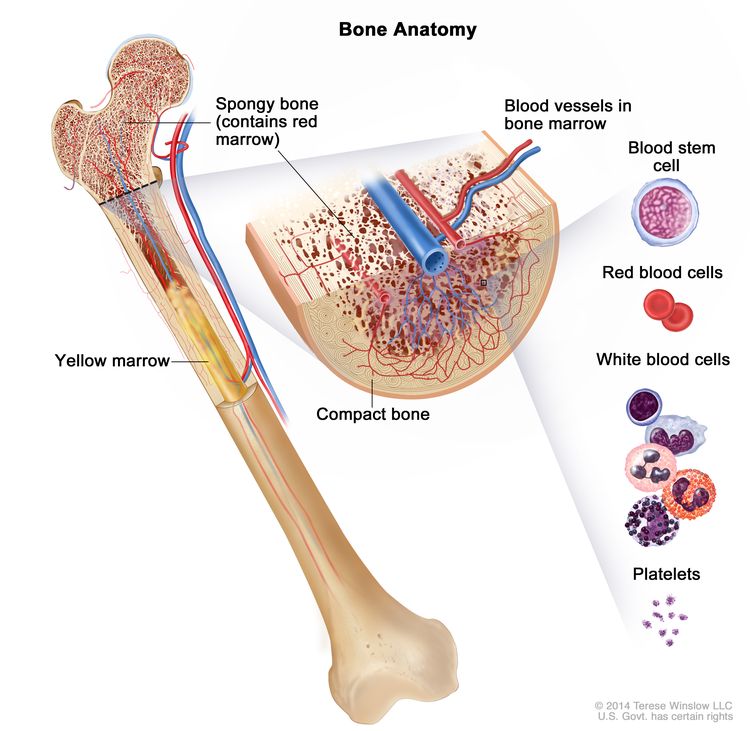
Research in the Treatment of Precursor Conditions

Multiple myeloma is a slow-growing cancer. It can develop silently for years without causing symptoms. The most common such precursor condition to multiple myeloma is called monoclonal gammopathy of undetermined significance, or MGUS. People with this condition have abnormal levels of certain blood markers. In some people, MGUS can progress to a condition called smoldering myeloma, which also doesn’t have symptoms. From there, it may turn into multiple myeloma. But it also may not cause full-blown cancer in a person’s lifetime.

Both MGUS and smoldering myeloma are usually found incidentally, by blood tests looking for other problems. If this happens, people are usually monitored and not given treatment right away. However, researchers have wondered if they can predict which people with MGUS or smoldering myeloma will eventually progress to myeloma. And, if progression can be predicted, would giving treatment before multiple myeloma develops help them live longer? Or would it only expose them to the side effects of treatment earlier without providing any benefit?

  • In a recent clinical trial called AQUILA, which was funded by the manufacturer of daratumumab, people with smoldering myeloma at high risk of progressing to multiple myeloma were randomly assigned to either receive the drug for up to 3 years or to undergo monitoring. Fewer patients receiving daratumumab progressed to multiple myeloma during the study, though they also experienced more side effects.
  • An ongoing trial at NCI is testing daratumumab as part of a multidrug regimen in people with smoldering myeloma at high risk of progressing to multiple myeloma.

NCI-Supported Research Programs

Many NCI-funded researchers working at the NIH campus and across the United States and the world are seeking ways to address multiple myeloma and other plasma cell neoplasms more effectively. Some research is basic, exploring questions as diverse as the biological underpinnings of cancer. And some is more clinical, seeking to translate this basic information into improving patient outcomes. The programs listed below are a small sampling of NCI’s research efforts in multiple myeloma and related plasma cell tumors.

The Multiple Myeloma Specialized Programs of Research Excellence (Myeloma SPOREs) are designed to quickly move basic scientific findings into clinical settings. The Myeloma SPOREs support the development of new treatments for multiple myeloma and related, rarer conditions such as Waldenstrom’s macroglobulinemia.

The National Clinical Trials Network funds clinical trials testing new treatments for multiple myeloma as well as precursor conditions such as smoldering myeloma. 

The Cancer Intervention and Surveillance Modeling Network (CISNET) is a consortium of NCI-sponsored investigators who use simulation modeling to improve our understanding of cancer control interventions in prevention, screening, and treatment and their effects on population trends in incidence and mortality. Investigators within CISNET’s Multiple Myeloma Working Group are developing such models to assess the value of guideline-recommended therapies and novel intervention strategies for myeloma prevention and control.

The Genomic Data Commons (GDC) provides the cancer research community with a unified repository and cancer knowledge base that enables data sharing across cancer genomic studies in support of precision medicine. The Multiple Myeloma Research Foundation has made genomic data from a large clinical trial of precision medicine for multiple myeloma, called The Relating Clinical Outcomes in Multiple Myeloma to Personal Assessment of Genetic Profile study (CoMMpassSM) available to the research community through the GDC.

Clinical Trials for Multiple Myeloma and Other Plasma Cell Cancers

NCI funds and oversees both early- and late-phase clinical trials to develop new treatments and improve patient care. Treatment clinical trials are available for multiple myeloma and other plasma cell cancers.

Multiple Myeloma Research Results

Plasma Cell Neoplasms (Including Multiple Myeloma)—Health Professional Version

Plasma Cell Neoplasms (Including Multiple Myeloma)—Health Professional Version

Causes & Prevention

NCI does not have PDQ evidence-based information about prevention of plasma cell neoplasms (including multiple myeloma).

Screening

NCI does not have PDQ evidence-based information about screening for plasma cell neoplasms (including multiple myeloma).

Supportive & Palliative Care

We offer evidence-based supportive and palliative care information for health professionals on the assessment and management of cancer-related symptoms and conditions.

Cancer Pain Nausea and Vomiting Nutrition in Cancer Care Transition to End-of-Life Care Last Days of Life View all Supportive and Palliative Care Summaries