Prostate-Specific Antigen (PSA) Test

What is the PSA test?

Prostate-specific antigen, or PSA, is a protein produced by normal, as well as malignant, cells of the prostate gland. Both prostate cancer and several benign conditions (particularly benign prostatic hyperplasia, or BPH, and prostatitis) can cause PSA levels in the blood to rise. 

The PSA test measures the level of PSA in the blood. This test is used in several different ways:

  • to monitor the progression of prostate cancer in men who have already been diagnosed with the disease
  • to follow up on prostate symptoms, such as painful or frequent urination, blood in urine or semen, and pelvic and/or back pain
  • to screen for prostate cancer in men who do not have symptoms of the disease

Is the PSA test recommended for prostate cancer screening?

The PSA test is not recommended for routine prostate cancer screening in the general population. It was used for this purpose for several decades, beginning in the late 1980s. But by around 2008, as more was learned about both the benefits and harms of prostate cancer screening, many professional medical organizations began to caution against routine population screening with the PSA test. Most organizations now recommend that individuals who are considering PSA screening first discuss the risks and benefits with their doctors before making a decision. 

Some organizations do recommend that men who are at higher risk of prostate cancer have routine PSA testing, beginning at age 40 or 45. Those at higher risk include Black men, men with inherited variants in BRCA2 (and to a lesser extent, in BRCA1), and men whose father or brother had prostate cancer.

The current recommendation of the United States Preventive Serves Task Force (USPSTF), which applies both to the general population and to those at increased risk due to race/ethnicity or family history, is as follows:

  • For individuals aged 55 to 69 years, the decision to undergo periodic PSA-based screening for prostate cancer should be an individual one. Before making the decision, a person should discuss the potential benefits and harms of screening with their clinician and consider these in the context of their own values and preferences.
  • PSA-based screening for prostate cancer is not recommended for individuals 70 years and older. 

Currently, Medicare provides coverage for an annual PSA test for all Medicare-eligible individuals over 50. Many private insurers cover PSA screening as well.

What is a normal PSA test result?

There is no single threshold that distinguishes a normal versus an abnormal PSA result. This is in part because there is no specific PSA level that means that someone has prostate cancer. However, the higher someone’s PSA level, the likelier it is that prostate cancer is present.

In general, a PSA level above 4.0 ng/mL is considered abnormal and may result in a recommendation for prostate biopsy. However, because PSA levels increase with age, some doctors apply a higher cutoff (such as 5 ng/ml) for older men and a lower cutoff ( such as 2.5 ng/mL) for younger men (1).

In addition, a lower cutoff for abnormal is used in men taking certain drugs, including finasteride and dutasteride, which are used to treat BPH. These drugs lower the PSA level.

Various factors can increase someone’s PSA level temporarily. An infection or inflammation of the prostate or having had a recent prostate biopsy can cause PSA levels to be raised for a month or two. Vigorous exercise (such as cycling) and ejaculation can also increase the PSA level transiently. People are generally recommended to wait until any conditions that can change PSA level resolve before they have testing and to avoid activities that may raise the PSA level for 2 days before testing.

What is done if a screening test shows an elevated PSA level?

If someone who has no symptoms of prostate cancer chooses to undergo prostate cancer screening and is found to have an abnormal PSA level, the doctor may recommend another PSA test in 6 to 8 weeks to confirm the original finding. If the PSA level is still elevated, the doctor may recommend continued observation with repeat PSA tests along with digital rectal exams (DREs) to watch for any changes over time.

If the PSA level continues to rise—especially if it rises quickly—or if a lump is detected during a DRE, the doctor may recommend additional tests. These may include additional blood- or urine-based tests, or imaging tests, such as magnetic resonance imaging (MRI) or high-resolution micro-ultrasound.

Alternatively, the doctor may recommend a prostate biopsy without further testing. During this procedure, multiple samples of prostate tissue are collected by inserting hollow needles into the prostate and then withdrawing them. The biopsy needle may be inserted through the wall of the rectum (transrectal biopsy) or through the perineum (transperineal biopsy). A pathologist then examines the collected tissue under a microscope. Although both biopsy techniques are guided by ultrasound imaging so the doctor can view the prostate during the biopsy procedure, ultrasound cannot be used alone to diagnose prostate cancer. An MRI-guided biopsy may be performed for patients with suspicious areas seen on MRI.

What are some of the potential benefits and harms of the PSA test for prostate cancer screening?

The potential benefit of the PSA test for prostate cancer screening is that it may help detect prostate cancer earlier, before it spreads and when it may be easier to treat, possibly reducing someone’s risk of dying from prostate cancer. 

A systematic review and meta-analysis of all randomized controlled trials comparing PSA screening with usual care in men without a diagnosis of prostate cancer concluded that PSA screening for prostate cancer leads to a small reduction in prostate cancer mortality over 10 years (2).

However, this potential benefit needs to be balanced against several potential harms:

  • Some cancers detected through PSA screening grow so slowly that they would never cause symptoms or become life threatening. However, treating them can cause harms. Detecting tumors that would not have caused problems during someone’s lifetime is called “overdiagnosis,” and treating them is called “overtreatment.”

    Overtreatment exposes a person unnecessarily to potential complications. These include urinary, bowel, and sexual side effects, such as leaking of urine following surgery; increased frequency and urgency of urination following radiation; loose stools or, less commonly, rectal bleeding, following radiation; and loss of erections or decreased erections, following both surgery and radiation.
     

  • Detecting prostate cancer earlier does not always result in cure. While the PSA test can help detect small tumors, some of these tumors, regardless of size, may have already spread beyond the prostate before being detected and may not be curable.
     
  • The PSA test may give false-positive results. A false-positive test result occurs when the PSA level is elevated but no cancer is present. A false-positive test result may create anxiety and lead to additional medical procedures, such as a prostate biopsy, that can be harmful. Possible side effects of biopsies include serious infections, pain, and bleeding.

    False-positive test results are common with PSA screening. About 6%–7% of men have a false-positive PSA test on any given screening round, and only about 25% of men who have a biopsy due to an elevated PSA level are found to have prostate cancer (3). 

The United States Preventive Services Task Force has estimated that, for every 1,000 men ages 55 to 69 years who are screened for 13 years (4):

  • About 1.3 deaths from prostate cancer would be avoided (or 1 death avoided per 769 men screened). Subsequent trial data showed that up to 2 deaths from prostate cancer would be avoided per every 1,000 men screened (or 1 death avoided in 570 men screened) (5).
  • 3 men would avoid developing metastatic cancer.
  • 5 men would die from prostate cancer despite having screening, diagnosis, and treatment.
  • 240 men would have a positive PSA test result, many of whom would have a biopsy that shows that the result was a false-positive; some men who had a biopsy would experience at least moderately bothersome symptoms (pain, bleeding, or infection) from the procedure (and 2 would be hospitalized).
  • 100 men would be diagnosed with prostate cancer. Of those, 80 would be treated (either immediately or after a period of active surveillance) with surgery or radiation. Many of these men would have a serious complication from treatment, with 50 experiencing sexual dysfunction and 15 experiencing urinary incontinence.
  • 200 men would die of causes other than prostate cancer.

How is the PSA test used in people who have been treated for prostate cancer?

The PSA test is used to monitor people after surgery or radiation therapy for prostate cancer to see if their cancer has recurred (come back). If a person’s PSA level begins to rise after prostate cancer treatment, it may be the first sign of a recurrence. Such a “biochemical relapse” typically appears months or years before the recurrence causes symptoms.

However, a single elevated PSA measurement in someone who has a history of prostate cancer does not always mean that the cancer has come back. Someone who has been treated for prostate cancer should discuss an elevated PSA level with their doctor. The doctor may recommend repeating the PSA test or performing other tests to check for evidence of a recurrence. The doctor may look for a trend of rising PSA level over time rather than a single elevated PSA level.

A rising trend in PSA level over time in combination with other findings, such as an abnormal result on imaging tests, may lead the doctor to recommend further cancer treatment.

How are researchers trying to improve the PSA test?

Scientists are investigating ways to improve the PSA test and to identify other potential biomarkers and imaging tests to help doctors better distinguish cancerous from benign conditions and slow-growing cancers from fast-growing, potentially lethal cancers. None of these tests has yet been proven to decrease the risk of death from prostate cancer. Some of the methods being studied include:

Blood-based tests. Tests that measure different characteristics of PSA in the blood may help

  • determine whether a prostate biopsy is needed (Prostate Health Index)
  • determine the risk of a high-grade prostate cancer requiring a biopsy (IsoPSA [6])
  • assess the risk of aggressive prostate cancer in someone with an abnormal prostate screening result (4Kscore test)

Urine-based tests. Tests that measure biomarkers in the urine may help

  • prevent an unnecessary biopsy among people with an elevated blood PSA (PCA3 mRNA and the TMPRSS2-ERG gene fusion in combination with PSA and the MPS2 test [7])
  • screen for prostate cancer (exosomal PCA3, SPDEF, and ERG RNA [ExoDx Prostate IntelliScore]; HOXC6 and DLX1 mRNA after an abnormal PSA and/or DRE [SelectMDx]; and small non-coding RNAs [Sentinel PCa Test])

Imaging tests. Tests that integrate magnetic resonance imaging (MRI) into PSA and biomarker screening are being studied to assess the risk of prostate cancer before a biopsy (8).
Prostate Cancer Prevention (PDQ®)–Patient Version

Prostate Cancer Prevention (PDQ®)–Patient Version

What is prevention?

Cancer prevention is action taken to lower the chance of getting cancer. By preventing cancer, the number of new cases of cancer in a group or population is lowered. Hopefully, this will lower the number of deaths caused by cancer.

To prevent new cancers from starting, scientists look at risk factors and protective factors. Anything that increases your chance of developing cancer is called a cancer risk factor; anything that decreases your chance of developing cancer is called a cancer protective factor.

Some risk factors for cancer can be avoided, but many cannot. For example, both smoking and inheriting certain genes are risk factors for some types of cancer, but only smoking can be avoided. Regular exercise and a healthy diet may be protective factors for some types of cancer. Avoiding risk factors and increasing protective factors may lower your risk but it does not mean that you will not get cancer.

Different ways to prevent cancer are being studied.

General Information About Prostate Cancer

Key Points

  • Prostate cancer is a disease in which malignant (cancer) cells form in the tissues of the prostate.
  • Prostate cancer is the second most common cancer among men in the United States.

Prostate cancer is a disease in which malignant (cancer) cells form in the tissues of the prostate.

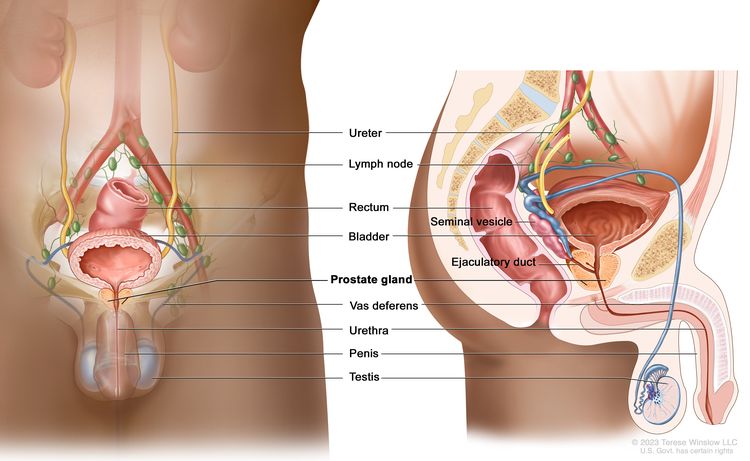
The prostate is a gland in the male reproductive system. The prostate is just below the bladder (the organ that collects and empties urine) and in front of the rectum (the lower part of the intestine). It is about the size of a walnut and surrounds part of the urethra (the tube that empties urine from the bladder). The prostate gland produces fluid that makes up part of the semen.

EnlargeDrawing of the male reproductive system and urinary system anatomy showing the front and side views of the ureters, bladder, prostate gland, vas deferens, urethra, penis, and testicles. A side view of the seminal vesicle and ejaculatory duct is also shown. The drawing also shows front and side views of the rectum and lymph nodes in the pelvis.
Anatomy of the male reproductive and urinary systems showing the ureters, bladder, prostate gland, urethra, penis, testicles, and other organs.

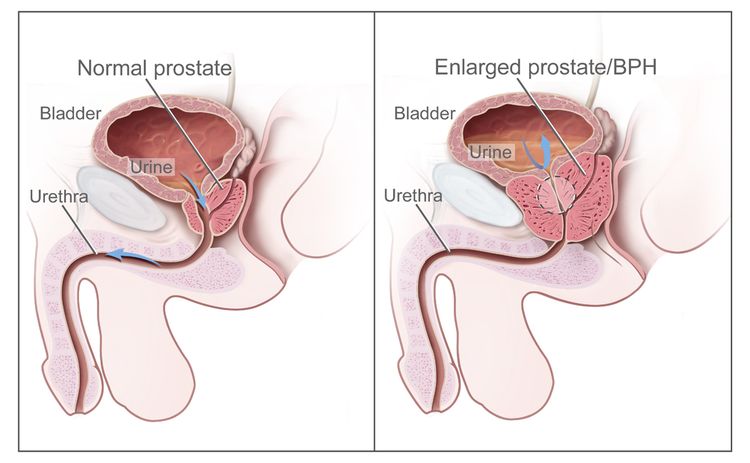
As men age, the prostate may get bigger. A bigger prostate may block the flow of urine from the bladder and cause problems with sexual function. This condition is called benign prostatic hyperplasia (BPH). BPH is not cancer, but surgery may be needed to correct it. The symptoms of BPH or of other problems in the prostate may be like symptoms of prostate cancer.

EnlargeTwo-panel drawing shows normal male reproductive and urinary anatomy and benign prostatic hyperplasia (BPH). Panel on the left shows the normal prostate and flow of urine from the bladder through the urethra. Panel on the right shows an enlarged prostate pressing on the bladder and urethra, blocking the flow of urine.
Normal prostate and benign prostatic hyperplasia (BPH). A normal prostate does not block the flow of urine from the bladder. An enlarged prostate presses on the bladder and urethra and blocks the flow of urine.

Prostate cancer is the second most common cancer among men in the United States.

Prostate cancer is most common in older men. In the United States, about one out of every eight men will be diagnosed with prostate cancer. Most men diagnosed with prostate cancer do not die of it.

See the following PDQ summaries for more information about prostate cancer:

Prostate Cancer Prevention

Key Points

  • Avoiding risk factors and increasing protective factors may help prevent cancer.
  • The following risk factors may increase the risk of prostate cancer:
    • Age
    • Family history of prostate cancer
    • Race
    • Hormones
    • Vitamin E
    • Folic acid
    • Dairy and calcium
  • The following protective factors may decrease the risk of prostate cancer:
    • Folate
    • Finasteride and dutasteride
  • The following have been proven not to affect the risk of prostate cancer, or their effects on prostate cancer risk are not known:
    • Selenium and vitamin E
    • Diet
    • Multivitamins
    • Lycopene
  • Cancer prevention clinical trials are used to study ways to prevent cancer.
  • New ways to prevent prostate cancer are being studied in clinical trials.

Avoiding risk factors and increasing protective factors may help prevent cancer.

Avoiding cancer risk factors may help prevent certain cancers. Risk factors include smoking, having overweight, and not getting enough exercise. Increasing protective factors such as quitting smoking and exercising may also help prevent some cancers. Talk to your doctor or other health care professional about how you might lower your risk of cancer.

The following risk factors may increase the risk of prostate cancer:

Age

Prostate cancer is rare in men younger than 50 years of age. The chance of developing prostate cancer increases as men get older.

Family history of prostate cancer

A man whose father, brother, or son has had prostate cancer has a higher-than-average risk of prostate cancer.

Race

Prostate cancer occurs more often in African American men than in White men. African American men with prostate cancer are more likely to die from the disease than White men with prostate cancer.

Hormones

The prostate needs male hormones to work the way it should. The main male sex hormone is testosterone. Testosterone helps the body develop and maintain male sex characteristics.

Testosterone is changed into dihydrotestosterone (DHT) by an enzyme in the body. DHT is important for normal prostate growth but can also cause the prostate to get bigger and may play a part in the development of prostate cancer.

Vitamin E

The Selenium and Vitamin E Cancer Prevention Trial (SELECT) found that vitamin E taken alone increased the risk of prostate cancer. The risk continued even after the men stopped taking vitamin E.

Folic acid

Folate is a kind of vitamin B that occurs naturally in some foods, such as green vegetables, beans, and orange juice. Folic acid is a man-made form of folate that is found in vitamin supplements and fortified foods, such as whole-grain breads and cereals. A 10-year study showed that the risk of prostate cancer was increased in men who took 1 milligram (mg) supplements of folic acid. However, the risk of prostate cancer was lower in men who had enough folate in their diets.

Dairy and calcium

A diet high in dairy foods and calcium may cause a small increase in the risk of prostate cancer.

The following protective factors may decrease the risk of prostate cancer:

Folate

Folate is a kind of vitamin B that occurs naturally in some foods, such as green vegetables, beans, and orange juice. Folic acid is a man-made form of folate that is found in vitamin supplements and fortified foods, such as whole-grain breads and cereals. A 10-year study showed that the risk of prostate cancer was lower in men who had enough folate in their diets. However, the risk of prostate cancer was increased in men who took 1 milligram (mg) supplements of folic acid.

Finasteride and dutasteride

Finasteride and dutasteride are drugs used to lower the amount of male sex hormones made by the body. These drugs block the enzyme that changes testosterone into dihydrotestosterone (DHT). Higher than normal levels of DHT may play a part in developing prostate cancer. Taking finasteride or dutasteride has been shown to lower the risk for prostate cancer, but it is not known if these drugs lower the risk of death from prostate cancer.

The Prostate Cancer Prevention Trial (PCPT) studied whether the drug finasteride can prevent prostate cancer in healthy men 55 years of age and older. This prevention study showed there were fewer prostate cancers in the group of men that took finasteride compared with the group of men that did not. The number of deaths from prostate cancer was the same in both groups. Men who took finasteride reported more side effects compared with the group of men that did not, including erectile dysfunction, loss of desire for sex, and enlarged breasts. In the PCPT, the men who took finasteride who did have prostate cancer had more aggressive tumors, but a follow-up analysis of the PCPT found that these men did not have more aggressive tumors.

The Reduction by Dutasteride of Prostate Cancer Events Trial (REDUCE) studied whether the drug dutasteride can prevent prostate cancer in men aged 50 to 75 years at higher risk for the disease. This prevention study showed there were fewer prostate cancers in the group of men who took dutasteride compared with the group of men that did not. The number of less aggressive prostate cancers was lower, but the number of more aggressive prostate cancers was not. Men who took dutasteride reported more side effects than men who did not, including erectile dysfunction, loss of desire for sex, less semen, and enlarged breasts.

The following have been proven not to affect the risk of prostate cancer, or their effects on prostate cancer risk are not known:

Selenium and vitamin E

The Selenium and Vitamin E Cancer Prevention Trial (SELECT) studied whether taking vitamin E and selenium (a mineral) will prevent prostate cancer. The selenium and vitamin E were taken separately or together by healthy men 55 years of age and older (50 years of age and older for African American men). The study showed that taking selenium alone or selenium and vitamin E together did not decrease the risk of prostate cancer.

Diet

It is not known if decreasing fat or increasing fruits and vegetables in the diet helps decrease the risk of prostate cancer or death from prostate cancer. In the PCPT trial, certain fatty acids increased the risk of high-grade prostate cancer while others decreased the risk of high-grade prostate cancer.

Multivitamins

Regular use of multivitamins has not been proven to increase the risk of early or localized prostate cancer. However, a large study showed an increased risk of advanced prostate cancer among men who took multivitamins more than seven times a week.

Lycopene

Some studies have shown that a diet high in lycopene may be linked to a decreased risk of prostate cancer, but other studies have not. It has not been proven that taking lycopene supplements decreases the risk of prostate cancer.

Cancer prevention clinical trials are used to study ways to prevent cancer.

Cancer prevention clinical trials are used to study ways to lower the risk of developing certain types of cancer. Some cancer prevention trials are conducted with healthy people who have not had cancer but who have an increased risk for cancer. Other prevention trials are conducted with people who have had cancer and are trying to prevent another cancer of the same type or to lower their chance of developing a new type of cancer. Other trials are done with healthy volunteers who are not known to have any risk factors for cancer.

The purpose of some cancer prevention clinical trials is to find out whether actions people take can prevent cancer. These may include eating fruits and vegetables, exercising, quitting smoking, or taking certain medicines, vitamins, minerals, or food supplements.

New ways to prevent prostate cancer are being studied in clinical trials.

Information about clinical trials supported by NCI can be found on NCI’s clinical trials search webpage. Clinical trials supported by other organizations can be found on the ClinicalTrials.gov website.

About This PDQ Summary

About PDQ

Physician Data Query (PDQ) is the National Cancer Institute’s (NCI’s) comprehensive cancer information database. The PDQ database contains summaries of the latest published information on cancer prevention, detection, genetics, treatment, supportive care, and complementary and alternative medicine. Most summaries come in two versions. The health professional versions have detailed information written in technical language. The patient versions are written in easy-to-understand, nontechnical language. Both versions have cancer information that is accurate and up to date and most versions are also available in Spanish.

PDQ is a service of the NCI. The NCI is part of the National Institutes of Health (NIH). NIH is the federal government’s center of biomedical research. The PDQ summaries are based on an independent review of the medical literature. They are not policy statements of the NCI or the NIH.

Purpose of This Summary

This PDQ cancer information summary has current information about prostate cancer prevention. It is meant to inform and help patients, families, and caregivers. It does not give formal guidelines or recommendations for making decisions about health care.

Reviewers and Updates

Editorial Boards write the PDQ cancer information summaries and keep them up to date. These Boards are made up of experts in cancer treatment and other specialties related to cancer. The summaries are reviewed regularly and changes are made when there is new information. The date on each summary (“Updated”) is the date of the most recent change.

The information in this patient summary was taken from the health professional version, which is reviewed regularly and updated as needed, by the PDQ Screening and Prevention Editorial Board.

Clinical Trial Information

A clinical trial is a study to answer a scientific question, such as whether one treatment is better than another. Trials are based on past studies and what has been learned in the laboratory. Each trial answers certain scientific questions in order to find new and better ways to help cancer patients. During treatment clinical trials, information is collected about the effects of a new treatment and how well it works. If a clinical trial shows that a new treatment is better than one currently being used, the new treatment may become “standard.” Patients may want to think about taking part in a clinical trial. Some clinical trials are open only to patients who have not started treatment.

Clinical trials can be found online at NCI’s website. For more information, call the Cancer Information Service (CIS), NCI’s contact center, at 1-800-4-CANCER (1-800-422-6237).

Permission to Use This Summary

PDQ is a registered trademark. The content of PDQ documents can be used freely as text. It cannot be identified as an NCI PDQ cancer information summary unless the whole summary is shown and it is updated regularly. However, a user would be allowed to write a sentence such as “NCI’s PDQ cancer information summary about breast cancer prevention states the risks in the following way: [include excerpt from the summary].”

The best way to cite this PDQ summary is:

PDQ® Screening and Prevention Editorial Board. PDQ Prostate Cancer Prevention. Bethesda, MD: National Cancer Institute. Updated <MM/DD/YYYY>. Available at: /types/prostate/patient/prostate-prevention-pdq. Accessed <MM/DD/YYYY>. [PMID: 26389260]

Images in this summary are used with permission of the author(s), artist, and/or publisher for use in the PDQ summaries only. If you want to use an image from a PDQ summary and you are not using the whole summary, you must get permission from the owner. It cannot be given by the National Cancer Institute. Information about using the images in this summary, along with many other images related to cancer can be found in Visuals Online. Visuals Online is a collection of more than 3,000 scientific images.

Disclaimer

The information in these summaries should not be used to make decisions about insurance reimbursement. More information on insurance coverage is available on Cancer.gov on the Managing Cancer Care page.

Contact Us

More information about contacting us or receiving help with the Cancer.gov website can be found on our Contact Us for Help page. Questions can also be submitted to Cancer.gov through the website’s E-mail Us.

Prostate Cancer Prevention (PDQ®)–Health Professional Version

Prostate Cancer Prevention (PDQ®)–Health Professional Version

Overview

Note: The Overview section summarizes the published evidence on this topic. The rest of the summary describes the evidence in more detail.

Other PDQ summaries on Prostate Cancer Screening; Prostate Cancer Treatment; and Levels of Evidence for Cancer Screening and Prevention Studies are also available.

Benefits From Finasteride and Dutasteride Chemoprevention

Chemoprevention with finasteride and dutasteride reduces the incidence of prostate cancer, but the evidence is inadequate to determine whether chemoprevention with finasteride or dutasteride reduces mortality from prostate cancer.

Magnitude of Effect: In the Prostate Cancer Prevention Trial (PCPT), absolute reduction in incidence for more than 7 years with finasteride as compared with placebo was 6% (18.4% with finasteride and 24.4% with placebo); relative risk reduction (RRR) for incidence was 24.8% (95% confidence interval [CI], 18.6%–30.6%). With long-term follow-up (median, 18.4 years), prostate cancer mortality was not statistically different between men in the placebo and finasteride groups of PCPT (hazard ratio [HR], finasteride vs. placebo, 0.75; 95% CI, 0.50–1.12). Long-term follow-up (median, 16 years) of PCPT participants found that with 7 years of finasteride therapy, there was a 21.1% relative reduction in risk of prostate cancer.[1]

In the Reduction by Dutasteride of Prostate Cancer Events (REDUCE) randomized trial of dutasteride versus placebo, using the restricted crude rate, the absolute risk reduction was 5.1% at 4 years, and the RRR was 22.8% (95% CI, 15.2%–29.8%; P < .001). There was no difference in prostate cancer or overall mortality, although the number of deaths was small and none were due to prostate cancer. The reduction in prostate cancer incidence occurred primarily in Gleason score 5 to 6 cancers.[2] That the reduction in incidence was primarily in less aggressive cancers (i.e., Gleason score 5–6) and not in more aggressive cancers (i.e., Gleason score 7–10) raises the question of whether this reduction in incidence would lead to any reduction in mortality. This question is presently unanswered.

  • Study Design: Two randomized controlled trials; one for finasteride and one for dutasteride.
  • Internal Validity: Good for the outcome of incidence, poor for the outcome of mortality.
  • Consistency: Good.
  • External Validity: The studies focused on different populations. The finasteride trial enrolled men with a prostate-specific antigen (PSA) of less than 3 ng/mL, constituting the majority of U.S. men, but those with a lower risk of cancer. In the dutasteride trial, men were at somewhat higher risk, with a PSA of 2.5 to 10.0 ng/mL and a prior negative biopsy. As such, results are generalizable primarily to these respective populations.

Harms From Finasteride and Dutasteride Chemoprevention

Finasteride

Men in the finasteride group had statistically significantly more erectile dysfunction, loss of libido, and gynecomastia than men in the placebo group. Men in the finasteride group had a statistically significant higher incidence of high-grade (Gleason score 7–10) cancers during the study than did men in the placebo group (relative risk, 1.27; 95% CI, 1.07–1.50).[3] Subsequent studies showed that diagnostic tests (PSA, prostate digital rectal exam, and prostate biopsy) had improved performance for detection of cancer and of high-grade cancer in men who received finasteride.[46] Long-term follow-up in the finasteride trial (PCPT) found no increased risk of prostate cancer mortality (HR, finasteride vs. placebo, 0.75; 95% CI, 0.50–1.12).

Magnitude of Effect: Statistically significant increases in the following outcomes were observed in the finasteride group (a greater fraction of men in the finasteride group [36.8%] temporarily discontinued treatment at some time during the study for reasons other than death or a diagnosis of prostate cancer than in the placebo group [28.9%]):

  • Percentage in finasteride group versus percentage in placebo group:
    • Reduced volume of ejaculate (60.4% vs. 47.3%).
    • Erectile dysfunction (67.4% vs. 61.5%).
    • Loss of libido (65.4% vs. 59.6%).
    • Gynecomastia (4.5% vs. 2.8%).
  • Study Design: Two randomized controlled trials; one for finasteride and one for dutasteride.
  • Internal Validity: Good: The finasteride trial used two subject-completed sexual functioning instruments administered at enrollment, randomization, 6 months, and annually over the 7-year study. The dutasteride trial administered a sexual functioning instrument after completion of placebo run-in and annually thereafter.
  • Consistency: Good (evidence other than the randomized controlled trial supports these effects).
  • External Validity: As above, the studies evaluated two different populations: PSA less than or equal to 3 ng/mL in the finasteride trial and PSA of 2.5 to 10.0 ng/mL with a prior negative biopsy in the REDUCE trial. The results are most generalizable to these two populations.

Dutasteride

Overall, 4.3% of men in the dutasteride group compared with 2% of men in the placebo group discontinued the trial because of drug-related adverse events (P < .001). Men in the dutasteride group had a higher incidence of decreased libido, loss of libido, decreased semen volume, erectile dysfunction, and gynecomastia than men in the placebo group.[2]

Magnitude of Effect: Increases in the following outcomes were observed in the dutasteride group:

  • Percentage in dutasteride group versus percentage in placebo group:
    • Decreased libido (3.3% vs. 1.6%).
    • Loss of libido (1.9% vs. 1.3%).
    • Decreased semen volume (1.4% vs. 0.2%).
    • Erectile dysfunction (9.0% vs. 5.7%).
    • Gynecomastia (1.9% vs. 1.0%).

U.S. Food and Drug Administration (FDA) Review of Finasteride and Dutasteride

The Oncology Drugs Advisory Committee of the FDA examined both finasteride and dutasteride in 2010. Neither agent was recommended for use for chemoprevention of prostate cancer.

Other Prevention Interventions

The Selenium and Vitamin E Cancer Prevention Trial (SELECT [NCT00006392]) was a large randomized placebo-controlled trial of vitamin E and selenium. It showed no reduction in prostate cancer period prevalence, but an increased risk of prostate cancer with vitamin E alone.[7]

Magnitude of Effect: Compared with the placebo group in which 529 men developed prostate cancer, there was a statistically significant increase in prostate cancer in the vitamin E group (620 cases) but not in the selenium plus vitamin E group (555 cases) or in the selenium group (575 cases). The magnitude of increase in prostate cancer risk with vitamin E alone was 17%.

  • Study Design for Vitamin E and Selenium: Randomized, placebo-controlled trial of selenium (200 µg/d from L-selenomethionine), vitamin E (400 IU/d of all-rac-[alpha]-tocopheryl acetate), or both.
  • Internal Validity: Good.
  • Consistency: Good.
  • External Validity: Good.
References
  1. Unger JM, Hershman DL, Till C, et al.: Using Medicare Claims to Examine Long-term Prostate Cancer Risk of Finasteride in the Prostate Cancer Prevention Trial. J Natl Cancer Inst 110 (11): 1208-1215, 2018. [PUBMED Abstract]
  2. Andriole GL, Bostwick DG, Brawley OW, et al.: Effect of dutasteride on the risk of prostate cancer. N Engl J Med 362 (13): 1192-202, 2010. [PUBMED Abstract]
  3. Thompson IM, Goodman PJ, Tangen CM, et al.: The influence of finasteride on the development of prostate cancer. N Engl J Med 349 (3): 215-24, 2003. [PUBMED Abstract]
  4. Thompson IM, Chi C, Ankerst DP, et al.: Effect of finasteride on the sensitivity of PSA for detecting prostate cancer. J Natl Cancer Inst 98 (16): 1128-33, 2006. [PUBMED Abstract]
  5. Thompson IM, Tangen CM, Goodman PJ, et al.: Finasteride improves the sensitivity of digital rectal examination for prostate cancer detection. J Urol 177 (5): 1749-52, 2007. [PUBMED Abstract]
  6. Lucia MS, Epstein JI, Goodman PJ, et al.: Finasteride and high-grade prostate cancer in the Prostate Cancer Prevention Trial. J Natl Cancer Inst 99 (18): 1375-83, 2007. [PUBMED Abstract]
  7. Klein EA, Thompson IM, Tangen CM, et al.: Vitamin E and the risk of prostate cancer: the Selenium and Vitamin E Cancer Prevention Trial (SELECT). JAMA 306 (14): 1549-56, 2011. [PUBMED Abstract]

Incidence and Mortality of Prostate Cancer

Carcinoma of the prostate is the most common tumor in men in the United States (other than skin cancer), with an estimated 313,780 new cases and 35,770 deaths expected in 2025.[1] A wide range of estimates of the impact of the disease are notable. The disease is histologically evident in as many as 34% of men in their fifth decade and in up to 70% of men aged 80 years and older.[2,3] The lifetime risk of being diagnosed with prostate cancer for U.S. men is 12.8%, while the lifetime risk of dying from prostate cancer is 2.0%.[4] The estimated reduction in life expectancy of men who die of prostate cancer is approximately 9 years.[5]

The extraordinarily high rate of clinically occult prostate cancer in the general population compared with the 20-fold lower likelihood of death from the disease indicates that many of these cancers have low biological risk. Concordant with this observation are the many series of patients with lower-risk (i.e., Gleason grade 6 and some low-volume Gleason grade 7 tumors) prostate cancer managed by surveillance alone with high survival rates at 5 and 10 years of follow-up.[6] Data demonstrate, however, that with longer follow-up, higher-grade cancers are associated with a greater risk of prostate cancer death.[7,8]

Because of marked variability in tumor differentiation from one microscopic field to another, many pathologists will report the range of differentiation among the malignant cells that are present in a biopsy using the Gleason grading system. This grading system includes five histological patterns distinguished by the glandular architecture of the cancer. The architectural patterns are identified and assigned a grade from 1 to 5 with 1 being the most differentiated and 5 being the least differentiated. The sum of the grades of the predominant and next most prevalent will range from 2 (well-differentiated tumors) to 10 (undifferentiated tumors).[9,10] Systematic changes to the histological interpretation of biopsy specimens by anatomical pathologists have occurred during the prostate-specific antigen (PSA) screening era (i.e., since about 1985) in the United States.[11] This phenomenon, sometimes called grade inflation, is the apparent increase in the distribution of high-grade tumors in the population for a period of time but in the absence of a true biological or clinical change. It is possibly the result of an increasing tendency for pathologists to read tumor grade as more aggressive, resulting in a higher preponderance to treat these cancers aggressively.[12] In general, these changes in interpretation have resulted in almost all prostate cancers being graded with Gleason grades of 3, 4, or 5; Gleason grades of 1 or 2 are highly unusual.

Treatment options available for prostate cancer include radical prostatectomy, external-beam radiation therapy, brachytherapy, cryotherapy, focal ablation, androgen deprivation with luteinizing hormone-releasing hormone analogs and/or antiandrogens, intermittent androgen deprivation, cytotoxic agents, and watchful waiting. Of all the means of management, only radical prostatectomy has been tested in a randomized clinical trial to assess survival benefit. In this study, prostatectomy was found to be superior to surveillance in men with localized prostate cancer, diagnosed in an era before widespread PSA screening. There were reduced rates of prostate cancer mortality (relative risk [RR], 0.56; 95% confidence interval [CI], 0.41–0.77) and overall mortality (RR, 0.71; 95% CI, 0.59–0.86).[13] Only 12% of the men had nonpalpable T1x tumors, suggesting that a minority of tumors were detected by PSA screening, whereas the majority were clinically detected. The relative efficacy of radical prostatectomy compared with other forms of treatment has not been adequately addressed.[14] Previous studies that compared radical prostatectomy with radiation therapy and brachytherapy closed because of poor patient accrual. Confounding issues in the treatment of prostate cancer include side effects of treatment, inability to predict the natural history of a given cancer, patient comorbidity that may affect an individual’s likelihood of surviving long enough to be at risk of disease morbidity and mortality, and an increasing body of evidence suggesting that, with careful PSA monitoring following treatment, a substantial fraction of patients may suffer disease recurrence.[15]

Because of considerable uncertainty regarding the efficacy of treatment and the difficulty with selecting patients for whom there is a known risk of disease progression, opinion in the medical community is divided regarding screening for carcinoma of the prostate. While both digital rectal examination and PSA screening have demonstrated reasonable performance characteristics (sensitivity, specificity, and positive predictive value) for the early detection of prostate cancer, conflicting outcomes of randomized trials examining the impact of screening on mortality has led some organizations to recommend for and others to recommend against screening.[16]

The tremendous impact of prostate cancer on the U.S. population and the financial burden of the disease for both patients and society have led to an increased interest in primary disease prevention.

The main treatment modalities for prostate cancer are surgery, radiation, hormonal, and active surveillance. For a detailed discussion, see Prostate Cancer Treatment. The goal of prostate cancer prevention interventions is to reduce the occurrence of prostate cancer, thereby obviating the need for treatment. As the effectiveness of prevention interventions improves, it is expected that the need for treatment will diminish.

References
  1. American Cancer Society: Cancer Facts and Figures 2025. American Cancer Society, 2025. Available online. Last accessed January 16, 2025.
  2. Sakr WA, Haas GP, Cassin BF, et al.: The frequency of carcinoma and intraepithelial neoplasia of the prostate in young male patients. J Urol 150 (2 Pt 1): 379-85, 1993. [PUBMED Abstract]
  3. Hølund B: Latent prostatic cancer in a consecutive autopsy series. Scand J Urol Nephrol 14 (1): 29-35, 1980. [PUBMED Abstract]
  4. Surveillance Research Program, National Cancer Institute: SEER*Explorer: An interactive website for SEER cancer statistics. Bethesda, MD: National Cancer Institute. Available online. Last accessed December 30, 2024.
  5. Horm JW, Sondik EJ: Person-years of life lost due to cancer in the United States, 1970 and 1984. Am J Public Health 79 (11): 1490-3, 1989. [PUBMED Abstract]
  6. Cooperberg MR, Carroll PR, Klotz L: Active surveillance for prostate cancer: progress and promise. J Clin Oncol 29 (27): 3669-76, 2011. [PUBMED Abstract]
  7. Lu-Yao GL, Albertsen PC, Moore DF, et al.: Outcomes of localized prostate cancer following conservative management. JAMA 302 (11): 1202-9, 2009. [PUBMED Abstract]
  8. Jones CU, Hunt D, McGowan DG, et al.: Radiotherapy and short-term androgen deprivation for localized prostate cancer. N Engl J Med 365 (2): 107-18, 2011. [PUBMED Abstract]
  9. Gleason DF, Mellinger GT: Prediction of prognosis for prostatic adenocarcinoma by combined histological grading and clinical staging. J Urol 111 (1): 58-64, 1974. [PUBMED Abstract]
  10. Gleason DF: Histologic grading and clinical staging of prostatic carcinoma. In: Tannenbaum M: Urologic Pathology: The Prostate. Lea and Febiger, 1977, pp 171-197.
  11. Albertsen PC, Hanley JA, Barrows GH, et al.: Prostate cancer and the Will Rogers phenomenon. J Natl Cancer Inst 97 (17): 1248-53, 2005. [PUBMED Abstract]
  12. Thompson IM, Canby-Hagino E, Lucia MS: Stage migration and grade inflation in prostate cancer: Will Rogers meets Garrison Keillor. J Natl Cancer Inst 97 (17): 1236-7, 2005. [PUBMED Abstract]
  13. Bill-Axelson A, Holmberg L, Garmo H, et al.: Radical Prostatectomy or Watchful Waiting in Prostate Cancer – 29-Year Follow-up. N Engl J Med 379 (24): 2319-2329, 2018. [PUBMED Abstract]
  14. Middleton RG, Thompson IM, Austenfeld MS, et al.: Prostate Cancer Clinical Guidelines Panel Summary report on the management of clinically localized prostate cancer. The American Urological Association. J Urol 154 (6): 2144-8, 1995. [PUBMED Abstract]
  15. Moul JW: Prostate specific antigen only progression of prostate cancer. J Urol 163 (6): 1632-42, 2000. [PUBMED Abstract]
  16. Carter HB, Albertsen PC: Re: Relative value of race, family history and prostate specific antigen as indications for early initiation of prostate cancer screening. J Urol 193 (3): 1063-4; discussion 1064, 2015. [PUBMED Abstract]

Risk Factors for Prostate Cancer Development

Age

Prostate cancer incidence escalates with increasing age. Although it is an unusual disease in men younger than 50 years, incidence rates increase substantially thereafter. Data from the Surveillance, Epidemiology and End Results (SEER) program for 2017 to 2021 showed that incidence rates for prostate cancer were 109.6 per 100,000 for men aged 50 to 54 years, 251.3 per 100,000 for men aged 55 to 59 years, 440.5 per 100,000 for men aged 60 to 64 years, and 693.2 per 100,000 for men aged 65 to 69 years. After age 70 years, incidence rates stabilized or decreased modestly. From 2018 to 2022, mortality rates showed a greater increasing trend with age than did incidence, increasing from 2.8 per 100,000 for men aged 50 to 54 years to 39.1 per 100,000 for men aged 65 to 69 years to 209.7 per 100,000 for men aged 80 to 84 years.[1]

Family History

Approximately 15% of men with a diagnosis of prostate cancer will be found to have a first-degree relative (e.g., brother, father) with prostate cancer, compared with approximately 8% of the U.S. population.[2] Approximately 9% of all prostate cancers may result from heritable susceptibility genes.[3] Several authors have completed segregation analyses, and though a single, rare autosomal gene has been suggested to cause cancer in some of these families, the burden of evidence suggests that the inheritance is considerably more complex.[46] Evidence from the Prostate Cancer Prevention Trial (PCPT) and Selenium and Vitamin E Cancer Prevention Trial suggest that physician and patient bias lead to a greater likelihood of prostate biopsy, which contributes significantly to the increased risk of prostate cancer diagnosis in men with a family history of the disease.[7]

Hormones

The development of the prostate is dependent upon the secretion of dihydrotestosterone (DHT) by the fetal testis. Testosterone causes normal virilization of the Wolffian duct structures and internal genitalia and is acted upon by the enzyme 5-alpha-reductase (5AR) to form DHT. DHT has a 4-fold to 50-fold greater affinity for the androgen receptor than testosterone, and it is DHT that leads to normal prostatic development. Children born with abnormal 5AR (due to a change in a single base pair in exon 5 of the normal type II 5AR gene), are born with ambiguous genitalia (variously described as hypospadias with a blind-ending vagina to a small phallus) but masculinize at puberty because of the surge of testosterone production at that time. Clinical, imaging, and histological studies of kindreds born with 5AR deficiency have demonstrated a small, pancake-appearing prostate with an undetectable prostate-specific antigen (PSA) level and no evidence of prostatic epithelium.[8] Long-term follow-up demonstrates that neither benign prostatic hyperplasia (BPH) nor prostate cancer develop.

Other evidence suggesting that the degree of cumulative exposure of the prostate to androgens is related to an increased risk of prostate cancer includes the following:

  1. Neither BPH nor prostate cancer have been reported in men castrated prior to puberty.[9]
  2. Androgen deprivation in almost all forms leads to involution of the prostate, a fall in PSA levels, apoptosis of prostate cancer and epithelial cells, and a clinical response in prostate cancer patients.[10,11]
  3. The results of two large-scale chemoprevention trials using 5AR inhibitors (finasteride and dutasteride) demonstrate that intraprostatic androgens modulate prostate cancer risk. In both studies, reductions in overall prostate cancer risk were identified although with increased risk of high-grade disease.[12,13]

Ecological studies have found a correlation between serum levels of testosterone, especially DHT, and overall risk of prostate cancer among African American, White, and Japanese males.[1416] However, evidence from prospective studies of the association between serum concentrations of sex hormones, including androgens and estrogens, does not support a direct link.[17] A collaborative analysis of 18 prospective studies, pooling prediagnostic measures on 3,886 men with incident prostate cancer and 6,438 control subjects, found no association between the risk of prostate cancer and serum concentrations of testosterone, calculated-free testosterone, DHT sulfate, androstenedione, androstanediol glucuronide, estradiol, or calculated-free estradiol.[17] A caution for interpreting the data is the unknown degree of correlation between serum levels and prostate tissue level. Androstanediol glucuronide may most closely reflect intraprostatic androgen activity, and this measure was not associated with the risk of prostate cancer. This lack of association affirms that risk stratification cannot be made on serum hormone concentrations.

Race

The risk of developing and dying of prostate cancer is higher among Black men (Hispanic and non-Hispanic), is of intermediate levels among White men (Hispanic and non-Hispanic), and is lowest among native Japanese men.[1,18] Conflicting data have been published regarding the etiology of these outcomes, but some evidence is available that access to health care may play a role in disease outcomes.[19] According to the Surveillance, Epidemiology, and End Results (SEER) Program, incidence of prostate cancer in African American men exceeds those of White men at all ages.[20]

Dietary Fat

An interesting observation is that although the incidence of latent (occult, histologically evident) prostate cancer is similar throughout the world, clinical prostate cancer varies from country to country by as much as 20-fold.[21] Previous ecological studies have demonstrated a direct relationship between a country’s prostate cancer-specific mortality rate and average total calories from fat consumed by the country’s population.[22,23] Studies of immigrants from Japan have demonstrated that native Japanese have the lowest risk of clinical prostate cancer, first-generation Japanese American men have an intermediate risk, and subsequent generations have a risk comparable to the U.S. population.[24,25] Animal models of explanted human prostate cancer have demonstrated decreased tumor growth rates in animals who are fed a low-fat diet.[26,27] Evidence from many case-control studies has shown an association between dietary fat and prostate cancer risk,[2830] although studies have not uniformly reached this conclusion.[3133] In a review of published studies of the relationship between dietary fat and prostate cancer risk, among descriptive studies, approximately half found an increased risk with increased dietary fat and half found no association.[34] Among case-control studies, about half of the studies found an increased risk with increasing dietary fat, animal fat, and saturated and monounsaturated fat intake while approximately half found no association. Only in studies of polyunsaturated fat intake were three studies reported of a significant negative association between prostate cancer and fat intake. Fat of animal origin seems to be associated with the highest risk.[19,35] In a series of 384 patients with prostate cancer, the risk of cancer progression to an advanced stage was greater in men with a high fat intake.[36] The announcement in 1996 that cancer mortality rates had fallen in the United States prompted the suggestion that this may be caused by decreases in dietary fat intake during the same time period.[37,38]

Two studies were conducted within the PCPT in which prospective nutritional information was collected and all participants were recommended to undergo biopsy. Findings included that among 9,559 participants, there was no association between any supplement or nutrient (including fat) and risk of prostate cancer overall, but the risk of high-grade cancer was associated with high intake of polyunsaturated fats. In a subset of 1,658 cases and 1,803 controls, specific fatty acids were examined, and docosahexaenoic acid was associated with risk of high-grade disease while trans-fatty acids (TFA) 18:1 and TFA 18:2 were inversely associated with risk of high-grade disease. These large-scale studies suggest a complex relationship between nutrients such as fat and risk of prostate cancer.[39,40]

The explanation for this possible association between prostate cancer and dietary fat is unknown. Several hypotheses have been advanced, including the following:

  1. Dietary fat may increase serum androgen levels, thereby increasing prostate cancer risk. This hypothesis is supported by observations from South Africa and the United States that changes in dietary fat intake change urinary and serum levels of androgens.[41,42]
  2. Certain types of fatty acids or their metabolites may initiate or promote prostate carcinoma development. The evidence for this hypothesis is conflicting, but one study suggests that linoleic acid (omega-6 polyunsaturated fatty acid) may stimulate prostate cancer cells, while omega-3 fatty acids inhibit cell growth.[43]
  3. An observation made in an animal model is that male offspring of pregnant rats who are fed a high-fat diet will develop prostate cancer at a higher rate than animals who are fed a low-fat diet.[44] This observation may explain some of the variations in prostate cancer incidence and mortality among ethnic groups; an observation has been made that first trimester androgen levels in pregnant Black men are higher than those in White men.[45]

Dairy and Calcium Intake

A meta-analysis of ten cohort studies (eight from the United States and two from Europe) concluded that men with the highest intake of dairy products (relative risk [RR], 1.11; 95% confidence interval [CI], 1.00–1.22; P = .04) and calcium (RR, 1.39; 95% CI, 1.09–1.77; P = .18) were more likely to develop prostate cancer than men with the lowest intake. The pooled RRs of advanced prostate cancer were 1.33 (95% CI, 1.00–1.78; P = .055) for the highest versus lowest intake categories of dairy products and 1.46 (95% CI, 0.65–3.25; P > .2) for the highest versus lowest intake categories of calcium. High intake of dairy products and calcium may be associated with an increased risk of prostate cancer, although the increase may be small.[46]

Multivitamin Use

Regular multivitamin use has not been associated with the risk of early or localized prostate cancer. However, in this large (295,344 men) study, there was a statistically significantly increased risk of advanced and fatal prostate cancer among men with excessive use of multivitamins.[47]

Folate

The Aspirin/Folate Polyp Prevention Study, a placebo-controlled randomized trial of aspirin and folic acid supplementation for the chemoprevention of colorectal adenomas, was conducted between July 6, 1994, and December 31, 2006. In a secondary analysis, the authors addressed the effect of folic acid supplementation on the risk of prostate cancer. Participants were followed for up to 10.8 (median, 7.0; interquartile range, 6.0–7.8) years and asked periodically to report all illnesses and hospitalizations.[48] Supplementation with 1 mg of folic acid was associated with an increased risk of prostate cancer. However, dietary and plasma levels among nonmultivitamin users were inversely associated with risk. These findings highlight the potentially complex role of folate in prostate carcinogenesis.[48,49]

Cadmium Exposure

Cadmium exposure is occupationally associated with nickel-cadmium batteries and cadmium recovery plant smelters and is associated with cigarette smoke.[50] The earliest studies of this agent documented an apparent association with prostate cancer, but better-designed studies have failed to note an association.[51,52]

Dioxin Exposure

Dioxin (2,3,7,8 tetrachlorodibenzo-p-dioxin or TCDD) is a contaminant of an herbicide used in Vietnam. This agent is similar to many components of herbicides used in farming. A review of the linkage between dioxin and prostate cancer risk, by the National Academy of Sciences Institute of Medicine Committee to Review the Health Effects in Vietnam Veterans of Exposure to Herbicides, found only two articles on prostate cancer with sufficient numbers of cases and follow-up to allow analysis.[53,54] The analysis of all available data suggests that the association between dioxin exposure and prostate cancer is not conclusive.[55]

Prostatitis

Several case-control and cohort studies, as well as two meta-analyses, suggested a significant but modest increase in the risk of prostate cancer in men with prostatitis (RR, 1.6) and in those with a history of syphilis or gonorrhea (RR, 1.4).[56,57] However, PSA values can be elevated with prostatitis, leading to more prostate biopsies and a greater likelihood of making the diagnosis of cancer. This is an example of ascertainment bias, and this bias can be significant in prostate cancer. Any factor associated with an elevation in serum PSA would be expected to lead to more biopsies being performed, and consequently an artifactual elevation in prostate cancer diagnoses. Despite a significant body of work relating inflammation to cancer, a cause and effect relationship has not been established between prostatitis and prostate cancer.[56,57]

References
  1. Surveillance Research Program, National Cancer Institute: SEER*Explorer: An interactive website for SEER cancer statistics. Bethesda, MD: National Cancer Institute. Available online. Last accessed December 30, 2024.
  2. Steinberg GD, Carter BS, Beaty TH, et al.: Family history and the risk of prostate cancer. Prostate 17 (4): 337-47, 1990. [PUBMED Abstract]
  3. Grönberg H, Isaacs SD, Smith JR, et al.: Characteristics of prostate cancer in families potentially linked to the hereditary prostate cancer 1 (HPC1) locus. JAMA 278 (15): 1251-5, 1997. [PUBMED Abstract]
  4. Carter BS, Steinberg GD, Beaty TH, et al.: Familial risk factors for prostate cancer. Cancer Surv 11: 5-13, 1991. [PUBMED Abstract]
  5. Schaid DJ, McDonnell SK, Blute ML, et al.: Evidence for autosomal dominant inheritance of prostate cancer. Am J Hum Genet 62 (6): 1425-38, 1998. [PUBMED Abstract]
  6. Bauer JJ, Srivastava S, Connelly RR, et al.: Significance of familial history of prostate cancer to traditional prognostic variables, genetic biomarkers, and recurrence after radical prostatectomy. Urology 51 (6): 970-6, 1998. [PUBMED Abstract]
  7. Tangen CM, Goodman PJ, Till C, et al.: Biases in Recommendations for and Acceptance of Prostate Biopsy Significantly Affect Assessment of Prostate Cancer Risk Factors: Results From Two Large Randomized Clinical Trials. J Clin Oncol 34 (36): 4338-4344, 2016. [PUBMED Abstract]
  8. Imperato-McGinley J, Gautier T, Zirinsky K, et al.: Prostate visualization studies in males homozygous and heterozygous for 5 alpha-reductase deficiency. J Clin Endocrinol Metab 75 (4): 1022-6, 1992. [PUBMED Abstract]
  9. Isaacs JT: Hormonal balance and the risk of prostatic cancer. J Cell Biochem Suppl 16H: 107-8, 1992. [PUBMED Abstract]
  10. Peters CA, Walsh PC: The effect of nafarelin acetate, a luteinizing-hormone-releasing hormone agonist, on benign prostatic hyperplasia. N Engl J Med 317 (10): 599-604, 1987. [PUBMED Abstract]
  11. Kyprianou N, Isaacs JT: Expression of transforming growth factor-beta in the rat ventral prostate during castration-induced programmed cell death. Mol Endocrinol 3 (10): 1515-22, 1989. [PUBMED Abstract]
  12. Andriole GL, Bostwick DG, Brawley OW, et al.: Effect of dutasteride on the risk of prostate cancer. N Engl J Med 362 (13): 1192-202, 2010. [PUBMED Abstract]
  13. Thompson IM, Goodman PJ, Tangen CM, et al.: The influence of finasteride on the development of prostate cancer. N Engl J Med 349 (3): 215-24, 2003. [PUBMED Abstract]
  14. Ellis L, Nyborg H: Racial/ethnic variations in male testosterone levels: a probable contributor to group differences in health. Steroids 57 (2): 72-5, 1992. [PUBMED Abstract]
  15. Ross RK, Bernstein L, Lobo RA, et al.: 5-alpha-reductase activity and risk of prostate cancer among Japanese and US white and black males. Lancet 339 (8798): 887-9, 1992. [PUBMED Abstract]
  16. Wu AH, Whittemore AS, Kolonel LN, et al.: Serum androgens and sex hormone-binding globulins in relation to lifestyle factors in older African-American, white, and Asian men in the United States and Canada. Cancer Epidemiol Biomarkers Prev 4 (7): 735-41, 1995 Oct-Nov. [PUBMED Abstract]
  17. Roddam AW, Allen NE, Appleby P, et al.: Endogenous sex hormones and prostate cancer: a collaborative analysis of 18 prospective studies. J Natl Cancer Inst 100 (3): 170-83, 2008. [PUBMED Abstract]
  18. Bunker CH, Patrick AL, Konety BR, et al.: High prevalence of screening-detected prostate cancer among Afro-Caribbeans: the Tobago Prostate Cancer Survey. Cancer Epidemiol Biomarkers Prev 11 (8): 726-9, 2002. [PUBMED Abstract]
  19. Optenberg SA, Thompson IM, Friedrichs P, et al.: Race, treatment, and long-term survival from prostate cancer in an equal-access medical care delivery system. JAMA 274 (20): 1599-605, 1995 Nov 22-29. [PUBMED Abstract]
  20. Cancer incidence in the United States (SEER) age-specific rates. In: Harras A, Edwards BK, Blot WJ, eds.: Cancer Rates and Risks. 4th ed. National Cancer Institute, 1996, pp 22.
  21. Wynder EL, Mabuchi K, Whitmore WF: Epidemiology of cancer of the prostate. Cancer 28 (2): 344-60, 1971. [PUBMED Abstract]
  22. Armstrong B, Doll R: Environmental factors and cancer incidence and mortality in different countries, with special reference to dietary practices. Int J Cancer 15 (4): 617-31, 1975. [PUBMED Abstract]
  23. Rose DP, Connolly JM: Dietary fat, fatty acids and prostate cancer. Lipids 27 (10): 798-803, 1992. [PUBMED Abstract]
  24. Haenszel W, Kurihara M: Studies of Japanese migrants. I. Mortality from cancer and other diseases among Japanese in the United States. J Natl Cancer Inst 40 (1): 43-68, 1968. [PUBMED Abstract]
  25. Shimizu H, Ross RK, Bernstein L, et al.: Cancers of the prostate and breast among Japanese and white immigrants in Los Angeles County. Br J Cancer 63 (6): 963-6, 1991. [PUBMED Abstract]
  26. Wang Y, Corr JG, Thaler HT, et al.: Decreased growth of established human prostate LNCaP tumors in nude mice fed a low-fat diet. J Natl Cancer Inst 87 (19): 1456-62, 1995. [PUBMED Abstract]
  27. Connolly JM, Coleman M, Rose DP: Effects of dietary fatty acids on DU145 human prostate cancer cell growth in athymic nude mice. Nutr Cancer 29 (2): 114-9, 1997. [PUBMED Abstract]
  28. Ross RK, Shimizu H, Paganini-Hill A, et al.: Case-control studies of prostate cancer in blacks and whites in southern California. J Natl Cancer Inst 78 (5): 869-74, 1987. [PUBMED Abstract]
  29. Kolonel LN, Yoshizawa CN, Hankin JH: Diet and prostatic cancer: a case-control study in Hawaii. Am J Epidemiol 127 (5): 999-1012, 1988. [PUBMED Abstract]
  30. Whittemore AS, Kolonel LN, Wu AH, et al.: Prostate cancer in relation to diet, physical activity, and body size in blacks, whites, and Asians in the United States and Canada. J Natl Cancer Inst 87 (9): 652-61, 1995. [PUBMED Abstract]
  31. Giovannucci E: Epidemiologic characteristics of prostate cancer. Cancer 75 (Suppl 7): 1766-77, 1995.
  32. Mettlin C, Selenskas S, Natarajan N, et al.: Beta-carotene and animal fats and their relationship to prostate cancer risk. A case-control study. Cancer 64 (3): 605-12, 1989. [PUBMED Abstract]
  33. Severson RK, Nomura AM, Grove JS, et al.: A prospective study of demographics, diet, and prostate cancer among men of Japanese ancestry in Hawaii. Cancer Res 49 (7): 1857-60, 1989. [PUBMED Abstract]
  34. Zhou JR, Blackburn GL: Bridging animal and human studies: what are the missing segments in dietary fat and prostate cancer? Am J Clin Nutr 66 (6 Suppl): 1572S-1580S, 1997. [PUBMED Abstract]
  35. Rose DP, Boyar AP, Wynder EL: International comparisons of mortality rates for cancer of the breast, ovary, prostate, and colon, and per capita food consumption. Cancer 58 (11): 2363-71, 1986. [PUBMED Abstract]
  36. Bairati I, Meyer F, Fradet Y, et al.: Dietary fat and advanced prostate cancer. J Urol 159 (4): 1271-5, 1998. [PUBMED Abstract]
  37. Cole P, Rodu B: Declining cancer mortality in the United States. Cancer 78 (10): 2045-8, 1996. [PUBMED Abstract]
  38. Wynder EL, Cohen LA: Correlating nutrition to recent cancer mortality statistics. J Natl Cancer Inst 89 (4): 324, 1997. [PUBMED Abstract]
  39. Kristal AR, Till C, Platz EA, et al.: Serum lycopene concentration and prostate cancer risk: results from the Prostate Cancer Prevention Trial. Cancer Epidemiol Biomarkers Prev 20 (4): 638-46, 2011. [PUBMED Abstract]
  40. Kristal AR, Arnold KB, Neuhouser ML, et al.: Diet, supplement use, and prostate cancer risk: results from the prostate cancer prevention trial. Am J Epidemiol 172 (5): 566-77, 2010. [PUBMED Abstract]
  41. Hill P, Wynder EL, Garbaczewski L, et al.: Diet and urinary steroids in black and white North American men and black South African men. Cancer Res 39 (12): 5101-5, 1979. [PUBMED Abstract]
  42. Hämäläinen E, Adlercreutz H, Puska P, et al.: Diet and serum sex hormones in healthy men. J Steroid Biochem 20 (1): 459-64, 1984. [PUBMED Abstract]
  43. Rose DP, Connolly JM: Effects of fatty acids and eicosanoid synthesis inhibitors on the growth of two human prostate cancer cell lines. Prostate 18 (3): 243-54, 1991. [PUBMED Abstract]
  44. Kondo Y, Homma Y, Aso Y, et al.: Promotional effect of two-generation exposure to a high-fat diet on prostate carcinogenesis in ACI/Seg rats. Cancer Res 54 (23): 6129-32, 1994. [PUBMED Abstract]
  45. Henderson BE, Bernstein L, Ross RK, et al.: The early in utero oestrogen and testosterone environment of blacks and whites: potential effects on male offspring. Br J Cancer 57 (2): 216-8, 1988. [PUBMED Abstract]
  46. Gao X, LaValley MP, Tucker KL: Prospective studies of dairy product and calcium intakes and prostate cancer risk: a meta-analysis. J Natl Cancer Inst 97 (23): 1768-77, 2005. [PUBMED Abstract]
  47. Lawson KA, Wright ME, Subar A, et al.: Multivitamin use and risk of prostate cancer in the National Institutes of Health-AARP Diet and Health Study. J Natl Cancer Inst 99 (10): 754-64, 2007. [PUBMED Abstract]
  48. Figueiredo JC, Grau MV, Haile RW, et al.: Folic acid and risk of prostate cancer: results from a randomized clinical trial. J Natl Cancer Inst 101 (6): 432-5, 2009. [PUBMED Abstract]
  49. Kristal AR, Lippman SM: Nutritional prevention of cancer: new directions for an increasingly complex challenge. J Natl Cancer Inst 101 (6): 363-5, 2009. [PUBMED Abstract]
  50. Pienta KJ: Epidemiology and etiology of prostate cancer. In: Raghavan D, Scher HI, Leibel SA, eds.: Principles and Practice of Genitourinary Oncology. Lippincott-Raven Publishers, 1997, pp 379-385.
  51. García Sánchez A, Antona JF, Urrutia M: Geochemical prospection of cadmium in a high incidence area of prostate cancer, Sierra de Gata, Salamanca, Spain. Sci Total Environ 116 (3): 243-51, 1992. [PUBMED Abstract]
  52. Boffetta P: Methodological aspects of the epidemiological association between cadmium and cancer in humans. In: Nordberg GF, Herber RF, Alessio L, eds.: Cadmium in the Human Environment: Toxicity and Carcinogenicity. Lyon, France: International Agency for Research on Cancer, 1992, pp 425-434.
  53. Fingerhut MA, Halperin WE, Marlow DA, et al.: Cancer mortality in workers exposed to 2,3,7,8-tetrachlorodibenzo-p-dioxin. N Engl J Med 324 (4): 212-8, 1991. [PUBMED Abstract]
  54. Bertazzi PA, Zocchetti C, Pesatori AC, et al.: Ten-year mortality study of the population involved in the Seveso incident in 1976. Am J Epidemiol 129 (6): 1187-200, 1989. [PUBMED Abstract]
  55. Committee to Review the Health Effects in Vietnam Veterans of Exposure to Herbicides: Veterans and Agent Orange: Update 1996. In: Washington DC, National Academy Press, 1996.
  56. Dennis LK, Dawson DV: Meta-analysis of measures of sexual activity and prostate cancer. Epidemiology 13 (1): 72-9, 2002. [PUBMED Abstract]
  57. Dennis LK, Lynch CF, Torner JC: Epidemiologic association between prostatitis and prostate cancer. Urology 60 (1): 78-83, 2002. [PUBMED Abstract]

Opportunities for Prevention

Hormonal Prevention

The Prostate Cancer Prevention Trial (PCPT), a large randomized placebo-controlled trial of finasteride (an inhibitor of alpha-reductase), was performed in 18,882 men aged 55 years or older. At 7 years, the incidence of prostate cancer was 18.4% in the finasteride group versus 24.4% in the placebo group, a relative risk reduction (RRR) of 24.8% (95% confidence interval [CI], 18.6%–30.6%; P < .001). The finasteride group had more patients with Gleason grade 7 to 10, but the clinical significance of Gleason scoring is uncertain in conditions of androgen deprivation.[1] High-grade cancers (Gleason score 7–10) were noted in 6.4% of finasteride patients, compared with 5.1% of men who received placebo, yielding a relative risk (RR) of 1.27 (95% CI, 1.07–1.50). The increase in high-grade tumors was seen within 1 year of finasteride exposure and did not increase during this time period.[2]

Finasteride decreases the risk of prostate cancer but may also alter the detection of disease through effects on prostate-specific antigen (PSA), prostate digital rectal examination (DRE), and decreased prostate volume (24%), creating a detection bias.[3] Adjustment of PSA in men taking finasteride preserves the performance characteristics for cancer detection.[4]

Examination of the outcomes of the PCPT found that finasteride significantly reduced the risk of high-grade prostatic intraepithelial neoplasia (HGPIN); HGPIN alone was reduced by 15% (RR, 0.85; 95% CI, 0.73–0.99) and HGPIN with prostate cancer was reduced by 31% (RR, 0.69; 95% CI, 0.56–0.85).[3,5] The concern that finasteride may increase the risk of high-grade cancer prompted an examination of the rate of cancer development in the PCPT. While a gradual and progressive increase in the number of high-grade tumors would have been expected over the study duration of 7 years, when compared with placebo, this was not the case. The increase in high-grade tumors was seen within 1 year of finasteride exposure and did not increase during this time period.[2] An analysis of the PCPT data adjusted for the sources of detection bias found that finasteride reduced the incidence of Gleason score 5 to 7 and Gleason score 3 to 4 prostate cancer, but not Gleason score 2 to 3 or Gleason score 8 to 10. The reduction in the incidence of Gleason score 7 (22%) was less than the reduction in the incidence of Gleason 5 score (58%) and Gleason score 6 (52%).[6] An analysis using different methodologies found an overall reduction of both low-grade (Gleason score <6) and high-grade (Gleason score >7) cancers.[7]

A follow-up analysis of the PCPT of finasteride mapped study participants with the National Death Index, allowing for an analysis of prostate cancer-specific mortality. With 296,842 person-years of follow-up and a median follow-up of 18.4 years, of the 9,423 men randomly assigned to the finasteride group, there were 3,048 deaths of which 42 were caused by prostate cancer; of the 9,457 men randomly assigned to the placebo group, there were 2,979 deaths of which 56 were caused by prostate cancer. The 25% reduction in risk of prostate cancer death with finasteride was not statistically significant (hazard ratio, finasteride vs. placebo, 0.75; 95% CI, 0.50–1.12). It was concluded that the early concern for an increased risk of high-grade prostate cancer with finasteride was not borne out. In this study, it was notable that, of the 61 prostate cancer deaths for which original Gleason grading was available, 23 (38%) of the prostate cancer deaths were seen in men whose original biopsy Gleason grade was less than or equal to 6.[8]

A retrospective, population-based, cohort study from the U.S. Department of Veterans Affairs health care system examined the impact of 5-alpha reductase inhibitor (5-ARI) use before prostate cancer diagnosis on prostate cancer-specific mortality.[9] The authors found that prediagnostic use of 5-ARIs was associated with a delayed diagnosis (median time from first elevated PSA was 3.6 years for men who received 5-ARIs versus 1.4 years for non–5-ARI users) and worsened cancer-specific outcomes (e.g., higher grade, higher clinical stage, more with positive nodes, and higher rates of metastatic disease) in men with prostate cancer. A subsequent letter to the editor pointed out the following challenges with the analysis:

  1. A 39% improvement in prostate cancer mortality with a 2-year earlier diagnosis and with only 5.9 years of follow-up is implausible, given that the very best reduction in prostate cancer mortality in a randomized clinical trial was 20%.
  2. Because the study could not assess 5-ARI medication adherence, PSA misadjustment was a serious concern.
  3. Because men treated with 5-ARIs are very different than those not treated (i.e., more urinary symptoms, older, larger prostates, etc.), major differences in baseline characteristics, as reported in the study, prevented adequate adjustment in outcomes.
  4. As demonstrated by the PCPT, because finasteride (a 5-ARI) prevents a substantial proportion of low-grade tumors, a greater proportion of high-grade tumors would be expected.
  5. Because national treatment guidelines recommend 5-ARIs for men with larger prostates, which have higher PSA values, and as prostate cancers are more commonly missed in larger prostates (and may be identified at a subsequent biopsy, often with a magnetic resonance imaging-directed biopsy), a later diagnosis would be common in this patient population.
  6. The authors’ analysis did not adjust for survival bias; men not receiving a 5-ARI had an earlier diagnosis, and therefore, an inherent longer survival.

When taken together, these biases call into question the conclusions, which appear to be at odds with the prostate cancer–specific mortality outcomes of the randomized PCPT.

The Reduction by Dutasteride of Prostate Cancer Events (REDUCE) trial randomly assigned 8,231 men aged 50 to 75 years at higher risk of prostate cancer (i.e., PSA 2.5–10.0 ng/mL) with one recent negative prostate biopsy to dutasteride at 0.5 mg daily or to placebo. The primary end point was prostate cancer diagnosed by prostate biopsy at 2 years and 4 years after randomization. After 4 years, among the 6,729 men (82% of initial population) who had at least one prostate biopsy, 25.1% of the placebo group and 19.9% of the dutasteride group had been diagnosed with prostate cancer, a statistically significant difference (absolute risk reduction, 5.1% and RRR, 22.8% [95% CI, 15.2%–29.8%]). The RRR in years 3 to 4 was similar to the RRR in years 1 to 2. The difference between the groups was entirely due to a reduction in prostate cancers with Gleason score 5 to 7. For years 3 to 4 there was a statistically significant increase in the dutasteride group compared with the placebo group in prostate cancers with Gleason score 8 to 10 (12 cancers in the dutasteride group vs. 1 cancer in the placebo group).[10]

Overall, there was no statistically significant difference in high-grade tumors for Gleason score 8 to 10 cancers in years 1 to 4 (29 tumors in the dutasteride group vs. 19 tumors in the placebo group, 0.9% vs. 0.6%; P = .15). However, in a retrospective analysis there was a statistically significant difference between years 3 to 4. Because this is a small retrospective subgroup, the finding of an increase in Gleason score 8 to 10 cancers is of uncertain validity. However, the finding of no reduction in these cancers is more significant.[10]

While long-term data are unavailable for dutasteride as a cancer prevention agent, evidence is now available that finasteride does not have a significant effect on overall survival or prostate cancer–specific survival. Its effect is primarily in preventing the diagnosis of prostate cancer and the subsequent events (staging, treatment, follow-up, and management of treatment-related side effects) after diagnosis.

Agents that are used for hormonal therapy of existing prostate cancers would be unsuitable for prostate cancer chemoprevention because of the cost and wide variety of side effects including sexual dysfunction, osteoporosis, and vasomotor symptoms (hot flushes).[11] Newer antiandrogens may play a role as preventive agents in the future.[12]

A Cochrane systematic review of all published studies of clinical outcome investigations of the prostate preventive effects of 5-ARIs through 2010 that were at least 1 year in duration concluded that finasteride and dutasteride reduce the risk of being diagnosed with prostate cancer among men who are screened regularly for prostate cancer. The review also concluded that mortality effects could not be assessed from these studies and that persistent use of these agents increased sexual and erectile dysfunction. The review was based on MEDLINE and Cochrane Collaboration Library computerized searches through June 2010 using the Medical Subject Headings terms and text words finasteride, dutasteride, neoplasms, azasteroids, reductase inhibitors, and enzyme inhibitors to identify randomized trials. Eight studies met the inclusion criteria. Only the PCPT and the REDUCE study were designed to assess the impact of 5-ARIs on prostate cancer period prevalence. Reviews of all eight studies concluded that compared with placebo, 5-ARIs resulted in 25% RR reduction in prostate cancers detected for cause (RR, 0.75; 95% CI, 0.67–0.83 and 1.4% absolute risk reduction [3.5% vs. 4.9%]). Six trials of 5-ARIs versus placebo assessed prostate cancers detected overall. Among these there was a 26% RR reduction favoring 5-ARIs (RR, 0.74; 95% CI, 0.55–1.00 and 2.9% absolute risk reduction [6.3% vs. 9.2%]). There were reductions across age, race, and family history. One placebo-controlled trial of men considered at greater risk for prostate cancer based on age, elevated PSA, and previous suspicion of prostate cancer leading to a prostate biopsy reported that dutasteride did not reduce prostate cancers detected for cause based on needle biopsy but did reduce risk of overall incident prostate cancer detected by biopsy by 23% (RR, 0.77; 95% CI, 0.7–0.85 and absolute risk reduction, 16.1% vs. 20.8%). There were reductions across age, family history of prostate cancer, PSA level, and prostate volume subgroups. The Cochrane review defined for cause cancers as follows:

  1. Suspected clinically from symptoms, abnormal DRE, or PSA and confirmed on biopsy.
  2. Study protocol recommended biopsy, but it was not done and the end-of-study biopsy showed prostate cancer.
  3. The end-of-study biopsy with PSA less than 4 ng/mL and/or suspicious DRE showed prostate cancer.[13]

Dietary Prevention With Fruit, Vegetables, and a Low-fat Diet

Results from studies of the association between dietary intake of fruits and vegetables and risk of prostate cancer are not consistent. A study evaluated 1,619 prostate cancer cases and 1,618 controls in a multicenter, multiethnic population. The study found that intake of legumes and yellow-orange and cruciferous vegetables was associated with a lower risk of prostate cancer.

The European Prospective Investigation into Cancer and Nutrition examined the association between fruit and vegetable intake and subsequent prostate cancer. After an average follow-up of 4.8 years, 1,104 men developed prostate cancer among the 130,544 male participants. No statistically significant associations were observed for fruit intake, vegetable intake, cruciferous vegetable intake, or the intake of fruits and vegetables combined.[14]

One study of dietary intervention over a 4-year period with reduced fat and increased consumption of fruit, vegetables, and fiber had no impact on serum PSA levels.[15] It is unknown whether dietary modification through the use of a low-fat, plant-based diet will reduce prostate cancer risk. While this outcome is unknown, multiple additional benefits may be observed in patients following such a diet, including a lower risk of hyperlipidemia, better control of blood pressure, and a lower risk of cardiovascular disease—all of which may merit adoption of such a diet.

Chemoprevention

While several agents, including alpha-tocopherol, selenium, lycopene, difluoromethylornithine,[1620] vitamin D,[2123] and isoflavonoids,[24,25] have shown potential in either clinical or laboratory studies for chemoprevention of prostate cancer. However, the correlations of cancer prevention with these agents are increasingly of concern given the statistically significant increased risk of prostate cancer with alpha-tocopherol in the Selenium and Vitamin E Cancer Prevention Trial (SELECT) and the lack of preventive effect (actually, a nonsignificant increase in prostate cancer risk) with selenium.

Chemoprevention with selenium and vitamin E

The SELECT (NCT00006392) was a large randomized placebo-controlled trial of vitamin E and selenium. It showed no reduction in prostate cancer period prevalence, but an increased risk of prostate cancer with vitamin E alone.[26]

Compared with the placebo group in which 529 men developed prostate cancer, there was a statistically significant increase in prostate cancer in the vitamin E group (620 cases), but not in the selenium plus vitamin E group (555 cases) or in the selenium group (575 cases). The magnitude of increase in prostate cancer risk with vitamin E alone was 17%. Of interest, the statistically increased risk of prostate cancer among men receiving vitamin E was seen after study supplements had been discontinued suggesting a longer-term effect of this agent.[26]

Chemoprevention with lycopene

Evidence exists that a diet with a high intake of fruits and vegetables is associated with a lower risk of cancer. Which, if any, micronutrients may account for this reduction is unknown. One group of nutrients often postulated as having chemoprevention properties is the carotenoids. Lycopene is the predominant circulating carotenoid in Americans and has a number of potential activities, including an antioxidant effect.[27] It is encountered in a number of vegetables, most notably tomatoes, and is best absorbed if these products are cooked and in the presence of dietary fats or oils.

The earliest studies of the association of lycopene and prostate cancer risk were generally negative before 1995 with only one study of 180 case-control patients showing a reduced risk.[2831] In 1995, an analysis of the Physicians’ Health Study found a one-third reduction in prostate cancer risk in the group of men with the highest consumption of tomato products when compared with the group with the lowest level of consumption, which was attributed to the lycopene content of these vegetables.[32] This large analysis prompted several subsequent studies, the results of which were mixed.[33,34] A review of the published data concluded that the evidence is weak that lycopene is associated with a reduced risk because previous studies were not controlled for total vegetable intake (i.e., separating the effect of tomatoes from vegetables), dietary intake instruments are poorly able to quantify lycopene intake, and other potential biases.[35] Specific dietary supplementation with lycopene remains to be demonstrated to reduce prostate cancer risk. In the largest prospective study to date, the PCPT, lycopene was not associated with any reduction in risk of prostate cancer among 9,559 men studied. Similarly, there was no relationship between lycopene serum concentrations and risk of prostate cancer.[36,37]

References
  1. Thompson IM, Goodman PJ, Tangen CM, et al.: The influence of finasteride on the development of prostate cancer. N Engl J Med 349 (3): 215-24, 2003. [PUBMED Abstract]
  2. Thompson IM, Klein EA, Lippman SM, et al.: Prevention of prostate cancer with finasteride: US/European perspective. Eur Urol 44 (6): 650-5, 2003. [PUBMED Abstract]
  3. Andriole G, Bostwick D, Civantos F, et al.: The effects of 5alpha-reductase inhibitors on the natural history, detection and grading of prostate cancer: current state of knowledge. J Urol 174 (6): 2098-104, 2005. [PUBMED Abstract]
  4. Etzioni RD, Howlader N, Shaw PA, et al.: Long-term effects of finasteride on prostate specific antigen levels: results from the prostate cancer prevention trial. J Urol 174 (3): 877-81, 2005. [PUBMED Abstract]
  5. Thompson IM, Lucia MS, Redman MW, et al.: Finasteride decreases the risk of prostatic intraepithelial neoplasia. J Urol 178 (1): 107-9; discussion 110, 2007. [PUBMED Abstract]
  6. Kaplan SA, Roehrborn CG, Meehan AG, et al.: PCPT: Evidence that finasteride reduces risk of most frequently detected intermediate- and high-grade (Gleason score 6 and 7) cancer. Urology 73 (5): 935-9, 2009. [PUBMED Abstract]
  7. Redman MW, Tangen CM, Goodman PJ, et al.: Finasteride does not increase the risk of high-grade prostate cancer: a bias-adjusted modeling approach. Cancer Prev Res (Phila Pa) 1 (3): 174-81, 2008. [PUBMED Abstract]
  8. Goodman PJ, Tangen CM, Darke AK, et al.: Long-Term Effects of Finasteride on Prostate Cancer Mortality. N Engl J Med 380 (4): 393-394, 2019. [PUBMED Abstract]
  9. Sarkar RR, Parsons JK, Bryant AK, et al.: Association of Treatment With 5α-Reductase Inhibitors With Time to Diagnosis and Mortality in Prostate Cancer. JAMA Intern Med 179 (6): 812-819, 2019. [PUBMED Abstract]
  10. Andriole GL, Bostwick DG, Brawley OW, et al.: Effect of dutasteride on the risk of prostate cancer. N Engl J Med 362 (13): 1192-202, 2010. [PUBMED Abstract]
  11. Thompson I, Feigl P, Coltman C: Chemoprevention of prostate cancer with finasteride. Important Adv Oncol : 57-76, 1995. [PUBMED Abstract]
  12. Nelson PS, Gleason TP, Brawer MK: Chemoprevention for prostatic intraepithelial neoplasia. Eur Urol 30 (2): 269-78, 1996. [PUBMED Abstract]
  13. Wilt TJ, Macdonald R, Hagerty K, et al.: 5-α-Reductase inhibitors for prostate cancer chemoprevention: an updated Cochrane systematic review. BJU Int 106 (10): 1444-51, 2010. [PUBMED Abstract]
  14. Key TJ, Allen N, Appleby P, et al.: Fruits and vegetables and prostate cancer: no association among 1104 cases in a prospective study of 130544 men in the European Prospective Investigation into Cancer and Nutrition (EPIC). Int J Cancer 109 (1): 119-24, 2004 Mar10. [PUBMED Abstract]
  15. Shike M, Latkany L, Riedel E, et al.: Lack of effect of a low-fat, high-fruit, -vegetable, and -fiber diet on serum prostate-specific antigen of men without prostate cancer: results from a randomized trial. J Clin Oncol 20 (17): 3592-8, 2002. [PUBMED Abstract]
  16. Heby O: Role of polyamines in the control of cell proliferation and differentiation. Differentiation 19 (1): 1-20, 1981. [PUBMED Abstract]
  17. Danzin C, Jung MJ, Grove J, et al.: Effect of alpha-difluoromethylornithine, an enzyme-activated irreversible inhibitor of ornithine decarboxylase, on polyamine levels in rat tissues. Life Sci 24 (6): 519-24, 1979. [PUBMED Abstract]
  18. Metcalf BW, Bey P, Danzin C, et al.: Catalytic irreversible inhibition of mammalian ornithine decarboxylase (E.C. 4.1.1.17) by substrate and product analogues. J Am Chem Soc 100(8): 2551-2553, 1978.
  19. Heston WD, Kadmon D, Lazan DW, et al.: Copenhagen rat prostatic tumor ornithine decarboxylase activity (ODC) and the effect of the ODC inhibitor alpha-difluoromethylornithine. Prostate 3 (4): 383-9, 1982. [PUBMED Abstract]
  20. Abeloff MD, Slavik M, Luk GD, et al.: Phase I trial and pharmacokinetic studies of alpha-difluoromethylornithine–an inhibitor of polyamine biosynthesis. J Clin Oncol 2 (2): 124-30, 1984. [PUBMED Abstract]
  21. Schwartz GG, Hulka BS: Is vitamin D deficiency a risk factor for prostate cancer? (Hypothesis). Anticancer Res 10 (5A): 1307-11, 1990 Sep-Oct. [PUBMED Abstract]
  22. Eisman JA, Barkla DH, Tutton PJ: Suppression of in vivo growth of human cancer solid tumor xenografts by 1,25-dihydroxyvitamin D3. Cancer Res 47 (1): 21-5, 1987. [PUBMED Abstract]
  23. Chida K, Hashiba H, Fukushima M, et al.: Inhibition of tumor promotion in mouse skin by 1 alpha,25-dihydroxyvitamin D3. Cancer Res 45 (11 Pt 1): 5426-30, 1985. [PUBMED Abstract]
  24. Adlercreutz H, Markkanen H, Watanabe S: Plasma concentrations of phyto-oestrogens in Japanese men. Lancet 342 (8881): 1209-10, 1993. [PUBMED Abstract]
  25. Peterson G, Barnes S: Genistein and biochanin A inhibit the growth of human prostate cancer cells but not epidermal growth factor receptor tyrosine autophosphorylation. Prostate 22 (4): 335-45, 1993. [PUBMED Abstract]
  26. Klein EA, Thompson IM, Tangen CM, et al.: Vitamin E and the risk of prostate cancer: the Selenium and Vitamin E Cancer Prevention Trial (SELECT). JAMA 306 (14): 1549-56, 2011. [PUBMED Abstract]
  27. Gerster H: The potential role of lycopene for human health. J Am Coll Nutr 16 (2): 109-26, 1997. [PUBMED Abstract]
  28. Hsing AW, Comstock GW, Abbey H, et al.: Serologic precursors of cancer. Retinol, carotenoids, and tocopherol and risk of prostate cancer. J Natl Cancer Inst 82 (11): 941-6, 1990. [PUBMED Abstract]
  29. Mills PK, Beeson WL, Phillips RL, et al.: Cohort study of diet, lifestyle, and prostate cancer in Adventist men. Cancer 64 (3): 598-604, 1989. [PUBMED Abstract]
  30. Schuman LM, Mandel JS, Radke A, et al.: Some selected features of the epidemiology of prostatic cancer: Minneapolis-St. Paul, Minnesota case-control study, 1976-1979. [Abstract] Trends in Cancer Incidence: Causes and Practical Implications (Proceedings of a Symposium Held in Oslo, Norway, Aug. 6-7, 1980) pp 345-354.
  31. Le Marchand L, Hankin JH, Kolonel LN, et al.: Vegetable and fruit consumption in relation to prostate cancer risk in Hawaii: a reevaluation of the effect of dietary beta-carotene. Am J Epidemiol 133 (3): 215-9, 1991. [PUBMED Abstract]
  32. Giovannucci E, Ascherio A, Rimm EB, et al.: Intake of carotenoids and retinol in relation to risk of prostate cancer. J Natl Cancer Inst 87 (23): 1767-76, 1995. [PUBMED Abstract]
  33. Jain MG, Hislop GT, Howe GR, et al.: Plant foods, antioxidants, and prostate cancer risk: findings from case-control studies in Canada. Nutr Cancer 34 (2): 173-84, 1999. [PUBMED Abstract]
  34. Key TJ, Silcocks PB, Davey GK, et al.: A case-control study of diet and prostate cancer. Br J Cancer 76 (5): 678-87, 1997. [PUBMED Abstract]
  35. Kristal AR, Cohen JH: Invited commentary: tomatoes, lycopene, and prostate cancer. How strong is the evidence? Am J Epidemiol 151 (2): 124-7; discussion 128-30, 2000. [PUBMED Abstract]
  36. Kristal AR, Till C, Platz EA, et al.: Serum lycopene concentration and prostate cancer risk: results from the Prostate Cancer Prevention Trial. Cancer Epidemiol Biomarkers Prev 20 (4): 638-46, 2011. [PUBMED Abstract]
  37. Kristal AR, Arnold KB, Neuhouser ML, et al.: Diet, supplement use, and prostate cancer risk: results from the prostate cancer prevention trial. Am J Epidemiol 172 (5): 566-77, 2010. [PUBMED Abstract]

Latest Updates to This Summary (04/09/2025)

The PDQ cancer information summaries are reviewed regularly and updated as new information becomes available. This section describes the latest changes made to this summary as of the date above.

Incidence and Mortality of Prostate Cancer

Updated statistics with estimated new cases and deaths for 2025 (cited American Cancer Society as reference 1).

This summary is written and maintained by the PDQ Screening and Prevention Editorial Board, which is editorially independent of NCI. The summary reflects an independent review of the literature and does not represent a policy statement of NCI or NIH. More information about summary policies and the role of the PDQ Editorial Boards in maintaining the PDQ summaries can be found on the About This PDQ Summary and PDQ® Cancer Information for Health Professionals pages.

About This PDQ Summary

Purpose of This Summary

This PDQ cancer information summary for health professionals provides comprehensive, peer-reviewed, evidence-based information about prostate cancer prevention. It is intended as a resource to inform and assist clinicians in the care of their patients. It does not provide formal guidelines or recommendations for making health care decisions.

Reviewers and Updates

This summary is reviewed regularly and updated as necessary by the PDQ Screening and Prevention Editorial Board, which is editorially independent of the National Cancer Institute (NCI). The summary reflects an independent review of the literature and does not represent a policy statement of NCI or the National Institutes of Health (NIH).

Board members review recently published articles each month to determine whether an article should:

  • be discussed at a meeting,
  • be cited with text, or
  • replace or update an existing article that is already cited.

Changes to the summaries are made through a consensus process in which Board members evaluate the strength of the evidence in the published articles and determine how the article should be included in the summary.

Any comments or questions about the summary content should be submitted to Cancer.gov through the NCI website’s Email Us. Do not contact the individual Board Members with questions or comments about the summaries. Board members will not respond to individual inquiries.

Levels of Evidence

Some of the reference citations in this summary are accompanied by a level-of-evidence designation. These designations are intended to help readers assess the strength of the evidence supporting the use of specific interventions or approaches. The PDQ Screening and Prevention Editorial Board uses a formal evidence ranking system in developing its level-of-evidence designations.

Permission to Use This Summary

PDQ is a registered trademark. Although the content of PDQ documents can be used freely as text, it cannot be identified as an NCI PDQ cancer information summary unless it is presented in its entirety and is regularly updated. However, an author would be permitted to write a sentence such as “NCI’s PDQ cancer information summary about breast cancer prevention states the risks succinctly: [include excerpt from the summary].”

The preferred citation for this PDQ summary is:

PDQ® Screening and Prevention Editorial Board. PDQ Prostate Cancer Prevention. Bethesda, MD: National Cancer Institute. Updated <MM/DD/YYYY>. Available at: /types/prostate/hp/prostate-prevention-pdq. Accessed <MM/DD/YYYY>. [PMID: 26389405]

Images in this summary are used with permission of the author(s), artist, and/or publisher for use within the PDQ summaries only. Permission to use images outside the context of PDQ information must be obtained from the owner(s) and cannot be granted by the National Cancer Institute. Information about using the illustrations in this summary, along with many other cancer-related images, is available in Visuals Online, a collection of over 2,000 scientific images.

Disclaimer

The information in these summaries should not be used as a basis for insurance reimbursement determinations. More information on insurance coverage is available on Cancer.gov on the Managing Cancer Care page.

Contact Us

More information about contacting us or receiving help with the Cancer.gov website can be found on our Contact Us for Help page. Questions can also be submitted to Cancer.gov through the website’s Email Us.

Hormone Therapy for Prostate Cancer

What are male sex hormones?

Hormones are substances that are made by glands in the body. Hormones circulate in the bloodstream and control the actions of certain cells or organs.

Androgens (male sex hormones) are a class of hormones that control the development and maintenance of male characteristics. The most abundant androgens in men are testosterone and dihydrotestosterone (DHT). 

Androgens are required for normal growth and function of the prostate, a gland in the male reproductive system that helps make semen. Androgens are also necessary for prostate cancers to grow. Androgens promote the growth of both normal and cancerous prostate cells by binding to and activating the androgen receptor, a protein that is expressed in prostate cells (1). Once activated, the androgen receptor stimulates the expression of specific genes that cause prostate cells to grow (2).

Almost all testosterone is produced in the testicles; a small amount is produced by the adrenal glands. Although prostate cells do not normally make testosterone, some prostate cancer cells acquire the ability to do so (3).

How does hormone therapy work against prostate cancer?

Early in their development, prostate cancers need androgens to grow. Hormone therapies, which are treatments that decrease androgen levels or block androgen action, can inhibit the growth of such prostate cancers, which are therefore called castrate-sensitive prostate cancer. Such cancers may also be described as being androgen dependent, androgen sensitive, castration sensitive, or hormone sensitive.

Most prostate cancers eventually stop responding to hormone therapy and become castration (or castrate) resistant. That is, they continue to grow even when androgen levels in the body are extremely low or undetectable. In the past, these tumors were also called hormone resistant, androgen independent, or hormone refractory; however, these terms are rarely used now because the tumors are not truly independent of androgens for their growth. In fact, some newer hormone therapies have become available that can be used to treat tumors that have become castration resistant.

What types of hormone therapy are used for prostate cancer?

Hormone therapy for prostate cancer can block the production or use of androgens (4). Currently available treatments can do so in several ways:

  • reducing androgen production by the testicles
  • blocking the action of androgens throughout the body
  • blocking androgen production (synthesis) throughout the body including by prostate cancer cells
Illustration of the male endocrine system focusing on hormone regulation. It shows the brain, hypothalamus, and pituitary gland producing LHRH, which stimulates the release of LH. Arrows indicate the feedback loop of hormone regulation within the body.

Androgen production in men. Drawing shows that testosterone production is regulated by luteinizing hormone (LH) and luteinizing hormone-releasing hormone (LHRH). The hypothalamus releases LHRH, which stimulates the release of LH from the pituitary gland. LH acts on specific cells in the testes to produce the majority of testosterone in the body. Most of the remaining androgens are produced by the adrenal glands. Androgens are taken up by prostate cells, where they either bind to the androgen receptor directly or are converted to dihydrotestosterone (DHT), which has a greater binding affinity for the androgen receptor than testosterone.

Credit: © Terese Winslow

Treatments that reduce androgen production by the testicles are the most commonly used hormone therapies for prostate cancer and the first type of hormone therapy that most people with prostate cancer receive. This form of hormone therapy, which is called androgen deprivation therapy, or ADT, includes:

  • Orchiectomy, a surgical procedure to remove both testicles. Removal of the testicles, called surgical castration, can reduce the level of testosterone in the blood by 90% to 95% (5). 
  • Drugs called luteinizing hormone-releasing hormone (LHRH) agonists, which prevent the pituitary gland from secreting a hormone called luteinizing hormone. LHRH agonists, which are sometimes called LHRH analogs, are synthetic proteins that are structurally similar to LHRH and bind to the LHRH receptor in the pituitary gland. (LHRH is also known as gonadotropin-releasing hormone or GnRH, so LHRH agonists are also called GnRH agonists or GnRH analogs.)

    Normally, when androgen levels in the body are low, the hypothalamus releases LHRH. This stimulates the pituitary gland to produce luteinizing hormone, which in turn stimulates the testicles to produce androgens. LHRH agonists, like the body’s own LHRH, initially stimulate the production of luteinizing hormone. However, the continued presence of high levels of LHRH agonists actually causes the pituitary gland to stop producing luteinizing hormone. As a result, the testicles are not stimulated to produce androgens.

    Treatment with an LHRH agonist is called medical castration or chemical castration. But unlike surgical castration (orchiectomy), medical castration is reversible. Once treatment is stopped, androgen production usually resumes.

    LHRH agonists are given by injection or are implanted under the skin. LHRH agonists that are approved to treat prostate cancer in the United States include leuprolide (Lupron Depot, Eligard, Camcevi), goserelin (Zoladex), and triptorelin (Trelstar).

    When patients receive an LHRH agonist for the first time, they may experience a phenomenon called “testosterone flare.” This is a temporary increase in testosterone level that occurs because LHRH agonists briefly cause the pituitary gland to secrete extra luteinizing hormone before blocking its release. The flare may worsen clinical symptoms (such as bone pain, ureter or bladder outlet obstruction, and spinal cord compression).

  • Drugs called LHRH antagonists, which are another form of medical castration. LHRH antagonists (also called GnRH antagonists) prevent LHRH from binding to its receptors in the pituitary gland. This in turn prevents the secretion of luteinizing hormone, which stops the testicles from producing androgens. Unlike LHRH agonists, LHRH antagonists do not cause a testosterone flare.

    LHRH antagonists that are approved to treat advanced prostate cancer in the United States include degarelix (Firmagon), which is given by injection, and relugolix (Orgovyx), which is a pill that is taken by mouth.

Treatments that block the action of androgens in the body, called antiandrogen therapies, androgen receptor blockers, or androgen receptor antagonists. Such treatments work by competing with androgens for binding to androgen receptors. By keeping androgens from binding to androgen receptors, these treatments reduce the ability of androgens to promote prostate cancer cell growth. 

Androgen receptor blockers are typically used together with ADT (orchiectomy or an LHRH agonist) because the combination both reduces androgen levels and keeps any remaining androgen from binding to androgen receptors. The combination is often referred to as combined androgen blockade, complete androgen blockade, maximal androgen blockade, or total androgen blockade. In addition to being used as hormone therapy for prostate cancer, androgen receptor blockers are sometimes used for a few weeks at the start of ADT to prevent testosterone flares.

Androgen receptor blockers that are approved in the United States to treat prostate cancer include the “first-generation” drugs flutamide, bicalutamide (Casodex), and nilutamide (Nilandron), and the “second-generation” drugs enzalutamide (Xtandi), apalutamide (Erleada), and darolutamide (Nubeqa). The second-generation drugs bind to and block the androgen receptor more strongly and specifically than the first-generation drugs (6). Darolutamide is the only androgen receptor blocker that does not cross the blood-brain barrier in humans, which may result in fewer central nervous system–related side effects. Androgen receptor blockers are given as pills to be swallowed.

Treatments that block the production of androgens throughout the body, known as androgen synthesis inhibitors. Like ADT, androgen synthesis inhibitors prevent androgen production by the testicles; unlike ADT they also prevent androgen production by the adrenal glands and prostate cancer cells. Even though only small amounts of androgens are produced outside the testicles, the low levels that are still produced can be enough to support the growth of some prostate cancers.

Androgen synthesis inhibitors lower testosterone levels to a greater extent than any other known treatment. They do so by inhibiting an enzyme called CYP17. This enzyme, which is found in testicular, adrenal, and prostate tumor tissues, is necessary for the body to produce testosterone.

Androgen synthesis inhibitors approved in the United States include abiraterone (Yonsa, Zytiga) and ketoconazole. Both are given as pills to be swallowed.

Abiraterone is used in combination with prednisone to treat metastatic prostate cancer, both castration-sensitive and castration-resistant. Ketoconazole is approved for indications other than prostate cancer but is sometimes used off-label as second-line treatment for castration-resistant prostate cancer, although such use is rare given the availability of second-generation androgen receptor blockers.

How is hormone therapy used to treat castration-sensitive prostate cancer?

Hormone therapy may be used in several ways to treat castration-sensitive prostate cancer, including for:

Early-stage prostate cancer with an intermediate or high risk of recurrence. Men who are having radiation therapy to treat early-stage prostate cancer that has an unfavorable intermediate or high risk of recurrence often receive ADT as well. And ADT may be used after prostatectomy in men who have high-risk node-positive disease (7, 8). 

Relapsed/recurrent prostate cancer. Hormone therapy is often used alone for people who have a recurrence of prostate cancer after earlier treatment with radiation or surgery. Hormone therapy is standard treatment for those who have a symptomatic recurrence (as documented by CT, MRI, PSMA PET scan, or bone scan) and may also be recommended for some people who have a “biochemical recurrence” (a rise in prostate-specific antigen [PSA] level after treatment with surgery or radiation), especially if the PSA level is rising rapidly. 

Advanced or metastatic prostate cancer. ADT used alone was for many years the standard treatment for men who, at the time of their initial prostate cancer diagnosis, are found to have castration-sensitive metastatic disease (i.e., disease that has spread to other parts of the body) (9). Now, such men are treated with ADT plus another type of hormone therapy (abiraterone, enzalutamide, or apalutamide) or ADT plus the chemotherapy drug docetaxel (Taxotere) and a second-generation androgen receptor blocker, such as abiraterone or darolutamide. Some of these men, especially those with extensive metastases, may be treated with ADT plus chemotherapy plus another type of hormone therapy (10). 

Although hormone therapy can delay progression of metastatic disease and may extend survival, it can also have side effects. Men should discuss the risks and potential benefits of hormone therapy with their doctors and potential ways to reduce some side effects

Palliation of symptoms. Hormone therapy is sometimes used alone for palliation or prevention of local symptoms in men with localized prostate cancer who are not candidates for surgery or radiation therapy (11). Such men include those with a limited life expectancy, those with locally advanced tumors, and/or those with other serious health conditions.

How will I know that my hormone therapy is working?

Doctors cannot predict how long hormone therapy will be effective in suppressing the growth of any individual man’s prostate cancer. Therefore, men who take hormone therapy for more than a few months are regularly tested to determine the level of PSA in their blood. An increase in PSA level may indicate that a man’s cancer has started growing again or become resistant to the hormone therapy that is currently being used.

How is castration-resistant prostate cancer treated?

Treatments for castration-resistant prostate cancer include:

People with castration-resistant prostate cancer who receive these treatments will continue to receive ADT (e.g., an LHRH agonist) to keep testosterone levels low, because an increase in testosterone could lead to tumor progression in some men (12).

What is intermittent ADT?

Researchers have investigated whether a technique called intermittent androgen deprivation can delay the development of hormone resistance. With intermittent androgen deprivation, hormone therapy is given in cycles with breaks between drug administrations rather than continuously, particularly in people with a biochemical recurrence. The goal of intermittent androgen deprivation is to delay the development of hormone resistance. An additional potential benefit of this approach is that the temporary break from the side effects of hormone therapy may improve a man’s quality of life. No trials have compared intermittent ADT with continuous ADT.

What are the side effects of hormone therapy for prostate cancer?

Because androgens affect many other organs besides the prostate, ADT can have a wide range of side effects (4, 13), including:

Antiandrogens can cause diarrhea, breast tenderness, nausea, hot flashes, loss of libido, and erectile dysfunction. The antiandrogen flutamide may damage the liver, and enzalutamide and apalutamide may cause fractures. Darolutamide may avoid some central nervous system–related side effects seen with enzalutamide and apalutamide, such as seizures and falls.

Androgen synthesis inhibitors can cause diarrhea, itching and rashes, fatigue, erectile dysfunction (with long-term use), and, potentially, liver damage.

Although the addition of ADT to radiation therapy has been shown to increase survival for men with high-risk prostate cancer, it worsens some adverse effects of radiotherapy, particularly sexual side effects and vitality (14). The risk of side effects increases the longer a person is on hormone therapy (13).

What can be done to reduce the side effects of hormone therapy for prostate cancer?

Men who lose bone mass during long-term hormone therapy may be prescribed drugs to slow or reverse this loss. The drugs zoledronic acid (Zometa) and alendronate (Fosamax) (both of which belong to a class of drugs called bisphosphonates) can be used to increase bone mineral density in men who are undergoing hormone therapy (15, 16), as can a newer drug, denosumab (Prolia), which increases bone mass through a different mechanism (17). However, drugs to treat bone loss are associated with a rare but serious side effect called osteonecrosis of the jaw (12).

Exercise may help reduce some of the side effects of hormone therapy, including bone loss, muscle loss, weight gain, fatigue, and insulin resistance (12, 18). Several clinical trials are examining whether exercise can reverse or prevent side effects of hormone therapy for prostate cancer.

The sexual side effects of hormone therapy for prostate cancer can be some of the most difficult to deal with. Erectile dysfunction drugs such as sildenafil (Viagra) do not usually work for men undergoing hormone therapy because these drugs do not address the loss of libido (sexual desire) that is associated with a lack of androgens.

More information about the sexual side effects of cancer treatment can be found on the Sexual Health Issues in Men with Cancer page.

Most of the sexual and emotional side effects caused by low levels of androgens will eventually go away if a man stops taking hormone therapy. However, particularly for older men and those who received ADT for a long time, testosterone levels may not fully recover and these side effects may not disappear completely. Some physical changes that have developed over time, such as bone loss, will remain after stopping hormone therapy.

Patients should be sure to tell their doctor about all medications and supplements they are taking, including over-the-counter herbal medicines. Some herbal medicines interact with drug metabolizing enzymes in the body, which can adversely affect hormone therapy (19).

Prostate Cancer—Health Professional Version

Prostate Cancer—Health Professional Version

Prostate Cancer—Patient Version

Prostate Cancer—Patient Version

Overview

Prostate cancer is the most common cancer and the second leading cause of cancer death among men in the United States. Prostate cancer usually grows very slowly, and finding and treating it before symptoms occur may not improve men’s health or help them live longer. Explore the links on this page to learn about prostate cancer treatment, prevention, screening, statistics, research, and more.

Coping with Cancer

The information in this section is meant to help you cope with the many issues and concerns that occur when you have cancer.

Emotions and Cancer Adjusting to Cancer Support for Caregivers Survivorship Advanced Cancer Managing Cancer Care

Kidney Cancer Research Results and Study Updates

See Advances in Kidney Cancer Research for an overview of recent findings and progress, plus ongoing projects supported by NCI.

Advances in Kidney Cancer Research

Representation of a DNA strand with a mutation

About 5% to 8% of kidney cancers are caused by inherited genetic changes.

Credit: iStock

NCI-funded researchers are working to advance our understanding of how to detect and treat kidney cancer. Much progress has been made over the last few decades, especially in identifying genes that can drive the development of kidney cancer. This knowledge has led to more effective treatments. Today, about 75% of people with kidney cancer will be alive 5 years after diagnosis.

This page highlights some of the latest research in kidney cancer, including advances that may soon translate into improved clinical care, NCI-supported programs that are fueling progress, and research findings from recent studies.

Research in Early Detection of Kidney Cancer

Liquid Biopsies to Detect Small Kidney Cancers

There is no screening test that is recommended to diagnose kidney cancer early in people at average risk. Genetic counseling and blood tests—sometimes called liquid biopsy tests—to detect kidney cancers early may be offered to people with hereditary conditions that put them at high risk of such tumors. Some liquid biopsy tests might also be used for tracking response to treatment and monitoring for cancer recurrence.

Genetic Testing for Kidney Cancer Risk

About 5% of kidney cancers are caused by inherited genetic changes. Many different hereditary syndromes increase the risk of kidney cancer (and sometimes other cancers). The gene changes that cause these syndromes have been identified, and people who have a history of kidney cancer in their family can now undergo genetic testing to see if they carry any of these changes.

This information from genetic testing can help health care providers develop a personalized plan for monitoring kidney health. Genetic testing and counseling may also be recommended based on factors such as age at diagnosis and what type of kidney cancer a person has.

Research in Kidney Cancer Treatment

Until a few decades ago, kidney cancer was considered to be a single disease. But that changed after the first gene linked to kidney cancer, called the VHL gene, was discovered at NCI in the 1990s. Alterations in this gene can be inherited (in people with Von Hippel-Lindau disease), or they can arise during someone’s lifetime.

Since this discovery, researchers have come to recognize that kidney cancer is many different diseases, each driven by distinct genetic features. This work has led to the development of many therapies for kidney cancer. Ongoing research is working to further develop targeted treatments and immunotherapy in kidney cancer treatment.

Targeted Therapies for Advanced Kidney Cancer

Clear Cell Renal Cancer

The most common type of kidney cancer is clear cell renal cancer. It is also called clear cell renal cell carcinoma or clear cell RCC. VHL is the most commonly altered gene in that cancer type. The VHL protein normally blocks tumor development. However, when it is altered or missing, cancer can develop and grow. Several drugs that target the VHL gene pathway have been approved by the FDA to treat clear cell renal cancer.

Researchers are continuing to study new treatments that target the VHL pathway. For example, clinical trials are testing drugs that shut down a protein in the VHL pathway called HIF-2α.

  • Other studies are testing belzutifan in combination with other targeted therapies and with immunotherapy.

Other types of drugs are also being tested in kidney cancer. For example, a new NCI-supported study is testing a combination of targeted drugs to help reduce the symptoms of kidney cancer that has spread to the bone.

Rare Kidney Cancer Types

About 15% of people with kidney cancer have papillary renal cell carcinoma, or papillary RCC. It is thought to start in a different kind of cell than clear cell renal cancer. Data from The Cancer Genome Atlas and other research efforts have shown that some cases of papillary RCC are driven by changes in a gene called MET. A number of studies are underway to improve treatment for people with this rare kidney cancer. Examples include:

Immunotherapy for Kidney Cancer

Immunotherapies are treatments that help the body’s immune system fight cancer more effectively. Immunotherapy has become a major focus of kidney cancer treatment research.

Immunotherapy After Surgery

For many people whose kidney cancer is found early, surgery alone is often enough to prevent the cancer from ever coming back. Until recently, no adjuvant therapy (treatment given after surgery) had been proven to improve how long people with kidney cancer live, even those at high risk of cancer recurrence.

But recently, a large study found that giving the immunotherapy drug pembrolizumab (Keytruda) after surgery helped people with clear-cell renal cancer at high risk of recurrence live longer. The drug can have serious side effects, however, so people with this type of cancer and their doctors must weigh the potential pros and cons of adjuvant treatment.

Immunotherapy for Advanced Kidney Cancer

Today, most people with advanced kidney cancer will receive a type of immunotherapy drug called an immune checkpoint inhibitor at some point during their treatment. 

A small minority of people with clear-cell renal cancer and other, rarer types of kidney cancer have their tumors disappear entirely during treatment with these drugs. Studies are underway to uncover characteristics of patients or tumors that make immunotherapy more likely to work. And combinations of immunotherapies or of immunotherapies plus targeted therapies have been approved or are being studied in trials.

Once cancer has spread from the kidney to other parts of the body, it’s not clear whether using surgery or radiation therapy to treat the initial kidney tumor helps patients live longer than treatment with immunotherapy alone. Ongoing NCI-supported trials are testing:

To date, studies have not compared existing immunotherapy combinations directly, or tested whether these drugs work better when given together than given sequentially.

Treatment of Kidney Tumors in Children

Although rare, kidney cancer can develop in children and adolescents. The most common type of kidney cancer in children is called Wilms tumor. Although screening for kidney cancer in adults hasn’t been shown to be effective to date, screening ultrasounds of the kidneys may benefit children with high genetic risk for Wilms tumor.

Treatment with the combination of surgery, radiation therapy, and chemotherapy has increased 5-year survival rates for children with all stages of Wilms tumor from 40% in the 1950s to nearly 90% today. NCI-funded studies are still testing ways to use existing drugs to further improve survival.

But this intensive treatment can have serious or even fatal long-term side effects, including second cancers and scarring of the lungs. So researchers are now testing whether less-intensive treatment regimens can maintain high survival rates while reducing side effects. For example:

The COG also conducts studies of rarer types of childhood kidney cancer. One COG study is currently analyzing data collected on the combination of targeted therapy and immunotherapy for a rare type of kidney cancer that tends to occur in adolescents and young adults called translocation renal cell carcinoma (tRCC). This study also enrolled adult patients with this rare cancer.

NCI-Supported Research Programs

Many NCI-funded researchers working at the NIH campus, as well as across the United States and throughout the world, are seeking ways to address kidney cancer more effectively. Some research is basic, exploring questions such as the biological underpinnings of cancer. And some is more clinical, seeking to translate this basic information into improving patient outcomes. The programs listed below are a small sampling of NCI’s research efforts in kidney cancer.

  • NCI’s Kidney Cancer Specialized Programs of Research Excellence (SPOREs) promote collaborative, interdisciplinary research. SPORE grants involve both basic and clinical/applied scientists working together. They support the efficient movement of basic scientific findings into clinical settings, as well as studies to determine the biological basis for observations made in individuals with cancer or in populations at risk for cancer.

Clinical Trials

NCI funds and oversees both early- and late-phase clinical trials to develop new treatments and improve patient care. Trials are available for kidney cancer diagnosis and treatment.

Kidney Cancer Research Results

Childhood Acute Promyelocytic Leukemia Treatment (PDQ®)–Health Professional Version

Childhood Acute Promyelocytic Leukemia Treatment (PDQ®)–Health Professional Version

General Information About Childhood Acute Promyelocytic Leukemia (APL)

APL occurs in about 7% of children with acute myeloid leukemia (AML).[1,2] APL is a distinct subtype of AML. Several factors that make APL unique include the following:

  • Clinical presentation of universal coagulopathy (disseminated intravascular coagulation) and unique morphological characteristics (French-American-British [FAB] M3 or its variants).
  • Unique molecular etiology as a result of the involvement of the RARA oncogene.
  • Unique sensitivity to the differentiating agent tretinoin and to the proapoptotic agent arsenic trioxide.[3]

When these unique features of APL are discovered at diagnosis, it is important to initiate proper supportive care measures to avoid coagulopathic complications during the first few days of therapy. It is also critical to institute an induction regimen specific to the treatment of APL. This regimen minimizes the risk of coagulopathic complications and provides a much improved long-term relapse-free survival and overall survival, compared with outcomes for patients with the other forms of AML.[4,5]

References
  1. von Neuhoff C, Reinhardt D, Sander A, et al.: Prognostic impact of specific chromosomal aberrations in a large group of pediatric patients with acute myeloid leukemia treated uniformly according to trial AML-BFM 98. J Clin Oncol 28 (16): 2682-9, 2010. [PUBMED Abstract]
  2. Smith MA, Ries LA, Gurney JG, et al.: Leukemia. In: Ries LA, Smith MA, Gurney JG, et al., eds.: Cancer incidence and survival among children and adolescents: United States SEER Program 1975-1995. National Cancer Institute, SEER Program, 1999. NIH Pub.No. 99-4649, pp 17-34. Also available online. Last accessed August 11, 2022.
  3. Melnick A, Licht JD: Deconstructing a disease: RARalpha, its fusion partners, and their roles in the pathogenesis of acute promyelocytic leukemia. Blood 93 (10): 3167-215, 1999. [PUBMED Abstract]
  4. Sanz MA, Grimwade D, Tallman MS, et al.: Management of acute promyelocytic leukemia: recommendations from an expert panel on behalf of the European LeukemiaNet. Blood 113 (9): 1875-91, 2009. [PUBMED Abstract]
  5. Sanz MA, Lo-Coco F: Modern approaches to treating acute promyelocytic leukemia. J Clin Oncol 29 (5): 495-503, 2011. [PUBMED Abstract]

Clinical Presentation

Clinically, acute promyelocytic leukemia (APL) is characterized by severe coagulopathy that is often present at the time of diagnosis.[1] APL blasts induce coagulopathy by activation of the coagulation cascade (caused by the expression of tissue factor and other procoagulants) with concomitant increase in primary and secondary fibrinolysis, resulting from the expression of annexin II on the APL blasts. Coagulopathy is typically manifested with thrombocytopenia, prolonged prothrombin time and partial thromboplastin time, elevated d-dimers, and hypofibrinogenemia.[2]

Coagulopathy and bleeding complications increase the risk of early death during induction therapy (particularly with cytotoxic agents used alone). Because of these complications, mortality was once more common in patients with APL than in patients with other French-American-British (FAB) or World Health Organization (WHO) AML types.[3,4]

Patients at greatest risk of coagulopathic complications are those presenting with high white blood cell (WBC) counts, decreased platelet count, abnormal coagulation studies (hypofibrinogenemia, prothrombin time), high body mass index, molecular variants of APL, and the presence of FLT3 internal tandem duplication (ITD) variants.[2,5,6]

Scoring systems using clinical characteristics and laboratory values can help predict the risk of developing severe or lethal coagulopathy, as demonstrated in studies of both adult and pediatric patients.[7,8] Aggressive supportive care to correct coagulopathy, even before clinical signs and symptoms of bleeding or thrombosis occur, is important to prevent early death.

Because tretinoin has been shown to ameliorate bleeding risk for patients with APL, tretinoin therapy is initiated as soon as APL is suspected on the basis of morphological and clinical presentation.[6,9,10] A retrospective analysis identified an increase in early death resulting from hemorrhage in patients with APL in whom tretinoin introduction was delayed.[2]

A multicooperative group analysis of children with APL who were treated with tretinoin and chemotherapy reported the following:[5]

  • Early induction coagulopathic deaths occurred in 25 of 683 children (3.7%); 23 deaths resulted from hemorrhage (19 central nervous system [CNS], 4 pulmonary), and 2 resulted from CNS thrombosis.
  • A lumbar puncture at diagnosis should not be performed until evidence of coagulopathy has resolved. When current treatment regimens with tretinoin and arsenic trioxide are used, diagnostic and therapeutic lumbar punctures are limited to only a relatively small subset of patients who present with signs and symptoms concerning for CNS disease and/or CNS hemorrhage.[11]

Tretinoin is administered early to address this emergent need, but participation in other AML clinical trials is not precluded should the diagnosis of APL prove to be incorrect. Additionally, initiation of supportive measures such as replacement transfusions to correct coagulopathy is critical during these initial days of diagnosis and therapy.

References
  1. Tallman MS, Hakimian D, Kwaan HC, et al.: New insights into the pathogenesis of coagulation dysfunction in acute promyelocytic leukemia. Leuk Lymphoma 11 (1-2): 27-36, 1993. [PUBMED Abstract]
  2. Altman JK, Rademaker A, Cull E, et al.: Administration of ATRA to newly diagnosed patients with acute promyelocytic leukemia is delayed contributing to early hemorrhagic death. Leuk Res 37 (9): 1004-9, 2013. [PUBMED Abstract]
  3. Lehmann S, Ravn A, Carlsson L, et al.: Continuing high early death rate in acute promyelocytic leukemia: a population-based report from the Swedish Adult Acute Leukemia Registry. Leukemia 25 (7): 1128-34, 2011. [PUBMED Abstract]
  4. Park JH, Qiao B, Panageas KS, et al.: Early death rate in acute promyelocytic leukemia remains high despite all-trans retinoic acid. Blood 118 (5): 1248-54, 2011. [PUBMED Abstract]
  5. Abla O, Ribeiro RC, Testi AM, et al.: Predictors of thrombohemorrhagic early death in children and adolescents with t(15;17)-positive acute promyelocytic leukemia treated with ATRA and chemotherapy. Ann Hematol 96 (9): 1449-1456, 2017. [PUBMED Abstract]
  6. Breen KA, Grimwade D, Hunt BJ: The pathogenesis and management of the coagulopathy of acute promyelocytic leukaemia. Br J Haematol 156 (1): 24-36, 2012. [PUBMED Abstract]
  7. Mitrovic M, Suvajdzic N, Bogdanovic A, et al.: International Society of Thrombosis and Hemostasis Scoring System for disseminated intravascular coagulation ≥ 6: a new predictor of hemorrhagic early death in acute promyelocytic leukemia. Med Oncol 30 (1): 478, 2013. [PUBMED Abstract]
  8. Rajpurkar M, Alonzo TA, Wang YC, et al.: Risk Markers for Significant Bleeding and Thrombosis in Pediatric Acute Promyelocytic Leukemia; Report From the Children’s Oncology Group Study AAML0631. J Pediatr Hematol Oncol 41 (1): 51-55, 2019. [PUBMED Abstract]
  9. Sanz MA, Grimwade D, Tallman MS, et al.: Management of acute promyelocytic leukemia: recommendations from an expert panel on behalf of the European LeukemiaNet. Blood 113 (9): 1875-91, 2009. [PUBMED Abstract]
  10. Visani G, Gugliotta L, Tosi P, et al.: All-trans retinoic acid significantly reduces the incidence of early hemorrhagic death during induction therapy of acute promyelocytic leukemia. Eur J Haematol 64 (3): 139-44, 2000. [PUBMED Abstract]
  11. Kutny MA, Alonzo TA, Abla O, et al.: Assessment of Arsenic Trioxide and All-trans Retinoic Acid for the Treatment of Pediatric Acute Promyelocytic Leukemia: A Report From the Children’s Oncology Group AAML1331 Trial. JAMA Oncol 8 (1): 79-87, 2022. [PUBMED Abstract]

Molecular Variants and Therapeutic Impact

RARA Fusion Proteins

The characteristic chromosomal abnormality associated with acute promyelocytic leukemia (APL) is t(15;17)(q22;q21). This translocation involves a breakpoint that includes the retinoic acid receptor and leads to production of the PML::RARA fusion protein.[1] Other more complex chromosomal rearrangements may also lead to a PML::RARA fusion and result in APL.

Patients with a suspected diagnosis of APL can have their diagnosis confirmed by detection of the PML::RARA fusion protein through fluorescence in situ hybridization (FISH), reverse transcriptase–polymerase chain reaction (RT-PCR), or conventional cytogenetics. Quantitative RT-PCR allows identification of the three common transcript variants and is used for monitoring response on treatment and early detection of molecular relapse.[2] In addition, an immunofluorescence method using an anti-PML monoclonal antibody can rapidly establish the presence of the PML::RARA fusion protein based on the characteristic distribution pattern of PML that occurs in the presence of the fusion protein.[35]

Uncommon molecular variants of APL produce fusion proteins that join distinctive gene partners (e.g., PLZF, NPM, STAT5B, and NuMA) to RARA.[6,7] Recognition of these rare variants is important because they differ in their sensitivities to tretinoin and arsenic trioxide.[8]

  • PLZF::RARA fusion gene variant. The PLZF::RARA variant, characterized by t(11;17)(q23;q21), represents about 0.8% of APL, expresses surface CD56, and has very fine granules, compared with t(15;17) APL.[911] APL with the PLZF::RARA fusion gene has been associated with a poor prognosis and usually does not respond to tretinoin or arsenic trioxide.[811]
  • NPM::RARA or NuMA::RARA fusion gene variants. The rare APL variants with NPM::RARA (t(5;17)(q35;q21)) or NuMA::RARA (t(11;17)(q13;q21)) translocations may still be responsive to tretinoin.[8,1215]
  • PML::RARA fusion gene variant. There are rare case reports of patients with PML::RARA fusion–negative APL. One such APL is the torque teno mini virus (TTMV) subtype.[1618] This is a newly described entity in which the TTMV genome is integrated into intron 2 of the human RARA gene, resulting in a TTMV::RARA gene fusion. The clinical and morphological features of this APL subtype are similar to those of PML::RARA fusion–positive APL.

FLT3 Variants

FLT3 variants (either internal tandem duplication or tyrosine kinase domain variants) are observed in 40% to 50% of APL cases. The presence of FLT3 variants is correlated with higher white blood cell counts and the microgranular variant (M3v) subtype.[1923] The FLT3 variant has previously been associated with an increased risk of induction death and, in some reports, an increased risk of treatment failure.[1925] Given the extremely high cure rates for children with APL who were treated with tretinoin and arsenic trioxide, FLT3 variants are not associated with inferior outcomes.[26]

References
  1. Melnick A, Licht JD: Deconstructing a disease: RARalpha, its fusion partners, and their roles in the pathogenesis of acute promyelocytic leukemia. Blood 93 (10): 3167-215, 1999. [PUBMED Abstract]
  2. Sanz MA, Grimwade D, Tallman MS, et al.: Management of acute promyelocytic leukemia: recommendations from an expert panel on behalf of the European LeukemiaNet. Blood 113 (9): 1875-91, 2009. [PUBMED Abstract]
  3. Falini B, Flenghi L, Fagioli M, et al.: Immunocytochemical diagnosis of acute promyelocytic leukemia (M3) with the monoclonal antibody PG-M3 (anti-PML). Blood 90 (10): 4046-53, 1997. [PUBMED Abstract]
  4. Gomis F, Sanz J, Sempere A, et al.: Immunofluorescent analysis with the anti-PML monoclonal antibody PG-M3 for rapid and accurate genetic diagnosis of acute promyelocytic leukemia. Ann Hematol 83 (11): 687-90, 2004. [PUBMED Abstract]
  5. Dimov ND, Medeiros LJ, Kantarjian HM, et al.: Rapid and reliable confirmation of acute promyelocytic leukemia by immunofluorescence staining with an antipromyelocytic leukemia antibody: the M. D. Anderson Cancer Center experience of 349 patients. Cancer 116 (2): 369-76, 2010. [PUBMED Abstract]
  6. Zelent A, Guidez F, Melnick A, et al.: Translocations of the RARalpha gene in acute promyelocytic leukemia. Oncogene 20 (49): 7186-203, 2001. [PUBMED Abstract]
  7. Yan W, Zhang G: Molecular Characteristics and Clinical Significance of 12 Fusion Genes in Acute Promyelocytic Leukemia: A Systematic Review. Acta Haematol 136 (1): 1-15, 2016. [PUBMED Abstract]
  8. Rego EM, Ruggero D, Tribioli C, et al.: Leukemia with distinct phenotypes in transgenic mice expressing PML/RAR alpha, PLZF/RAR alpha or NPM/RAR alpha. Oncogene 25 (13): 1974-9, 2006. [PUBMED Abstract]
  9. Licht JD, Chomienne C, Goy A, et al.: Clinical and molecular characterization of a rare syndrome of acute promyelocytic leukemia associated with translocation (11;17). Blood 85 (4): 1083-94, 1995. [PUBMED Abstract]
  10. Guidez F, Ivins S, Zhu J, et al.: Reduced retinoic acid-sensitivities of nuclear receptor corepressor binding to PML- and PLZF-RARalpha underlie molecular pathogenesis and treatment of acute promyelocytic leukemia. Blood 91 (8): 2634-42, 1998. [PUBMED Abstract]
  11. Grimwade D, Biondi A, Mozziconacci MJ, et al.: Characterization of acute promyelocytic leukemia cases lacking the classic t(15;17): results of the European Working Party. Groupe Français de Cytogénétique Hématologique, Groupe de Français d’Hematologie Cellulaire, UK Cancer Cytogenetics Group and BIOMED 1 European Community-Concerted Action “Molecular Cytogenetic Diagnosis in Haematological Malignancies”. Blood 96 (4): 1297-308, 2000. [PUBMED Abstract]
  12. Sukhai MA, Wu X, Xuan Y, et al.: Myeloid leukemia with promyelocytic features in transgenic mice expressing hCG-NuMA-RARalpha. Oncogene 23 (3): 665-78, 2004. [PUBMED Abstract]
  13. Redner RL, Corey SJ, Rush EA: Differentiation of t(5;17) variant acute promyelocytic leukemic blasts by all-trans retinoic acid. Leukemia 11 (7): 1014-6, 1997. [PUBMED Abstract]
  14. Wells RA, Catzavelos C, Kamel-Reid S: Fusion of retinoic acid receptor alpha to NuMA, the nuclear mitotic apparatus protein, by a variant translocation in acute promyelocytic leukaemia. Nat Genet 17 (1): 109-13, 1997. [PUBMED Abstract]
  15. Wells RA, Hummel JL, De Koven A, et al.: A new variant translocation in acute promyelocytic leukaemia: molecular characterization and clinical correlation. Leukemia 10 (4): 735-40, 1996. [PUBMED Abstract]
  16. Umeda M, Ma J, Huang BJ, et al.: Integrated Genomic Analysis Identifies UBTF Tandem Duplications as a Recurrent Lesion in Pediatric Acute Myeloid Leukemia. Blood Cancer Discov 3 (3): 194-207, 2022. [PUBMED Abstract]
  17. Chen X, Wang F, Zhou X, et al.: Torque teno mini virus driven childhood acute promyelocytic leukemia: The third case report and sequence analysis. Front Oncol 12: 1074913, 2022. [PUBMED Abstract]
  18. Sala-Torra O, Beppu LW, Abukar FA, et al.: TTMV-RARA fusion as a recurrent cause of AML with APL characteristics. Blood Adv 6 (12): 3590-3592, 2022. [PUBMED Abstract]
  19. Callens C, Chevret S, Cayuela JM, et al.: Prognostic implication of FLT3 and Ras gene mutations in patients with acute promyelocytic leukemia (APL): a retrospective study from the European APL Group. Leukemia 19 (7): 1153-60, 2005. [PUBMED Abstract]
  20. Gale RE, Hills R, Pizzey AR, et al.: Relationship between FLT3 mutation status, biologic characteristics, and response to targeted therapy in acute promyelocytic leukemia. Blood 106 (12): 3768-76, 2005. [PUBMED Abstract]
  21. Arrigoni P, Beretta C, Silvestri D, et al.: FLT3 internal tandem duplication in childhood acute myeloid leukaemia: association with hyperleucocytosis in acute promyelocytic leukaemia. Br J Haematol 120 (1): 89-92, 2003. [PUBMED Abstract]
  22. Noguera NI, Breccia M, Divona M, et al.: Alterations of the FLT3 gene in acute promyelocytic leukemia: association with diagnostic characteristics and analysis of clinical outcome in patients treated with the Italian AIDA protocol. Leukemia 16 (11): 2185-9, 2002. [PUBMED Abstract]
  23. Tallman MS, Kim HT, Montesinos P, et al.: Does microgranular variant morphology of acute promyelocytic leukemia independently predict a less favorable outcome compared with classical M3 APL? A joint study of the North American Intergroup and the PETHEMA Group. Blood 116 (25): 5650-9, 2010. [PUBMED Abstract]
  24. Iland HJ, Bradstock K, Supple SG, et al.: All-trans-retinoic acid, idarubicin, and IV arsenic trioxide as initial therapy in acute promyelocytic leukemia (APML4). Blood 120 (8): 1570-80; quiz 1752, 2012. [PUBMED Abstract]
  25. Kutny MA, Moser BK, Laumann K, et al.: FLT3 mutation status is a predictor of early death in pediatric acute promyelocytic leukemia: a report from the Children’s Oncology Group. Pediatr Blood Cancer 59 (4): 662-7, 2012. [PUBMED Abstract]
  26. Kutny MA, Alonzo TA, Abla O, et al.: Assessment of Arsenic Trioxide and All-trans Retinoic Acid for the Treatment of Pediatric Acute Promyelocytic Leukemia: A Report From the Children’s Oncology Group AAML1331 Trial. JAMA Oncol 8 (1): 79-87, 2022. [PUBMED Abstract]

Classification of Childhood APL

Childhood acute myeloid leukemia and other myeloid malignancies are classified according to the 2022 World Health Organization Classification system. For more information, see the Classification of Pediatric Myeloid Malignancies section in Childhood Acute Myeloid Leukemia Treatment.

Prognostic Factors Affecting Risk-Based Treatment

White Blood Cell (WBC) Count

The prognostic significance of WBC count is used to define high-risk and low-risk patient populations and to assign induction treatment. High-risk patients are defined by a WBC count of 10 × 109/L or greater.[1,2] Patients with high-risk acute promyelocytic leukemia (APL) are given an anthracycline (idarubicin) along with induction therapy. Postinduction therapy is the same for both standard- and high-risk APL.[3]

APL in children is generally similar to APL in adults, although children have a higher incidence of hyperleukocytosis (defined as a WBC count higher than 10 × 109/L) and a higher incidence of the microgranular morphological subtype.[47] As in adults, children with WBC counts of less than 10 × 109/L at diagnosis have historically had better outcomes than patients with higher WBC counts.[5,6,8] Presenting WBC count is still used to determine induction therapy. However, with modern tretinoin- and arsenic trioxide–based therapy, patients with high-risk APL have similar excellent survival rates as patients with standard-risk APL.

In the Children’s Oncology Group (COG) AAML0631 (NCT00866918) trial, which included treatment with chemotherapy, tretinoin, and arsenic trioxide, patients were stratified on the basis of WBC count to standard risk or high risk. Risk classification primarily defined early death risk rather than relapse risk (standard risk, 0 of 66 patients vs. high risk, 4 of 35 patients).[9] In the COG AAML1331 (NCT02339740) trial, patients were treated with tretinoin and arsenic trioxide along with aggressive supportive care measures. There was only 1 death (standard-risk APL) and 3 relapses (1 standard risk and 2 high risk) reported among 154 patients. Thus, no significant differences were seen between the risk groups.[3] In the COG AAML0631 (NCT00866918) and AAML1331 (NCT02339740) trials, relapse risk after remission induction was 4% and 2% overall, respectively.[3,9]

Minimal Residual Disease (MRD) and Molecular Remission

For APL, MRD detection at the end of induction therapy lacks prognostic significance, likely related to the delayed clearance of differentiating leukemic cells destined to eventually die.[10,11] However, it is standard practice to document molecular remission after completion of two to four cycles of consolidation therapy.

References
  1. Sanz MA, Martín G, González M, et al.: Risk-adapted treatment of acute promyelocytic leukemia with all-trans-retinoic acid and anthracycline monochemotherapy: a multicenter study by the PETHEMA group. Blood 103 (4): 1237-43, 2004. [PUBMED Abstract]
  2. Lo-Coco F, Avvisati G, Vignetti M, et al.: Front-line treatment of acute promyelocytic leukemia with AIDA induction followed by risk-adapted consolidation for adults younger than 61 years: results of the AIDA-2000 trial of the GIMEMA Group. Blood 116 (17): 3171-9, 2010. [PUBMED Abstract]
  3. Kutny MA, Alonzo TA, Abla O, et al.: Assessment of Arsenic Trioxide and All-trans Retinoic Acid for the Treatment of Pediatric Acute Promyelocytic Leukemia: A Report From the Children’s Oncology Group AAML1331 Trial. JAMA Oncol 8 (1): 79-87, 2022. [PUBMED Abstract]
  4. de Botton S, Coiteux V, Chevret S, et al.: Outcome of childhood acute promyelocytic leukemia with all-trans-retinoic acid and chemotherapy. J Clin Oncol 22 (8): 1404-12, 2004. [PUBMED Abstract]
  5. Testi AM, Biondi A, Lo Coco F, et al.: GIMEMA-AIEOPAIDA protocol for the treatment of newly diagnosed acute promyelocytic leukemia (APL) in children. Blood 106 (2): 447-53, 2005. [PUBMED Abstract]
  6. Ortega JJ, Madero L, Martín G, et al.: Treatment with all-trans retinoic acid and anthracycline monochemotherapy for children with acute promyelocytic leukemia: a multicenter study by the PETHEMA Group. J Clin Oncol 23 (30): 7632-40, 2005. [PUBMED Abstract]
  7. Guglielmi C, Martelli MP, Diverio D, et al.: Immunophenotype of adult and childhood acute promyelocytic leukaemia: correlation with morphology, type of PML gene breakpoint and clinical outcome. A cooperative Italian study on 196 cases. Br J Haematol 102 (4): 1035-41, 1998. [PUBMED Abstract]
  8. Sanz MA, Lo Coco F, Martín G, et al.: Definition of relapse risk and role of nonanthracycline drugs for consolidation in patients with acute promyelocytic leukemia: a joint study of the PETHEMA and GIMEMA cooperative groups. Blood 96 (4): 1247-53, 2000. [PUBMED Abstract]
  9. Kutny MA, Alonzo TA, Gerbing RB, et al.: Arsenic Trioxide Consolidation Allows Anthracycline Dose Reduction for Pediatric Patients With Acute Promyelocytic Leukemia: Report From the Children’s Oncology Group Phase III Historically Controlled Trial AAML0631. J Clin Oncol 35 (26): 3021-3029, 2017. [PUBMED Abstract]
  10. Mandelli F, Diverio D, Avvisati G, et al.: Molecular remission in PML/RAR alpha-positive acute promyelocytic leukemia by combined all-trans retinoic acid and idarubicin (AIDA) therapy. Gruppo Italiano-Malattie Ematologiche Maligne dell’Adulto and Associazione Italiana di Ematologia ed Oncologia Pediatrica Cooperative Groups. Blood 90 (3): 1014-21, 1997. [PUBMED Abstract]
  11. Burnett AK, Grimwade D, Solomon E, et al.: Presenting white blood cell count and kinetics of molecular remission predict prognosis in acute promyelocytic leukemia treated with all-trans retinoic acid: result of the Randomized MRC Trial. Blood 93 (12): 4131-43, 1999. [PUBMED Abstract]

The Central Nervous System (CNS) and APL

CNS involvement at the time of diagnosis is not ascertained in most patients with acute promyelocytic leukemia (APL) because of the presence of disseminated intravascular coagulation. The Children’s Oncology Group (COG) AAML0631 (NCT00866918) trial identified 28 patients out of 101 enrolled children who had cerebrospinal fluid (CSF) exams at diagnosis. In 7 of these children, blasts were identified in atraumatic taps.[1] None of the patients experienced a CNS relapse with intrathecal treatment during induction and prophylactic doses during therapy. In the COG AAML1331 (NCT02339740) study, CSF exams were deferred if the patient did not have CNS symptoms or hemorrhage. Only 5 of 141 children without a history of CNS hemorrhage were diagnosed with CNS involvement, whereas 2 of 13 patients with CNS hemorrhage met the criteria for CNS disease.[2]

Overall, CNS relapse is uncommon for patients with APL, particularly for those with white blood cell (WBC) counts of less than 10 × 109/L.[3,4] In two clinical trials enrolling more than 1,400 adults with APL in which CNS prophylaxis was not administered, the cumulative incidence of CNS relapse was less than 1% for patients with WBC counts of less than 10 × 109/L, while it was approximately 5% for those with WBC counts of 10 × 109/L or greater.[3,4] In addition to high WBC counts at diagnosis, CNS hemorrhage during induction is also a risk factor for CNS relapse.[4] A review of published cases of pediatric APL also observed low rates of CNS relapse.[5,6]

Arsenic trioxide is an agent known to have excellent CNS penetration. Because patients with APL receive arsenic trioxide and there is a low prevalence of CNS relapses, CSF exams are not necessary at diagnosis. In addition, the use of intrathecal chemotherapy prophylaxis is not required unless CNS hemorrhage occurs. Two COG trials revealed similar low incidences of CNS relapses.

  • The COG AAML0631 study included treatment with two courses of arsenic trioxide along with prophylactic intrathecal chemotherapy. CNS disease was detected in 2 of 3 children whose disease relapsed.[1]
  • In the COG AAML1331 trial, only one patient was found to have CNS involvement (CNS 2A) that occurred in conjunction with a marrow relapse. In this study, triple intrathecal chemotherapy was administered to those who had CNS disease at diagnosis and/or experienced a CNS hemorrhage early in their diagnosis. No patients experienced recurrent CNS disease.[2]
References
  1. Kutny MA, Alonzo TA, Gerbing RB, et al.: Arsenic Trioxide Consolidation Allows Anthracycline Dose Reduction for Pediatric Patients With Acute Promyelocytic Leukemia: Report From the Children’s Oncology Group Phase III Historically Controlled Trial AAML0631. J Clin Oncol 35 (26): 3021-3029, 2017. [PUBMED Abstract]
  2. Kutny MA, Alonzo TA, Abla O, et al.: Assessment of Arsenic Trioxide and All-trans Retinoic Acid for the Treatment of Pediatric Acute Promyelocytic Leukemia: A Report From the Children’s Oncology Group AAML1331 Trial. JAMA Oncol 8 (1): 79-87, 2022. [PUBMED Abstract]
  3. de Botton S, Sanz MA, Chevret S, et al.: Extramedullary relapse in acute promyelocytic leukemia treated with all-trans retinoic acid and chemotherapy. Leukemia 20 (1): 35-41, 2006. [PUBMED Abstract]
  4. Montesinos P, Díaz-Mediavilla J, Debén G, et al.: Central nervous system involvement at first relapse in patients with acute promyelocytic leukemia treated with all-trans retinoic acid and anthracycline monochemotherapy without intrathecal prophylaxis. Haematologica 94 (9): 1242-9, 2009. [PUBMED Abstract]
  5. Chow J, Feusner J: Isolated central nervous system recurrence of acute promyelocytic leukemia in children. Pediatr Blood Cancer 52 (1): 11-3, 2009. [PUBMED Abstract]
  6. Kaspers G, Gibson B, Grimwade D, et al.: Central nervous system involvement in relapsed acute promyelocytic leukemia. Pediatr Blood Cancer 53 (2): 235-6; author reply 237, 2009. [PUBMED Abstract]

Special Considerations for the Treatment of Children With Cancer

Cancer in children and adolescents is rare, although the overall incidence has slowly increased since 1975.[1] Children and adolescents with cancer should be referred to medical centers that have a multidisciplinary team of cancer specialists with experience treating the cancers that occur during childhood and adolescence.[2] This multidisciplinary team approach incorporates the skills of the following pediatric specialists and others to ensure that children receive treatment, supportive care, and rehabilitation to achieve optimal survival and quality of life:

  • Primary care physicians.
  • Pediatric surgeons.
  • Pathologists.
  • Pediatric radiation oncologists.
  • Pediatric medical oncologists and hematologists.
  • Rehabilitation specialists.
  • Pediatric oncology nurses.
  • Social workers.
  • Child-life professionals.
  • Psychologists.
  • Nutritionists.

For specific information about supportive care for children and adolescents with cancer, see the summaries on Supportive and Palliative Care.

The American Academy of Pediatrics has outlined guidelines for pediatric cancer centers and their role in the treatment of children and adolescents with cancer.[3] At these centers, clinical trials are available for most types of cancer that occur in children and adolescents, and the opportunity to participate is offered to most patients and their families. Clinical trials for children and adolescents diagnosed with cancer are generally designed to compare potentially better therapy with current standard therapy. Other types of clinical trials test novel therapies when there is no standard therapy for a cancer diagnosis. Most of the progress in identifying curative therapies for childhood cancers has been achieved through clinical trials. Information about ongoing clinical trials is available from the NCI website.

References
  1. Smith MA, Seibel NL, Altekruse SF, et al.: Outcomes for children and adolescents with cancer: challenges for the twenty-first century. J Clin Oncol 28 (15): 2625-34, 2010. [PUBMED Abstract]
  2. Wolfson J, Sun CL, Wyatt L, et al.: Adolescents and Young Adults with Acute Lymphoblastic Leukemia and Acute Myeloid Leukemia: Impact of Care at Specialized Cancer Centers on Survival Outcome. Cancer Epidemiol Biomarkers Prev 26 (3): 312-320, 2017. [PUBMED Abstract]
  3. American Academy of Pediatrics: Standards for pediatric cancer centers. Pediatrics 134 (2): 410-4, 2014. Also available online. Last accessed February 25, 2025.

Treatment of APL

Modern treatment programs for acute promyelocytic leukemia (APL) are based on the sensitivity of leukemia cells to the differentiation-inducing and apoptotic effects of tretinoin and arsenic trioxide. APL therapy first diverged from the therapy of other non-APL subtypes of acute myeloid leukemia (AML) with the addition of tretinoin to chemotherapy. With the incorporation of arsenic trioxide into modern treatment regimens, the use of traditional chemotherapy in adults and children is restricted to only the induction phase for high-risk patients.[13]

Treatment options for children with APL may include the following:

Arsenic Trioxide and Tretinoin, With or Without Chemotherapy

Given the very high level of activity with the combination of arsenic trioxide and tretinoin for adults with APL [1,2] and data indicating that children with APL have a similar response to these agents,[37] the use of these two agents is the optimal therapeutic approach for this disease.

Induction therapy for patients with standard-risk APL includes repeated cycles of tretinoin and arsenic trioxide alone. Patients with high-risk APL receive treatment similar to that for patients with standard-risk disease, but they also receive short courses of chemotherapy during induction therapy.[3] Assessment of response to induction therapy in the first month of treatment using morphological and molecular criteria may provide misleading results because delayed persistence of differentiating leukemia cells can occur in patients who will ultimately achieve a complete remission (CR).[8,9] Alterations in planned treatment based on these early observations are not appropriate because it is rare for APL to be resistant to tretinoin plus arsenic trioxide.[3,10,11]

Almost all children with APL who were treated with tretinoin, arsenic trioxide, and modern supportive care achieved CR in the absence of coagulopathy-related mortality.[3,1216]

Results from the completed cooperative group trial (Children’s Oncology Group [COG] AAML1331 [NCT02339740]) verified the benefit of treatment with tretinoin and arsenic trioxide for children with newly diagnosed APL,[3] similar to results reported by other groups.[7] The dramatic efficacy of tretinoin against APL results from the ability of pharmacological doses of tretinoin to overcome the repression of signaling caused by the PML::RARA fusion protein at physiological tretinoin concentrations. Restoration of signaling leads to differentiation of APL cells and then to postmaturation apoptosis.[17] Most patients with APL achieve a CR when treated with tretinoin, although single-agent tretinoin is generally not curative.[18,19]

Arsenic trioxide, a proapoptotic and differentiation agent via binding to and the degradation of the PML::RARA fusion oncoprotein, is the most active agent in the treatment of APL. While initially used in patients with relapsed APL, it is now incorporated into the treatment of newly diagnosed patients. Data supporting the use of arsenic trioxide initially came from trials that included adult patients only, but its efficacy has now been seen in trials that included pediatric patients.

Based on the adult and pediatric experiences, consolidation therapy may include repeated cycles of tretinoin and arsenic trioxide without additional chemotherapy.[13,7] Studies using arsenic trioxide–based consolidation have demonstrated excellent survival rates without cytarabine consolidation.[1,3,7,20,21]

Based on data from adult trials and the COG AAML1331 (NCT02339740) trial, maintenance therapy is likely unnecessary for patients with APL who are treated with tretinoin and arsenic trioxide.[3] Because of the favorable outcomes with tretinoin and arsenic trioxide, hematopoietic stem cell transplant is not recommended in first CR.

Before this approach was discovered, chemotherapy was used in all or most phases of therapy including induction, consolidation, and maintenance for pediatric trials like AAML0631 (NCT00866918). The regimens that use chemotherapy are now primarily of historical interest. They can also be used as a reference in refractory cases because of the findings from randomized clinical trials that compared regimens with the combination of tretinoin and arsenic trioxide with or without chemotherapy.

Evidence (arsenic trioxide and tretinoin, with or without chemotherapy):

  1. In children and adolescents with newly diagnosed APL treated on the COG AAML0631 (NCT00866918) trial, two consolidation cycles of arsenic trioxide were incorporated into a chemotherapy regimen with lower cumulative anthracycline doses compared with historical controls.[22]
    • The 3-year overall survival (OS) rate was 94%, and the event-free survival (EFS) rate was 91%.
    • Patients with standard-risk APL had an OS rate of 98% and an EFS rate of 95%.
    • Patients with high-risk APL had an OS rate of 86% and an EFS rate of 83%. This lower survival compared with standard-risk patients was primarily caused by early death events.
    • The relapse risk after arsenic trioxide consolidation was 4% and was similar for standard-risk and high-risk APL.
  2. The concurrent use of arsenic trioxide and tretinoin in newly diagnosed patients with APL results in high rates of CR.[2325] Early experience in children with newly diagnosed APL showed high rates of CR to arsenic trioxide, either as a single agent or given with tretinoin.[26][Level of evidence C1] Results of a meta-analysis of seven published studies in adult patients with APL suggested that using a combination of arsenic trioxide and tretinoin may be more effective than using arsenic trioxide alone to induce CR.[27]
    • In early trials in children, the impact of arsenic added to induction (either alone or with tretinoin) on EFS and OS had appeared promising.[26,28,29]
  3. Arsenic trioxide was evaluated as a component of induction therapy with idarubicin and tretinoin in the APML4 clinical trial, which enrolled both children and adults (N = 124 evaluable patients).[20] Patients received two courses of consolidation therapy with arsenic trioxide and tretinoin (but no anthracycline) and maintenance therapy with tretinoin, mercaptopurine, and methotrexate.[30]
    • The 2-year freedom-from-relapse rate was 97.5%, the failure-free survival rate was 88.1%, and the OS rate was 93.2%.
    • These outcome results were superior to those reported for patients who did not receive arsenic trioxide in the predecessor clinical trial (APML3).
  4. The historically controlled noninferiority COG AAML1331 (NCT02339740) trial was conducted between 2015 and 2019. The study included pediatric patients (age range, 1–21 years) with APL. The study examined whether the addition of arsenic trioxide to induction therapy, and continued through consolidation, could sustain the excellent outcomes seen in the AAML0631 (NCT00866918) trial. Additionally, chemotherapy was eliminated entirely, except when patients with high-risk APL were given short courses of idarubicin during induction therapy. Patients with standard risk APL, compared to past trials, had idarubicin eliminated from the induction cycle. Mitoxantrone, high-dose cytarabine, and idarubicin were eliminated from the consolidation cycles. Then, mercaptopurine and methotrexate were eliminated from the maintenance cycles. Intrathecal doses of cytarabine were also eliminated. The AAML1331 study included 154 patients, 98 of whom were classified as standard risk and 56 of whom were classified as high risk.[3]

    Standard-risk patients received tretinoin plus arsenic trioxide on days 1 to 28, with the possibility of continuing treatment up to day 70 to achieve a hematologic CR. High-risk patients received the same induction therapy schedule as standard-risk patients, with the addition of idarubicin on induction days 1, 3, 5, and 7. High-risk patients also received daily dexamethasone as a prophylactic treatment to prevent differentiation syndrome on days 1 to 14. All patients received the same consolidation therapy, which consisted of tretinoin on days 1 to 14 and days 29 to 42. Patients were also given arsenic trioxide 5 days each week for 4 consecutive weeks in every 8-week consolidation cycle for four cycles, although the fourth consolidation therapy cycle concluded on day 28. There was no maintenance therapy phase.[3]

    • The median duration of induction therapy for all patients (standard risk and high risk) was 47 days which included a 14-day rest period before starting consolidation therapy. All standard-risk and high-risk patients who completed their induction therapy achieved a hematologic CR or a CR with incomplete hematologic recovery before day 70.
    • During induction therapy, one standard-risk patient died of complications from coagulopathy, differentiation syndrome, and subsequent organ failure. No high-risk patients died of complications.
    • All patients who received quantitative polymerase chain reaction (PCR) testing after completing their second round of consolidation therapy were in molecular remission.
    • No patients experienced a relapse while on therapy. One standard-risk patient (1%) and two high-risk patients (4%) experienced relapses after therapy completion. These patients were successfully salvaged.

    The AAML1331 and AAML0631 trials were compared and the following was reported:

    • Standard-risk patients had equivalent 2-year EFS rates (98% vs. 97%) and OS rates (99% vs. 98.5%).
    • High-risk patients who enrolled in the AAML1331 trial had a significantly improved 2-year EFS rate (96.4% vs. 82.9%; P = .05) and OS rate (100% vs. 85.7%; P = .02).
    • In the AAML1331 trial, only a few patients with CNS symptoms or hemorrhage were examined and treated using triple intrathecal chemotherapy, whereas in the AAML0631 study, all standard-risk patients received three prophylactic doses of intrathecal chemotherapy, and all high-risk patients received four prophylactic doses of intrathecal chemotherapy.
    • The length of therapy was significantly shorter in the AAML1331 trial (9 months) than in the AAML0631 trial (>2 years).
    • Hospitalizations during consolidation therapy were significantly reduced in the AAML1331 trial, when compared with the AAML0631 trial (0 days vs. 13 days, respectively; P < .001).
    • In the AAML1331 trial, early death was significantly lower in high-risk patients (0 vs. 4 in AAML0631; P = .02), and not significantly different for standard-risk patients (1 vs. 0 in AAML0631; P = .16).

In summary, survival rates for children with APL exceeding 90% are achievable using treatment programs that prescribe the rapid initiation of tretinoin with appropriate supportive care measures and combine arsenic trioxide with tretinoin for induction and consolidation therapy.[3,7] Cytotoxic chemotherapy is required only for high-risk patients, and its use is restricted to induction therapy.[3] For patients in CR for more than 5 years, relapse is extremely rare.[31][Level of evidence B1]

Treatment Options Under Clinical Evaluation

Information about National Cancer Institute (NCI)–supported clinical trials can be found on the NCI website. For information about clinical trials sponsored by other organizations, see the ClinicalTrials.gov website.

Complications Unique to APL Therapy

In addition to the previously mentioned universal presence of coagulopathy in patients newly diagnosed with APL (further described below), several other unique complications occur in patients with APL as a result of treatment. The clinician should be aware of these complications. These include two tretinoin-related conditions, pseudotumor cerebri and differentiation syndrome (also called retinoic acid syndrome), and an arsenic trioxide–related complication, QT interval prolongation.

  • Pseudotumor cerebri. Pseudotumor cerebri is typically manifested by headache, papilledema, sixth nerve palsy, visual field cuts, and normal intracranial imaging in the face of an elevated opening lumbar puncture pressure (not often obtained in APL patients). Pseudotumor cerebri is known to be associated with tretinoin, presumably by the same mechanism of vitamin A toxicity that leads to increased production of cerebrospinal fluid.

    The incidence of pseudotumor cerebri has been reported to be as low as 1.7% with very strict definitions of the complication and as high as 6% to 16% in pediatric trials.[3,12,22,32,33] Pseudotumor cerebri is thought to be more prevalent in children receiving tretinoin, leading to lower dosing in contemporary pediatric APL clinical trials.[3,33] Pseudotumor cerebri most typically occurs during induction at a median of 15 days (range, 1–35 days) after starting tretinoin, but is known to occur in other phases of therapy as well.[32] Pseudotumor cerebri incidence and severity may be exacerbated with the concurrent use of azoles via inhibition of cytochrome P450 metabolism of tretinoin.

    When a diagnosis of pseudotumor cerebri is suspected, tretinoin is withheld until symptoms abate and then is slowly escalated to full dose as tolerated.[32]

  • Differentiation syndrome. Differentiation syndrome (also known as retinoic acid syndrome or tretinoin syndrome) is a life-threatening syndrome thought to be an inflammatory response–mediated syndrome manifested by weight gain, fever, edema, pulmonary infiltrates, pleuro-pericardial effusions, hypotension, and, in the most severe cases, acute renal failure.[34] In the COG AAML0631 (NCT00866918) study, it was present in 20% of patients during induction. It was more prevalent in high-risk children (31%) than in low-risk children (13%), a risk factor also seen in adults with APL.[22,35] There is a bimodal peak with this syndrome seen in the first and third weeks of induction therapy.

    Since differentiation syndrome occurs more often in high-risk patients, dexamethasone is given with tretinoin and/or arsenic trioxide to prevent this complication.[34] Prophylaxis with dexamethasone and hydroxyurea (for cytoreduction) is also administered to standard-risk patients if their WBC count rises to greater than 10 × 109/L after the start of tretinoin or arsenic. If differentiation syndrome occurs, the patient’s dexamethasone dose may be escalated with temporary withholding of tretinoin and arsenic trioxide and, similar to pseudotumor cerebri, restarted at a lower dose and escalated as tolerated. When this approach was used in the COG AAML1331 (NCT02339740) trial, 24.5% of standard-risk patients and 30.4% of high-risk patients presented with differentiation syndrome. Only one standard-risk patient died of differentiation syndrome and coagulopathy.[3]

    Patients with standard-risk APL who are treated during induction with tretinoin and arsenic trioxide alone, without other cytotoxic chemotherapy, have a risk of hyperleukocytosis (WBC count >10 × 109/L). The differentiating effect of tretinoin and arsenic trioxide can cause a rapid and significant rise in the WBC count after initiation of therapy. While hyperleukocytosis is a risk factor for developing differentiation syndrome, it may occur without developing the signs or symptoms of differentiation syndrome. In the COG AAML1331 trial, 32 of 98 patients with standard-risk APL developed hyperleukocytosis. This was managed with the initiation of hydroxyurea for cytoreduction and prophylaxis with dexamethasone to prevent differentiation syndrome. Patients with high-risk APL did not require hydroxyurea because they received idarubicin doses in early induction, which were effective for cytoreduction.[3]

  • Coagulopathy. Along with differentiation syndrome, coagulopathy complications result in a higher risk of death during induction therapy (early death in APL). For more information about the diagnosis and management of coagulopathy, see the Clinical Presentation section.
  • QT interval prolongation. Arsenic trioxide is associated with QT interval prolongation that can lead to life-threatening arrhythmias (e.g., torsades de pointes).[36] It is essential to monitor electrolytes closely in patients receiving arsenic trioxide and to maintain potassium and magnesium values at mid-reference ranges, as well as to be cognizant of other agents known to prolong the QT interval.[37]

Minimal Residual Disease Monitoring

The current induction and consolidation therapies result in molecular remission in most patients, as measured by reverse transcriptase (RT)-PCR for the PML::RARA fusion protein. Only 1% or less of patients show molecular evidence of disease at the end of consolidation therapy.[10,11] While two negative RT-PCR assays after completion of therapy are associated with long-term remission,[38] conversion from negative to positive RT-PCR is highly predictive of subsequent hematologic relapse.[39]

Patients with persistent or relapsing disease on the basis of PML::RARA fusion protein RT-PCR measurement may benefit from intervention with relapse therapies.[40,41] For more information, see the Treatment of Recurrent APL section.

References
  1. Lo-Coco F, Avvisati G, Vignetti M, et al.: Retinoic acid and arsenic trioxide for acute promyelocytic leukemia. N Engl J Med 369 (2): 111-21, 2013. [PUBMED Abstract]
  2. Platzbecker U, Avvisati G, Cicconi L, et al.: Improved Outcomes With Retinoic Acid and Arsenic Trioxide Compared With Retinoic Acid and Chemotherapy in Non-High-Risk Acute Promyelocytic Leukemia: Final Results of the Randomized Italian-German APL0406 Trial. J Clin Oncol 35 (6): 605-612, 2017. [PUBMED Abstract]
  3. Kutny MA, Alonzo TA, Abla O, et al.: Assessment of Arsenic Trioxide and All-trans Retinoic Acid for the Treatment of Pediatric Acute Promyelocytic Leukemia: A Report From the Children’s Oncology Group AAML1331 Trial. JAMA Oncol 8 (1): 79-87, 2022. [PUBMED Abstract]
  4. Creutzig U, Dworzak MN, Bochennek K, et al.: First experience of the AML-Berlin-Frankfurt-Münster group in pediatric patients with standard-risk acute promyelocytic leukemia treated with arsenic trioxide and all-trans retinoid acid. Pediatr Blood Cancer 64 (8): , 2017. [PUBMED Abstract]
  5. Yang MH, Wan WQ, Luo JS, et al.: Multicenter randomized trial of arsenic trioxide and Realgar-Indigo naturalis formula in pediatric patients with acute promyelocytic leukemia: Interim results of the SCCLG-APL clinical study. Am J Hematol 93 (12): 1467-1473, 2018. [PUBMED Abstract]
  6. Zhang L, Zou Y, Chen Y, et al.: Role of cytarabine in paediatric acute promyelocytic leukemia treated with the combination of all-trans retinoic acid and arsenic trioxide: a randomized controlled trial. BMC Cancer 18 (1): 374, 2018. [PUBMED Abstract]
  7. Zheng H, Jiang H, Hu S, et al.: Arsenic Combined With All-Trans Retinoic Acid for Pediatric Acute Promyelocytic Leukemia: Report From the CCLG-APL2016 Protocol Study. J Clin Oncol 39 (28): 3161-3170, 2021. [PUBMED Abstract]
  8. Sanz MA, Grimwade D, Tallman MS, et al.: Management of acute promyelocytic leukemia: recommendations from an expert panel on behalf of the European LeukemiaNet. Blood 113 (9): 1875-91, 2009. [PUBMED Abstract]
  9. Sanz MA, Lo-Coco F: Modern approaches to treating acute promyelocytic leukemia. J Clin Oncol 29 (5): 495-503, 2011. [PUBMED Abstract]
  10. Lo-Coco F, Avvisati G, Vignetti M, et al.: Front-line treatment of acute promyelocytic leukemia with AIDA induction followed by risk-adapted consolidation for adults younger than 61 years: results of the AIDA-2000 trial of the GIMEMA Group. Blood 116 (17): 3171-9, 2010. [PUBMED Abstract]
  11. Sanz MA, Montesinos P, Rayón C, et al.: Risk-adapted treatment of acute promyelocytic leukemia based on all-trans retinoic acid and anthracycline with addition of cytarabine in consolidation therapy for high-risk patients: further improvements in treatment outcome. Blood 115 (25): 5137-46, 2010. [PUBMED Abstract]
  12. Testi AM, Biondi A, Lo Coco F, et al.: GIMEMA-AIEOPAIDA protocol for the treatment of newly diagnosed acute promyelocytic leukemia (APL) in children. Blood 106 (2): 447-53, 2005. [PUBMED Abstract]
  13. Ortega JJ, Madero L, Martín G, et al.: Treatment with all-trans retinoic acid and anthracycline monochemotherapy for children with acute promyelocytic leukemia: a multicenter study by the PETHEMA Group. J Clin Oncol 23 (30): 7632-40, 2005. [PUBMED Abstract]
  14. Imaizumi M, Tawa A, Hanada R, et al.: Prospective study of a therapeutic regimen with all-trans retinoic acid and anthracyclines in combination of cytarabine in children with acute promyelocytic leukaemia: the Japanese childhood acute myeloid leukaemia cooperative study. Br J Haematol 152 (1): 89-98, 2011. [PUBMED Abstract]
  15. Gregory J, Kim H, Alonzo T, et al.: Treatment of children with acute promyelocytic leukemia: results of the first North American Intergroup trial INT0129. Pediatr Blood Cancer 53 (6): 1005-10, 2009. [PUBMED Abstract]
  16. Testi AM, Pession A, Diverio D, et al.: Risk-adapted treatment of acute promyelocytic leukemia: results from the International Consortium for Childhood APL. Blood 132 (4): 405-412, 2018. [PUBMED Abstract]
  17. Altucci L, Rossin A, Raffelsberger W, et al.: Retinoic acid-induced apoptosis in leukemia cells is mediated by paracrine action of tumor-selective death ligand TRAIL. Nat Med 7 (6): 680-6, 2001. [PUBMED Abstract]
  18. Huang ME, Ye YC, Chen SR, et al.: Use of all-trans retinoic acid in the treatment of acute promyelocytic leukemia. Blood 72 (2): 567-72, 1988. [PUBMED Abstract]
  19. Castaigne S, Chomienne C, Daniel MT, et al.: All-trans retinoic acid as a differentiation therapy for acute promyelocytic leukemia. I. Clinical results. Blood 76 (9): 1704-9, 1990. [PUBMED Abstract]
  20. Iland HJ, Bradstock K, Supple SG, et al.: All-trans-retinoic acid, idarubicin, and IV arsenic trioxide as initial therapy in acute promyelocytic leukemia (APML4). Blood 120 (8): 1570-80; quiz 1752, 2012. [PUBMED Abstract]
  21. Powell BL, Moser B, Stock W, et al.: Arsenic trioxide improves event-free and overall survival for adults with acute promyelocytic leukemia: North American Leukemia Intergroup Study C9710. Blood 116 (19): 3751-7, 2010. [PUBMED Abstract]
  22. Kutny MA, Alonzo TA, Gerbing RB, et al.: Arsenic Trioxide Consolidation Allows Anthracycline Dose Reduction for Pediatric Patients With Acute Promyelocytic Leukemia: Report From the Children’s Oncology Group Phase III Historically Controlled Trial AAML0631. J Clin Oncol 35 (26): 3021-3029, 2017. [PUBMED Abstract]
  23. Shen ZX, Shi ZZ, Fang J, et al.: All-trans retinoic acid/As2O3 combination yields a high quality remission and survival in newly diagnosed acute promyelocytic leukemia. Proc Natl Acad Sci U S A 101 (15): 5328-35, 2004. [PUBMED Abstract]
  24. Ravandi F, Estey E, Jones D, et al.: Effective treatment of acute promyelocytic leukemia with all-trans-retinoic acid, arsenic trioxide, and gemtuzumab ozogamicin. J Clin Oncol 27 (4): 504-10, 2009. [PUBMED Abstract]
  25. Hu J, Liu YF, Wu CF, et al.: Long-term efficacy and safety of all-trans retinoic acid/arsenic trioxide-based therapy in newly diagnosed acute promyelocytic leukemia. Proc Natl Acad Sci U S A 106 (9): 3342-7, 2009. [PUBMED Abstract]
  26. Cheng Y, Zhang L, Wu J, et al.: Long-term prognosis of childhood acute promyelocytic leukaemia with arsenic trioxide administration in induction and consolidation chemotherapy phases: a single-centre experience. Eur J Haematol 91 (6): 483-9, 2013. [PUBMED Abstract]
  27. Wang H, Chen XY, Wang BS, et al.: The efficacy and safety of arsenic trioxide with or without all-trans retinoic acid for the treatment of acute promyelocytic leukemia: a meta-analysis. Leuk Res 35 (9): 1170-7, 2011. [PUBMED Abstract]
  28. Zhang L, Zhao H, Zhu X, et al.: Retrospective analysis of 65 Chinese children with acute promyelocytic leukemia: a single center experience. Pediatr Blood Cancer 51 (2): 210-5, 2008. [PUBMED Abstract]
  29. Zhou J, Zhang Y, Li J, et al.: Single-agent arsenic trioxide in the treatment of children with newly diagnosed acute promyelocytic leukemia. Blood 115 (9): 1697-702, 2010. [PUBMED Abstract]
  30. Iland HJ, Collins M, Bradstock K, et al.: Use of arsenic trioxide in remission induction and consolidation therapy for acute promyelocytic leukaemia in the Australasian Leukaemia and Lymphoma Group (ALLG) APML4 study: a non-randomised phase 2 trial. Lancet Haematol 2 (9): e357-66, 2015. [PUBMED Abstract]
  31. Douer D, Zickl LN, Schiffer CA, et al.: All-trans retinoic acid and late relapses in acute promyelocytic leukemia: very long-term follow-up of the North American Intergroup Study I0129. Leuk Res 37 (7): 795-801, 2013. [PUBMED Abstract]
  32. Coombs CC, DeAngelis LM, Feusner JH, et al.: Pseudotumor Cerebri in Acute Promyelocytic Leukemia Patients on Intergroup Protocol 0129: Clinical Description and Recommendations for New Diagnostic Criteria. Clin Lymphoma Myeloma Leuk 16 (3): 146-51, 2016. [PUBMED Abstract]
  33. de Botton S, Coiteux V, Chevret S, et al.: Outcome of childhood acute promyelocytic leukemia with all-trans-retinoic acid and chemotherapy. J Clin Oncol 22 (8): 1404-12, 2004. [PUBMED Abstract]
  34. Sanz MA, Montesinos P: How we prevent and treat differentiation syndrome in patients with acute promyelocytic leukemia. Blood 123 (18): 2777-82, 2014. [PUBMED Abstract]
  35. Montesinos P, Bergua JM, Vellenga E, et al.: Differentiation syndrome in patients with acute promyelocytic leukemia treated with all-trans retinoic acid and anthracycline chemotherapy: characteristics, outcome, and prognostic factors. Blood 113 (4): 775-83, 2009. [PUBMED Abstract]
  36. Unnikrishnan D, Dutcher JP, Varshneya N, et al.: Torsades de pointes in 3 patients with leukemia treated with arsenic trioxide. Blood 97 (5): 1514-6, 2001. [PUBMED Abstract]
  37. Barbey JT: Cardiac toxicity of arsenic trioxide. Blood 98 (5): 1632; discussion 1633-4, 2001. [PUBMED Abstract]
  38. Jurcic JG, Nimer SD, Scheinberg DA, et al.: Prognostic significance of minimal residual disease detection and PML/RAR-alpha isoform type: long-term follow-up in acute promyelocytic leukemia. Blood 98 (9): 2651-6, 2001. [PUBMED Abstract]
  39. Diverio D, Rossi V, Avvisati G, et al.: Early detection of relapse by prospective reverse transcriptase-polymerase chain reaction analysis of the PML/RARalpha fusion gene in patients with acute promyelocytic leukemia enrolled in the GIMEMA-AIEOP multicenter “AIDA” trial. GIMEMA-AIEOP Multicenter “AIDA” Trial. Blood 92 (3): 784-9, 1998. [PUBMED Abstract]
  40. Lo Coco F, Diverio D, Avvisati G, et al.: Therapy of molecular relapse in acute promyelocytic leukemia. Blood 94 (7): 2225-9, 1999. [PUBMED Abstract]
  41. Esteve J, Escoda L, Martín G, et al.: Outcome of patients with acute promyelocytic leukemia failing to front-line treatment with all-trans retinoic acid and anthracycline-based chemotherapy (PETHEMA protocols LPA96 and LPA99): benefit of an early intervention. Leukemia 21 (3): 446-52, 2007. [PUBMED Abstract]

Treatment of Recurrent APL

Historically, 10% to 20% of patients with acute promyelocytic leukemia (APL) relapsed. However, current studies that incorporated arsenic trioxide therapy showed a cumulative incidence of relapse of less than 5%.[13]

In patients with APL who initially received chemotherapy-based treatments, the duration of first remission was prognostic. Patients who relapsed within 12 to 18 months of initial diagnosis had a worse outcome.[46]

An important issue in children who relapsed is the exposure to anthracyclines received in previous trials, which ranged from 400 mg/m2 to 750 mg/m2.[7] Thus, regimens containing anthracyclines were often not optimal for children with APL who relapsed.

Treatment options for children with recurrent APL may include the following:

Arsenic Trioxide With or Without Tretinoin

For children with recurrent APL, the use of arsenic trioxide as a single agent or in regimens including tretinoin should be considered, depending on the therapy given during first remission. Arsenic trioxide is an active agent in adult patients with recurrent APL, with approximately 85% to 94% of patients achieving remission after treatment with this agent.[813] More limited data in children suggest that children with relapsed APL have a response to arsenic trioxide that is similar to that of adults.[8,10,13,14] Arsenic trioxide is well tolerated in children with relapsed APL, with a toxicity profile similar to that of adults.[8,13]

Arsenic trioxide is capable of inducing remissions in patients who relapse after having received arsenic trioxide with or without other agents during initial therapy.[13,15] However, APL cells may develop arsenic trioxide resistance when they acquire somatic variants in the PML domain of the PML::RARA fusion oncogene.[16]

Because arsenic trioxide causes QT-interval prolongation that can lead to life-threatening arrhythmias,[17] it is essential to monitor electrolytes closely in patients receiving arsenic trioxide and to maintain potassium and magnesium values at midnormal ranges.[18]

Gemtuzumab Ozogamicin

In one trial, the use of gemtuzumab ozogamicin, an anti-CD33/calicheamicin antibody-drug conjugate, as a single agent resulted in a molecular remission rate of 91% (9 of 11 patients) after two doses and a molecular remission rate of 100% (13 of 13 patients) after three doses. These results demonstrate excellent activity of this agent in patients with relapsed APL.[19]

HSCT

Retrospective pediatric studies have reported 5-year event-free survival (EFS) rates after either autologous or allogeneic transplant approaches to be similar, at approximately 70%.[20,21]

Evidence (autologous HSCT):

  1. A study in adult patients treated with an autologous transplant demonstrated the following:[22]
    • There was an improved 7-year EFS rate (77% vs. 50%) when both the patient and the stem cell product had negative PML::RARA fusion transcripts by polymerase chain reaction (molecular remission) before transplant.
  2. Another study demonstrated that among seven patients undergoing autologous HSCT and whose cells were minimal residual disease (MRD) positive, all relapsed in less than 9 months after transplant. However, only one of eight patients whose autologous donor cells were MRD negative relapsed.[23]
  3. An additional report demonstrated a difference in survival based on the treatment received during relapse.[24]
    • The 5-year EFS rate was 83.3% for patients who underwent autologous HSCT in second molecular remission.
    • The 5-year EFS rate was 34.5% for patients who received only maintenance therapy.
  4. Another retrospective report found an improved survival for patients treated with HSCT after achieving a molecular remission.[13]
    • Ninety-four percent of pediatric and adult patients (64 of 67) with relapsed APL, after primarily receiving single-agent arsenic trioxide, achieved a molecular remission after treatment with arsenic-containing reinduction regimens.
    • For patients who received postremission consolidation with HSCT (n = 35), the 5-year overall survival (OS) rate was 90.3% (± 5.3%), and the EFS rate was 87.1% (± 6.0%). These outcomes were significantly superior to the outcomes of patients who received an arsenic-containing maintenance regimen, which resulted in a 5-year OS rate of 58.6% (± 10.4%) and an EFS rate of 47.7% (± 10.3%).

Such data support the use of autologous transplant in patients who are MRD negative in second complete remission and have MRD-negative stem cell collections.

Because of the rarity of APL in children and the favorable outcome for this disease, clinical trials in relapsed APL to compare treatment approaches are likely not feasible. However, an international expert panel provided recommendations for the treatment of relapsed APL on the basis of the reported pediatric and adult experiences.[25]

References
  1. Platzbecker U, Avvisati G, Cicconi L, et al.: Improved Outcomes With Retinoic Acid and Arsenic Trioxide Compared With Retinoic Acid and Chemotherapy in Non-High-Risk Acute Promyelocytic Leukemia: Final Results of the Randomized Italian-German APL0406 Trial. J Clin Oncol 35 (6): 605-612, 2017. [PUBMED Abstract]
  2. Kutny MA, Alonzo TA, Gerbing RB, et al.: Arsenic Trioxide Consolidation Allows Anthracycline Dose Reduction for Pediatric Patients With Acute Promyelocytic Leukemia: Report From the Children’s Oncology Group Phase III Historically Controlled Trial AAML0631. J Clin Oncol 35 (26): 3021-3029, 2017. [PUBMED Abstract]
  3. Kutny MA, Alonzo TA, Abla O, et al.: Assessment of Arsenic Trioxide and All-trans Retinoic Acid for the Treatment of Pediatric Acute Promyelocytic Leukemia: A Report From the Children’s Oncology Group AAML1331 Trial. JAMA Oncol 8 (1): 79-87, 2022. [PUBMED Abstract]
  4. Marjerrison S, Antillon F, Bonilla M, et al.: Outcome of children treated for relapsed acute myeloid leukemia in Central America. Pediatr Blood Cancer 61 (7): 1222-6, 2014. [PUBMED Abstract]
  5. Lengfelder E, Lo-Coco F, Ades L, et al.: Arsenic trioxide-based therapy of relapsed acute promyelocytic leukemia: registry results from the European LeukemiaNet. Leukemia 29 (5): 1084-91, 2015. [PUBMED Abstract]
  6. Holter Chakrabarty JL, Rubinger M, Le-Rademacher J, et al.: Autologous is superior to allogeneic hematopoietic cell transplantation for acute promyelocytic leukemia in second complete remission. Biol Blood Marrow Transplant 20 (7): 1021-5, 2014. [PUBMED Abstract]
  7. Sanz MA, Grimwade D, Tallman MS, et al.: Management of acute promyelocytic leukemia: recommendations from an expert panel on behalf of the European LeukemiaNet. Blood 113 (9): 1875-91, 2009. [PUBMED Abstract]
  8. Fox E, Razzouk BI, Widemann BC, et al.: Phase 1 trial and pharmacokinetic study of arsenic trioxide in children and adolescents with refractory or relapsed acute leukemia, including acute promyelocytic leukemia or lymphoma. Blood 111 (2): 566-73, 2008. [PUBMED Abstract]
  9. Niu C, Yan H, Yu T, et al.: Studies on treatment of acute promyelocytic leukemia with arsenic trioxide: remission induction, follow-up, and molecular monitoring in 11 newly diagnosed and 47 relapsed acute promyelocytic leukemia patients. Blood 94 (10): 3315-24, 1999. [PUBMED Abstract]
  10. Shen ZX, Chen GQ, Ni JH, et al.: Use of arsenic trioxide (As2O3) in the treatment of acute promyelocytic leukemia (APL): II. Clinical efficacy and pharmacokinetics in relapsed patients. Blood 89 (9): 3354-60, 1997. [PUBMED Abstract]
  11. Shen ZX, Shi ZZ, Fang J, et al.: All-trans retinoic acid/As2O3 combination yields a high quality remission and survival in newly diagnosed acute promyelocytic leukemia. Proc Natl Acad Sci U S A 101 (15): 5328-35, 2004. [PUBMED Abstract]
  12. Avvisati G, Lo-Coco F, Paoloni FP, et al.: AIDA 0493 protocol for newly diagnosed acute promyelocytic leukemia: very long-term results and role of maintenance. Blood 117 (18): 4716-25, 2011. [PUBMED Abstract]
  13. Fouzia NA, Sharma V, Ganesan S, et al.: Management of relapse in acute promyelocytic leukaemia treated with up-front arsenic trioxide-based regimens. Br J Haematol 192 (2): 292-299, 2021. [PUBMED Abstract]
  14. Zhang P: The use of arsenic trioxide (As2O3) in the treatment of acute promyelocytic leukemia. J Biol Regul Homeost Agents 13 (4): 195-200, 1999 Oct-Dec. [PUBMED Abstract]
  15. Lu J, Huang X, Bao L, et al.: Treatment outcomes in relapsed acute promyelocytic leukemia patients initially treated with all-trans retinoic acid and arsenic compound-based combined therapies. Oncol Lett 7 (1): 177-182, 2014. [PUBMED Abstract]
  16. Zhu HH, Qin YZ, Huang XJ: Resistance to arsenic therapy in acute promyelocytic leukemia. N Engl J Med 370 (19): 1864-6, 2014. [PUBMED Abstract]
  17. Unnikrishnan D, Dutcher JP, Varshneya N, et al.: Torsades de pointes in 3 patients with leukemia treated with arsenic trioxide. Blood 97 (5): 1514-6, 2001. [PUBMED Abstract]
  18. Barbey JT: Cardiac toxicity of arsenic trioxide. Blood 98 (5): 1632; discussion 1633-4, 2001. [PUBMED Abstract]
  19. Lo-Coco F, Cimino G, Breccia M, et al.: Gemtuzumab ozogamicin (Mylotarg) as a single agent for molecularly relapsed acute promyelocytic leukemia. Blood 104 (7): 1995-9, 2004. [PUBMED Abstract]
  20. Dvorak CC, Agarwal R, Dahl GV, et al.: Hematopoietic stem cell transplant for pediatric acute promyelocytic leukemia. Biol Blood Marrow Transplant 14 (7): 824-30, 2008. [PUBMED Abstract]
  21. Bourquin JP, Thornley I, Neuberg D, et al.: Favorable outcome of allogeneic hematopoietic stem cell transplantation for relapsed or refractory acute promyelocytic leukemia in childhood. Bone Marrow Transplant 34 (9): 795-8, 2004. [PUBMED Abstract]
  22. de Botton S, Fawaz A, Chevret S, et al.: Autologous and allogeneic stem-cell transplantation as salvage treatment of acute promyelocytic leukemia initially treated with all-trans-retinoic acid: a retrospective analysis of the European acute promyelocytic leukemia group. J Clin Oncol 23 (1): 120-6, 2005. [PUBMED Abstract]
  23. Meloni G, Diverio D, Vignetti M, et al.: Autologous bone marrow transplantation for acute promyelocytic leukemia in second remission: prognostic relevance of pretransplant minimal residual disease assessment by reverse-transcription polymerase chain reaction of the PML/RAR alpha fusion gene. Blood 90 (3): 1321-5, 1997. [PUBMED Abstract]
  24. Thirugnanam R, George B, Chendamarai E, et al.: Comparison of clinical outcomes of patients with relapsed acute promyelocytic leukemia induced with arsenic trioxide and consolidated with either an autologous stem cell transplant or an arsenic trioxide-based regimen. Biol Blood Marrow Transplant 15 (11): 1479-84, 2009. [PUBMED Abstract]
  25. Abla O, Kutny MA, Testi AM, et al.: Management of relapsed and refractory childhood acute promyelocytic leukaemia: recommendations from an international expert panel. Br J Haematol 175 (4): 588-601, 2016. [PUBMED Abstract]

Latest Updates to This Summary (06/14/2024)

The PDQ cancer information summaries are reviewed regularly and updated as new information becomes available. This section describes the latest changes made to this summary as of the date above.

Editorial changes were made to this summary.

This summary is written and maintained by the PDQ Pediatric Treatment Editorial Board, which is editorially independent of NCI. The summary reflects an independent review of the literature and does not represent a policy statement of NCI or NIH. More information about summary policies and the role of the PDQ Editorial Boards in maintaining the PDQ summaries can be found on the About This PDQ Summary and PDQ® Cancer Information for Health Professionals pages.

About This PDQ Summary

Purpose of This Summary

This PDQ cancer information summary for health professionals provides comprehensive, peer-reviewed, evidence-based information about the treatment of childhood acute promyelocytic leukemia. It is intended as a resource to inform and assist clinicians in the care of their patients. It does not provide formal guidelines or recommendations for making health care decisions.

Reviewers and Updates

This summary is reviewed regularly and updated as necessary by the PDQ Pediatric Treatment Editorial Board, which is editorially independent of the National Cancer Institute (NCI). The summary reflects an independent review of the literature and does not represent a policy statement of NCI or the National Institutes of Health (NIH).

Board members review recently published articles each month to determine whether an article should:

  • be discussed at a meeting,
  • be cited with text, or
  • replace or update an existing article that is already cited.

Changes to the summaries are made through a consensus process in which Board members evaluate the strength of the evidence in the published articles and determine how the article should be included in the summary.

The lead reviewers for Childhood Acute Promyelocytic Leukemia Treatment are:

  • Alan Scott Gamis, MD, MPH (Children’s Mercy Hospital)
  • Karen J. Marcus, MD, FACR (Dana-Farber of Boston Children’s Cancer Center and Blood Disorders Harvard Medical School)
  • Jessica Pollard, MD (Dana-Farber/Boston Children’s Cancer and Blood Disorders Center)
  • Michael A. Pulsipher, MD (Huntsman Cancer Institute at University of Utah)
  • Rachel E. Rau, MD (University of Washington School of Medicine, Seatle Children’s)
  • Lewis B. Silverman, MD (Dana-Farber Cancer Institute/Boston Children’s Hospital)
  • Malcolm A. Smith, MD, PhD (National Cancer Institute)
  • Sarah K. Tasian, MD (Children’s Hospital of Philadelphia)

Any comments or questions about the summary content should be submitted to Cancer.gov through the NCI website’s Email Us. Do not contact the individual Board Members with questions or comments about the summaries. Board members will not respond to individual inquiries.

Levels of Evidence

Some of the reference citations in this summary are accompanied by a level-of-evidence designation. These designations are intended to help readers assess the strength of the evidence supporting the use of specific interventions or approaches. The PDQ Pediatric Treatment Editorial Board uses a formal evidence ranking system in developing its level-of-evidence designations.

Permission to Use This Summary

PDQ is a registered trademark. Although the content of PDQ documents can be used freely as text, it cannot be identified as an NCI PDQ cancer information summary unless it is presented in its entirety and is regularly updated. However, an author would be permitted to write a sentence such as “NCI’s PDQ cancer information summary about breast cancer prevention states the risks succinctly: [include excerpt from the summary].”

The preferred citation for this PDQ summary is:

PDQ® Pediatric Treatment Editorial Board. PDQ Childhood Acute Promyelocytic Leukemia Treatment. Bethesda, MD: National Cancer Institute. Updated <MM/DD/YYYY>. Available at: /types/leukemia/hp/child-aml-treatment-pdq/childhood-apl-treatment-pdq. Accessed <MM/DD/YYYY>.

Images in this summary are used with permission of the author(s), artist, and/or publisher for use within the PDQ summaries only. Permission to use images outside the context of PDQ information must be obtained from the owner(s) and cannot be granted by the National Cancer Institute. Information about using the illustrations in this summary, along with many other cancer-related images, is available in Visuals Online, a collection of over 2,000 scientific images.

Disclaimer

Based on the strength of the available evidence, treatment options may be described as either “standard” or “under clinical evaluation.” These classifications should not be used as a basis for insurance reimbursement determinations. More information on insurance coverage is available on Cancer.gov on the Managing Cancer Care page.

Contact Us

More information about contacting us or receiving help with the Cancer.gov website can be found on our Contact Us for Help page. Questions can also be submitted to Cancer.gov through the website’s Email Us.

Juvenile Myelomonocytic Leukemia Treatment (PDQ®)–Health Professional Version

Juvenile Myelomonocytic Leukemia Treatment (PDQ®)–Health Professional Version

Incidence

Juvenile myelomonocytic leukemia (JMML) is a rare leukemia that occurs approximately ten times less frequently than acute myeloid leukemia in children. The annual incidence is about 1 to 2 cases per 1 million people.[1] JMML is the most common myeloproliferative neoplasm observed in young children, presenting at a median age of approximately 1.8 years. It occurs more commonly in boys (male-to-female ratio, approximately 2.5:1).

References
  1. Passmore SJ, Chessells JM, Kempski H, et al.: Paediatric myelodysplastic syndromes and juvenile myelomonocytic leukaemia in the UK: a population-based study of incidence and survival. Br J Haematol 121 (5): 758-67, 2003. [PUBMED Abstract]

Clinical Presentation

Common clinical features at diagnosis include the following:[1]

  • Hepatosplenomegaly (97%).
  • Lymphadenopathy (76%).
  • Pallor (64%).
  • Fever (54%).
  • Skin rash (36%).

Patients may also present with an elevated white blood cell count and increased circulating monocytes.[1]

References
  1. Niemeyer CM, Arico M, Basso G, et al.: Chronic myelomonocytic leukemia in childhood: a retrospective analysis of 110 cases. European Working Group on Myelodysplastic Syndromes in Childhood (EWOG-MDS) Blood 89 (10): 3534-43, 1997. [PUBMED Abstract]

World Health Organization Classification

The World Health Organization (WHO) classifies juvenile myelomonocytic leukemia (JMML) as a RAS pathway activation–driven myeloproliferative neoplasm (MPN) of early childhood.[1]

For information about the classification system for acute myeloid leukemia (AML), see the World Health Organization (WHO) Classification System for Childhood AML section in Childhood Acute Myeloid Leukemia Treatment.

References
  1. Khoury JD, Solary E, Abla O, et al.: The 5th edition of the World Health Organization Classification of Haematolymphoid Tumours: Myeloid and Histiocytic/Dendritic Neoplasms. Leukemia 36 (7): 1703-1719, 2022. [PUBMED Abstract]

Diagnostic Criteria

In children presenting with clinical features suggestive of juvenile myelomonocytic leukemia (JMML), current criteria for a definitive diagnosis are described in Table 1.[1]

Table 1. Diagnostic Criteria for JMML According to the 5th Edition of the WHO Classification of Hematolymphoid Tumors
GM-CSF = granulocyte-macrophage colony-stimulating factor; JMML = juvenile myelomonocytic leukemia; WHO = World Health Organization.
aGermline variants in PTPN11, KRAS, or NRAS (which cause Noonan syndrome) may lead to JMML-like transient myeloproliferative disorder.
bOccasional cases have heterozygous splice-site variants.
cSuch as RRAS or RRAS2.
dFor cases that do not meet the genetic criteria or if genetic testing is not available. These individuals must meet the following criteria in addition to the clinical, hematologic, and laboratory criteria.
Clinical, Hematologic, and Laboratory Criteria (All Criteria Are Required for Diagnosis)
  1. Peripheral blood monocyte count is ≥1 × 10⁹/L
  2. Blasts and promonocytes constitute <20% of peripheral blood and bone marrow
  3. Clinical evidence of organ infiltration, most commonly splenomegaly
  4. Absence of the BCR::ABL1 fusion gene
  5. Absence of a KMT2A rearrangement
Genetic Criteria (1 Criterion is Sufficient for Diagnosis)
  1. A variant in a component or a regulator of the canonical RAS pathway:
    a) A clonal somatic variant in PTPN11, KRAS, or NRASa
    b) A clonal somatic or germline variant in NF1 and a loss of heterozygosity or compound heterozygosity in NF1
    c) A clonal somatic or germline variant in CBL and a loss of heterozygosity in CBLb
  2. A noncanonical clonal RAS pathway pathogenic variantc or fusions that activate genes located upstream of the RAS pathway, such as ALK, PDGFRB, and ROS1
Other Criteria (2 or More Are Required for Diagnosis)d
  1. Circulating myeloid (promyelocytes, myelocytes, metamyelocytes) and erythroid precursors
  2. Increased hemoglobin F for age
  3. Thrombocytopenia with hypercellular bone marrow, often with megakaryocytic hypoplasia; dysplastic features may or may not be evident
  4. Myeloid progenitors are hypersensitive to GM-CSF (detected by clonogenic assays or by measuring STAT5 phosphorylation in the absence or with low dose of exogenous GM-CSF)
References
  1. Khoury JD, Solary E, Abla O, et al.: The 5th edition of the World Health Organization Classification of Haematolymphoid Tumours: Myeloid and Histiocytic/Dendritic Neoplasms. Leukemia 36 (7): 1703-1719, 2022. [PUBMED Abstract]

Pathogenesis and Risk Factors

The pathogenesis of juvenile myelomonocytic leukemia (JMML) has been closely linked to activation of the RAS oncogene pathway, along with related syndromes (see Figure 1).[1,2] In addition, distinctive RNA expression and DNA methylation patterns have been reported. These patterns are correlated with clinical factors such as age and appear to be associated with prognosis.[3,4]

EnlargeSchematic diagram showing ligand-stimulated Ras activation, the Ras-Erk pathway, and gene mutations contributing to the neuro-cardio-facio-cutaneous congenital disorders and JMML.
Figure 1. Schematic diagram showing ligand-stimulated Ras activation, the Ras-Erk pathway, and the gene mutations found to date contributing to the neuro-cardio-facio-cutaneous congenital disorders and JMML. NL/MGCL: Noonan-like/multiple giant cell lesion; CFC: cardia-facio-cutaneous; JMML: juvenile myelomonocytic leukemia. Reprinted from Leukemia Research, 33 (3), Rebecca J. Chan, Todd Cooper, Christian P. Kratz, Brian Weiss, Mignon L. Loh, Juvenile myelomonocytic leukemia: A report from the 2nd International JMML Symposium, Pages 355-62, Copyright 2009, with permission from Elsevier.

Syndromes and genetic features associated with an increased risk of developing JMML include the following:[5,6]

  • Neurofibromatosis type 1 (NF1). Up to 14% of cases of JMML occur in children with NF1.[7]
  • Noonan syndrome. Noonan syndrome is usually inherited as an autosomal dominant condition but can also arise spontaneously. It is characterized by facial dysmorphism, short stature, webbed neck, and neurocognitive and cardiac abnormalities. Germline variants in PTPN11 are observed in children with Noonan syndrome and in children with JMML.[810]

    Importantly, some children with Noonan syndrome have hematologic features indistinguishable from JMML that self-resolve during infancy, similar to what happens in children with Down syndrome and transient myeloproliferative disorder.[2,10]

    In a large prospective cohort of 641 patients with Noonan syndrome and a germline PTPN11 variant, 36 patients (approximately 6%) showed myeloproliferative features, with 20 patients (approximately 3%) meeting the consensus diagnostic criteria for JMML.[10]

    • Of the 20 patients meeting the criteria for JMML, 12 patients had severe neonatal manifestations (e.g., life-threatening complications related to congenital heart defects, pleural effusion, leukemia infiltrates, and/or thrombocytopenia), and 10 of 20 patients died during the first month of life.
    • Among the remaining eight patients, none required intensive therapy at diagnosis or during follow-up.
    • All 16 patients with myeloproliferative features that did not meet JMML criteria were alive, with a median follow-up of 3 years, and no patient received chemotherapy.
  • Variants in the CBL gene. CBL is an E3 ubiquitin-protein ligase that is involved in targeting proteins, particularly tyrosine kinases, for proteasomal degradation. Variants in the CBL gene occur in 10% to 15% of JMML cases,[11,12] with many of these cases occurring in children with germline CBL variants.[1315]

    CBL germline variants result in an autosomal dominant developmental disorder that is often characterized by impaired growth, developmental delay, cryptorchidism, and a predisposition to JMML.[13,15] Some individuals with CBL germline variants experience spontaneous regression of their JMML but develop vasculitis later in life,[13] whereas patients with only somatic CBL variants require therapy.[15] JMML arising from germline variants is clinically indistinguishable from JMML arising from somatic variants, which necessitates studies of both normal and leukemic tissue.[15] CBL variants are nearly always mutually exclusive of RAS and PTPN11 variants.[11]

References
  1. Chan RJ, Cooper T, Kratz CP, et al.: Juvenile myelomonocytic leukemia: a report from the 2nd International JMML Symposium. Leuk Res 33 (3): 355-62, 2009. [PUBMED Abstract]
  2. Loh ML: Recent advances in the pathogenesis and treatment of juvenile myelomonocytic leukaemia. Br J Haematol 152 (6): 677-87, 2011. [PUBMED Abstract]
  3. Bresolin S, Zecca M, Flotho C, et al.: Gene expression-based classification as an independent predictor of clinical outcome in juvenile myelomonocytic leukemia. J Clin Oncol 28 (11): 1919-27, 2010. [PUBMED Abstract]
  4. Olk-Batz C, Poetsch AR, Nöllke P, et al.: Aberrant DNA methylation characterizes juvenile myelomonocytic leukemia with poor outcome. Blood 117 (18): 4871-80, 2011. [PUBMED Abstract]
  5. Stiller CA, Chessells JM, Fitchett M: Neurofibromatosis and childhood leukaemia/lymphoma: a population-based UKCCSG study. Br J Cancer 70 (5): 969-72, 1994. [PUBMED Abstract]
  6. Choong K, Freedman MH, Chitayat D, et al.: Juvenile myelomonocytic leukemia and Noonan syndrome. J Pediatr Hematol Oncol 21 (6): 523-7, 1999 Nov-Dec. [PUBMED Abstract]
  7. Niemeyer CM, Arico M, Basso G, et al.: Chronic myelomonocytic leukemia in childhood: a retrospective analysis of 110 cases. European Working Group on Myelodysplastic Syndromes in Childhood (EWOG-MDS) Blood 89 (10): 3534-43, 1997. [PUBMED Abstract]
  8. Tartaglia M, Niemeyer CM, Fragale A, et al.: Somatic mutations in PTPN11 in juvenile myelomonocytic leukemia, myelodysplastic syndromes and acute myeloid leukemia. Nat Genet 34 (2): 148-50, 2003. [PUBMED Abstract]
  9. Kratz CP, Niemeyer CM, Castleberry RP, et al.: The mutational spectrum of PTPN11 in juvenile myelomonocytic leukemia and Noonan syndrome/myeloproliferative disease. Blood 106 (6): 2183-5, 2005. [PUBMED Abstract]
  10. Strullu M, Caye A, Lachenaud J, et al.: Juvenile myelomonocytic leukaemia and Noonan syndrome. J Med Genet 51 (10): 689-97, 2014. [PUBMED Abstract]
  11. Loh ML, Sakai DS, Flotho C, et al.: Mutations in CBL occur frequently in juvenile myelomonocytic leukemia. Blood 114 (9): 1859-63, 2009. [PUBMED Abstract]
  12. Muramatsu H, Makishima H, Jankowska AM, et al.: Mutations of an E3 ubiquitin ligase c-Cbl but not TET2 mutations are pathogenic in juvenile myelomonocytic leukemia. Blood 115 (10): 1969-75, 2010. [PUBMED Abstract]
  13. Niemeyer CM, Kang MW, Shin DH, et al.: Germline CBL mutations cause developmental abnormalities and predispose to juvenile myelomonocytic leukemia. Nat Genet 42 (9): 794-800, 2010. [PUBMED Abstract]
  14. Pérez B, Mechinaud F, Galambrun C, et al.: Germline mutations of the CBL gene define a new genetic syndrome with predisposition to juvenile myelomonocytic leukaemia. J Med Genet 47 (10): 686-91, 2010. [PUBMED Abstract]
  15. Hecht A, Meyer JA, Behnert A, et al.: Molecular and phenotypic diversity of CBL-mutated juvenile myelomonocytic leukemia. Haematologica 107 (1): 178-186, 2022. [PUBMED Abstract]

Genomics of Juvenile Myelomonocytic Leukemia (JMML)

Molecular Features of JMML

The genomic landscape of JMML is characterized by variants in one of five genes of the RAS pathway: NF1, NRAS, KRAS, PTPN11, and CBL.[13] In a series of 118 consecutively diagnosed JMML cases with RAS pathway–activating variants, PTPN11 was the most commonly altered gene, accounting for 51% of cases (19% germline and 32% somatic) (see Figure 2).[1] Patients with NRAS variants accounted for 19% of cases, and patients with KRAS variants accounted for 15% of cases. NF1 variants accounted for 8% of cases, and CBL variants accounted for 11% of cases. Although variants among these five genes are generally mutually exclusive, 4% to 17% of cases have variants in two of these RAS pathway genes,[13] a finding that is associated with poorer prognosis.[1,3]

The variant rate in JMML leukemia cells is very low, but additional variants beyond those of the five RAS pathway genes described above are observed.[13] Secondary genomic alterations are observed for genes of the transcriptional repressor complex PRC2 (e.g., ASXL1 was altered in 7%–8% of cases). Some genes associated with myeloproliferative neoplasms in adults are also altered at low rates in JMML (e.g., SETBP1 was altered in 6%–9% of cases).[14] JAK3 variants are also observed in a small percentage (4%–12%) of JMML cases.[14] Cases with germline PTPN11 and germline CBL variants showed low rates of additional variants (see Figure 2).[1] The presence of variants beyond disease-defining RAS pathway variants is associated with an inferior prognosis.[1,2]

A report describing the genomic landscape of JMML found that 16 of 150 patients (11%) lacked canonical RAS pathway variants. Among these 16 patients, 3 were observed to have in-frame fusions involving receptor tyrosine kinases (DCTN1::ALK, RANBP2::ALK, and TBL1XR1::ROS1 gene fusions). These patients all had monosomy 7 and were aged 56 months or older. One patient with an ALK gene fusion was treated with crizotinib plus conventional chemotherapy and achieved a complete molecular remission and proceeded to allogeneic bone marrow transplant.[3]

EnlargeChart showing alteration profiles in individual JMML cases.
Figure 2. Alteration profiles in individual JMML cases. Germline and somatically acquired alterations with recurring hits in the RAS pathway and PRC2 network are shown for 118 patients with JMML who underwent detailed genetic analysis. Blast excess was defined as a blast count ≥10% but <20% of nucleated cells in the bone marrow at diagnosis. Blast crisis was defined as a blast count ≥20% of nucleated cells in the bone marrow. NS, Noonan syndrome. Reprinted by permission from Macmillan Publishers Ltd: Nature Genetics (Caye A, Strullu M, Guidez F, et al.: Juvenile myelomonocytic leukemia displays mutations in components of the RAS pathway and the PRC2 network. Nat Genet 47 [11]: 1334-40, 2015), copyright (2015).

Genomic and Molecular Prognostic Factors

Several genomic factors affect the prognosis of patients with JMML, including the following:

  1. Number of non–RAS pathway variants. A predictor of prognosis for children with JMML is the number of variants beyond the disease-defining RAS pathway variants.[1,2]
    • One study observed that zero or one somatic alteration (pathogenic variant or monosomy 7) was identified in 64 patients (65.3%) at diagnosis, whereas two or more alterations were identified in 34 patients (34.7%).[2] In multivariate analysis, variant number (2 or more vs. 0 or 1) maintained significance as a predictor of inferior event-free survival (EFS) and overall survival (OS). A higher proportion of patients diagnosed with two or more alterations were older and male, and these patients also demonstrated a higher rate of monosomy 7 or somatic NF1 variants.[2]
    • Another study observed that approximately 60% of patients had one or more additional variants beyond their disease-defining RAS pathway variant. These patients had an inferior OS compared with patients who had no additional variants (3-year OS rate, 61% vs. 85%, respectively).[1]
    • A third study observed a trend for an inferior OS for patients with two or more variants compared with patients with zero or one variant.[3]
  2. RAS pathway double variants. Although variants in the five canonical RAS pathway genes associated with JMML (NF1, NRAS, KRAS, PTPN11, and CBL) are generally mutually exclusive, 4% to 17% of cases have variants in two of these RAS pathway genes.[1,2] This finding has been associated with a poorer prognosis.[1,2]
    • Two RAS pathway variants were identified in 11% of JMML patients in one report, and these patients had a significantly inferior EFS rate (14%) compared with patients who had a single RAS pathway variant (62%). Patients with Noonan syndrome were excluded from the analyses.[2]
    • Similar findings for RAS pathway variants were reported in a second study. This study observed that patients with RAS pathway double variants (15 of 96 patients) had lower survival rates than did patients with either no additional variants or with additional variants beyond the RAS pathway variant.[1]
  3. DNA methylation profile.
    • One study applied DNA methylation profiling to a discovery cohort of 39 patients with JMML and to a validation cohort of 40 patients. Distinctive subsets of JMML with either high, intermediate, or low methylation levels were observed in both cohorts. Patients with the lowest methylation levels had the highest survival rates, and all but 1 of 15 patients experienced spontaneous resolution in the low methylation cohort. High methylation status was associated with lower EFS rates.[5]
    • Another study applied DNA methylation profiling to a cohort of 106 patients with JMML. The study observed one subgroup of patients with a hypermethylation profile and one subgroup of patients with a hypomethylation profile. Patients in the hypermethylation group had a significantly lower OS rate than did patients in the hypomethylation group (5-year OS rate, 46% vs. 73%, respectively). Patients in the hypermethylation group also had a significantly poorer 5-year transplant-free survival rate than did patients in the hypomethylation group (2.2%; 95% CI, 0.2%–10.1% vs. 41.2%; 95% CI, 27.1%–54.8%). Hypermethylation status was associated with two or more variants, higher fetal hemoglobin levels, older age, and lower platelet count at diagnosis. All patients with Noonan syndrome were in the hypomethylation group.[3]
    • A study examined 33 patients with JMML who had CBL variants. The study identified 31 patients with low methylation and 2 patients with intermediate methylation. Both of the children with intermediate methylation relapsed after undergoing HSCT. Because treatment, which included observation only, varied among the 31 patients with low methylation, the impact of the methylation profile on therapeutic decisions and outcomes could not be fully assessed. However, the methylation status was not prognostic of spontaneous resolution.[6]
  4. LIN28B overexpression. LIN28B overexpression, which is present in approximately one-half of children with JMML, identifies a biologically distinctive subset of JMML. LIN28B is an RNA-binding protein that regulates stem cell renewal.[7]
    • LIN28B overexpression was positively correlated with high blood fetal hemoglobin level and age (both of which are associated with poor prognosis), and it was negatively correlated with presence of monosomy 7 (also associated with inferior prognosis). Although LIN28B overexpression identifies a subset of patients with increased risk of treatment failure, it was not found to be an independent prognostic factor when other factors such as age and monosomy 7 status are considered.[7]
    • Another study also observed a subset of JMML patients with elevated LIN28B expression. The study identified LIN28B as the gene for which expression was most strongly associated with hypermethylation status.[3]
References
  1. Caye A, Strullu M, Guidez F, et al.: Juvenile myelomonocytic leukemia displays mutations in components of the RAS pathway and the PRC2 network. Nat Genet 47 (11): 1334-40, 2015. [PUBMED Abstract]
  2. Stieglitz E, Taylor-Weiner AN, Chang TY, et al.: The genomic landscape of juvenile myelomonocytic leukemia. Nat Genet 47 (11): 1326-33, 2015. [PUBMED Abstract]
  3. Murakami N, Okuno Y, Yoshida K, et al.: Integrated molecular profiling of juvenile myelomonocytic leukemia. Blood 131 (14): 1576-1586, 2018. [PUBMED Abstract]
  4. Sakaguchi H, Okuno Y, Muramatsu H, et al.: Exome sequencing identifies secondary mutations of SETBP1 and JAK3 in juvenile myelomonocytic leukemia. Nat Genet 45 (8): 937-41, 2013. [PUBMED Abstract]
  5. Stieglitz E, Mazor T, Olshen AB, et al.: Genome-wide DNA methylation is predictive of outcome in juvenile myelomonocytic leukemia. Nat Commun 8 (1): 2127, 2017. [PUBMED Abstract]
  6. Hecht A, Meyer JA, Behnert A, et al.: Molecular and phenotypic diversity of CBL-mutated juvenile myelomonocytic leukemia. Haematologica 107 (1): 178-186, 2022. [PUBMED Abstract]
  7. Helsmoortel HH, Bresolin S, Lammens T, et al.: LIN28B overexpression defines a novel fetal-like subgroup of juvenile myelomonocytic leukemia. Blood 127 (9): 1163-72, 2016. [PUBMED Abstract]

Clinical Prognostic Factors

Historically, more than 90% of patients with juvenile myelomonocytic leukemia (JMML) died despite the use of chemotherapy.[1] However, with the application of hematopoietic stem cell transplant, survival rates of approximately 50% are now observed.[2] Patients appeared to follow three distinct clinical courses:

  • Rapidly progressive disease and early demise.
  • Transiently stable disease followed by progression and death.
  • Clinical improvement that lasted up to 9 years before progression or, rarely, long-term survival.

Favorable prognostic factors for survival after any therapy include the following:[3,4]

  • Age younger than 2 years.
  • Platelet count greater than 33 × 109/L.
  • Low age-adjusted fetal hemoglobin levels.

In contrast, being older than 2 years and having high blood fetal hemoglobin levels at diagnosis are predictors of poor outcome.[3,4]

References
  1. Freedman MH, Estrov Z, Chan HS: Juvenile chronic myelogenous leukemia. Am J Pediatr Hematol Oncol 10 (3): 261-7, 1988 Fall. [PUBMED Abstract]
  2. Locatelli F, Nöllke P, Zecca M, et al.: Hematopoietic stem cell transplantation (HSCT) in children with juvenile myelomonocytic leukemia (JMML): results of the EWOG-MDS/EBMT trial. Blood 105 (1): 410-9, 2005. [PUBMED Abstract]
  3. Niemeyer CM, Arico M, Basso G, et al.: Chronic myelomonocytic leukemia in childhood: a retrospective analysis of 110 cases. European Working Group on Myelodysplastic Syndromes in Childhood (EWOG-MDS) Blood 89 (10): 3534-43, 1997. [PUBMED Abstract]
  4. Passmore SJ, Chessells JM, Kempski H, et al.: Paediatric myelodysplastic syndromes and juvenile myelomonocytic leukaemia in the UK: a population-based study of incidence and survival. Br J Haematol 121 (5): 758-67, 2003. [PUBMED Abstract]

Special Considerations for the Treatment of Children With Cancer

Cancer in children and adolescents is rare, although the overall incidence has slowly increased since 1975.[1] Children and adolescents with cancer should be referred to medical centers that have a multidisciplinary team of cancer specialists with experience treating the cancers that occur during childhood and adolescence.[2] This multidisciplinary team approach incorporates the skills of the following pediatric specialists and others to ensure that children receive treatment, supportive care, and rehabilitation to achieve optimal survival and quality of life:

  • Primary care physicians.
  • Pediatric surgeons.
  • Pathologists.
  • Pediatric radiation oncologists.
  • Pediatric medical oncologists and hematologists.
  • Rehabilitation specialists.
  • Pediatric oncology nurses.
  • Social workers.
  • Child-life professionals.
  • Psychologists.
  • Nutritionists.

For specific information about supportive care for children and adolescents with cancer, see the summaries on Supportive and Palliative Care.

The American Academy of Pediatrics has outlined guidelines for pediatric cancer centers and their role in the treatment of children and adolescents with cancer.[3] At these centers, clinical trials are available for most types of cancer that occur in children and adolescents, and the opportunity to participate is offered to most patients and their families. Clinical trials for children and adolescents diagnosed with cancer are generally designed to compare potentially better therapy with current standard therapy. Other types of clinical trials test novel therapies when there is no standard therapy for a cancer diagnosis. Most of the progress in identifying curative therapies for childhood cancers has been achieved through clinical trials. Information about ongoing clinical trials is available from the NCI website.

References
  1. Smith MA, Seibel NL, Altekruse SF, et al.: Outcomes for children and adolescents with cancer: challenges for the twenty-first century. J Clin Oncol 28 (15): 2625-34, 2010. [PUBMED Abstract]
  2. Wolfson J, Sun CL, Wyatt L, et al.: Adolescents and Young Adults with Acute Lymphoblastic Leukemia and Acute Myeloid Leukemia: Impact of Care at Specialized Cancer Centers on Survival Outcome. Cancer Epidemiol Biomarkers Prev 26 (3): 312-320, 2017. [PUBMED Abstract]
  3. American Academy of Pediatrics: Standards for pediatric cancer centers. Pediatrics 134 (2): 410-4, 2014. Also available online. Last accessed February 25, 2025.

Treatment of JMML

Treatment options for juvenile myelomonocytic leukemia (JMML) include the following:

Chemotherapy Before HSCT

Previous efforts to use chemotherapy before curative-intent HSCT have had a mixed and overall unsatisfactory impact on survival. However, control of symptoms has been aided by various lower- and higher-intensity regimens.[1,2]

Evidence (chemotherapy before HSCT):

  1. In an attempt to cytoreduce leukemic burden, the combination of fludarabine and cytarabine with isotretinoin alone was given for two cycles before planned HSCT in 34 of 87 evaluable children with JMML in the Children’s Oncology Group (COG) AAML0122 trial.[3]
    • In this group, the overall response rate (partial response [PR] and complete response [CR]) was 68%. However, achieving a CR before HSCT did not significantly improve overall survival, event-free survival (EFS), or relapse risk.
  2. A phase II, single-arm, open-label trial included 18 children with newly diagnosed JMML who received single-agent azacitidine, given for 7 days in 28-day cycles.[4]
    • The study found that 61% of patients had partial remissions after three cycles of treatment.
    • Responding patients, defined using the International JMML response criteria,[5] tended to be younger and had low-to-medium methylation classifications.
    • Six patients became platelet-transfusion independent, and all responders had reductions in splenomegaly.
    • Seventeen of the 18 patients received an HSCT at a median of 5.5 months after diagnosis. Of these 17 patients, 14 remained leukemia-free at last follow-up (median, 23.8 months after HSCT).[4]

    Partially based on this trial, the U.S. Food and Drug Administration expanded the approved indications for azacitidine to include children with newly diagnosed JMML.

HSCT

HSCT currently offers the best chance of cure for JMML.[1,69]

Evidence (HSCT):

  1. A report from the European Working Group on Childhood Myelodysplastic Syndromes included 100 transplant recipients at multiple centers treated with a common preparative regimen of busulfan, cyclophosphamide, and melphalan, with or without antithymocyte globulin. Recipients had been treated with varying degrees of pretransplant chemotherapy or differentiating agents, and some patients had a splenectomy.[7]
    • The 5-year EFS rate was 55% for children with JMML who underwent HSCT using HLA-identical matched family donor cells and 49% for children with JMML who underwent HSCT using unrelated donor cells.
    • The multivariate analysis showed no effect on survival of previous acute myeloid leukemia–like chemotherapy versus low-dose chemotherapy or no chemotherapy.
    • No effect on survival was observed for splenectomy pretransplant or difference in spleen size.
    • No difference in outcomes was found based on related versus unrelated donors.
    • Only age older than 4 years and female sex were shown to be poor prognostic factors for outcome and increased risk of relapse (relative risk [RR], 2.24 [1.07–4.69]; P = .032 for older age; RR, 2.22 [1.09–4.50]; P = .028 for females).[7]
  2. In one study, cord blood transplant produced the following results:[10][Level of evidence C2]
    • The 5-year disease-free survival rate was 44%.
    • Outcomes were improved in children younger than 1.4 years at diagnosis, those with nonmonosomy 7 karyotype, and those receiving 5/6 to 6/6 HLA-matched cord units.
    • This suggests that cord blood can provide an additional donor pool for this group of children.
  3. The use of reduced-intensity preparative regimens to decrease the adverse side effects of transplant have also been reported in small numbers of patients, generally for patients ineligible for myeloablative HSCT.[11,12]
    1. The COG conducted a randomized trial in children with JMML that compared a standard-intensity preparative regimen (busulfan/cyclophosphamide/melphalan) with a reduced-intensity regimen (busulfan/fludarabine).[13]
      • The trial closed to enrollment early when an interim analysis revealed a higher frequency of relapse/disease persistence (7 of 9 patients) in children who received the reduced-intensity regimen than in children who received the standard-intensity regimen (1 of 6 patients).

The role of conventional antileukemia therapy in the treatment of JMML is not defined. Determining the role of specific agents in the treatment of JMML is complicated because of the absence of consensus response criteria.[14] Some agents that have shown antileukemia activity against JMML include etoposide, cytarabine, thiopurines (thioguanine and mercaptopurine), isotretinoin, and farnesyl inhibitors, but none of these have been shown to improve outcome.[1418]; [3][Level of evidence B4]

Approaches to Recurrence After HSCT or Refractory JMML

Disease recurrence is the primary cause of treatment failure for children with JMML after HSCT and occurs in 30% to 40% of cases.[68] While the role of donor lymphocyte infusions is uncertain,[19] reports indicate that approximately 50% of patients with relapsed JMML can be successfully treated with a second HSCT.[20]

In a prospective study, four children with relapsed JMML after stem cell transplant were treated with azacitidine. Three patients responded to azacitidine and were able to proceed to a second transplant.[21]

In a prospective study, ten children with relapsed or refractory JMML were treated with oral trametinib (an MEK inhibitor) daily for up to 12 28-day cycles. Five patients had objective responses (three clinical PRs and two clinical CRs) within five cycles. Two patients had stable disease. All seven patients remained alive at a median follow-up of 24 months, including three who continued to receive trametinib off study (for 6, 24, and 24 months, respectively) without proceeding to HSCT. The four patients who underwent HSCT remained in CR at a median of 24 months of follow-up. The RAS pathway variants were no longer detected in the four patients who underwent HSCT, whereas the three other patients continued to have detectable variants without progressive disease while receiving trametinib. No severe adverse events were reported.[22]

References
  1. Locatelli F, Niemeyer CM: How I treat juvenile myelomonocytic leukemia. Blood 125 (7): 1083-90, 2015. [PUBMED Abstract]
  2. Wintering A, Dvorak CC, Stieglitz E, et al.: Juvenile myelomonocytic leukemia in the molecular era: a clinician’s guide to diagnosis, risk stratification, and treatment. Blood Adv 5 (22): 4783-4793, 2021. [PUBMED Abstract]
  3. Stieglitz E, Ward AF, Gerbing RB, et al.: Phase II/III trial of a pre-transplant farnesyl transferase inhibitor in juvenile myelomonocytic leukemia: a report from the Children’s Oncology Group. Pediatr Blood Cancer 62 (4): 629-36, 2015. [PUBMED Abstract]
  4. Niemeyer CM, Flotho C, Lipka DB, et al.: Response to upfront azacitidine in juvenile myelomonocytic leukemia in the AZA-JMML-001 trial. Blood Adv 5 (14): 2901-2908, 2021. [PUBMED Abstract]
  5. Niemeyer CM, Loh ML, Cseh A, et al.: Criteria for evaluating response and outcome in clinical trials for children with juvenile myelomonocytic leukemia. Haematologica 100 (1): 17-22, 2015. [PUBMED Abstract]
  6. Smith FO, King R, Nelson G, et al.: Unrelated donor bone marrow transplantation for children with juvenile myelomonocytic leukaemia. Br J Haematol 116 (3): 716-24, 2002. [PUBMED Abstract]
  7. Locatelli F, Nöllke P, Zecca M, et al.: Hematopoietic stem cell transplantation (HSCT) in children with juvenile myelomonocytic leukemia (JMML): results of the EWOG-MDS/EBMT trial. Blood 105 (1): 410-9, 2005. [PUBMED Abstract]
  8. Yusuf U, Frangoul HA, Gooley TA, et al.: Allogeneic bone marrow transplantation in children with myelodysplastic syndrome or juvenile myelomonocytic leukemia: the Seattle experience. Bone Marrow Transplant 33 (8): 805-14, 2004. [PUBMED Abstract]
  9. Baker D, Cole C, Price J, et al.: Allogeneic bone marrow transplantation in juvenile myelomonocytic leukemia without total body irradiation. J Pediatr Hematol Oncol 26 (3): 200-3, 2004. [PUBMED Abstract]
  10. Locatelli F, Crotta A, Ruggeri A, et al.: Analysis of risk factors influencing outcomes after cord blood transplantation in children with juvenile myelomonocytic leukemia: a EUROCORD, EBMT, EWOG-MDS, CIBMTR study. Blood 122 (12): 2135-41, 2013. [PUBMED Abstract]
  11. Yabe M, Sako M, Yabe H, et al.: A conditioning regimen of busulfan, fludarabine, and melphalan for allogeneic stem cell transplantation in children with juvenile myelomonocytic leukemia. Pediatr Transplant 12 (8): 862-7, 2008. [PUBMED Abstract]
  12. Koyama M, Nakano T, Takeshita Y, et al.: Successful treatment of JMML with related bone marrow transplantation after reduced-intensity conditioning. Bone Marrow Transplant 36 (5): 453-4; author reply 454, 2005. [PUBMED Abstract]
  13. Dvorak CC, Satwani P, Stieglitz E, et al.: Disease burden and conditioning regimens in ASCT1221, a randomized phase II trial in children with juvenile myelomonocytic leukemia: A Children’s Oncology Group study. Pediatr Blood Cancer 65 (7): e27034, 2018. [PUBMED Abstract]
  14. Bergstraesser E, Hasle H, Rogge T, et al.: Non-hematopoietic stem cell transplantation treatment of juvenile myelomonocytic leukemia: a retrospective analysis and definition of response criteria. Pediatr Blood Cancer 49 (5): 629-33, 2007. [PUBMED Abstract]
  15. Castleberry RP, Emanuel PD, Zuckerman KS, et al.: A pilot study of isotretinoin in the treatment of juvenile chronic myelogenous leukemia. N Engl J Med 331 (25): 1680-4, 1994. [PUBMED Abstract]
  16. Woods WG, Barnard DR, Alonzo TA, et al.: Prospective study of 90 children requiring treatment for juvenile myelomonocytic leukemia or myelodysplastic syndrome: a report from the Children’s Cancer Group. J Clin Oncol 20 (2): 434-40, 2002. [PUBMED Abstract]
  17. Loh ML: Childhood myelodysplastic syndrome: focus on the approach to diagnosis and treatment of juvenile myelomonocytic leukemia. Hematology Am Soc Hematol Educ Program 2010: 357-62, 2010. [PUBMED Abstract]
  18. Hasle H: Myelodysplastic and myeloproliferative disorders in children. Curr Opin Pediatr 19 (1): 1-8, 2007. [PUBMED Abstract]
  19. Yoshimi A, Bader P, Matthes-Martin S, et al.: Donor leukocyte infusion after hematopoietic stem cell transplantation in patients with juvenile myelomonocytic leukemia. Leukemia 19 (6): 971-7, 2005. [PUBMED Abstract]
  20. Yoshimi A, Mohamed M, Bierings M, et al.: Second allogeneic hematopoietic stem cell transplantation (HSCT) results in outcome similar to that of first HSCT for patients with juvenile myelomonocytic leukemia. Leukemia 21 (3): 556-60, 2007. [PUBMED Abstract]
  21. Rubio-San-Simón A, van Eijkelenburg NKA, Hoogendijk R, et al.: Azacitidine (Vidaza®) in Pediatric Patients with Relapsed Advanced MDS and JMML: Results of a Phase I/II Study by the ITCC Consortium and the EWOG-MDS Group (Study ITCC-015). Paediatr Drugs 25 (6): 719-728, 2023. [PUBMED Abstract]
  22. Stieglitz E, Lee AG, Angus SP, et al.: Efficacy of the Allosteric MEK Inhibitor Trametinib in Relapsed and Refractory Juvenile Myelomonocytic Leukemia: a Report from the Children’s Oncology Group. Cancer Discov 14 (9): 1590-1598, 2024. [PUBMED Abstract]

Treatment Options Under Clinical Evaluation

Information about National Cancer Institute (NCI)–supported clinical trials can be found on the NCI website. For information about clinical trials sponsored by other organizations, see the ClinicalTrials.gov website.

The following is an example of a national and/or institutional clinical trial that is currently being conducted:

  • NCT05849662 (A Phase I/II Study of Trametinib and Azacitidine for Patients With Newly Diagnosed Juvenile Myelomonocytic Leukemia [JMML]): This clinical trial will test the safety and efficacy of combining trametinib and azacitidine in patients with JMML.

Latest Updates to This Summary (12/10/2024)

The PDQ cancer information summaries are reviewed regularly and updated as new information becomes available. This section describes the latest changes made to this summary as of the date above.

Treatment of Juvenile Myelomonocytic Leukemia (JMML)

Revised text to state that previous efforts to use chemotherapy before curative-intent hematopoietic stem cell transplant (HSCT) have had a mixed and overall unsatisfactory impact on survival. However, control of symptoms has been aided by various lower- and higher-intensity regimens (cited Wintering et al. as reference 2).

Added text to state that in an attempt to cytoreduce leukemic burden, the combination of fludarabine and cytarabine with isotretinoin alone was given for two cycles before planned HSCT in 34 of 87 evaluable children with JMML in the Children’s Oncology Group AAML0122 trial. In this group, the overall response rate was 68%. However, achieving a complete response before HSCT did not significantly improve overall survival, event-free survival, or relapse risk.

Added Approaches to Recurrence After HSCT or Refractory JMML as a new subsection.

This summary is written and maintained by the PDQ Pediatric Treatment Editorial Board, which is editorially independent of NCI. The summary reflects an independent review of the literature and does not represent a policy statement of NCI or NIH. More information about summary policies and the role of the PDQ Editorial Boards in maintaining the PDQ summaries can be found on the About This PDQ Summary and PDQ® Cancer Information for Health Professionals pages.

About This PDQ Summary

Purpose of This Summary

This PDQ cancer information summary for health professionals provides comprehensive, peer-reviewed, evidence-based information about the treatment of juvenile myelomonocytic leukemia. It is intended as a resource to inform and assist clinicians in the care of their patients. It does not provide formal guidelines or recommendations for making health care decisions.

Reviewers and Updates

This summary is reviewed regularly and updated as necessary by the PDQ Pediatric Treatment Editorial Board, which is editorially independent of the National Cancer Institute (NCI). The summary reflects an independent review of the literature and does not represent a policy statement of NCI or the National Institutes of Health (NIH).

Board members review recently published articles each month to determine whether an article should:

  • be discussed at a meeting,
  • be cited with text, or
  • replace or update an existing article that is already cited.

Changes to the summaries are made through a consensus process in which Board members evaluate the strength of the evidence in the published articles and determine how the article should be included in the summary.

The lead reviewers for Juvenile Myelomonocytic Leukemia Treatment are:

  • Alan Scott Gamis, MD, MPH (Children’s Mercy Hospital)
  • Karen J. Marcus, MD, FACR (Dana-Farber of Boston Children’s Cancer Center and Blood Disorders Harvard Medical School)
  • Jessica Pollard, MD (Dana-Farber/Boston Children’s Cancer and Blood Disorders Center)
  • Michael A. Pulsipher, MD (Huntsman Cancer Institute at University of Utah)
  • Rachel E. Rau, MD (University of Washington School of Medicine, Seatle Children’s)
  • Lewis B. Silverman, MD (Dana-Farber Cancer Institute/Boston Children’s Hospital)
  • Malcolm A. Smith, MD, PhD (National Cancer Institute)
  • Sarah K. Tasian, MD (Children’s Hospital of Philadelphia)

Any comments or questions about the summary content should be submitted to Cancer.gov through the NCI website’s Email Us. Do not contact the individual Board Members with questions or comments about the summaries. Board members will not respond to individual inquiries.

Levels of Evidence

Some of the reference citations in this summary are accompanied by a level-of-evidence designation. These designations are intended to help readers assess the strength of the evidence supporting the use of specific interventions or approaches. The PDQ Pediatric Treatment Editorial Board uses a formal evidence ranking system in developing its level-of-evidence designations.

Permission to Use This Summary

PDQ is a registered trademark. Although the content of PDQ documents can be used freely as text, it cannot be identified as an NCI PDQ cancer information summary unless it is presented in its entirety and is regularly updated. However, an author would be permitted to write a sentence such as “NCI’s PDQ cancer information summary about breast cancer prevention states the risks succinctly: [include excerpt from the summary].”

The preferred citation for this PDQ summary is:

PDQ® Pediatric Treatment Editorial Board. PDQ Juvenile Myelomonocytic Leukemia Treatment. Bethesda, MD: National Cancer Institute. Updated <MM/DD/YYYY>. Available at: /types/leukemia/hp/child-aml-treatment-pdq/childhood-jmml-treatment-pdq. Accessed <MM/DD/YYYY>. [PMID: 38630974]

Images in this summary are used with permission of the author(s), artist, and/or publisher for use within the PDQ summaries only. Permission to use images outside the context of PDQ information must be obtained from the owner(s) and cannot be granted by the National Cancer Institute. Information about using the illustrations in this summary, along with many other cancer-related images, is available in Visuals Online, a collection of over 2,000 scientific images.

Disclaimer

Based on the strength of the available evidence, treatment options may be described as either “standard” or “under clinical evaluation.” These classifications should not be used as a basis for insurance reimbursement determinations. More information on insurance coverage is available on Cancer.gov on the Managing Cancer Care page.

Contact Us

More information about contacting us or receiving help with the Cancer.gov website can be found on our Contact Us for Help page. Questions can also be submitted to Cancer.gov through the website’s Email Us.